Quick Answer: Is There an Electric Chrysler Pacifica?
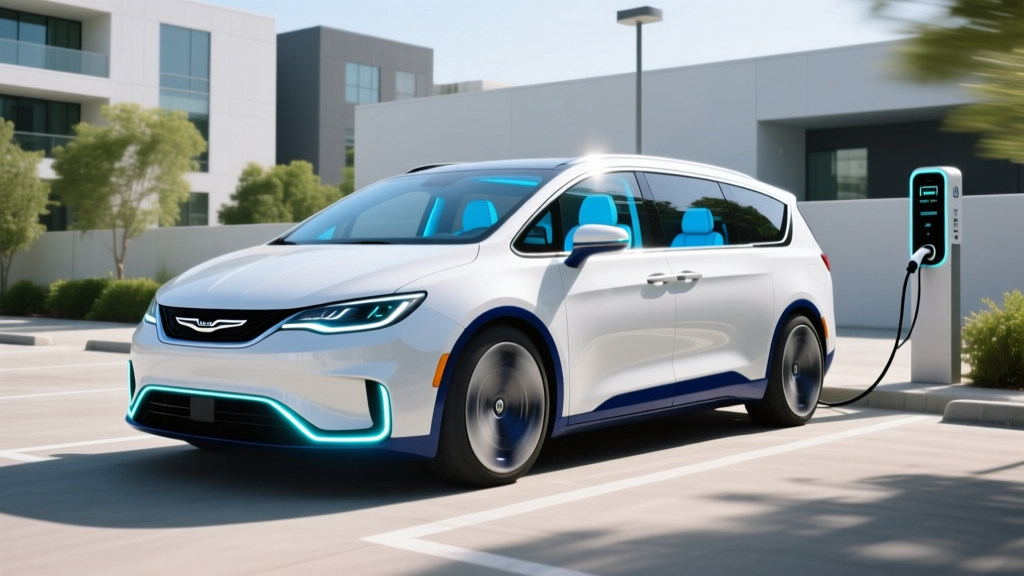
No. As of 2026, Chrysler does not offer a fully electric (battery-electric) Pacifica minivan. The closest electrified option is the Chrysler Pacifica Hybrid, a plug-in hybrid electric vehicle (PHEV) that pairs a 16 kWh lithium-ion battery with a 3.6-liter V6 engine. It delivers an EPA-rated 32 miles of electric-only range and 82 MPGe in EV mode, with a combined gas-only rating of 30 MPG once the battery is depleted. A fully battery-electric Pacifica has not been announced with a confirmed production timeline, though Stellantis has signaled future electrified minivans under its broader EV strategy.
If you're searching for an electric Chrysler Pacifica because you want a zero-tailpipe-emission family hauler, you'll need to look at alternatives like the Kia EV9 (3-row BEV) or the upcoming Volkswagen ID. Buzz. But if your goal is electrified daily school runs with gas backup for road trips, the Pacifica Hybrid is a legitimate, proven option. Here's the full breakdown.
Pacifica Hybrid vs. Gas Pacifica: Spec-by-Spec Comparison
Before evaluating whether the Pacifica Hybrid satisfies the "electric minivan" need, it helps to see exactly what you're getting versus the conventional gas model. The differences go deeper than just the powertrain.
| Specification | 2026 Pacifica Hybrid (PHEV) | 2026 Pacifica Gas (V6 AWD) |
|---|---|---|
| Powertrain | 3.6L V6 + 2 electric motors (e-CVT) | 3.6L V6 (9-speed auto) |
| Combined Horsepower | 260 hp | 287 hp |
| Battery (Usable) | 16 kWh (NMC lithium-ion) | None (standard 12V only) |
| EPA Electric-Only Range | 32 miles | N/A |
| EPA MPGe (EV Mode) | 82 MPGe | N/A |
| EPA MPG (Gas, Combined) | 30 MPG | 22 MPG (AWD) |
| Total Range (EV + Gas) | ~520 miles | ~460 miles |
| Level 2 Charge Time (0–100%) | ~2 hours at 6.6 kW | N/A |
| DC Fast Charging | Not supported | N/A |
| Stow 'n Go Seating (2nd Row) | No (battery occupies under-floor space) | Yes |
| Towing Capacity | Not rated for towing | 3,600 lbs |
| Base MSRP | ~$51,095 | ~$40,440 |
The trade-offs are immediate and consequential. You gain roughly 8 MPG combined in gas-only driving and 32 miles of electric commuting, but you lose Stow 'n Go second-row seating (the battery lives under the floor where those seats would fold), towing capability, and about $10,600 in base price. For families who need the folding-seat flexibility or tow a small trailer, the gas Pacifica is the more functional vehicle. For those whose priority is reducing fuel spend on daily drives under 30 miles, the Hybrid makes a strong case.
Real-World Electric Range: What 32 Miles Actually Gets You
The EPA's 32-mile electric range figure for the Pacifica Hybrid is derived from controlled laboratory testing. Real-world results depend on climate, terrain, speed, and how aggressively you use cabin heating or air conditioning.
- Mild weather (55–75°F), city/suburban driving: 30–34 miles — you can match or slightly exceed the EPA estimate thanks to regenerative braking in stop-and-go traffic.
- Highway driving (70+ mph), mild weather: 24–28 miles — higher speeds drain the 16 kWh battery faster.
- Cold weather (below 32°F), cabin heat on: 20–25 miles — battery chemistry loses efficiency in the cold, and resistive cabin heating draws significant energy. The Pacifica Hybrid does not have a heat pump, which hurts winter EV range.
- Hot weather (90°F+), A/C maxed: 26–30 miles — less impact than cold weather, but still a reduction.
For context, the average American one-way commute is roughly 16 miles, according to the U.S. Census Bureau. That means a large share of Pacifica Hybrid owners can complete their daily round-trip commute entirely on electricity — provided they charge at home overnight. This is the PHEV value proposition: electric for the routine, gasoline for the exception.
Charging at Home: What Pacifica Hybrid Owners Need to Know
The Pacifica Hybrid uses a standard J1772 connector for Level 1 and Level 2 AC charging. It does not support DC fast charging — there is no CCS or NACS port on this vehicle. That's not a practical limitation given the small 16 kWh battery; DC fast charging would be overkill for a pack this size.
| Charging Level | Power (kW) | 0–100% Time | Equipment Needed |
|---|---|---|---|
| Level 1 (120V household outlet) | ~1.4 kW | ~13–14 hours | Included portable cordset; standard outlet |
| Level 2 (240V, 32A) | 6.6 kW (vehicle-limited) | ~2 hours | Home wall charger or public Level 2 station |
Home charging setup cost: If you already have a 240V outlet (like a dryer outlet) in your garage, a quality Level 2 EVSE (electric vehicle supply equipment) such as a ChargePoint Home Flex or Emporia Vue runs $350–$650 for the unit alone. A licensed electrician installing a new 240V/40A circuit typically charges $500–$1,500 depending on the distance from your electrical panel and whether a panel upgrade is needed. Total realistic cost: $850–$2,150 for a functional home Level 2 setup.
If you're limited to Level 1 (a standard 120V outlet), the 13–14 hour full charge time still works for most PHEV owners: plug in when you get home at 6 PM, and the battery is full by 7–8 AM. The 16 kWh battery is small enough that Level 1 is genuinely viable, unlike with a full BEV where Level 1 is impractical.
Total Cost of Ownership: Pacifica Hybrid vs. Gas Pacifica Over 5 Years
The Pacifica Hybrid costs roughly $10,600 more at base MSRP. Does the fuel savings close that gap? Here's a realistic 5-year / 75,000-mile ownership comparison, assuming 15,000 miles/year, $3.50/gallon regular unleaded, and $0.14/kWh home electricity (national averages).
| Cost Category | Pacifica Hybrid (PHEV) | Pacifica Gas (AWD) |
|---|---|---|
| Base MSRP | $51,095 | $40,440 |
| Federal Tax Credit (§30D) | Up to $7,500 (if eligible)* | $0 |
| Effective Purchase Price | ~$43,595 | $40,440 |
| Fuel/Energy (5 years) | ~$4,800** | ~$11,900 |
| Maintenance (5 years) | ~$2,800 | ~$3,500 |
| Insurance (5 years, avg.) | ~$9,200 | ~$8,400 |
| Estimated Depreciation | ~$22,000 | ~$18,500 |
| 5-Year Total Cost | ~$82,395 | ~$82,740 |
* §30D tax credit eligibility depends on MSRP caps (vans/minivans capped at $80,000), buyer income limits ($150K single / $300K joint AGI), and battery component and critical mineral sourcing requirements. The Pacifica Hybrid has historically qualified, but sourcing rules tighten annually. Verify current eligibility on IRS.gov before purchasing. Point-of-sale transfer is available at participating dealers.
** Fuel cost assumes ~60% of miles driven on electricity (reflecting daily charging and regular overnight plug-in behavior). If you rarely charge, your PHEV fuel cost rises toward the gas model's figure.
The takeaway: with the full $7,500 tax credit, the Hybrid roughly breaks even with the gas model over 5 years. Without the credit, the gas Pacifica is cheaper to own. The Hybrid's advantage grows if electricity costs are low (e.g., solar-charged or off-peak rates under $0.10/kWh) or if gas prices spike above $4.50/gallon.
Federal Tax Credit Eligibility: The §30D Details That Matter
The IRS §30D Clean Vehicle Credit can reduce your effective purchase price by up to $7,500, but qualification is not automatic. Here's the 2026 checklist:
- MSRP cap: Minivans/vans must be under $80,000 MSRP. The Pacifica Hybrid qualifies — its top trim sits around $58,000.
- Buyer income cap: Modified AGI must not exceed $150,000 (single), $225,000 (head of household), or $300,000 (married filing jointly).
- Battery components: A percentage of battery components must be manufactured or assembled in North America. This threshold increases annually.
- Critical minerals: A percentage of critical minerals in the battery must be sourced from the U.S. or a free-trade-agreement country. This threshold also tightens yearly.
- Point-of-sale transfer: You can transfer the credit to the dealer at purchase, reducing your out-of-pocket cost immediately rather than waiting for a tax refund.
- Foreign entity of concern (FEOC): Vehicles with battery components or critical minerals from certain foreign entities are disqualified. This restriction has phased in since 2024.
The Pacifica Hybrid is assembled in Windsor, Ontario, Canada, and its battery sourcing has generally met the thresholds for at least partial credit. However, the exact credit amount ($3,750 or $7,500) depends on the specific model year's compliance with the critical-minerals prong. Always confirm with your dealer and cross-reference the fueleconomy.gov tax credit database for the exact VIN.
Common Misconceptions About the Pacifica Hybrid
| Myth | Fact |
|---|---|
| "It's a fully electric minivan." | It's a plug-in hybrid. The gas engine kicks in after 32 miles of EV driving or under heavy acceleration. You cannot drive cross-country on electricity alone. |
| "You need a special charger at home." | A standard 120V outlet works fine for overnight charging of the 16 kWh battery. A 240V Level 2 charger is faster but not mandatory. |
| "The battery will need expensive replacement soon." | Stellantis warranties the hybrid battery for 10 years / 100,000 miles (8 years/100,000 miles in some states). PHEV batteries experience less deep-cycle stress than full BEV batteries due to their smaller usable window and blended operation. |
| "I'll save thousands in fuel every year." | Savings depend entirely on charging behavior. If you never plug in, you're driving a heavier, less efficient gas minivan. Real savings require routine charging — expect $800–$1,400/year in fuel savings with daily plug-in habits. |
| "It has Stow 'n Go like the regular Pacifica." | The second-row seats do NOT fold into the floor. The hybrid battery occupies that space. Third-row Stow 'n Go is retained. |
Decision Framework: Is the Pacifica Hybrid Right for Your Family?
Choose the Pacifica Hybrid if:
- Your daily driving is under 30 miles round-trip and you can charge at home every night
- You want electric-mode school runs and errands but need gas flexibility for 400+ mile family road trips
- You qualify for the §30D tax credit, narrowing the price gap with the gas model
- You don't need second-row Stow 'n Go seating or towing capability
- You want the lowest tailpipe emissions during daily driving without range anxiety
Choose the gas Pacifica (AWD) if:
- You need full Stow 'n Go seating flexibility for cargo hauling
- You tow a camper, boat, or trailer (3,600-lb capacity)
- You cannot charge at home (apartment, street parking, no garage access)
- Your budget is firm below $45,000 and you don't qualify for the tax credit
- You drive predominantly highway miles where the PHEV advantage shrinks
Consider a fully electric alternative if:
- You want zero gasoline use and have reliable home charging
- The Kia EV9 (3-row, EPA ~279–304 miles range, ~$54,900 base) fits your space needs
- You're willing to wait for the Volkswagen ID. Buzz (retro-styled electric microbus, EPA ~230 miles, 3-row seating) or future Stellantis electric minivan announcements
What First-Time EV and PHEV Buyers Should Know
If the Pacifica Hybrid is your entry point into electrified driving, here are the practical realities no brochure mentions:
1. Plug in every night. The entire economic case for a PHEV depends on maximizing electric miles. A PHEV you don't charge is just a heavier, thirstier gas car. Build the habit: plug in when you park at home, unplug when you leave. It takes 10 seconds.
2. Understand kW vs. kWh. Kilowatts (kW) measure power — the rate at which energy flows. Kilowatt-hours (kWh) measure energy — the total capacity of the battery. The Pacifica Hybrid has a 16 kWh battery and charges at up to 6.6 kW. Think of kWh as the size of the gas tank and kW as the width of the fuel hose.
3. Cold weather reduces electric range. Expect 20–25 miles of EV range in freezing temperatures instead of 32. The engine will also activate to provide cabin heat in very cold conditions, even if the battery isn't depleted. This is normal PHEV behavior, not a malfunction.
4. The engine will start periodically even in EV mode. The Pacifica Hybrid's engine management system may briefly run the gas engine for maintenance cycles, cold-weather heat, or hard acceleration. Don't be alarmed if the engine fires up with a full battery on a cold morning.
5. Insurance may cost slightly more. PHEVs and BEVs typically carry 10–15% higher insurance premiums than their gas counterparts due to higher repair costs for battery and powertrain components. Get quotes before purchasing.
Frequently Asked Questions
Will Chrysler ever make a fully electric Pacifica?
Stellantis (Chrysler's parent company) has committed to offering electrified options across its lineup, and a battery-electric minivan is a logical future product. However, as of 2026, no fully electric Pacifica has been officially announced with a production date or confirmed specifications. The company's STLA Large platform, which underpins upcoming electric vehicles, could theoretically support an electric minivan, but Chrysler has not committed publicly to a timeline.
Can I take the Pacifica Hybrid on road trips?
Absolutely. Once the 16 kWh battery is depleted after ~32 miles, the Pacifica Hybrid operates as a conventional hybrid with an EPA rating of 30 MPG combined. With a 14.5-gallon fuel tank, total range is approximately 520 miles. You refuel at any gas station in under 5 minutes. This is the core advantage of a PHEV over a BEV for one-car families who road-trip regularly.
Does the Pacifica Hybrid qualify for the $7,500 federal tax credit?
It has historically qualified for at least a partial credit, but eligibility depends on current-year battery sourcing rules, your income, and the vehicle's MSRP. Check the fueleconomy.gov database for the specific model year and ask your dealer to confirm the credit amount before signing. Point-of-sale transfer is available at participating dealerships, allowing you to apply the credit as a down payment reduction.
What happens if the hybrid battery fails out of warranty?
Out-of-warranty hybrid battery replacement for the Pacifica Hybrid typically costs between $6,000 and $9,000 including labor, based on dealer estimates. However, the 10-year/100,000-mile warranty covers most owners through the vehicle's prime ownership period. Real-world data from Pacifica Hybrids in service since 2017 suggests the battery is durable under normal use, with gradual capacity loss rather than sudden failure.
How does the Pacifica Hybrid compare to the Toyota Sienna Hybrid?
The Toyota Sienna is a conventional (non-plug-in) hybrid with an EPA rating of 36 MPG combined — better than the Pacifica Hybrid's 30 MPG in gas-only mode. However, the Sienna cannot drive on electricity alone; it has no EV-only range. The Pacifica Hybrid offers 32 miles of zero-tailpipe-emission driving for short trips, which the Sienna cannot match. The Sienna also offers AWD and retains more cargo flexibility. If your priority is maximum MPG without plugging in, the Sienna wins. If you want electric-mode daily driving, the Pacifica Hybrid is the only minivan option.