The Short Answer on Electric Chevrolet Corvettes
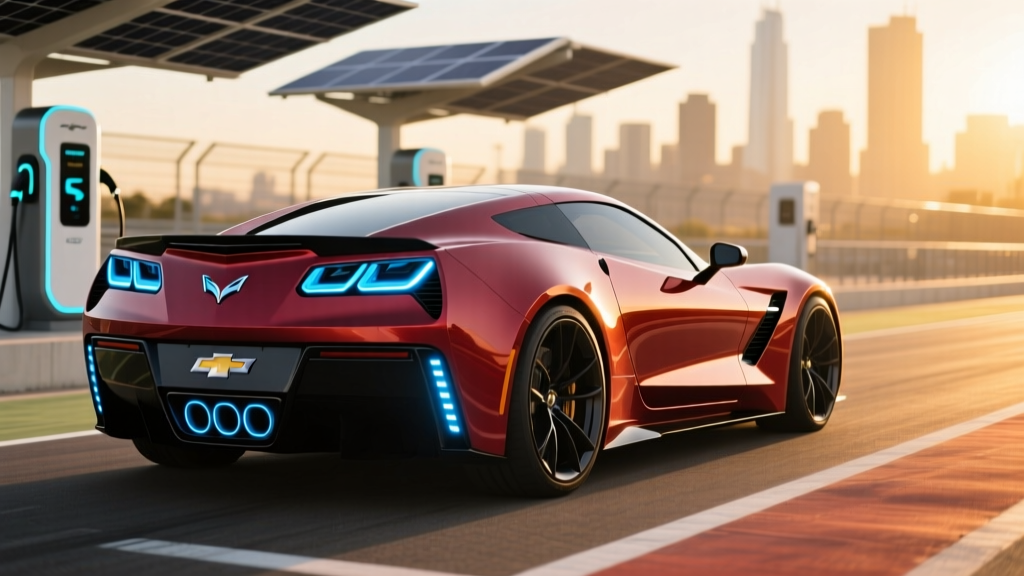
As of 2026, Chevrolet does not sell a fully electric Corvette. The closest production model is the Corvette E-Ray, a performance hybrid pairing a 6.2L V8 with an electric front axle for a combined 655 horsepower and 0–60 mph in 2.5 seconds. GM has confirmed that an all-electric Corvette is in development, but no official launch date, EPA range, battery specs, or pricing have been published. If you want a Corvette with electric drive elements today, the E-Ray AWD hybrid (starting around $104,900 MSRP) is your only option. If you want a pure BEV Corvette, you are waiting on an unreleased, unpriced vehicle.
The Corvette E-Ray: Chevy's Current Electrified Sports Car
The Corvette E-Ray occupies a unique space in the sports car market. It is not a plug-in hybrid — you cannot charge it from a wall outlet, and it offers no meaningful electric-only range. Instead, it uses a small lithium-ion battery (approximately 1.9 kWh usable) paired with a front-mounted electric motor that drives the front wheels. The rear wheels are powered by Chevrolet's familiar 6.2L LT2 V8 producing 495 hp. Combined system output is 655 hp and 595 lb-ft of torque, routed through an all-wheel-drive system that gives the E-Ray its staggering 2.5-second 0–60 mph time.
The electric motor provides torque fill at low RPMs and enables a brief "stealth mode" for low-speed electric-only driving — roughly 3–4 miles at under 45 mph, primarily intended for quiet neighborhood departures rather than any practical EV range. Once you exceed that speed or demand, the V8 fires up immediately.
| Spec | Value |
|---|---|
| Powertrain | 6.2L V8 + front electric motor (AWD) |
| Combined HP / Torque | 655 hp / 595 lb-ft |
| Battery (usable) | ~1.9 kWh lithium-ion (not plug-in) |
| 0–60 mph | 2.5 seconds (Chevrolet est.) |
| EPA Fuel Economy | ~19 mpg combined (est.) |
| Electric-only range | ~3–4 miles (stealth mode, low speed) |
| Starting MSRP | $104,900 (1LZ coupe) |
| Federal EV Tax Credit (§30D) | Not eligible (not a PHEV/BEV) |
Because the E-Ray's battery cannot be charged externally and its electric-only range falls well below the 25-mile minimum required for PHEV classification, it does not qualify for the IRS §30D federal clean vehicle credit. Buyers should not factor any tax incentive into the purchase price.
All-Electric Corvette: What GM Has Confirmed (and What Remains Unknown)
General Motors executives have stated publicly that an all-electric Corvette is part of the brand's future, leveraging GM's Ultium battery platform and BEV3/BEV4 architecture. However, as of early 2026, Chevrolet has not released:
- A production timeline or model year
- Battery capacity (kWh) or chemistry (NMC vs. LFP vs. next-gen)
- EPA range estimates
- DC fast-charge capability (peak kW)
- Motor configuration (dual, tri, or quad motor)
- Pricing or trim structure
- Whether the electric Corvette will carry the Corvette nameplate or launch as a new sub-brand
Industry speculation points to a dual- or tri-motor setup producing well over 700 hp, a battery in the 85–100 kWh range targeting 250–300 miles of EPA range, and 800V architecture for fast charging. These are educated estimates based on GM's Ultium platform capabilities — not confirmed specifications. Any article presenting these figures as official is premature.
What we can reasonably expect: a sports car with instantaneous electric torque, a low center of gravity from a floor-mounted battery pack, and a weight figure that will almost certainly exceed the current C8 Stingray's ~3,600 lbs. Battery mass is the central engineering challenge for any electric sports car, and it directly impacts handling dynamics, tire wear, and efficiency.
E-Ray vs. Gas Stingray vs. Future EV: Cost and Performance Comparison
For buyers weighing their Corvette options today, here is how the current lineup stacks up on the metrics that matter:
| Metric | Stingray (Gas) | E-Ray (Hybrid AWD) | Z06 (Gas) |
|---|---|---|---|
| Powertrain | 6.2L V8, RWD | 6.2L V8 + electric motor, AWD | 5.5L flat-plane V8, RWD |
| Horsepower | 490 hp | 655 hp combined | 670 hp |
| 0–60 mph | 2.9 sec | 2.5 sec | 2.6 sec |
| EPA Combined | ~19 mpg | ~19 mpg (est.) | ~15 mpg |
| Starting MSRP | $68,300 | $104,900 | $115,800 |
| Annual fuel cost* | ~$2,800 | ~$2,800 | ~$3,500 |
| EV Tax Credit | None | None | None |
*Annual fuel cost based on 12,000 miles/year, $3.50/gallon premium, and EPA combined estimates. Source: fueleconomy.gov methodology.
The E-Ray commands a roughly $36,600 premium over the base Stingray, justified primarily by the AWD system, the electric torque-fill, and the 2.5-second 0–60 time. It does not save fuel compared to the Stingray — the added weight of the electric motor, battery, and AWD hardware offsets any efficiency gains from the hybrid system. The E-Ray is a performance purchase, not an efficiency purchase.
Real-World Ownership: What a Future Electric Corvette Buyer Should Prepare For
If you are waiting for an all-electric Corvette, the ownership experience will differ substantially from any current Corvette. Here are the practical realities to plan for:
Home Charging Is Non-Negotiable for Sports Car Ownership
A battery-electric Corvette will likely have an 85–100 kWh battery. Charging that battery from 10% to 90% on a standard 120V Level 1 outlet would take 3–4 days. A Level 2 home charger (240V, 48A / 11.5 kW) would handle a full overnight charge in roughly 8–9 hours. Without home charging access, owning an electric sports car becomes impractical — public DC fast chargers are not a sustainable daily fueling strategy for a vehicle you want to drive on short notice.
Home Level 2 installation costs typically range from $1,200 to $3,500 depending on your electrical panel capacity and the distance from panel to garage. If your home has a 100A panel, a 200A upgrade ($2,000–$4,000) may be required before adding a 48A EVSE.
Range Expectations for an Electric Sports Car
Sports car aerodynamics work against range. The current C8 Corvette has a drag coefficient around 0.32, which is respectable but not class-leading for efficiency. An electric Corvette with similar proportions and a ~95 kWh battery would likely achieve 250–300 miles EPA. In real-world highway driving at 75+ mph, expect 200–240 miles before needing to charge. In cold weather (below 30°F), add a 20–30% range reduction on top of that — putting winter highway range potentially below 175 miles.
This is not a road-trip car in the same way a gas Corvette is. A 500-mile drive in a Stingray requires one fuel stop. In an electric Corvette with 220 real-world highway miles of range, you are looking at two to three 25–35 minute DC fast-charge stops, assuming functional 150+ kW chargers are available along your route.
Insurance, Maintenance, and Tire Costs
EV sports cars will likely carry higher insurance premiums than their gas counterparts due to battery replacement cost, higher repair complexity, and the performance profile. Current high-performance EVs like the Porsche Taycan Turbo S and Tesla Model S Plaid see annual insurance costs 15–30% higher than comparable gas sports cars, according to industry data.
Maintenance savings are real: no oil changes, no spark plugs, no transmission fluid. But tire costs are not trivial. EVs are heavier and deliver instant torque, accelerating tire wear. Expect to replace tires every 15,000–20,000 miles on a performance EV, compared to 25,000–35,000 on a lighter gas sports car. A set of Michelin Pilot Sport 4S tires for a Corvette runs $1,200–$1,600.
Cost Breakdown: Electric Corvette (Projected) vs. Gas Stingray
While we lack official pricing for an electric Corvette, we can model a plausible 5-year cost of ownership using reasonable estimates based on comparable performance EVs and current Corvette pricing.
| Cost Category | Stingray (Gas, $68K MSRP) | Electric Corvette (Projected, $100K MSRP) |
|---|---|---|
| Purchase price | $68,300 | $100,000 (est.) |
| Federal tax credit | $0 | Up to $7,500 (if eligible*) |
| Fuel / energy (5 yr) | $14,000 (premium gas) | $5,400 (home charging, $0.15/kWh) |
| Maintenance (5 yr) | $4,500 | $2,200 |
| Tires (5 yr) | $3,200 | $4,800 |
| Insurance (5 yr) | $12,500 | $15,600 (est.) |
| Home charger install | $0 | $2,000 |
| Total 5-yr cost | $102,500 | $120,600 |
*The §30D federal tax credit has strict requirements including MSRP caps ($80,000 for sedans/sports cars), buyer income limits ($150K single / $300K joint), and battery component/critical mineral sourcing rules. A $100K+ electric Corvette would likely exceed the MSRP cap and be ineligible. Verify current rules at IRS.gov before planning around any credit amount.
The math shows that even with significant fuel and maintenance savings, the higher purchase price, insurance, and tire costs of an electric Corvette would likely keep its total cost of ownership above the gas Stingray over five years. The break-even point would require a lower MSRP, home solar charging, or a longer ownership horizon.
Common Misconceptions About Electric Corvettes
| Myth | Fact |
|---|---|
| "The E-Ray is a plug-in hybrid." | The E-Ray cannot be plugged in. Its 1.9 kWh battery charges solely through regenerative braking and the V8 engine. It has no plug and no meaningful EV range. |
| "An electric Corvette will be lighter than a gas one." | Battery packs for 250+ mile range add 900–1,200 lbs. An electric Corvette will almost certainly weigh more than the current 3,600-lb Stingray, likely exceeding 4,500 lbs. |
| "Electric Corvettes will qualify for the $7,500 tax credit." | The §30D credit caps MSRP at $80,000 for non-SUVs. A performance EV from Chevrolet at a Corvette price point ($90K–$130K) would almost certainly exceed this cap and be ineligible. |
| "An EV Corvette will sound like a gas Corvette." | Electric motors are inherently quiet. Chevrolet may add synthetic sound (as they've done with the Blazer EV SS), but it will not replicate a V8 exhaust note. This is a fundamental trade-off. |
| "The electric Corvette is available to order now." | As of 2026, Chevrolet has not opened orders, published specs, or announced a model year for a fully electric Corvette. It remains in development. |
Decision Framework: Which Corvette Is Right for You?
If / Then Guide
If you want the fastest production Corvette today → The E-Ray's 2.5-second 0–60 mph time beats the Z06 off the line thanks to AWD launch grip and electric torque fill. Pay the $104,900+ premium and accept 19 mpg.
If you want a traditional V8 sports car experience → The Stingray at $68,300 remains one of the best performance-per-dollar vehicles on the market. The Z06 at $115,800 delivers 670 hp and a flat-plane crank soundtrack no EV will replicate.
If you want a fully electric Corvette → You are waiting. No release date, no specs, no pricing exist. Consider the Porsche Taycan, Tesla Model S Plaid, or upcoming electric sports cars from other manufacturers if you need a performance EV now.
If you want electric daily driving with V8 weekend capability → Buy a dedicated EV for commuting (Chevy Equinox EV, Tesla Model 3, Hyundai Ioniq 6) and keep a gas or E-Ray Corvette for weekend drives. This two-car approach covers both use cases without compromise.
If you want a Corvette with lower fuel costs → The E-Ray will not save you fuel. No current Corvette variant is an efficiency play. Wait for the BEV or look outside the Corvette lineup entirely.
What First-Time EV Buyers Should Know Before Waiting for an Electric Corvette
If an electric Corvette is your gateway into EV ownership, understand these fundamentals before you commit:
- kW vs. kWh: Kilowatts (kW) measure power — how fast you charge or how hard the motors can push. Kilowatt-hours (kWh) measure energy — the size of the battery and how far you can drive. A 100 kWh battery charged at 150 kW will not fill in 40 minutes because charging speed tapers above 80% state of charge to protect battery health.
- Home charging is essential: Relying solely on public charging for a sports car you want to drive spontaneously is frustrating and expensive. Budget $1,500–$3,500 for a Level 2 home installation.
- Cold weather reduces range 20–30%: If you live in the northern US and plan to drive an electric Corvette in winter, plan for 175–200 miles of real range from a 250-mile EPA rating.
- Insurance will be higher: Get quotes on comparable performance EVs (Taycan, Model S Plaid, BMW i4 M50) before assuming an electric Corvette will cost the same to insure as a Stingray.
- Depreciation is uncertain: EV depreciation has been volatile. Gas Corvettes hold value exceptionally well. An electric Corvette's resale value will depend on battery health perception, market adoption, and how quickly the technology evolves.
Frequently Asked Questions
Is there a fully electric Chevrolet Corvette available in 2026?
No. Chevrolet has not released a fully electric Corvette. The only electrified Corvette available is the E-Ray, a performance hybrid that pairs a 6.2L V8 with a small electric front axle. It cannot be plugged in and does not qualify as a PHEV or BEV.
When will an all-electric Corvette be released?
GM has confirmed an electric Corvette is in development, but no model year, launch date, or timeline has been announced. Industry estimates place it no earlier than the 2028–2029 timeframe, but this is speculation, not official guidance.
Does the Corvette E-Ray qualify for the federal EV tax credit?
No. The E-Ray's battery cannot be charged from an external source and its electric-only range is approximately 3–4 miles — far below the 25-mile minimum required for PHEV eligibility under IRS §30D rules.
How much will an electric Corvette cost?
Chevrolet has not published pricing. Based on the current Corvette lineup ($68K–$130K) and comparable performance EVs (Porsche Taycan starting at $92K, Tesla Model S Plaid at $90K), an electric Corvette would likely start between $90,000 and $120,000, with high-performance variants exceeding $150,000.
Will an electric Corvette be as fast as the Z06?
Likely faster in a straight line. Electric motors deliver peak torque instantly, and AWD electric launches are devastatingly quick. The E-Ray already beats the Z06 to 60 mph (2.5 vs. 2.6 seconds) with less total horsepower. A full BEV with more power and AWD would likely target sub-2.0-second 0–60 times. However, track lap times depend on weight management, cooling, and tire technology — areas where battery mass is a disadvantage.
Can I reserve an electric Corvette?
No. Chevrolet has not opened reservations or a waitlist for an electric Corvette. Any website claiming to accept deposits for an electric Corvette is not affiliated with General Motors.