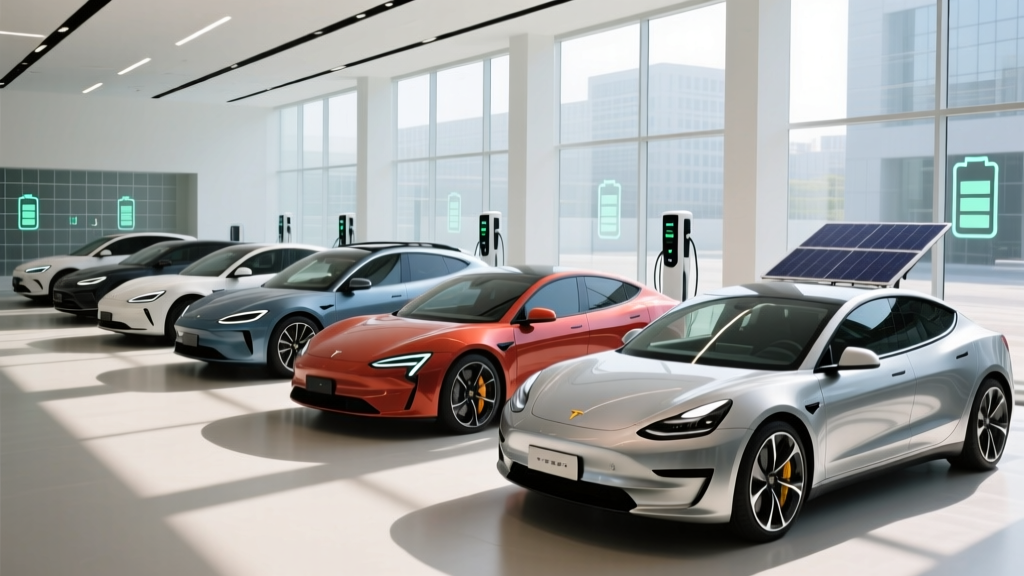
Tesla still sets the benchmark for electric-vehicle software, charging infrastructure, and efficiency — but the competitive landscape in 2026 looks radically different from even two years ago. Legacy automakers have closed the gap on range, surpassed Tesla on charging speed in some cases, and in several instances undercut the Model 3 and Model Y on price after federal tax credits. If you're cross-shopping electric cars similar to Tesla, you no longer have to compromise.
This guide profiles the four strongest Tesla alternatives available right now: the 2026 Hyundai Ioniq 5, 2026 Ford Mustang Mach-E, 2026 BMW i4, and 2026 Polestar 2. Each is evaluated on the metrics that matter most to EV buyers — real-world range, DC fast-charging speed, total cost after incentives, and day-to-day usability. No marketing superlatives, just data.
2026 Hyundai Ioniq 5: The Efficiency King That Charges Like a Tesla
The Ioniq 5 remains the strongest all-around alternative to the Tesla Model Y. Hyundai's E-GMP platform delivers an 800V architecture, meaning DC fast-charging speeds that rival — and in sustained sessions, often beat — Tesla's V3 Superchargers. The 2026 model year carries over with minor software updates and an expanded color palette.
| Spec | 2026 Ioniq 5 SEL AWD |
|---|---|
| EPA Range | 290 miles |
| Battery (usable) | 77.4 kWh, NMC |
| Peak DC Fast Charge | 240 kW |
| 10–80% DC Time | ~18 minutes |
| Level 2 Home Rate | 10.9 kW (~37 mi/hr) |
| 0–60 mph | 4.5 seconds |
| Horsepower | 320 hp (dual-motor AWD) |
| Efficiency | 110 MPGe / 30 kWh/100mi |
| Cargo Volume | 27.2 cu ft (rear up) / 59.3 cu ft (rear folded) |
| Base MSRP | $47,650 |
| Battery Warranty | 10 years / 100,000 miles |
Charging Speed: The Ioniq 5's Biggest Advantage
The 800V architecture isn't just a spec-sheet number. On a 350 kW Electrify America or Ionity station, the Ioniq 5 sustains above 200 kW from roughly 10% to 55% SoC before tapering. That 18-minute 10–80% session is real and repeatable when the battery is preconditioned — something the navigation system handles automatically when you route to a charger. For comparison, the Tesla Model Y Long Range peaks around 250 kW but tapers earlier, often resulting in similar or slightly slower real-world 10–80% times.
| Charging Level | Power | Speed |
|---|---|---|
| Level 1 (120V) | ~1.4 kW | ~4 miles/hour |
| Level 2 (240V, 48A) | 10.9 kW | ~37 miles/hour |
| DC Fast (peak) | 240 kW | 10–80% in ~18 min |
Tax Credit & Pricing
The 2026 Ioniq 5 SEL AWD starts at $47,650 (including destination). Under current IRS §30D rules, the Ioniq 5 has qualified for the full $7,500 federal credit thanks to Hyundai's Savannah, Georgia production, though battery-sourcing and critical-mineral requirements shift periodically. Buyer income caps apply: $150,000 single / $300,000 joint filers. The MSRP cap for SUVs is $80,000. Always verify current eligibility on irs.gov before purchasing, and confirm point-of-sale transfer availability with your dealer.
2026 Ford Mustang Mach-E: The Driver's EV Crossover
Ford has iterated the Mach-E aggressively since its 2021 launch. The 2026 model benefits from a revised battery pack, improved thermal management, and Ford's BlueCruise 1.5 hands-free driving system on compatible highways. If you want something that drives more like a sports sedan than an appliance, the Mach-E is the Tesla Model Y's most dynamic rival.
| Spec | 2026 Mach-E Premium AWD (Ext. Range) |
|---|---|
| EPA Range | 320 miles |
| Battery (usable) | 91 kWh, NMC |
| Peak DC Fast Charge | 150 kW |
| 10–80% DC Time | ~36 minutes |
| Level 2 Home Rate | 11.5 kW (~39 mi/hr) |
| 0–60 mph | 4.8 seconds |
| Horsepower | 365 hp (dual-motor AWD) |
| Efficiency | 101 MPGe / 33 kWh/100mi |
| Cargo Volume | 29.7 cu ft (rear up) / 59.7 cu ft (rear folded) |
| Base MSRP | $51,875 |
| Battery Warranty | 8 years / 100,000 miles |
Where the Mach-E Falls Short: DC Charging
The Mach-E's 150 kW peak charge rate is the weakest link in this comparison. While 10–80% in 36 minutes is acceptable, it's noticeably slower than the Ioniq 5 or a Tesla on a Supercharger. If your routine includes frequent 300+ mile road trips, this matters. For daily home charging and occasional long drives, it's a minor inconvenience.
Tax Credit Status
Ford produces the Mach-E in Cuautitlán, Mexico, which has historically complicated §30D eligibility due to battery-sourcing and assembly requirements. As of early 2026, certain trims may qualify for partial or full credits depending on battery component sourcing. Check fueleconomy.gov's tax credit tracker for the latest VIN-specific eligibility before committing.
2026 BMW i4: The Sedan for Drivers Who Miss BMWs
The i4 targets Tesla Model 3 buyers who want a traditional luxury sedan experience — premium materials, a conventional (and excellent) driver interface, and chassis tuning that reminds you why BMW built its reputation on driving dynamics. The Gran Coupe body style offers practical hatchback cargo access.
| Spec | 2026 BMW i4 eDrive40 |
|---|---|
| EPA Range | 307 miles |
| Battery (usable) | 81.5 kWh, NMC |
| Peak DC Fast Charge | 200 kW |
| 10–80% DC Time | ~28 minutes |
| Level 2 Home Rate | 11 kW (~36 mi/hr) |
| 0–60 mph | 5.5 seconds |
| Horsepower | 335 hp (single-motor RWD) |
| Efficiency | 109 MPGe / 31 kWh/100mi |
| Cargo Volume | 16.6 cu ft (rear up) / 45.8 cu ft (rear folded) |
| Base MSRP | $57,900 |
| Battery Warranty | 8 years / 100,000 miles |
The Luxury Tax: Pricing and Credit Eligibility
At $57,900 base (and $65,000+ as typically equipped), the i4 sits above the Model 3 in price. The MSRP cap for sedans under §30D is $55,000 — meaning the base eDrive40 barely misses the threshold once destination charges are included. The i4 is best suited for buyers who prioritize build quality and driving refinement over maximizing incentives. BMW's iDrive 8.5 infotainment and available Driving Assistant Professional (Level 2 ADAS) are genuinely competitive with Tesla's tech stack.
2026 Polestar 2: The Scandinavian Underdog
Polestar's compact fastback sedan occupies a unique space: minimalist Scandinavian design, Google Built-in infotainment, and competitive range at a price point that undercuts the BMW i4. The 2026 model year introduces a larger battery and NACS charge port as standard.
| Spec | 2026 Polestar 2 Long Range Dual Motor |
|---|---|
| EPA Range | 320 miles |
| Battery (usable) | 79 kWh, NMC |
| Peak DC Fast Charge | 200 kW |
| 10–80% DC Time | ~26 minutes |
| Level 2 Home Rate | 11 kW (~38 mi/hr) |
| 0–60 mph | 4.3 seconds |
| Horsepower | 421 hp (dual-motor AWD) |
| Efficiency | 107 MPGe / 31 kWh/100mi |
| Cargo Volume | 14.4 cu ft (trunk) + frunk 1.4 cu ft |
| Base MSRP | $54,300 |
| Battery Warranty | 8 years / 100,000 miles |
Standout Tech and Drawbacks
Google Built-in means native Google Maps navigation, Google Assistant voice control, and Play Store apps — no phone projection needed. The available Pilot Pack adds adaptive cruise with lane centering (Level 2). The main drawback is rear-seat space: legroom is tighter than the Mach-E or Ioniq 5, making the Polestar 2 best for couples or small families rather than car-seat duty.
Side-by-Side: How They Stack Up Against Tesla
| Metric | Tesla Model Y LR | Ioniq 5 AWD | Mach-E ER AWD | BMW i4 eDrive40 | Polestar 2 DM |
|---|---|---|---|---|---|
| EPA Range | 320 mi | 290 mi | 320 mi | 307 mi | 320 mi |
| Battery | ~75 kWh NMC | 77.4 kWh NMC | 91 kWh NMC | 81.5 kWh NMC | 79 kWh NMC |
| Peak DC kW | 250 kW | 240 kW | 150 kW | 200 kW | 200 kW |
| 10–80% Time | ~20 min | ~18 min | ~36 min | ~28 min | ~26 min |
| 0–60 mph | 4.8s | 4.5s | 4.8s | 5.5s | 4.3s |
| Base MSRP | $44,990 | $47,650 | $51,875 | $57,900 | $54,300 |
| Cargo (max) | 72.1 cu ft | 59.3 cu ft | 59.7 cu ft | 45.8 cu ft | 15.8 cu ft |
| Battery Warranty | 8yr/120k mi | 10yr/100k mi | 8yr/100k mi | 8yr/100k mi | 8yr/100k mi |
Decision Framework: Which Tesla Alternative Fits You?
Choose the Hyundai Ioniq 5 if: You prioritize the fastest DC charging in the segment, want strong cargo versatility, and value the 10-year battery warranty. Best for road-trippers who can't afford 35-minute charge stops.
Choose the Ford Mustang Mach-E if: You want the most range (320 miles) combined with engaging driving dynamics and the largest cargo area outside of Tesla. Accept slower DC charging as a trade-off.
Choose the BMW i4 if: You're a sedan buyer who values premium build quality, ride refinement, and traditional luxury-brand ownership. You'll pay more and likely forgo the federal tax credit.
Choose the Polestar 2 if: You want a distinctive design, Google-native infotainment, native NACS Supercharger access, and strong performance at a mid-luxury price. Best for couples without rear-seat demands.
Pros and Cons at a Glance
Pros Across These Alternatives
- Ioniq 5 charges faster than any Tesla on compatible 350 kW stations
- Mach-E and Polestar 2 match or exceed Model Y EPA range
- All offer Level 2 ADAS (BlueCruise, Highway Driving Assist, etc.)
- Hyundai's 10-year battery warranty beats Tesla's 8-year coverage
- Native NACS ports expanding Supercharger access across brands
Cons to Consider
- None match Tesla's Supercharger network reliability in rural areas
- Mach-E's 150 kW peak charge rate is a road-trip bottleneck
- i4 and Polestar 2 sedan/fastback cargo space trails the Model Y significantly
- Tesla's software/app ecosystem remains more polished than competitors
- Tax credit eligibility varies — Tesla's US assembly gives it a consistent advantage
Frequently Asked Questions
What electric car is most similar to a Tesla Model Y in 2026?
The Hyundai Ioniq 5 is the closest overall match in terms of size, cargo versatility, and technology. The Ford Mustang Mach-E matches the Model Y's 320-mile range and offers comparable cargo space. Neither replicates Tesla's Supercharger network advantage, but both now support NACS for Supercharger access.
Do any of these EVs charge faster than a Tesla?
Yes. The Hyundai Ioniq 5's 800V architecture enables a 10–80% charge in approximately 18 minutes on a 350 kW station — slightly faster than a Tesla Model Y on a V3 Supercharger in real-world sustained sessions. The charge curve matters more than peak kW.
Which Tesla alternative qualifies for the $7,500 federal tax credit?
Eligibility under IRS §30D depends on final assembly location, battery component sourcing, critical mineral requirements, MSRP caps ($55,000 for sedans, $80,000 for SUVs/vans/pickups), and buyer income limits ($150K single / $300K joint). The US-built Ioniq 5 has consistently qualified. The Mexico-built Mach-E's eligibility varies by battery lot. Verify on irs.gov before purchase.
Is the BMW i4 worth the premium over a Tesla Model 3?
If you value interior material quality, ride comfort, and traditional luxury dealership service, yes. The i4's cabin and chassis are a step above the Model 3. However, the i4's higher price, likely tax-credit ineligibility, and smaller cargo area make it a lifestyle choice rather than a pure value play.
What is the real-world range of the Hyundai Ioniq 5?
The EPA rates the 2026 Ioniq 5 SEL AWD at 290 miles. In real-world highway driving at 70–75 mph, expect 250–265 miles. In sub-freezing winter conditions, that drops to roughly 210–230 miles, though the standard heat pump helps mitigate losses compared to EVs without one.
Can I use Tesla Superchargers with these non-Tesla EVs?
The 2026 Polestar 2 includes a native NACS port for direct Supercharger access. The Ioniq 5 and Mach-E can use Superchargers with a Tesla-provided NACS adapter (included or available from the manufacturer). Always confirm adapter compatibility and Supercharger station availability in your area via the Tesla app or in-vehicle navigation.