The Short Answer: Can a 10-Year-Old Legally Drive a Real Electric Car?
No. In every U.S. state, a 10-year-old cannot legally operate a full-size, street-legal electric vehicle — or any motor vehicle — on public roads. Minimum learner's permit ages range from 14 to 16 depending on the state, and full licensure typically arrives at 16–18. There is no "kids' EV" exemption in motor vehicle codes.
If your search for electric cars for 10 year olds to drive is motivated by wanting a child to experience EV technology safely, there are legitimate alternatives: battery-powered ride-on toy vehicles, supervised private-property driving in some jurisdictions, and EV-education programs. Below, we break down what actually exists, what's legal, what it costs, and how to think about your family's electrified future as your child approaches driving age.
Why This Search Trend Exists (and What Parents Really Want)
Monthly search volume for "electric cars for 10 year olds to drive" sits around 1,600 queries — a signal that parents are either curious about kid-sized EVs, looking for safe ride-on toys modeled after real electric cars, or wondering whether early EV familiarity gives their child a head start. Some families living on large private properties (farms, ranches, long driveways) also want to know whether low-speed electric vehicles can be operated off-road by minors.
The honest answer splits into three categories:
- Ride-on toy EVs: Battery-powered 6V–24V miniature cars (brands like Power Wheels, Rollplay, Best Choice Products). These are toys, not vehicles. Top speed: 2–6 mph. Price: $150–$500.
- Youth-oriented electric karts and UTVs: Products like the Segway Ninebot eKart or Polaris RZR 170 (gas, but electric equivalents exist). Designed for controlled environments. Speed: 10–25 mph. Price: $1,000–$4,000.
- Real EVs driven under adult supervision on private property: Legally gray, insurance-excluded, and generally not recommended for a 10-year-old regardless of maturity.
Ride-On Electric Toy Cars: What's Actually Available in 2026
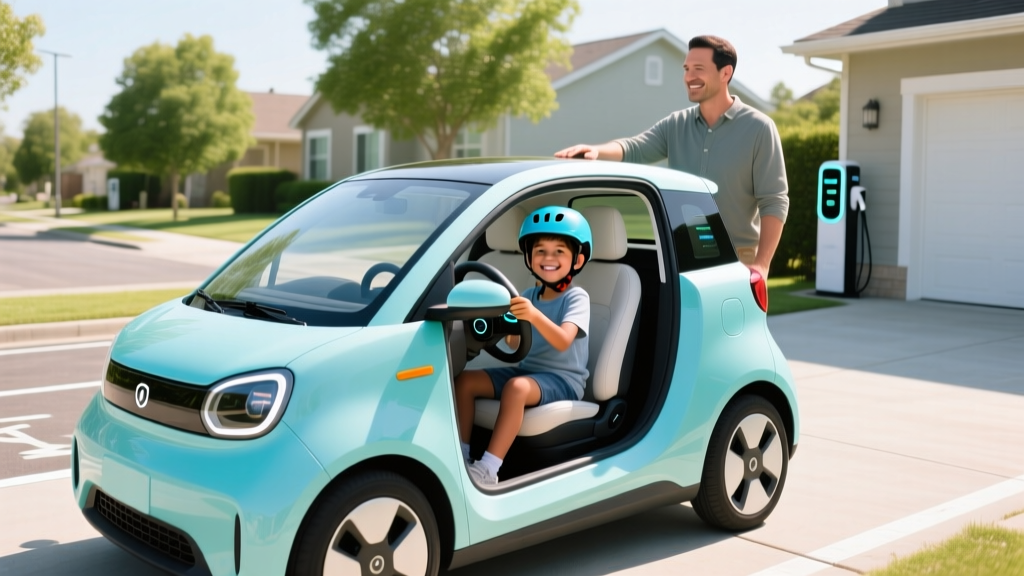
If your child wants to "drive an EV," the realistic option is a licensed ride-on toy modeled after real electric vehicles. Several manufacturers now produce miniature versions of popular EVs:
| Toy Model | Battery | Top Speed | Age Range | Approx. Price |
|---|---|---|---|---|
| Rollplay Tesla Model S (Ride-On) | 12V / 7Ah lead-acid | 3–6 mph | 3–7 yrs | $250–$350 |
| Best Choice Products Ford F-150 Lightning | 12V / 7Ah | 2–5 mph | 3–8 yrs | $200–$300 |
| Kiddieland Rivian R1T (Licensed) | 12V | 3 mph | 3–6 yrs | $180–$250 |
| Generic 24V Electric UTV (2-Seater) | 24V / 12Ah | 5–8 mph | 5–10 yrs | $350–$500 |
These toys typically run 45–90 minutes on a full charge and take 8–12 hours to recharge. They feature parent remote-override controls, seat belts, and speed limiters. They teach basic steering and spatial awareness but have no regenerative braking, no real thermal management, and no connection to actual EV drivetrain technology.
Private Property and Low-Speed Vehicles: The Legal Gray Zone
Some families ask whether a 10-year-old can drive a Neighborhood Electric Vehicle (NEV) or Low-Speed Vehicle (LSV) on private roads or within gated communities. Federal law (FMVSS 500) defines LSVs as four-wheeled vehicles with a top speed of 20–25 mph, but state law governs who can operate them. Most states require at least a learner's permit or driver's license even for LSV operation on any road open to public travel — including HOA-maintained roads in many jurisdictions.
On fully private property (a farm, a large estate with no public access), enforcement is rare, but insurance companies will not cover a minor operating a motor vehicle, and liability exposure is significant if an accident occurs. The NHTSA's LSV guidance makes clear that these vehicles are subject to safety standards but defers operator licensing to states.
Common Misconceptions About Kids and EVs
| Myth | Fact |
|---|---|
| "There are street-legal electric cars designed for children." | No. Every U.S. state requires a minimum age of 14–16 for any motor vehicle operation on public roads, regardless of fuel type. |
| "EVs are easier for kids to drive because they're automatic." | EVs have instant torque and rapid acceleration. A Tesla Model 3 RWD does 0–60 mph in 5.8 seconds. That responsiveness demands mature judgment, not less. |
| "A 10-year-old can drive a golf cart on neighborhood roads." | Most states require a license or permit for golf cart operation on any public road. Private-course paths are the exception. |
| "Electric ride-on toys teach real EV driving skills." | They teach basic steering and pedal awareness. Real EV driving involves regenerative braking modulation, energy management, charging logistics, and ADAS interaction — none of which toys replicate. |
| "My kid can learn to drive our EV in an empty parking lot legally." | Technically, operation of a motor vehicle by an unlicensed person on public-access property (even an empty lot) can result in citations. Truly private property is a different legal question. |
Looking Ahead: Preparing Your 10-Year-Old for Real EV Ownership
If the real motivation behind this search is forward-thinking — preparing your child for the electrified driving future they'll enter at 16 — here's where your attention is better spent:
What a 2026 Teen Driver Will Actually Need to Know
- Charging literacy: Understanding kW (charge rate) vs. kWh (battery capacity), the difference between Level 2 home charging (~7–11 kW, adding 25–40 miles per hour) and DC fast charging (50–350 kW, 10–80% in 15–35 minutes).
- Range planning: EPA estimates are tested under mixed conditions. Real-world highway range at 70+ mph drops 15–25%. Cold-weather range loss (below 30°F) can cut EPA figures by 20–40% without a heat pump.
- ADAS awareness: Systems like Tesla Autopilot, Ford BlueCruise, and GM Super Cruise are SAE Level 2 — they assist with steering and speed but require constant driver attention. They are not self-driving.
- Regenerative braking: Most EVs offer adjustable regen. One-pedal driving is possible but takes practice. New drivers should start with low-regen settings for familiarity.
Decision Framework: What's Right for Your Family?
If your child is 10 and wants to "drive an EV" now:
- → Buy a 12V–24V licensed ride-on toy ($200–$500). Supervise outdoor use. Use it to spark interest in electric technology.
If you live on private property and want supervised driving experience:
- → A youth electric kart (Segway eKart Pro, ~$1,200) on a controlled surface is the safest option. Full-size EV operation by a minor is not insurable and carries serious liability.
If you're preparing your child for real driving at 15–16:
- → Involve them in your family's EV ownership: let them plug in the car, monitor the charging app, calculate trip energy consumption, and understand why preconditioning matters for DC fast charging.
- → When they get a permit, choose a vehicle with strong IIHS safety ratings, moderate power (avoid Performance trims), and intuitive ADAS. The Hyundai Ioniq 5, Chevrolet Equinox EV, or Volvo EX30 are strong first-EV candidates for new drivers.
Real Costs: Family EV Ownership vs. Gas Car (Context for Parents Planning Ahead)
When your child does reach driving age, here's how a typical family EV compares to a gas equivalent over five years of ownership. These figures reflect 2026 market conditions:
| Cost Factor | 2026 EV (e.g., Hyundai Ioniq 5 SEL, ~$43,000 MSRP) | 2026 Gas Car (e.g., Toyota RAV4 LE, ~$31,000 MSRP) |
|---|---|---|
| Purchase Price (before incentives) | $43,000 | $31,000 |
| Federal Tax Credit (§30D, if eligible) | –$3,750 to $7,500* | $0 |
| Home Level 2 Charger Install | $500–$2,000 (240V/40A circuit) | $0 |
| Annual Fuel/Energy (12,000 mi/yr) | $480–$720 (home charging at $0.14/kWh avg) | $1,500–$1,800 (gas at $3.20/gal, 28 MPG) |
| Annual Maintenance | $200–$400 (no oil, fewer brake replacements) | $600–$1,000 |
| Insurance (Teen Driver Added) | $2,400–$3,600/yr | $2,000–$3,200/yr |
| 5-Year Total Energy + Maintenance | $3,400–$5,600 | $10,500–$14,000 |
*Federal §30D credit eligibility depends on MSRP caps ($55,000 sedans / $80,000 SUVs/trucks), buyer income limits ($150K single / $300K joint), and battery critical-mineral sourcing rules. Verify current-year rules at IRS.gov.
First-Time EV Buyer Tips for Families (When Your Teen Gets Their License)
Whether you're buying a second family car or handing down your current EV, here's what matters for a new teen driver behind the wheel of an electric vehicle:
- Choose moderate powertrains. A Chevrolet Equinox EV 3LT (213 hp, 0–60 in ~7.5 sec) is far more appropriate than a Tesla Model 3 Performance (510 hp, 0–60 in 2.9 sec). Instant torque amplifies driver error.
- Prioritize safety ratings. Check IIHS Top Safety Pick status and NHTSA 5-star ratings. The Ioniq 5 and Volvo EX30 both earned top marks in 2025–2026 testing.
- Set speed and geofencing limits. Many EV apps (FordPass, Hyundai Bluelink, Tesla app) allow parents to set maximum speed alerts, curfew boundaries, and seatbelt reminders.
- Teach charging etiquette. Don't unplug another EV at a public station. Don't park at a charger without plugging in (ICEing). Move your car when charging is complete.
- Explain the charge curve. DC fast charging peaks at a specific kW (e.g., 240 kW on the Ioniq 5) but tapers significantly above 80% SoC. Road-trip planning means charging to 80% and moving on, not waiting for 100%.
Frequently Asked Questions
Are there any real electric vehicles made specifically for children?
No. All street-legal EVs are manufactured and certified for licensed adult drivers. The closest products are battery-powered ride-on toys (6V–24V) and youth electric karts, which are classified as toys or off-road recreation equipment — not motor vehicles.
Can a 10-year-old legally drive a Tesla or any EV on private property?
On genuinely private property with no public access, enforcement is unlikely, but insurance policies exclude coverage for unlicensed operators. If an accident occurs, the vehicle owner bears full civil liability. It is not recommended.
What's the youngest legal driving age for any motor vehicle in the U.S.?
South Dakota issues a restricted minor's permit at age 14. Most states begin learner's permits at 15–16. No state permits a 10-year-old to drive on public roads, regardless of vehicle type or fuel source.
What electric ride-on toy is best for a 10-year-old?
At age 10, most children have outgrown standard 12V ride-on cars (typically rated for ages 3–8). A 24V two-seat UTV-style toy ($350–$500) or an electric kart like the Segway Ninebot eKart ($800–$1,200) offers age-appropriate engagement. These are for supervised use on private property only.
How can I get my kid interested in electric vehicles before driving age?
Involve them in real ownership tasks: monitoring battery State of Charge (SoC), calculating energy cost per mile, using apps like PlugShare or A Better Routeplanner for road-trip planning, and understanding the difference between kW and kWh. Many EVs also display real-time energy flow diagrams that fascinate technically curious kids.
Will my teen be able to get a federal tax credit when they buy their first EV?
The §30D Clean Vehicle Credit is tied to the buyer's tax liability and income, not age. If your teen has earned income and files taxes, they could theoretically qualify — but the income caps ($150,000 single filer) and MSRP caps still apply. Most teens will not have sufficient tax liability to use a non-refundable credit. The point-of-sale transfer option allows the credit to reduce the purchase price at the dealer, but the buyer still must meet income requirements. Consult a tax professional.
The Bottom Line
There are no street-legal electric cars for 10 year olds to drive — and there shouldn't be. Full-size EVs deliver instant torque, demand mature risk assessment, and carry legal and insurance requirements that minors cannot satisfy. What does exist are ride-on toy EVs, youth karts, and — most valuably — the opportunity to build real EV literacy now so that when your child turns 16, they're not just licensed to drive, they're fluent in charging, range planning, and energy management. That's the head start that actually matters.