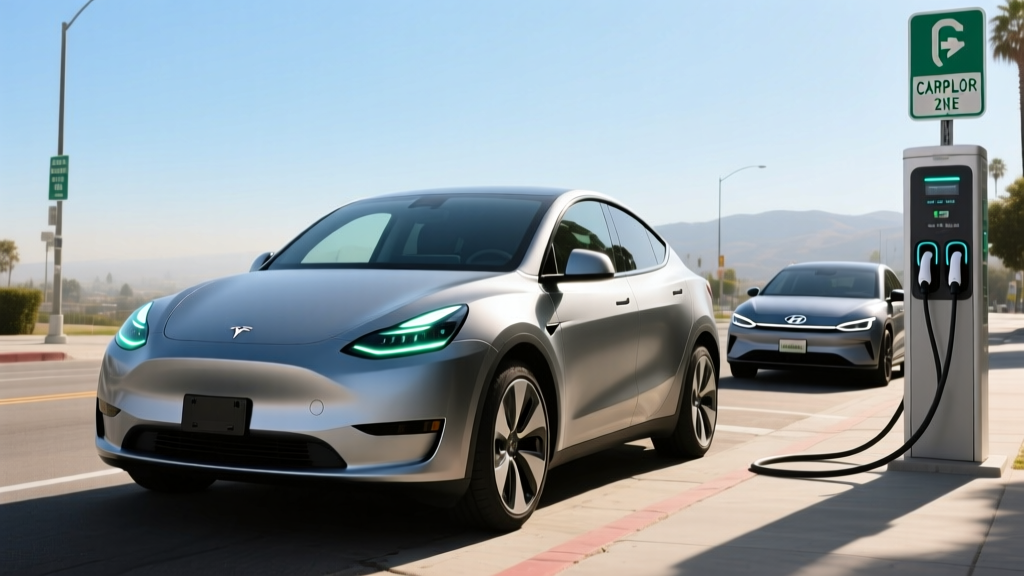
California's carpool lanes (HOV lanes) can cut commute times dramatically — and driving a qualifying electric vehicle is one of the fastest ways to get solo access. But the rules have tightened significantly since the program's early days. Here's the direct answer every California EV shopper needs:
Quick Answer: Electric Cars & California Carpool Lane Access
To legally drive solo in California HOV lanes in 2026, you need a Clean Air Vehicle (CAV) decal issued by the DMV. As of 2026, the CAV program is closed to new applicants — the program sunset on September 30, 2025, per California legislation. Vehicles that received decals before the sunset may continue using HOV lanes until their decal's expiration date (typically 3–4 years from issuance). New EV buyers in 2026 cannot obtain a new CAV decal. If you already hold a valid, unexpired CAV decal, you retain HOV access through its printed expiration.
This guide covers what the sunset means for current and prospective EV owners, what alternatives exist, and how to evaluate whether an EV purchase still makes financial sense for California commuters even without guaranteed HOV lane perks.
How the California CAV Decal Program Worked (And Why It Ended)
California's CAV decal program was created to incentivize zero-emission and low-emission vehicle adoption by granting solo drivers access to carpool lanes — a privilege normally reserved for vehicles with two or more occupants. Over the years, the rules evolved:
- Pre-2019: White decals (pure ZEVs/battery-electric) had no expiration and were transferable with the vehicle.
- 2019–2024: The program shifted to time-limited decals (typically 3–4 years) that were not transferable upon vehicle sale. Income caps were introduced in later legislative sessions.
- 2024–2025: Final application windows operated under stricter income thresholds (single filers under $150,000 AGI, heads of household under $225,000, joint filers under $300,000 in some legislative proposals) and MSRP caps.
- September 30, 2025: The program officially sunset. No new applications accepted after this date.
The sunset was anticipated for years. California's HOV lanes became increasingly congested with CAV decal holders — by some DMV estimates, over 100,000 decals were active on major corridors like the I-405 and I-10, eroding the time-savings benefit that made the program attractive in the first place.
What This Means for 2026 EV Buyers in California
If you're shopping for an electric car in California in 2026, here's the practical reality:
You cannot get a new CAV decal. This applies to all new EV purchases and leases, regardless of the vehicle's price, range, or emissions classification. The DMV is no longer processing applications.
Existing decals remain valid until expiration. If you bought a qualifying EV in, say, 2024 and received a CAV decal, it remains valid through its printed expiration date (e.g., through 2027 or 2028 depending on issuance). These decals are tied to the vehicle and owner — they are not transferable if you sell the car.
Used EVs with expired or no decals do not qualify. Buying a used Tesla Model 3 or Chevrolet Bolt that previously had a CAV decal does not grant you HOV access. The decal program is closed, full stop.
The Used-CEV HOV Access Exception
California did create a limited pathway for used zero-emission vehicle buyers: the Used Clean Air Vehicle decal. However, this pathway also closed with the broader program sunset in September 2025. If you obtained a used-CEV decal before the deadline, it remains valid through its expiration.
The Real Value of HOV Lane Access: Time and Money by the Numbers
Before the sunset, HOV lane access was one of the most tangible financial benefits of EV ownership in California — arguably more immediately valuable than the federal tax credit for daily commuters. Here's what the data showed:
| Commute Corridor | General Lane Avg (min) | HOV Lane Avg (min) | Daily Time Saved | Annual Hours Saved (250 workdays) |
|---|---|---|---|---|
| I-405 Sepulveda Pass (NB, AM peak) | 68 | 34 | 34 min | ~142 hours |
| I-10 Eastbound (West LA → Downtown) | 55 | 28 | 27 min | ~113 hours |
| US-101 (Silicon Valley → SF) | 72 | 40 | 32 min | ~133 hours |
| I-80 Eastbound (East Bay commute) | 48 | 25 | 23 min | ~96 hours |
Estimates based on Caltrans traffic data and INRIX congestion reports. Actual savings vary by time of day, incident, and specific corridor segment.
At an average loaded wage of $45/hour, 120 annual hours saved translates to roughly $5,400/year in time value — a figure that made the CAV decal one of the most valuable EV incentives in the country for corridor commuters.
EV Ownership Costs in California (2026): Still Worth It Without HOV Access?
Even without carpool lane privileges, EVs in California continue to offer compelling economics — but the math has shifted. Here's a real-world cost breakdown comparing a popular EV against a comparable gas vehicle for a California commuter driving 15,000 miles/year.
| Cost Factor | 2026 Tesla Model 3 RWD (EV) | 2026 Toyota Camry LE (Gas) |
|---|---|---|
| Base MSRP | $38,990 | $28,855 |
| Federal §30D Tax Credit (if eligible) | Up to $7,500 (subject to income, MSRP, and battery sourcing rules — verify at IRS.gov) | $0 |
| Effective Purchase Price (after credit) | ~$31,490 | $28,855 |
| Annual Fuel/Energy Cost (15k mi/yr) | ~$540 (home L2 at $0.16/kWh, 28 kWh/100mi) | ~$1,950 (32 MPG combined, $4.16/gal CA avg) |
| Annual Maintenance | ~$150 (cabin filter, tire rotation, wiper fluid) | ~$650 (oil changes, filters, brake pads over time) |
| Annual Insurance (CA avg) | ~$2,400 | ~$1,800 |
| 5-Year Total Operating Cost | ~$15,450 | ~$22,000 |
| 5-Year Net Cost (purchase + operating) | ~$46,940 | ~$50,855 |
Key takeaway: Even without HOV lane access, the Model 3 comes out roughly $3,900 ahead over 5 years in this scenario — driven primarily by California's high gas prices and the EV's dramatically lower energy and maintenance costs. Insurance premiums remain the EV's biggest ongoing disadvantage.
California-Specific Incentives That Still Apply (2026)
- Clean Fuel Rebate: Some California utilities (PG&E, SCE, SDG&E) still offer $500–$1,500 rebates for EV purchases or leases — check your local utility's EV program page.
- CVRP (Clean Vehicle Rebate Project): The statewide $2,000 rebate for new EVs has been exhausted in recent funding cycles. Check California Energy Commission for any renewed funding.
- CC4A (Clean Cars 4 All): Low-income Californians scrapping older gas vehicles may qualify for up to $9,500 toward a new or used EV or PHEV through participating air districts.
- Utility EV Rate Plans: Time-of-use plans (e.g., PG&E's EV2-A) offer electricity as low as $0.10–$0.14/kWh during off-peak hours, further reducing charging costs.
Which EVs Made the Cut? Vehicles That Qualified Before the Sunset
For reference — and for buyers looking at the used market who might find a vehicle with a still-valid decal (though remember, decals are non-transferable) — here are the types of vehicles that qualified under the CAV program's final rules:
- All battery-electric vehicles (BEVs): Tesla Model 3/Y/S/X, Chevrolet Bolt EV/EUV, Hyundai Ioniq 5/6, Kia EV6/EV9, Ford Mustang Mach-E, Rivian R1T/R1S, BMW i4/iX, Mercedes EQS/EQB, Nissan Leaf, Subaru Solterra, Toyota bZ4X, Volkswagen ID.4, and all other pure BEVs.
- Fuel cell electric vehicles (FCEVs): Toyota Mirai, Hyundai Nexo.
- Qualifying PHEVs (with income/MSRP caps in later years): Toyota Prius Prime, Toyota RAV4 Prime, Chrysler Pacifica PHEV, and others meeting the ≤50g CO₂/mile threshold.
Note: Standard hybrids (HEVs) like the regular Toyota Prius or Honda Accord Hybrid never qualified for CAV decals under the program's final rules — only plug-in vehicles met the emissions threshold.
Decision Framework: Should You Still Buy an EV in California in 2026?
If-Then EV Buying Framework for California Commuters
Choose an EV if:
- You have access to Level 2 home charging (garage, driveway, or workplace) — this is the single biggest factor in EV satisfaction.
- Your commute is under 80 miles round-trip, and you value $1,200–$1,800/year in fuel and maintenance savings.
- You're eligible for the full or partial §30D federal tax credit (income ≤$150k single / $300k joint; vehicle MSRP ≤$55k sedans / $80k SUVs/trucks; verify battery sourcing at IRS.gov).
- You care about reducing tailpipe emissions in a state where the grid is increasingly renewable (~40%+ from solar/wind/hydro in 2025).
- You drive a corridor with toll-lane options (e.g., I-110, I-10 Express Lanes) where EVs may still receive toll discounts even without a CAV decal.
Consider a hybrid (HEV/PHEV) or delay your purchase if:
- Your primary motivation for going electric was HOV lane access — that benefit is no longer available to new buyers.
- You live in an apartment without charging access and your area has sparse public DC fast charging infrastructure.
- You regularly drive 300+ miles in a single day (rural NorCal, Tahoe trips, LA-to-Vegas) and don't want to plan around charging stops.
- Your household income exceeds §30D caps, eliminating the federal credit and narrowing the price gap with efficient hybrids like the Prius (57 MPG combined, ~$28,000 MSRP).
Common Misconceptions About California EV Carpool Lane Rules
| Myth | Fact |
|---|---|
| "Any electric car can use the carpool lane." | Only vehicles with a valid, unexpired CAV decal may use HOV lanes solo. Without the decal, you need 2+ occupants like any other vehicle. |
| "I can buy a used EV that had a CAV decal and inherit the HOV access." | CAV decals issued after 2019 are non-transferable. When the original owner sells the vehicle, the decal privilege ends. You cannot apply for a new one because the program has sunset. |
| "The CAV program is still open — I just haven't applied yet." | The program closed to new applications on September 30, 2025. The DMV is not accepting new CAV decal applications in 2026. |
| "HOV lane access is worth more than the federal tax credit." | For heavy commuters on congested corridors (I-405, US-101), the time savings could be worth $4,000–$6,000/year — potentially exceeding the $7,500 credit over the decal's lifespan. But this is now moot for new buyers. |
| "PHEVs like the RAV4 Prime still qualify." | They qualified before the sunset. No new PHEV or BEV buyer can obtain a CAV decal in 2026. |
| "Tesla gets special carpool lane rules." | Tesla vehicles never had unique HOV privileges — they qualified under the same CAV decal program as all other eligible ZEVs. |
Real-World Ownership: What California EV Drivers Actually Face in 2026
Home Charging Access Remains the Biggest Divider
California leads the nation in public charging infrastructure, with over 12,000 DC fast-charging ports statewide as of early 2026. But home Level 2 charging is still where 80%+ of all EV charging happens for those who have access. A typical home L2 installation (240V, 40–48 amp circuit) costs $800–$2,500 including equipment and electrician labor, depending on panel proximity and permit requirements.
If you're in an apartment or condo without dedicated EV charging, your experience will depend heavily on your local public network. Electrify America, EVgo, and Tesla Superchargers are the most reliable options in urban California, but session costs at DC fast chargers ($0.35–$0.55/kWh) can erode the fuel savings advantage compared to home charging at $0.12–$0.16/kWh.
Cold-Weather Range Loss (Yes, Even in California)
Most of coastal and Southern California rarely sees temperatures that significantly impact EV range. But if you commute from the High Desert, Sierra foothills, or regularly drive to Tahoe, expect 15–25% range reduction in near-freezing conditions due to battery chemistry limitations and cabin heating demand. A 350-mile EPA-rated EV may deliver 270–295 miles in these conditions — still adequate for most trips, but worth planning around.
Insurance Costs: The Persistent EV Penalty
California EV owners pay an average of 20–35% more for auto insurance than comparable gas car owners. A Tesla Model Y might cost $2,200–$2,800/year to insure in the Bay Area versus $1,600–$2,000 for a Toyota RAV4. This is driven by higher repair costs (specialized body shops, aluminum panels, battery replacement risk) and higher vehicle MSRP. Shop quotes from GEICO, Progressive, State Farm, and EV-specialty insurers like Lemonade before purchasing.
Frequently Asked Questions
Can I still apply for a California CAV decal in 2026?
No. The Clean Air Vehicle decal program closed to new applications on September 30, 2025. The California DMV is not accepting new applications, and no legislative extension has been enacted as of early 2026.
If I buy a used EV that previously had a CAV decal, do I get HOV lane access?
No. CAV decals issued after 2019 were non-transferable. The decal privilege was tied to the original applicant and vehicle combination. Once the vehicle is sold, the HOV access ends, and you cannot reapply because the program has sunset.
Are there any toll discounts for EVs in California even without a CAV decal?
Some express lane programs and toll bridges have offered EV discounts or exemptions in the past, but many of these were tied to the CAV decal itself. Check with the specific toll authority (e.g., Metro ExpressLanes, FasTrak) for current policies, as these vary by corridor and are subject to change.
What's the cheapest EV I can buy in California in 2026?
The 2026 Nissan Leaf S starts at approximately $28,140 MSRP (149-mile EPA range, 40 kWh battery). The 2026 Chevrolet Equinox EV 2LT starts around $33,600 (315-mile range, 85 kWh battery). After the §30D federal tax credit (if eligible), effective prices can drop to ~$20,640 and ~$26,100 respectively — though credit eligibility depends on your income, the vehicle's battery sourcing, and MSRP caps.
Is a PHEV a better choice than a BEV now that HOV access is gone?
It depends on your driving pattern. If you drive 30–40 miles daily and can charge at home, a PHEV like the Toyota Prius Prime (44 miles electric-only range, $33,445 MSRP) gives you gas-free commuting with unlimited range for road trips — no charging anxiety. If you drive more than 50 miles daily or want to maximize fuel savings, a BEV with 300+ miles of range and lower per-mile energy costs may still be the better long-term choice.
Will California reopen the CAV decal program?
There is no announced plan to reopen or extend the CAV decal program as of early 2026. California's transportation policy has shifted focus toward direct purchase incentives, charging infrastructure investment, and fleet electrification mandates rather than HOV lane access perks. Monitor the California DMV and California Energy Commission for any legislative updates.
Disclaimer: CAV program rules, federal tax credit eligibility, and California incentive availability are subject to legislative change. Verify all information with the California DMV and IRS before making a purchase decision. This article reflects information available as of early 2026.