Quick Answer: Should You Buy an EV in 2026?
Electric cars in 2026 make financial sense if you can charge at home, drive under 250 miles daily, and qualify for the up-to-$7,500 federal §30D tax credit (subject to MSRP caps, income limits, and battery-sourcing rules). The median new EV transaction price sits around $44,000, and models like the Tesla Model 3, Hyundai Ioniq 5, and Chevrolet Equinox EV deliver 250–330 miles of EPA range. Expect to save $800–$1,500/year on fuel versus a comparable gas car if you charge primarily at home on a Level 2 setup. If you lack home charging access, frequently drive in sub-20°F winters, or regularly tow heavy loads, a plug-in hybrid (PHEV) may serve you better.
The 2026 EV Landscape: What's Changed
The electric vehicle market in 2026 is defined by three shifts: the widespread adoption of the NACS (North American Charging Standard) connector across nearly all new models, a maturing used-EV market with vehicles hitting the $18,000–$28,000 range, and tighter IRS §30D battery-sourcing requirements that have reduced the number of models qualifying for the full $7,500 credit.
New entrants like the next-generation Chevrolet Bolt (with NACS native charging and LFP chemistry) sit alongside refreshed stalwarts. Meanwhile, 800-volt architectures—once exclusive to Porsche and Hyundai/Kia—have proliferated to mid-price vehicles, enabling 10–80% DC fast charges in 18–22 minutes at compatible 350 kW stations.
The practical upshot: there are more viable electric cars in 2026 than ever, but choosing the right one requires understanding your charging situation, driving patterns, and tax-credit eligibility before stepping into a dealership.
EV vs Gas vs Hybrid: The Real Numbers
Buyers cross-shopping electric cars against gas vehicles and hybrids need to look past sticker price and evaluate total cost of ownership (TCO) over a realistic 5-year horizon. Here's how a representative 2026 EV stacks up against its gas and PHEV alternatives:
| Category | EV (e.g., Tesla Model 3 RWD) | Gas (e.g., Toyota Camry LE) | PHEV (e.g., Toyota Prius Prime) |
|---|---|---|---|
| Base MSRP | $40,240 | $29,995 | $34,695 |
| Est. Federal Tax Credit | −$3,750 to −$7,500* | $0 | $3,750–$7,500* |
| Effective Purchase Price | $32,740–$36,490 | $29,995 | $27,195–$30,945 |
| 5-Yr Fuel/Energy Cost | $3,750 (home L2 @ $0.14/kWh) | $9,375 ($3.50/gal, 32 MPG) | $5,200 (mixed) |
| 5-Yr Maintenance | $1,800 | $3,600 | $3,200 |
| 5-Yr Insurance (avg) | $9,500 | $7,200 | $7,800 |
| Estimated 5-Yr TCO | $47,790–$51,540 | $50,170 | $43,395–$47,145 |
*Federal credit eligibility depends on income caps ($150K single / $300K joint AGI), MSRP limits ($55K cars / $80K SUVs/trucks), and battery critical-mineral sourcing. Verify current-year rules at IRS.gov. Point-of-sale transfer is available from participating dealers.
The EV wins on fuel and maintenance but loses ground on insurance premiums, which run 15–30% higher than equivalent gas vehicles due to repair complexity and parts cost. The PHEV splits the difference—offering 40+ miles of electric-only commuting with a gas engine for road trips, making it the pragmatic pick for single-vehicle households without reliable home charging.
Range Reality Check: EPA Stickers vs Real World
The most common mistake first-time EV buyers make is treating the EPA range estimate as a guarantee. In practice, real-world range depends heavily on speed, temperature, and terrain. Here's what to actually expect from popular 2026 models:
| Model | Battery (kWh, usable) | Chemistry | EPA Range | Real Highway (70 mph, 65°F) | Cold Weather (20°F, mixed) |
|---|---|---|---|---|---|
| Tesla Model 3 Long Range AWD | 79 kWh, NMC | NMC | 341 mi | ~275–290 mi | ~220–250 mi |
| Hyundai Ioniq 5 SE (RWD) | 77.4 kWh, NMC | NMC | 303 mi | ~250–265 mi | ~200–225 mi |
| Chevrolet Equinox EV RS | 85 kWh, NMC | NMC | 319 mi | ~260–280 mi | ~210–235 mi |
| Ford Mustang Mach-E Select | 75.7 kWh, NMC | NMC | 250 mi | ~210–225 mi | ~170–190 mi |
| Chevrolet Bolt (next-gen, announced) | 65 kWh, LFP | LFP | ~260 mi (prelim.) | ~220 mi (est.) | ~185 mi (est.) |
Rule of thumb: Plan for 75–85% of EPA range on sustained highway driving at 70+ mph, and 60–70% in sub-freezing temperatures. EVs with heat pumps (standard on Hyundai/Kia, Tesla, and most 2026 models) lose less range in cold than those relying on resistive heating. LFP batteries (like the upcoming Bolt and Tesla Model 3 RWD) tolerate regular 100% charging better than NMC, which prefers an 80% daily limit for longevity.
Charging at Home: The Make-or-Break Factor
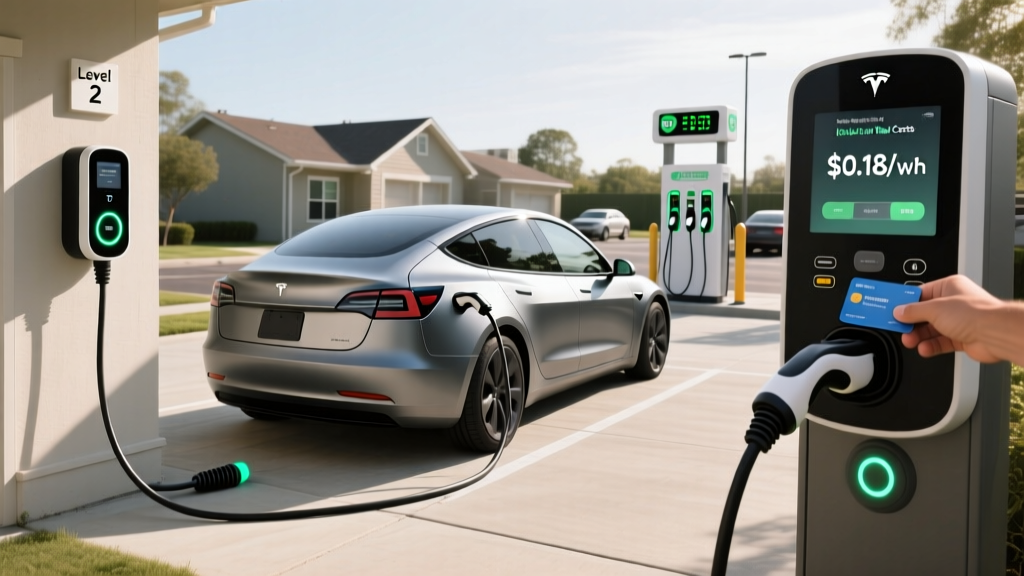
Home charging access is the single biggest determinant of EV satisfaction. If you can install a Level 2 (240V) charger in your garage or driveway, an EV becomes a "start every morning with a full tank" experience. If you can't—because you rent, live in an apartment, or have an older electrical panel—the calculus changes significantly.
Level 2 Home Charger Installation: What It Actually Costs
| Component | Typical Range | Notes |
|---|---|---|
| Level 2 Charger (40–48A, hardwired) | $400–$700 | Emporia, ChargePoint, Wallbox, Tesla Wall Connector |
| Electrician labor (240V circuit, 50–60A breaker) | $600–$2,000 | Depends on panel proximity and conduit run |
| Electrical panel upgrade (if needed) | $1,500–$4,000 | Required if panel is 100A or near capacity |
| Permit & inspection | $100–$400 | Varies by municipality |
| Total (no panel upgrade) | $1,100–$3,100 | Most homes with 200A service |
| Total (with panel upgrade) | $2,600–$7,100 | Older homes with 100A service |
Always get a load calculation from a licensed electrician before assuming your panel can handle a 48A EV circuit. The Residential Clean Energy Credit (30% up to $1,000 for charger hardware through 2032) may offset some hardware cost—check current eligibility.
For apartment dwellers or those without dedicated parking, public charging becomes a regular expense. DC fast charging costs $0.30–$0.55/kWh at Electrify America, EVgo, and Tesla Superchargers, making it roughly 2–3× more expensive than home charging and approaching the per-mile cost of a fuel-efficient gas car. If more than 50% of your charging will be public DC fast, run the TCO math carefully before committing to a full EV.
Charging Speeds: kW, kWh, and the Curve That Matters
A critical distinction every EV buyer must internalize: kW (kilowatts) measures power—how fast energy flows into the battery at a given moment. kWh (kilowatt-hours) measures energy—the total capacity of the battery. Think of kW as the width of a hose and kWh as the size of the bucket.
Peak charge rate (the big number automakers advertise) is only sustained for a portion of the session. As the battery fills past 50–60% state of charge (SoC), the charge rate tapers to protect the cells. Here's what that looks like in practice:
| Level | Voltage | Max Power (kW) | Miles of Range Added Per Hour | Best For |
|---|---|---|---|---|
| Level 1 (standard outlet) | 120V | 1.2–1.9 kW | 3–5 mi/hr | Overnight top-up, PHEVs |
| Level 2 (home/public) | 240V | 7.2–11.5 kW | 20–40 mi/hr | Daily home charging |
| DC Fast (50–150 kW) | 400V+ | 50–150 kW | 120–300 mi/hr | Road trips, quick top-ups |
| DC Fast (250–350 kW) | 800V | 250–350 kW | 500–800 mi/hr (peak) | 800V vehicles on compatible stations |
For example, the 2026 Hyundai Ioniq 5 (800V architecture) peaks at ~240 kW on a 350 kW charger and reaches 10–80% in approximately 18 minutes. However, the sustained average over that session is closer to ~170 kW due to taper above 60% SoC. The Tesla Model 3 Long Range peaks at ~250 kW on a V3 Supercharger with a 10–80% time of ~22 minutes. Always look at 10–80% time, not peak kW, when comparing charging speed.
Federal Tax Credit: The §30D Eligibility Checklist for 2026
The federal EV tax credit remains one of the most impactful purchase incentives—but qualifying has become more complex. Here's what determines whether you receive up to $7,500 (or $0):
- Buyer income cap: Modified AGI must not exceed $150,000 (single), $225,000 (head of household), or $300,000 (married filing jointly).
- Vehicle MSRP cap: $55,000 for sedans/wagons; $80,000 for SUVs, pickups, and vans. The vehicle classification follows IRS definitions, not automaker marketing.
- Battery critical-mineral sourcing: A percentage of critical minerals must be sourced from the US or free-trade-agreement countries. This threshold increases annually, narrowing eligible models each year.
- Battery component manufacturing: A percentage of battery components must be manufactured or assembled in North America, with thresholds also rising annually.
- Final assembly: Vehicle must undergo final assembly in North America (verify via the DOE VIN lookup tool on fueleconomy.gov).
- Point-of-sale transfer: You can transfer the credit to the dealer at purchase to reduce the sale price directly, rather than waiting to claim it on your tax return.
Important: Battery-sourcing rules change annually and have disqualified several previously eligible models. Always confirm credit eligibility for the specific trim and build date you're purchasing at IRS.gov or through your dealer's point-of-sale system. This article reflects rules as of early 2026; consult a tax professional for your specific situation.
EV vs PHEV vs Gas: A Practical Decision Framework
Not sure which powertrain fits your life? Use this framework:
Choose a full EV (BEV) if:
- You have home Level 2 charging (garage, driveway, or employer-installed)
- Your daily driving is under 200 miles round-trip
- You want minimal maintenance (no oil changes, fewer brake replacements due to regenerative braking)
- You qualify for the federal or state EV credit, narrowing the price gap
- You live in a moderate climate or your EV includes a heat pump
Choose a PHEV if:
- You can't reliably charge at home but want electric commuting for short trips
- You take frequent road trips (>300 miles) and don't want to plan around DC fast chargers
- You live in an extremely cold climate (below 0°F regularly) where EV range loss is severe
- You want one vehicle that covers all use cases without range planning
Stick with a gas vehicle (for now) if:
- You have zero charging access at home, work, or in your community
- You regularly tow heavy loads (>5,000 lbs), where EV range drops 40–50%
- Your budget is under $25,000 and the used-EV market in your area is thin
Common EV Misconceptions—Corrected with Data
| Myth | Fact (with data) |
|---|---|
| "EV batteries need replacing every 5 years." | Federal law mandates battery warranties of 8 years / 100,000 miles (10/150,000 in CARB states). Average degradation is 5–10% over 8 years for NMC; LFP degrades even slower. Full replacements are rare and typically covered under warranty. |
| "EVs are worse for the environment because of battery mining." | Lifecycle analyses by the EPA and ICCT show EVs produce fewer lifecycle emissions than gas cars in every US grid region, even accounting for mining. The grid is getting cleaner every year, making EVs greener over time. |
| "You can't take an EV on a road trip." | Tesla's Supercharger network has 25,000+ stalls in North America (now open to NACS-equipped non-Teslas). Electrify America, EVgo, and others add CCS/NACS coverage on major corridors. A 600-mile trip adds 40–60 minutes of charging vs. a gas car. |
| "EVs are slow." | The Tesla Model 3 Performance does 0–60 in 2.9 seconds. Even the base Hyundai Ioniq 5 (168 HP, RWD) hits 60 in ~7.0 seconds. Electric motors deliver instant torque—most EVs out-accelerate their gas counterparts. |
| "Charging takes too long." | Home Level 2 charging takes ~8–10 hours overnight (you sleep through it). DC fast charging on road trips: 10–80% in 18–25 minutes for 800V vehicles. Plan meal/bathroom breaks around charging and the delay is minimal. |
What First-Time EV Buyers Should Know Before Signing
Based on ownership patterns and common regrets, here are the most important things first-time buyers overlook:
- Preconditioning matters. EVs that precondition the battery before DC fast charging (Tesla, Hyundai/Kia, Ford) achieve significantly faster charge speeds, especially in cold weather. Without preconditioning, your first 10 minutes at a fast charger may trickle at under 40 kW.
- Tire costs are higher. EVs are heavier and deliver instant torque, wearing tires 20–30% faster than gas cars. Budget $800–$1,400 for a set of EV-optimized tires every 30,000–40,000 miles.
- Insurance varies wildly. Get quotes before purchasing. Some insurers charge 25%+ more for EVs; others offer EV-specific discounts. Shop at least three providers.
- Regenerative braking changes how you drive. Most EVs offer adjustable regen, with the highest setting enabling "one-pedal driving" (the car slows significantly when you lift off the accelerator). It takes about a week to adapt and then feels natural.
- The frunk is real but small. Front trunks on EVs typically offer 2–4 cubic feet—enough for a charging cable and a small bag, not a second full cargo area.
- Used EVs can be a smart buy—but check battery health. Ask for a State of Health (SoH) report. A battery at 90%+ SoH is excellent. Below 85%, factor in reduced range and potential warranty claims.
Frequently Asked Questions
How long do EV batteries last?
Modern EV batteries are designed to last the life of the vehicle. Federal warranty requirements cover 8 years / 100,000 miles with a minimum 70% capacity retention. Real-world data from fueleconomy.gov and fleet studies show most NMC batteries retain 88–93% capacity after 100,000 miles. LFP batteries (used in base Tesla Model 3 and the upcoming Chevrolet Bolt) show even slower degradation and can be charged to 100% daily without accelerated wear.
Is it cheaper to charge an EV than to buy gas?
At home on a Level 2 charger with average US electricity rates ($0.16/kWh), an EV achieving 3.5 mi/kWh costs roughly $0.046 per mile. A gas car at 30 MPG with $3.50/gallon fuel costs $0.117 per mile. That's a 60% savings per mile when charging at home. Public DC fast charging at $0.45/kWh raises the EV cost to ~$0.129/mile—slightly more than gas. Home charging is the key to EV cost savings.
Do I need a 200-amp electrical panel for an EV charger?
Not necessarily. A 48-amp Level 2 charger requires a 60-amp breaker. Many homes with 100-amp panels can accommodate this if the panel isn't near capacity. A licensed electrician must perform a load calculation to determine if your panel has headroom. If not, a panel upgrade to 200A typically costs $1,500–$4,000. Some utilities offer rebates for panel upgrades tied to EV adoption.
What happens if I run out of charge on the road?
The same thing that happens if you run out of gas: you need a tow to the nearest charger. However, EVs provide multiple low-battery warnings, and navigation systems in modern EVs (Tesla, Hyundai, Ford, GM) route you through charging stations automatically. Running out of charge is almost always a planning failure, not a sudden surprise. Roadside assistance programs from AAA and automakers increasingly offer mobile charging or flatbed tows to the nearest station.
Are electric cars safe in a crash?
Yes. EVs consistently earn top ratings from IIHS and NHTSA. Battery packs are housed in reinforced enclosures below the floor, lowering the center of gravity and reducing rollover risk. In the rare event of a battery fire, thermal propagation is slower than gasoline fires, giving occupants more time to exit. First responders receive specific EV training for high-voltage system shutoff.
Should I wait for solid-state batteries?
Solid-state batteries promise higher energy density and faster charging, but mass-market availability remains 2028–2030 at the earliest for most automakers. Current NMC and LFP batteries are mature, reliable, and well-warranted. Waiting for next-generation tech means delaying a purchase that is already economically viable today—if an EV fits your situation now, there is no compelling reason to wait.