The Short Answer
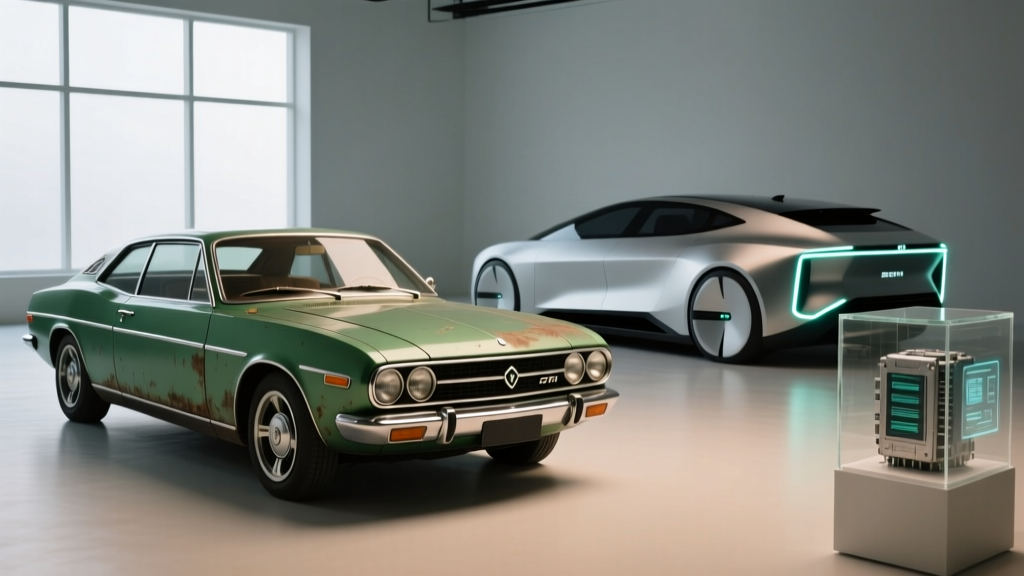
Electric cars from the 1970s — like the CitiCar, Enfield 8000, and various converted prototypes — offered 30–50 miles of range on heavy lead-acid batteries, topped out around 40–60 mph, and cost roughly the same as a mid-range gasoline car. They failed commercially because battery energy density was abysmal (about 30–40 Wh/kg for lead-acid vs. 250–300 Wh/kg for modern NMC cells), public charging didn't exist, and the 1970s oil crisis that briefly made them attractive faded. Today's EVs deliver 250–400+ miles of EPA range, charge at 150–350 kW on DC fast chargers, and qualify for up to $7,500 in federal tax credits under IRS §30D rules — making the comparison almost unrecognizable.
What Electric Cars in the 1970s Actually Looked Like
The 1973 OPEC oil embargo sent gasoline prices soaring and triggered genuine panic about fuel supply. That crisis gave battery-electric vehicles their first serious commercial opening in the United States since the early 1900s. Several companies rushed small, low-speed electric cars to market, and the federal government funded demonstration fleets through the Electric and Hybrid Vehicle Research, Development, and Demonstration Act of 1976.
The most recognizable product was the CitiCar, built by Sebring-Vanguard in Florida. It looked like a doorstop on wheels and performed roughly like one, too. Here's what the specs looked like:
| Spec | CitiCar (1974–1977) | Typical 2026 EV (e.g., Hyundai Ioniq 5) |
|---|---|---|
| Battery chemistry | Lead-acid (8 × 6V) | NMC lithium-ion (77.4 kWh usable) |
| Battery weight | ~850 lbs | ~860 lbs |
| Energy density | ~35 Wh/kg | ~260 Wh/kg |
| Range | 35–45 miles (ideal conditions) | 318 miles EPA (real-world ~260–280 mi highway) |
| Top speed | ~50 mph | 115 mph (electronically limited) |
| 0–30 mph | ~12 seconds | 0–60 mph in 5.0 sec (RWD) / 3.4 sec (AWD) |
| "Charging" | Standard 120V outlet, ~8–10 hours | Level 2: ~7 hrs; DC fast: 10–80% in ~18 min at 240 kW peak |
| MSRP (year of sale) | ~$3,000 (≈$15,500 in 2026 dollars) | $42,600 base (before incentives) |
| Units sold | ~2,600 total | Hyundai sold 100,000+ Ioniq 5 units globally since launch |
Other 1970s EVs included the Enfield 8000 (a British prototype that never reached mass production), AMC's electric Hornet concepts, and various one-off conversions built by universities and national labs. Jet Propulsion Laboratory and the Department of Energy tested fleet EVs using nickel-zinc and early lithium chemistries, but none reached consumers at scale.
The fundamental problem wasn't engineering ambition — it was physics. Lead-acid batteries stored roughly 7× less energy per kilogram than today's lithium-ion cells. A CitiCar's battery pack weighed nearly as much as a modern Ioniq 5 pack but held maybe 4–5 kWh of usable energy versus 77.4 kWh today. That meant short range, poor performance, and batteries that needed replacement every 2–3 years at significant cost.
Why 1970s Electric Cars Failed: The Real Constraints
Understanding the specific failure modes matters because some of them — especially charging infrastructure gaps and cold-weather range loss — remain relevant to buyers in 2026.
Battery Energy Density and Cycle Life
Lead-acid batteries degrade rapidly under deep cycling. A CitiCar owner could expect 300–500 full charge cycles before capacity dropped below 80%. In daily use, that meant a battery replacement every 2–3 years, at a cost of several hundred dollars (roughly $2,000–$3,000 in 2026 dollars). Modern NMC and LFP lithium-ion packs are warranted for 8 years/100,000 miles and typically retain 85–90% capacity at that point, based on data from fleet operators and fueleconomy.gov testing.
No Public Charging Infrastructure
In 1976, there were zero public charging stations in the United States. You charged at a standard 120V household outlet, adding perhaps 4–5 miles of range per hour. The concept of a DC fast-charging network didn't exist. Compare that to 2026: the U.S. has over 200,000 public charging ports, including roughly 50,000+ DC fast chargers across networks like Tesla Supercharger, Electrify America, and EVgo. The NACS connector has largely standardized access.
The Oil Crisis Ended
By the early 1980s, oil prices stabilized and gasoline became cheap again. Consumer urgency evaporated. The CitiCar's manufacturer went bankrupt in 1977. The federal EV demonstration program wound down. Without sustained policy support or a lasting fuel-price crisis, the market for compromised electric vehicles disappeared.
2026 EV Ownership: What's Changed (And What Hasn't)
Here's where history meets the present. Several barriers that killed 1970s EVs have been solved — but not all of them, and not for every buyer.
Cost Comparison: 2026 EV vs. Gasoline Car (5-Year / 75,000 Miles)
| Category | 2026 EV (e.g., Chevy Equinox EV LT, $33,600 MSRP) | 2026 Gas Car (e.g., Toyota RAV4 LE, $29,500 MSRP) |
|---|---|---|
| Purchase price (after §30D credit) | ~$26,100 (if eligible for full $7,500 point-of-sale transfer) | $29,500 |
| Fuel / energy (75,000 mi) | ~$3,200 (at $0.14/kWh avg, 3.5 mi/kWh) | ~$9,400 (at $3.50/gal, 28 MPG combined) |
| Maintenance (5 years) | ~$1,800 (tires, cabin filter, brake fluid — no oil changes) | ~$4,200 (oil changes, filters, spark plugs, transmission fluid) |
| Insurance (5-year avg) | ~$9,500 (EV premiums run 15–25% higher on average) | ~$7,800 |
| Estimated depreciation | ~$12,000 | ~$10,500 |
| 5-year total cost of ownership | ~$52,600 | ~$61,400 |
Source: Author calculations using EPA efficiency data from fueleconomy.gov and IRS §30D rules from irs.gov. Actual costs vary by state, utility rate, driving pattern, and credit eligibility.
What's Solved Since the 1970s
- Range: 250–400+ EPA miles eliminates the daily usability problem entirely for most drivers.
- Charging speed: Modern 800V architectures (Hyundai/Kia E-GMP, Porsche Taycan, GM Ultium) charge from 10–80% in 18–25 minutes at peak rates of 200–350 kW.
- Performance: Even base-trim EVs deliver 0–60 times under 7 seconds — sports-car territory by 1970s standards.
- Battery longevity: LFP packs (Tesla Model 3 RWD, Ford Mustang Mach-E Select) can exceed 3,000 cycles with minimal degradation. NMC packs routinely last 1,500–2,000 cycles. Federal warranty mandates cover 8 years/100,000 miles minimum.
- Infrastructure: The Tesla Supercharger network opened to NACS-equipped non-Tesla EVs starting in 2024, dramatically expanding reliable DC fast-charging access.
What Hasn't Fully Changed
- Apartment and street-parking charging: If you can't install a Level 2 charger at home, EV ownership remains significantly harder. Roughly 30% of U.S. households lack dedicated off-street parking.
- Cold-weather range loss: EVs still lose 20–40% of EPA range in sub-freezing temperatures due to battery chemistry and cabin heating demands. A 1970s EV with 40 miles of range became a 25-mile EV in winter; a 2026 EV with 300 miles becomes a 200-mile EV. Proportionally the same, but far less painful in absolute terms.
- Upfront cost: Despite incentives, EV MSRPs still skew higher than comparable gas vehicles, especially in the sub-$30,000 segment where new-EV options remain limited.
- Charging deserts: Rural areas in the Mountain West, Great Plains, and parts of the South still have sparse DC fast-charging coverage.
Real Costs and Savings: A 2026 Buyer's Breakdown
Per-Mile Operating Cost: EV vs. Gas vs. Hybrid (2026)
| Vehicle Type | Example Model | Energy/Fuel Cost per Mile | Maintenance per Mile | Combined per Mile |
|---|---|---|---|---|
| BEV (home charging) | Tesla Model 3 RWD (LFP, 132 MPGe) | $0.040 | $0.024 | $0.064 |
| BEV (public DC fast charging) | Tesla Model 3 RWD | $0.105 | $0.024 | $0.129 |
| PHEV (mixed driving) | Toyota RAV4 Prime (38 kWh/100mi + 38 MPG gas) | $0.068 | $0.035 | $0.103 |
| HEV | Toyota RAV4 Hybrid (39 MPG) | $0.090 | $0.045 | $0.135 |
| Gas (ICE) | Toyota RAV4 (28 MPG) | $0.125 | $0.056 | $0.181 |
Assumes $0.14/kWh home electricity, $0.42/kWh public DC fast charging, $3.50/gallon gasoline. Maintenance estimates from AAA Your Driving Costs 2025 methodology.
The per-mile numbers make clear what 1970s EV buyers couldn't achieve: home-charged EVs now cost roughly one-third as much to operate per mile as a gasoline car. But the public-charging column is a cautionary tale — if you rely entirely on DC fast chargers at $0.35–$0.50/kWh, your fuel savings shrink dramatically. This is the modern equivalent of the 1970s infrastructure gap.
Federal Tax Credit Eligibility (§30D) — 2026 Rules
The IRS §30D clean vehicle credit offers up to $7,500 for qualifying new EVs, but eligibility depends on several factors that change annually. Per irs.gov, key requirements include:
- MSRP caps: Vans, SUVs, and pickups ≤ $80,000; sedans and other body styles ≤ $55,000.
- Buyer income caps: Modified AGI ≤ $150,000 (single), $225,000 (head of household), $300,000 (joint).
- Battery sourcing: Increasing percentages of critical minerals and battery components must be sourced from the U.S. or free-trade-agreement countries; components from "foreign entities of concern" (primarily China) disqualify the vehicle.
- Point-of-sale transfer: Buyers can transfer the credit to the dealer at purchase, reducing the sale price directly rather than waiting for a tax refund.
Not every EV qualifies for the full $7,500. Many qualify for $3,750 (meeting one of two sourcing thresholds) or nothing at all. Always verify current eligibility on the IRS and DOE clean vehicle pages before committing to a purchase.
Common Misconceptions About EVs — Then and Now
| Myth | Fact |
|---|---|
| "EVs are a new, unproven technology." | Electric cars predate gasoline cars (the 1830s–1900s saw widespread electric carriages). The 1970s revival failed due to battery limitations, not the concept itself. Modern lithium-ion EVs have accumulated billions of real-world miles. |
| "EV batteries need replacing every few years." | This was true for 1970s lead-acid packs. Modern LFP and NMC packs are warrantied for 8 years/100,000 miles at ≥70% capacity retention. Real-world data from Tesla fleet reports and Recurrent Auto show most packs retain 85–92% at 100,000 miles. |
| "You'll be stranded with no charging stations." | The U.S. has 200,000+ public charging ports as of 2026. However, reliability varies — Electrify America and EVgo stations average 85–90% uptime, while Tesla Superchargers exceed 99%. Rural gaps persist. |
| "EVs are worse for the environment because of electricity generation." | Even on the dirtiest U.S. grids (e.g., parts of the Midwest relying on coal), an EV produces fewer lifetime CO₂-equivalent emissions than a comparable gas car, per Argonne National Laboratory lifecycle analyses. On cleaner grids, the advantage is 60–80%. |
| "EVs cost more to own, period." | Higher purchase price is real, but 5-year TCO favors EVs for most drivers who can charge at home, thanks to lower fuel and maintenance costs. Without home charging, the math flips. |
Decision Framework: Should You Buy an EV in 2026?
Use this framework based on your actual living situation and driving patterns — not aspirational scenarios:
Choose a full BEV if:
- You have access to Level 2 home charging (garage, driveway, or workplace)
- Your daily driving is under 80 miles round-trip
- You take road trips fewer than 6 times per year (DC fast-charging covers these)
- You live in a region with moderate winters or your EV has a heat pump (standard on most 2026 models from Hyundai, Tesla, BMW)
- You qualify for the §30D credit or your state offers additional incentives
Choose a PHEV if:
- You lack reliable home or workplace charging but want some electric driving
- You regularly drive 200+ miles in a single day (no charging stops needed on gas)
- You want EV-like daily commuting (30–45 electric miles) without range risk
- You live in extreme cold climates where BEV range loss is most punishing
Stick with a gas car or HEV if:
- You have no access to any charging (street parking only, no workplace chargers)
- You tow heavy loads frequently (EV towing range drops 40–60%)
- Your budget is strictly under $28,000 and you're buying new (very few EV options at this price point in 2026)
- You live in a charging desert and take frequent long highway trips
What First-Time EV Buyers Should Know in 2026
If you're coming from a lifetime of gasoline cars, the ownership paradigm shift is real. Here are the practical realities no brochure will emphasize:
Home charging is the single biggest factor in EV satisfaction. A Level 2 (240V) home charger delivering 7–11.5 kW adds 25–45 miles of range per hour of charging. Installation costs range from $500 (simple NEMA 14-50 outlet near your panel) to $3,000+ (panel upgrade, long conduit runs). Get a quote from a licensed electrician before buying the car.
EPA range is optimistic for highway driving. The EPA test cycle includes significant low-speed and city driving where regenerative braking helps. Expect 80–90% of EPA range at sustained 70–80 mph highway speeds, and 60–75% in freezing temperatures with cabin heat running. A 310-mile EPA rating realistically means ~250 miles on a winter road trip.
Charging curves taper above 80%. A vehicle that advertises "250 kW peak charging" does not sustain that rate. Typical charge curves hold peak power from roughly 10–50% SoC, then taper progressively. A "10–80% in 18 minutes" claim is meaningful; a "0–100% in 25 minutes" claim is marketing fiction.
kW vs. kWh — know the difference. kW (kilowatts) measures power — how fast energy flows, like water pressure. kWh (kilowatt-hours) measures energy — how much the battery holds, like a tank size. A 77 kWh battery charging at 250 kW is like filling a 20-gallon tank at 8 gallons per minute. The battery size (kWh) determines range; the charge rate (kW) determines how long you wait.
Insurance costs more. EV insurance premiums run 15–25% higher than comparable gas cars, driven by higher repair costs (specialized body shops, battery replacement protocols) and higher vehicle values. Get quotes before purchasing — the difference can be $300–$600/year.
What the 1970s Teach Us About 2026 EV Adoption
The 1970s EV experiment failed for identifiable, fixable reasons: terrible batteries, no infrastructure, and temporary fuel-price motivation. Lithium-ion chemistry solved the battery problem. The Bipartisan Infrastructure Law's $7.5 billion charging investment and private-sector buildout are addressing infrastructure. And federal §30D credits, state rebates, and falling battery costs (down from $1,200/kWh in 2010 to ~$110/kWh in 2025) provide sustained economic motivation that the 1970s never had.
But the lessons persist. Infrastructure gaps still matter — they've just shifted from "no chargers exist" to "chargers exist but aren't equally reliable or accessible." Cold weather still bites. Upfront cost still deters budget-conscious buyers. And policy support can't be taken for granted, as credit eligibility rules tighten annually.
The CitiCar's 40-mile range and 50-mph top speed feel almost comical next to a 2026 Ioniq 5's 318 EPA miles and 240 kW charging. The distance between those two vehicles represents one of the most dramatic technological transformations in automotive history. The question for today's buyer isn't whether EVs work — they clearly do — but whether your specific situation (housing, driving, budget, climate) makes one the right choice right now.
Were there any mass-produced electric cars in the 1970s?
No vehicle reached true mass production. The CitiCar/ComutaCar came closest with roughly 2,600 units sold between 1974 and 1977. The Enfield 8000, various AMC electric concepts, and government demonstration fleets existed but never scaled beyond hundreds of units. For comparison, Tesla produced over 1.8 million vehicles in 2024 alone.
How much did a 1970s electric car cost compared to a gas car?
The CitiCar sold for approximately $3,000 (about $15,500 in 2026 dollars), which was comparable to a basic Ford Pinto or Chevy Vega. However, it delivered a fraction of the performance and range, making it poor value despite low operating costs. Today, the EV price premium is narrowing — a Chevy Equinox EV starts at $33,600 and can drop below $27,000 with the §30D credit.
What battery technology did 1970s EVs use?
Almost exclusively lead-acid batteries — the same chemistry used for 12V starter batteries today. Lead-acid offers about 35 Wh/kg energy density, meaning you needed massive, heavy packs for minimal range. Some government research programs tested nickel-zinc and early lithium cells, but these never reached production vehicles. The shift to lithium-ion (250–300 Wh/kg) is the single biggest factor that made modern EVs viable.
Why didn't electric cars catch on during the 1970s oil crisis?
Three converging factors: (1) Battery technology was fundamentally inadequate for mainstream use — 40-mile range and 50-mph top speed weren't practical for most American drivers. (2) No charging infrastructure existed outside a standard wall outlet. (3) When oil prices stabilized in the early 1980s, consumer urgency disappeared. Without sustained government support or continuing fuel-price pressure, the niche market collapsed.
How does 2026 EV range compare to 1970s EV range?
The difference is roughly 7–10×. A CitiCar delivered 35–45 miles of range; a 2026 Hyundai Ioniq 5 delivers 318 EPA miles, and the Lucid Air Grand Touring achieves 516 EPA miles. Real-world highway range for a modern EV typically falls 15–25% below the EPA sticker, but even with that discount, today's EVs cover 5–8× the distance of 1970s counterparts on a single charge.