The Short Answer
Electric cars in the 1920s offered roughly 40–80 miles of range on heavy lead-acid batteries, cost more than twice a comparable Ford Model T, and vanished when electric starters made gas cars easier to operate and gasoline became cheap and ubiquitous. Today's EVs deliver 250–400+ miles on lightweight lithium-ion packs, charge to 80% in 18–35 minutes on DC fast chargers, and qualify for up to $7,500 in federal tax credits under IRS §30D. The core lesson from 1920 remains true in 2026: an EV's viability depends on energy density, charging infrastructure, and total cost of ownership — not just the powertrain.
If you searched for "electric cars 1920" you may be researching automotive history, writing a paper, or simply curious how far the technology has come. Either way, the parallels between the EV market's collapse a century ago and the buying decisions facing shoppers today are surprisingly direct. This guide uses that history as a lens to help you evaluate a modern EV purchase with hard data.
What Electric Cars Looked Like in the 1920s
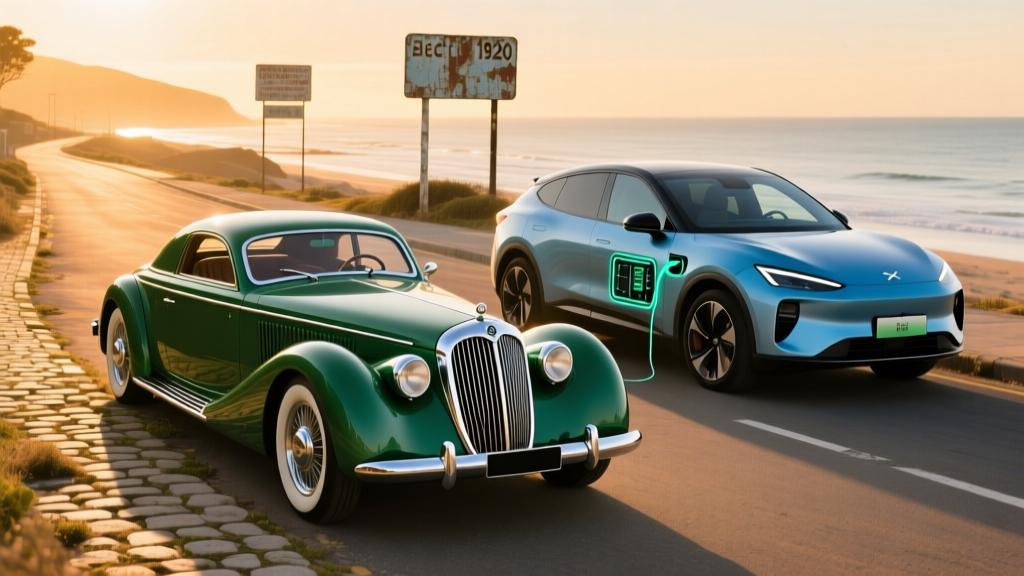
By 1920, electric vehicles had already peaked. At their height around 1900–1912, EVs held roughly one-third of the U.S. automobile market alongside steam and gasoline cars. Brands like Baker Electric, Detroit Electric, and Columbia produced refined urban runabouts favored by physicians and affluent city drivers who valued quiet operation and the absence of a hand crank.
The specifications, by modern standards, were stark:
| Specification | ~1920 Detroit Electric | 2026 Tesla Model Y (Long Range) | 2026 Hyundai Ioniq 5 (Long Range) |
|---|---|---|---|
| Battery chemistry | Lead-acid | NMC lithium-ion | NMC lithium-ion |
| Battery weight | ~800–1,200 lb | ~1,060 lb (usable ~75 kWh) | ~1,000 lb (usable ~77.4 kWh) |
| Range | ~40–80 miles | EPA 320 mi | EPA 305 mi |
| Top speed | ~15–20 mph | 130 mph | 115 mph |
| "Refuel" time | 8+ hours (AC mains) | ~25 min (10–80% at 250 kW peak) | ~18 min (10–80% at ~240 kW peak) |
| New price (approx.) | $2,000–$3,000 (~$65,000+ today) | $46,630 MSRP | $46,650 MSRP |
The energy density gap tells the story. Lead-acid cells store roughly 30–40 watt-hours per kilogram. Modern NMC lithium-ion cells store 220–270 Wh/kg — about seven times more energy per unit mass. That single physics constraint is why a 1920 EV couldn't travel from Boston to Providence, while a 2026 Ioniq 5 can cover that trip twice before needing a plug.
Why EVs Disappeared by the Late 1920s
Three converging forces killed the early electric car, and each maps onto a concern modern buyers still raise:
- Refueling infrastructure: Gasoline stations proliferated rapidly after 1910, while household electricity remained limited outside cities. Rural drivers had no practical way to recharge.
- Range and speed limits: As paved roads connected cities, drivers wanted 200+ mile range and 40+ mph cruising — capabilities that lead-acid batteries simply couldn't deliver.
- The electric starter: Cadillac's 1912 introduction of the electric starter motor eliminated the dangerous hand crank, removing one of the EV's biggest convenience advantages.
By 1930, electric passenger cars were effectively extinct in the U.S. The lesson for 2026 shoppers: infrastructure access and real-world range still dominate EV satisfaction surveys — not horsepower or styling.
How a 2026 EV Compares to a Gas Car: The Numbers
The comparison that matters today isn't 1920 vs. 2026 — it's EV vs. internal combustion right now. Here's a realistic side-by-side using a popular crossover segment:
| Cost Category | 2026 Tesla Model Y LR ($46,630) | 2026 Toyota RAV4 Gas ($31,425) |
|---|---|---|
| Purchase price (before incentives) | $46,630 | $31,425 |
| Federal §30D tax credit (if eligible) | –$7,500* | $0 |
| Effective purchase price | $39,130 | $31,425 |
| Fuel/energy (75,000 mi total) | ~$4,500 (home charging avg $0.14/kWh) | ~$9,750 (30 MPG, $3.90/gal) |
| Maintenance (5 years) | ~$1,200 | ~$3,200 |
| Insurance (5-year avg) | ~$10,500 | ~$8,400 |
| Estimated 5-year total cost | ~$55,330 | ~$52,775 |
*§30D credit eligibility depends on MSRP caps (≤$55,000 for SUVs), buyer income limits ($150K single / $300K joint), and battery critical-mineral sourcing requirements per IRS rules. Always confirm with a tax professional.
The EV's energy savings (~$5,250 over five years) and maintenance savings (~$2,000) close most of the upfront gap, but higher insurance premiums eat some of that back. The break-even point typically lands around year 4–5 for a driver with reliable home charging. Without home charging, the math tilts back toward gas or hybrid because public DC fast charging at $0.35–$0.55/kWh erodes the fuel-cost advantage.
Real-World Ownership: What First-Time EV Buyers Must Know
The EPA sticker is a starting point, not a guarantee. Here's what actually moves the needle day to day:
Range Reality Check
A 2026 EV rated at 320 miles EPA will typically deliver:
- Mild-weather mixed driving: 280–310 miles
- Highway at 75 mph: 240–270 miles (aerodynamic drag scales with the square of speed)
- Cold weather (below 30°F): 200–240 miles without a heat pump; 230–270 miles with one
- Towing: Expect 40–55% range reduction at highway speeds
Charging Access Is the Real Gatekeeper
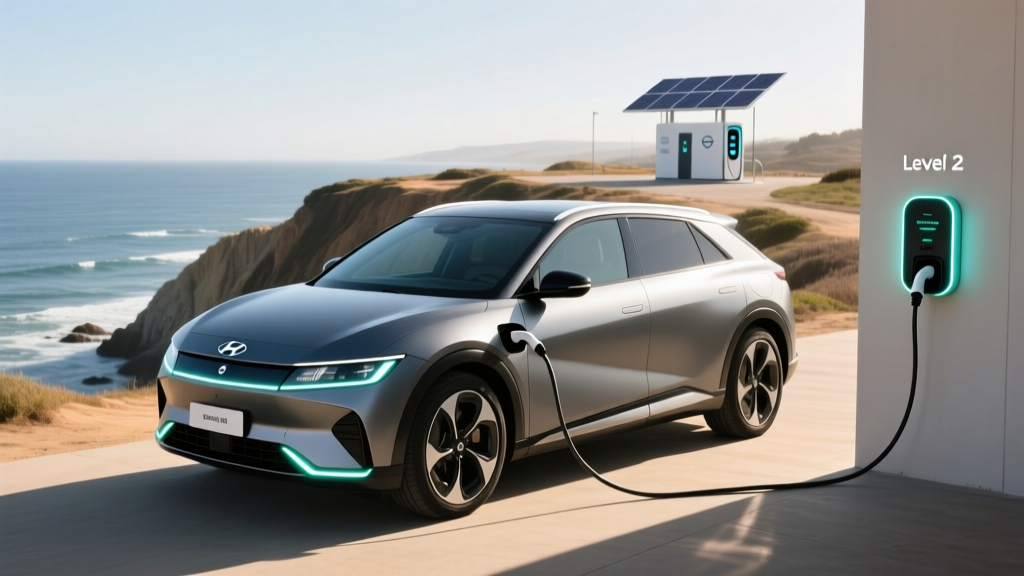
Home Level 2 charging (240V, 32–48 amps, 7.7–11.5 kW) adds roughly 25–40 miles per hour of charging and is the single biggest predictor of EV satisfaction. A typical installation runs $800–$2,500 including the EVSE ($350–$700), electrician labor ($400–$1,500), and permits — but can jump to $3,000–$6,000 if your panel needs a 200-amp upgrade.
If you live in an apartment, rely on street parking, or drive for rideshare, a PHEV like the Toyota RAV4 Prime (42 miles electric-only, 94 MPGe combined per fueleconomy.gov) may fit your life better than a BEV today.
The Charge Curve Most Brochures Don't Show
Peak DC fast-charge rates (say, 250 kW) are sustained only from roughly 10–40% state of charge. Above 60%, the battery management system tapers power to protect the cells. A "10–80% in 25 minutes" claim often means 80–100% takes another 25–35 minutes. Plan road-trip stops around 80% tops to keep average speeds high.
Common EV Myths vs. the Data
| Myth | Fact |
|---|---|
| "EV batteries need replacing every few years." | Modern NMC and LFP packs are warrantied for 8 years/100,000 miles (10 years/150,000 miles in CARB states) at ≥70% capacity retention. Real-world data from Tesla and Hyundai shows ~10–12% degradation at 150,000 miles. |
| "EVs are worse in winter." | Range drops 15–30% in cold, but EVs start reliably (no cold-cranking amps to worry about), and preconditioning while plugged in preserves range. A heat pump (standard on most 2026 models) recovers 5–10% of that loss. |
| "The grid can't support mass EV adoption." | Most charging happens overnight when demand is low. The DOE projects manageable grid load growth through 2035 with planned infrastructure investment. |
| "EVs produce more lifetime emissions than gas cars." | Even on coal-heavy grids, lifetime GHG emissions for EVs are lower than equivalent gas cars per EPA analysis. On clean grids (hydro, wind, solar), the advantage is dramatic. |
| "Every EV qualifies for $7,500 off." | Under §30D, the vehicle must meet MSRP caps, buyer income limits, and battery component/critical-mineral sourcing thresholds. Many popular models qualify for only $3,750 or $0 depending on the model year. Check the IRS list before buying. |
Decision Framework: Should You Buy an EV, a PHEV, or Stick with Gas?
Buy a battery-electric vehicle (BEV) if:
- You have home or workplace Level 2 charging access
- Your daily driving is under 80 miles round-trip
- You take road trips ≤2–3 times per year and can plan around DC fast chargers
- You want minimal maintenance and the lowest per-mile energy cost
Buy a plug-in hybrid (PHEV) if:
- You can charge at home but also take frequent long road trips
- You live in a region with extreme cold or sparse public charging
- You want electric-only commuting (30–45 mi) without range anxiety
Stick with a gas or conventional hybrid (HEV) if:
- You have no access to home or workplace charging
- You regularly tow heavy loads over long distances
- Your annual mileage is low enough that fuel savings won't offset the EV price premium
Frequently Asked Questions
Were electric cars actually popular before the 1920s?
Yes. Around 1900, roughly 28% of U.S. cars were electric, 40% steam, and 32% gasoline. EVs dominated urban markets until cheap gasoline, the electric starter, and mass-produced Model Ts tipped the balance after 1912.
How much does it cost to charge an EV at home in 2026?
At the U.S. residential average of ~$0.16/kWh, fully charging a 75 kWh battery costs about $12 — good for roughly 280–300 real-world miles. That's equivalent to $1.70 per gallon of gasoline.
Do I need to upgrade my electrical panel for a Level 2 charger?
Maybe. A 48-amp Level 2 charger requires a 60-amp dedicated circuit. Homes with older 100-amp service often need a $1,500–$3,000 panel upgrade. Homes with modern 200-amp service usually have headroom. A licensed electrician should evaluate your load calculation before you buy equipment.
Will an EV's battery outlast the car?
Likely, yes. Federal law mandates an 8-year/100,000-mile battery warranty (10/150,000 in CARB states). Fleet data from high-mileage Tesla and Hyundai models shows 85–90% capacity retention at 150,000 miles. Full replacement, if ever needed, currently runs $8,000–$18,000 depending on the pack.
What's the single biggest mistake a first-time EV buyer can make?
Buying more range than you need while ignoring charging access. A 320-mile EV with no home charger is often less convenient than a 250-mile EV that plugs in every night. Solve charging first, then right-size the battery for your actual driving pattern.