Quick Answer: Can a 12-Year-Old Legally Drive an Electric Car?
No. In every U.S. state, a 12-year-old cannot legally operate a full-size, street-legal electric vehicle (or any motor vehicle) on public roads. The minimum age for a learner's permit ranges from 14 to 16 depending on the state, and a full driver's license typically requires the driver to be at least 16. However, there are narrow exceptions: low-speed vehicles (LSVs) and neighborhood electric vehicles (NEVs) — small, limited-speed EVs capped at 20–25 mph — may be driven by younger teens in some states with a learner's permit or special license. Off-road electric vehicles (e-bikes, electric go-karts, electric ATVs) are not street-legal but can be operated on private property. This guide breaks down exactly what's legal, what's not, and what EV options actually exist for families with younger teens.
Why "Electric Cars for 12-Year-Olds to Drive" Is a Misleading Search
The phrase "electric cars for 12-year-olds to drive" generates hundreds of searches per month, but it reflects a fundamental misunderstanding of U.S. traffic law. Parents searching this term are typically motivated by one of three scenarios:
- They want a safe first vehicle for a child approaching driving age and assume EVs might be simpler or safer to learn on.
- They've seen small electric vehicles (NEVs, golf carts, electric ride-ons) marketed online and wonder if these are street-legal for younger drivers.
- They live in a rural or private-community setting where they believe road rules don't apply.
Let's address each scenario with the actual law, the real vehicle options, and the costs involved.
Legal Driving Ages for EVs: State-by-State Reality
Electric vehicles are classified as motor vehicles under federal and state law. That means the same age restrictions that apply to gas cars apply to EVs — there is no separate "EV license" or lower age threshold for electric cars.
| License Type | Typical Minimum Age | Applies to EVs? | Notes |
|---|---|---|---|
| Learner's Permit | 14–16 (varies by state) | Yes | Must be accompanied by a licensed adult; SD, ND, AK allow permits at 14 |
| Restricted/Provisional License | 15–16 | Yes | Limits on passengers, nighttime driving; varies widely |
| Full Driver's License | 16–18 | Yes | Most states issue unrestricted licenses at 16–17 |
| Low-Speed Vehicle (LSV) Permit | 14–16 (varies) | Yes — limited | Only for NEVs/LSVs capped at 25 mph; not all states allow minors |
Key takeaway: A 12-year-old cannot legally drive a Tesla Model 3, Chevrolet Equinox EV, Hyundai Ioniq 5, or any other full-size EV on any public road in any U.S. state. The vehicle being electric does not change the law.
Low-Speed Vehicles (LSVs) and NEVs: The Only Exception
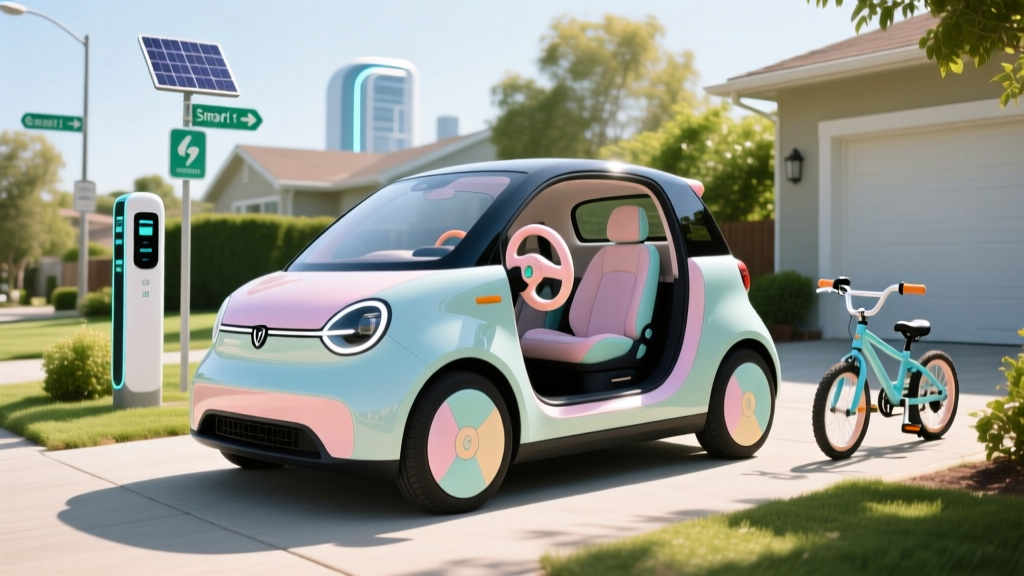
The one category where younger teens might legally operate an electric vehicle is the Low-Speed Vehicle (LSV) class, sometimes called a Neighborhood Electric Vehicle (NEV). These are federally regulated under NHTSA FMVSS Standard 500 and have specific characteristics:
- Top speed: 20–25 mph (electronically limited)
- Required equipment: Headlights, taillights, turn signals, seat belts, VIN, windshield (AS-1 or AS-5 glazing)
- Where they can be driven: Roads with speed limits of 35 mph or less (varies by state and municipality)
- Crash protection: None beyond seat belts — no airbags, no crumple zones, no side-impact protection
In some states, a 14- or 15-year-old with a learner's permit may operate an LSV on qualifying roads. But at age 12, even LSV operation on public roads is generally prohibited.
Popular LSV/NEV Options and Pricing (2026)
| Vehicle | Type | Top Speed | Range | Price (MSRP) | Street Legal? |
|---|---|---|---|---|---|
| GEM e2/e4/e6 | NEV/LSV | 25 mph | 30–40 mi | $13,000–$18,000 | Yes (on ≤35 mph roads) |
| Club Car Onward (electric) | Golf cart / LSV | 20–25 mph | 25–35 mi | $12,000–$16,000 | LSV-configured only |
| Wink NEV | NEV/LSV | 25 mph | 30–45 mi | $10,000–$14,000 | Yes (on ≤35 mph roads) |
| Electric ride-on cars (Power Wheels, etc.) | Toy | 2–5 mph | 1–2 hours | $200–$600 | No — private property only |
Safety warning: LSVs and NEVs offer zero crash protection comparable to a modern vehicle. The IIHS has published research showing that LSV occupants face significantly higher injury risk in any collision with a full-size vehicle. These are not substitutes for real cars, and they should never be driven by unsupervised minors.
EV vs Gas for a First Teen Driver: What to Consider at Age 15–16
If your child is approaching legal driving age (15–16), you may be weighing whether an EV or a gas car makes more sense as a first vehicle. Here's a data-driven comparison using a realistic scenario: a used or affordable new EV versus a comparable used gas compact.
| Factor | Affordable EV (e.g., 2025 Chevy Equinox EV LT) | Gas Compact (e.g., 2020 Honda Civic LX) |
|---|---|---|
| Purchase Price | ~$33,000 new (before incentives) | ~$16,000–$19,000 used |
| Federal Tax Credit (§30D) | Up to $7,500 (subject to income, MSRP cap, sourcing — see IRS rules) | $0 |
| Fuel / Energy Cost per Mile | ~$0.04/mi (home charging at $0.13/kWh) | ~$0.12/mi (30 MPG at $3.50/gal) |
| Annual Fuel Savings (12,000 mi/yr) | ~$480/yr | ~$1,400/yr cost |
| Maintenance (annual) | ~$300–$400 (no oil, fewer brake replacements) | ~$600–$900 (oil, filters, brake pads) |
| Insurance (teen driver, avg) | $2,800–$4,200/yr (EVs cost more to insure) | $2,200–$3,500/yr |
| EPA Range / MPG | 315 mi EPA range; 97 MPGe combined | 30/38/33 MPG city/hwy/combined |
| Real-World Highway Range | ~250–270 mi (cold/highway reduces range 15–20%) | ~420 mi per tank |
| Refueling / Charging Time | Home Level 2: ~8 hrs (full); DC fast: 10–80% in ~22 min at 150 kW | ~5 min at a gas station |
What the Numbers Tell Us
For a teen driver, an EV saves roughly $600–$900 per year in fuel and maintenance compared to a gas car. However, the higher insurance premiums for EVs (typically 15–30% more, per industry data) can erase a significant portion of those savings — especially with a teen on the policy. The upfront purchase price is also substantially higher unless you're buying a used EV like a 2021 Nissan Leaf or 2019 Chevrolet Bolt EV in the $12,000–$18,000 range.
Real Costs: 5-Year Ownership Breakdown for a Teen's First EV
Let's model a realistic 5-year cost of ownership for a family buying a used 2022 Chevrolet Bolt EV (a common, affordable used EV pick for new drivers) versus a used 2020 Toyota Corolla gas sedan.
| Cost Category (5 Years) | Used 2022 Chevy Bolt EV (2LT) | Used 2020 Toyota Corolla LE |
|---|---|---|
| Purchase Price | $18,000 | $17,000 |
| Federal Used EV Credit (§25E) | –$4,000 (4% of sale price, max $4,000; income limits apply) | $0 |
| Net Purchase Cost | $14,000 | $17,000 |
| Fuel/Energy (60,000 mi total) | $2,400 (home charging) | $7,000 (gas at $3.50/gal, 33 MPG) |
| Maintenance (5 years) | $1,800 | $3,500 |
| Insurance (5 years, teen driver) | $17,500 | $14,000 |
| Home Charger Install (Level 2) | $800–$1,500 (one-time) | $0 |
| Total 5-Year Cost | $36,500–$37,200 | $41,500 |
Net savings with the EV: roughly $4,300–$5,000 over 5 years, driven primarily by fuel savings and the used-EV tax credit. But this assumes reliable home charging access. If you rely solely on public DC fast charging at $0.35–$0.50/kWh, the Bolt's energy cost jumps to $5,500–$8,000 over 5 years, narrowing or eliminating the gap.
Common Myths About EVs for Young Drivers — Fact-Checked
| Myth | Fact |
|---|---|
| "Electric cars are safer for teens because they're simpler to drive." | EVs are heavier (battery mass) and have instant torque, which can make them harder to control for inexperienced drivers. A 2025 Model 3 Performance does 0–60 in 2.9 seconds — far too much power for a new driver. |
| "You don't need a license to drive a small electric vehicle." | Any vehicle operated on public roads requires a valid license or permit, regardless of size or power. Only toys operated on private property are exempt. |
| "EVs don't need maintenance, so they're cheaper for teens." | EVs eliminate oil changes and have less brake wear (thanks to regen), but they still need tire rotations, cabin filters, coolant checks, and suspension work. Budget $300–$400/year minimum. |
| "My kid can drive a golf cart around the neighborhood at 12." | Golf carts on public roads are regulated by state and local law. Most jurisdictions require a licensed driver, registration, and insurance. Driving a golf cart without a license can result in citations and liability exposure. |
| "A 12-year-old can drive an EV on private property legally." | On truly private property (your own land, closed courses), there's generally no law preventing it. But the moment the vehicle touches a public road, driveway access included in some jurisdictions, traffic law applies. |
Decision Framework: What to Actually Buy and When
If your child is 12–13 years old:
- Do not buy any street-driven vehicle. They cannot legally operate one for 2–4 more years.
- If they want an electric driving experience, consider off-road electric ATVs, electric dirt bikes, or supervised driving on private property — with helmets and safety gear.
- Start building a savings plan for a used EV purchase when they reach permit age.
If your child is 14–15 and approaching permit age:
- Begin researching affordable used EVs — the 2021–2023 Chevrolet Bolt EV/EUV, 2021–2022 Nissan Leaf, and 2020–2022 Hyundai Kona Electric are strong picks in the $14,000–$22,000 range.
- Check your state's learner's permit age (see your state DMV website) and plan the purchase around their eligibility date.
- Get insurance quotes now — teen driver premiums on EVs can be 20–30% higher than on gas equivalents. This may change your vehicle choice.
- Verify your home electrical panel can support a Level 2 charger (240V, 40-amp circuit). A panel upgrade from 100A to 200A adds $1,500–$3,500 to your setup cost.
If your child is 16+ with a license:
- Choose a modest-power EV — avoid performance trims. A Bolt EV (200 HP), Kona Electric (201 HP), or base Model 3 RWD (271 HP, still potent) are reasonable. Avoid anything above 300 HP for a first-year driver.
- Prioritize vehicles with strong ADAS features: automatic emergency braking, lane-keeping assist, blind-spot monitoring. All modern EVs include these, but verify they're active and not disabled.
- Confirm §30D new EV credit or §25E used EV credit eligibility based on your household income (AGI caps: $150K single / $300K joint for §30D; $75K single / $150K joint for §25E).
What First-Time EV Buyers (and Their Parents) Must Know
If you're buying an EV for a teen who is approaching driving age, here are the practical realities that most buying guides gloss over:
- Home charging is not optional for most families. Relying on public charging adds cost ($0.35–$0.50/kWh vs. $0.13/kWh at home), time (20–40 minute stops), and unreliability (broken chargers, occupied stalls). If you can't install a Level 2 charger at home, an EV may not be practical.
- Cold weather cuts range 15–30%. If you live in the upper Midwest or Northeast, a Bolt EV rated at 259 miles EPA may deliver only 180–210 miles in January. Factor this into your range expectations.
- Insurance is the hidden cost. EVs cost more to repair (specialized parts, high-voltage safety protocols), and insurers price this in. Always get a quote before purchasing.
- Battery degradation is minimal in modern EVs — most lose only 5–10% capacity over 5 years. The 8-year/100,000-mile battery warranty (federally mandated minimum) provides long-term protection. A 2022 Bolt EV bought in 2026 should still have 90%+ battery health.
- Teach your teen about charging etiquette and planning. Using apps like PlugShare or A Better Routeplanner is a skill, and road-tripping in an EV requires more forethought than a gas car. This is a learning curve, not a dealbreaker.
FAQ: Electric Cars and Young Drivers
Can a 12-year-old drive an electric car on private property?
Generally, yes — on truly private property (your own land, a closed track), there's no law prohibiting it. However, this does not extend to public roads, sidewalks, or shared driveways in most jurisdictions. Always supervise minors operating any motorized vehicle.
What is the youngest age to legally drive an EV on public roads?
The youngest learner's permit age in the U.S. is 14 (South Dakota, North Dakota, Alaska). In most states, it's 15 or 16. The vehicle being electric makes no difference — the same licensing laws apply.
Are Neighborhood Electric Vehicles (NEVs) safe for teens?
NEVs and LSVs lack airbags, crumple zones, and any meaningful crash structure. They are legal on low-speed roads but should not be considered safe alternatives to full-size vehicles. The IIHS has documented serious injury risk in LSV collisions. Use extreme caution and never allow unsupervised minors to operate them.
What's the best affordable EV for a teen's first car?
For 2026, the best value used EVs for new drivers include the Chevrolet Bolt EV/EUV (259 mi range, ~$14,000–$20,000 used), Nissan Leaf SV Plus (212 mi range, ~$13,000–$18,000 used), and Hyundai Kona Electric (258 mi range, ~$16,000–$22,000 used). All offer adequate range, modest power, and strong safety features.
Does the federal tax credit apply if I buy an EV for my teen?
The §30D new-vehicle credit (up to $7,500) and §25E used-vehicle credit (up to $4,000) are claimed by the taxpayer — typically the parent. Income caps apply ($150K/$300K AGI for new; $75K/$150K for used). The vehicle must meet MSRP caps ($55K for cars, $80K for SUVs/trucks for §30D) and battery-sourcing requirements. Consult a tax professional and review current IRS guidance before purchasing.
Should I buy an EV or a hybrid for my teen?
If you have reliable home charging and your teen's daily driving is under 100 miles, a used EV is typically cheaper to operate. If home charging isn't available or your teen drives long rural routes, a hybrid like the Toyota Corolla Hybrid (50 MPG combined, ~$18,000 used) eliminates range concerns entirely while still reducing fuel costs.