The Short Answer: Electric Cargo Trains vs. Your Next EV
An electric cargo train is not a consumer vehicle you can buy — it refers to battery-electric and hybrid-electric freight locomotives currently being deployed by railroads like Union Pacific and BNSF. However, the battery chemistry, megawatt-scale charging infrastructure, and total-cost-of-ownership math driving rail electrification directly influence the EV you can buy. Heavy-duty LFP battery packs, ultra-high-power charging corridors, and fleet-level economics are filtering down to consumer trucks and SUVs. If you're researching EVs and landed on "electric cargo train," here's what matters: rail-grade LFP cells from suppliers like CATL and BYD are the same chemistry now offered in consumer vehicles (Tesla Model 3 RWD, Ford F-150 Lightning Standard Range), and the charging corridor investments railroads are making along freight routes overlap with the DC fast-charging networks you'll use on road trips.
What Is an Electric Cargo Train, Exactly?
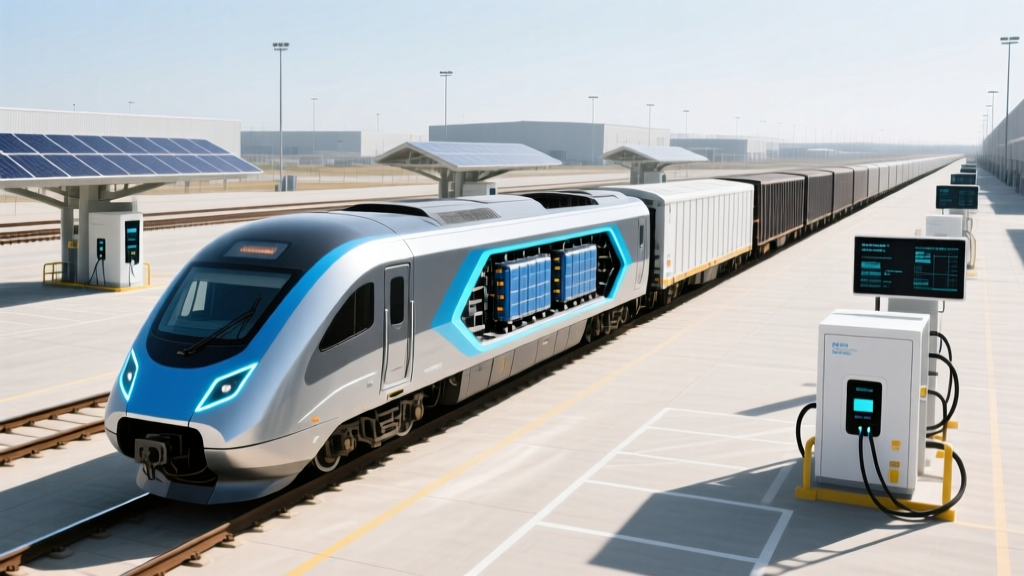
Freight railroads have historically relied on diesel-electric locomotives — a diesel engine turns a generator that powers electric traction motors. A true battery-electric locomotive replaces the diesel engine entirely with large battery packs, drawing stored energy to power those same traction motors. Union Pacific began ordering battery-electric switcher locomotives from Progress Rail (a Caterpillar company) and Wabtec in 2023, with units entering yard service in California and Nebraska through 2024-2025.
Key specs of current battery-electric freight locomotives:
- Battery capacity: 7 to 14 megawatt-hours (MWh) — that's 7,000 to 14,000 kWh, roughly 100x a consumer EV battery
- Chemistry: LFP (lithium iron phosphate), chosen for cycle life and thermal stability over energy density
- Charging: Megawatt Charging System (MCS) connectors at 1.5 to 3+ MW, plus regenerative braking and wayside charging in some corridors
- Range: Highly variable by duty cycle; yard switchers run 8-24 hours before recharging, while line-haul units may require mid-route charging or hybrid operation
- Cost: Estimated $5-10 million per unit (vs. ~$2-3 million for a conventional diesel-electric locomotive)
The reason this matters for consumer EV buyers: the supply chains, battery chemistries, and high-power charging standards being validated in rail freight are the same ones shaping your next electric truck or SUV.
Battery Chemistry: What Rail Teaches Consumer EV Buyers
Electric cargo trains almost exclusively use LFP (lithium iron phosphate) battery cells. Here's why — and what that means when you're choosing between LFP and NMC (nickel manganese cobalt) in a consumer vehicle.
| Factor | LFP (Rail & Consumer Standard-Range) | NMC/NCA (Consumer Long-Range) |
|---|---|---|
| Energy Density | Lower (~160 Wh/kg cell-level) | Higher (~250-300 Wh/kg) |
| Cycle Life | 3,000-6,000+ cycles to 80% SoH | 1,000-2,000 cycles to 80% SoH |
| Thermal Stability | Excellent — no thermal runaway to ~270°C | Good — requires active thermal management |
| Cold Performance | Weaker below 32°F without preconditioning | Better low-temp discharge capability |
| Cost per kWh | ~$50-70/kWh at pack level (2025-2026) | ~$80-110/kWh at pack level |
| Consumer Examples | Tesla Model 3 RWD (60 kWh), F-150 Lightning Std Range (98 kWh) | Tesla Model Y LR (75 kWh), Hyundai Ioniq 5 (77.4 kWh) |
| Charging Recommendation | Can charge to 100% daily without harm | Best kept at 80% daily; 100% for trips only |
Rail operators chose LFP because a locomotive battery must survive thousands of deep charge-discharge cycles over 15-20 years, operate in extreme heat near tracks, and minimize fire risk in yard environments. These same priorities — longevity, safety, cost — matter to consumer buyers who plan to keep their EV for 8+ years.
Buyer takeaway: If you're choosing a standard-range EV with LFP (like the base Tesla Model 3 or the Ford F-150 Lightning Standard Range), you're getting the same fundamental cell chemistry proven in heavy industrial use. The trade-off is less range per kilogram of battery — but a battery that will likely outlast the vehicle itself.
Charging Infrastructure: From Megawatts to Kilowatts
The charging gap between an electric cargo train and your EV is enormous, but the infrastructure investments overlap more than you might think.
| Charging Type | Power Level | Application | Time to Charge |
|---|---|---|---|
| Rail MCS (Megawatt Charging System) | 1,500-3,750 kW (1.5-3.75 MW) | Battery-electric locomotives | 7 MWh pack: ~2-4 hours |
| Heavy-Duty MCS (trucks) | 600-1,200 kW | Class 8 electric semis (Freightliner eCascadia) | 400 kWh pack: ~25-45 min |
| Consumer DC Fast Charging (CCS/NACS) | 150-350 kW peak | Passenger EVs at Electrify America, Tesla Supercharger | 75 kWh pack: 10-80% in 18-30 min |
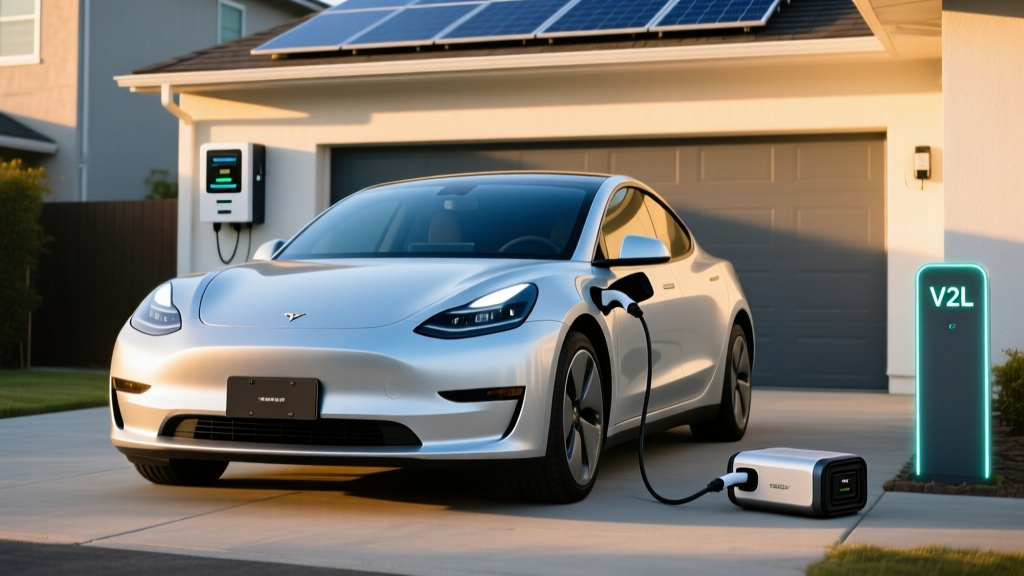
| Consumer Level 2 (home/public AC) | 7.2-19.2 kW | Home wall connectors, destination chargers | 75 kWh pack: ~4-10 hours |
| Consumer Level 1 (120V outlet) | 1.2-1.4 kW | Emergency/trickle charging | 75 kWh pack: ~54-63 hours |
The MCS connector standard being deployed for electric freight locomotives and heavy-duty trucks is the same standard the Charging Interface Initiative (CharIN) developed — and its existence is pushing charger manufacturers to build power electronics that eventually trickle down to higher-power consumer stations. When Electrify America or Tesla installs 350 kW chargers along an interstate, those stations often sit near freight corridors that may eventually host MCS infrastructure.
Real-world charging reality for consumer EVs: Peak charge rate (e.g., "up to 250 kW") is not sustained. A Hyundai Ioniq 5 peaks at ~240 kW but tapers significantly above 60% SoC. Expect a 10-80% charge in roughly 18 minutes on a 350 kW station, but 80-100% can take an additional 20-30 minutes due to the charge curve taper. Rail operators avoid this problem by charging to operationally sufficient levels rather than full — a practice consumer EV owners should adopt with NMC batteries.
Cost Comparison: Rail Electrification vs. Consumer EV Ownership
The economics driving electric cargo train adoption mirror the consumer EV decision in miniature: higher upfront cost, lower operating cost, and a break-even timeline that depends on utilization.
| Cost Factor | Diesel Locomotive | Battery-Electric Locomotive | Gas Car (Toyota Camry) | Consumer EV (Tesla Model 3 RWD) |
|---|---|---|---|---|
| Purchase Price | ~$2.5M | ~$5-10M | ~$28,000 | ~$38,990 (2026 MSRP) |
| Fuel/Energy Cost per Mile | ~$1.50-2.50/mi (diesel) | ~$0.40-0.80/mi (electricity) | ~$0.14/mi (gas at $3.30/gal, 32 MPG) | ~$0.04-0.06/mi (electric at $0.14/kWh) |
| Maintenance per Year | High (engine, filters, fluids, emissions) | Low (no engine, fewer moving parts) | ~$1,200/yr | ~$600/yr |
| Lifespan | 25-35 years | 20-30 years (battery replacement likely) | ~15 years / 200k miles | ~15-20 years / battery warranty 8yr/100k mi |
| Break-Even vs. Gas/Diesel | N/A | ~3-7 years (high-utilization routes) | N/A | ~3-6 years (15k mi/yr driving) |
The pattern is identical at both scales: the battery-electric option costs 50-100% more upfront but delivers 60-80% lower energy costs and significantly reduced maintenance. For railroads running locomotives 16+ hours daily, the payback is fast. For consumers driving 12,000-15,000 miles annually, the DOE's fuel cost calculator shows similar 3-6 year break-even timelines depending on local electricity and gas prices.
What First-Time EV Buyers Should Know (Lessons from Heavy Industry)
Rail operators evaluating battery-electric locomotives ask the same questions you should ask before buying your first EV. Here's how those questions translate:
1. What's the Real Range Under Operating Conditions?
A locomotive rated for 14 MWh might theoretically run 24 hours, but cold weather, heavy loads, and mountain grades cut that significantly. Your EV's EPA range is similarly optimistic. A Tesla Model 3 RWD rated at EPA 272 miles will realistically deliver 230-250 miles in mixed driving, and potentially 180-200 miles at sustained 75+ mph highway speeds in winter. Always budget 20-30% below EPA for highway and cold-weather trips.
2. Where Will I Charge, and What Does It Cost to Set Up?
Railroads must build dedicated charging depots — a multi-million-dollar infrastructure project. Your version is a home Level 2 charger installation:
- Level 2 charger hardware: $350-$700 (ChargePoint Home Flex, Tesla Wall Connector, Emporia Level 2)
- Electrical panel assessment: $150-$300 (many homes need a 200A panel; older 100A panels may require a $1,500-$3,000 upgrade)
- Electrician labor (240V/50A circuit run): $800-$2,500 depending on distance from panel to garage
- Permit and inspection: $100-$400 depending on jurisdiction
- Total typical install: $1,400-$4,000 for most homes with adequate panel capacity
If you lack home charging access (apartment, street parking), public DC fast charging costs $0.30-$0.60/kWh at networks like Electrify America — roughly 3-5x the cost of home charging at $0.10-$0.15/kWh. This is a real ownership constraint that no amount of enthusiasm eliminates.
3. How Long Will the Battery Last?
Rail operators spec LFP batteries specifically for 15+ year lifespans with thousands of cycles. Consumer LFP packs show similar durability: Tesla's LFP Model 3 batteries have demonstrated less than 10% degradation at 100,000 miles in fleet data. NMC batteries degrade faster but are still warrantied for 8 years / 100,000 miles (federally mandated minimum) with a capacity retention threshold of 70% or better. Most manufacturers, including Hyundai and Ford, warrant at 70% retention — meaning your 77.4 kWh pack should still hold 54+ kWh after 8 years.
4. What About the Federal Tax Credit?
Under IRS §30D rules for 2026, the new clean vehicle credit offers up to $7,500 — but eligibility depends on multiple factors:
- MSRP caps: Vans, SUVs, and pickups must be under $80,000; sedans under $55,000
- Buyer income limits: AGI must not exceed $150,000 (single), $225,000 (head of household), or $300,000 (joint)
- Battery sourcing: Increasingly strict critical-mineral and battery-component requirements must be met (many vehicles that qualified in 2024 no longer qualify in 2026)
- Point-of-sale transfer: You can transfer the credit to the dealer at purchase, reducing your out-of-pocket cost immediately — but if your tax liability is less than the credit, you may owe it back
Always verify current eligibility on the fueleconomy.gov tax credit page before purchasing, as qualifying models change frequently.
Common Misconceptions: Fact vs. Fiction
| Myth | Fact |
|---|---|
| "Electric cargo trains prove EVs can handle any heavy-duty job" | Battery-electric locomotives currently serve primarily as yard switchers. Long-haul freight still requires diesel or hybrid operation due to energy density limits. Consumer EVs face similar range/payload trade-offs in towing. |
| "If trains can charge in minutes, why can't my EV?" | Rail MCS charging delivers 1.5-3+ MW — roughly 6-12x the peak rate of a 250 kW consumer DC fast charger. Consumer vehicles can't accept that power level without battery damage. Physics limits C-rate (charge speed relative to battery capacity). |
| "LFP batteries are new and unproven" | LFP chemistry has been in industrial and stationary storage for over a decade. Rail operators chose LFP specifically because it's proven at scale. Consumer adoption is the late stage, not the early stage. |
| "EV batteries will need expensive replacement within a few years" | Modern EV batteries (LFP and NMC) are warrantied 8yr/100,000 mi minimum. Real-world data from high-mileage fleets shows 10-15% degradation at 150,000+ miles. Full replacement ($8,000-$18,000 depending on pack size) is rarely needed within a typical ownership period. |
| "EVs are always cheaper to own than gas cars" | Not universally. Higher insurance premiums (+10-25%), higher upfront cost, and expensive public charging (if no home access) can erase savings for low-mileage drivers. The break-even point is typically 12,000+ miles/year with home charging. |
Your Decision Framework: Should You Buy an EV?
Choose a Battery-Electric Vehicle (BEV) If:
- You have reliable home or workplace Level 2 charging access
- You drive 12,000+ miles per year (higher utilization = faster break-even)
- Your daily commute is under 80 miles round-trip (covers 90%+ of trips on a single charge)
- You live in a moderate climate, or you're willing to accept 20-30% winter range loss
- You qualify for the §30D tax credit (check income and vehicle eligibility)
- You plan to keep the vehicle 5+ years (amortizes the higher upfront cost)
Choose a Plug-In Hybrid (PHEV) If:
- You lack reliable home charging but want some electric driving
- You regularly take 300+ mile road trips and don't want to plan around DC fast chargers
- You live in an extreme cold-weather climate where BEV range loss is punishing
- Your budget is tighter and you want lower upfront cost with partial electrification
Stick With a Hybrid (HEV) or Gas Vehicle If:
- You have zero charging access (no home, no workplace, limited public infrastructure in your area)
- You drive fewer than 8,000 miles per year (fuel savings won't offset EV premium)
- You regularly tow heavy loads (towing can cut EV range by 40-50%)
- You need the lowest possible upfront purchase price
Frequently Asked Questions
Are there electric cargo trains I can ride or see in operation?
Battery-electric freight locomotives from Progress Rail and Wabtec are in yard-switching service with Union Pacific and BNSF in select locations (primarily California's South Coast Air Basin, where zero-emission mandates accelerate adoption). These are not passenger services. Amtrak's electrified routes (Northeast Corridor) use overhead catenary wire-powered electric locomotives — a different technology from battery-electric freight.
Will electric cargo train technology make consumer EVs cheaper?
Indirectly, yes. The massive LFP battery orders from railroads and heavy-duty truck makers are driving down per-kWh costs across the entire supply chain. CATL's LFP cells, used in both industrial and consumer applications, have dropped below $50/kWh at the cell level. This cost reduction is why the 2026 Tesla Model 3 RWD starts at ~$38,990 — a price point that would have been impossible with 2020 battery costs.
How does regenerative braking in trains compare to EVs?
Both use the same principle: electric traction motors reverse to become generators during deceleration, converting kinetic energy back into stored battery energy. A heavy freight locomotive descending a grade can recover enormous amounts of energy — sometimes enough to power a following train uphill on the same route. Consumer EVs recover 15-30% of energy during typical stop-and-go driving, which is why city MPGe ratings are often higher than highway ratings for EVs (the opposite of gas cars).
What's the biggest risk for a first-time EV buyer?
The single biggest risk is purchasing an EV without confirmed home charging access. Public DC fast charging costs 3-5x more than home charging, adds 20-40 minutes per session, and station reliability varies widely ( Electrify America and non-Tesla networks average 80-90% uptime; Tesla Superchargers average 97%+). If you cannot install or reliably access Level 2 charging at home or work, a PHEV or HEV is a lower-risk choice.
Do electric cargo trains use the same charging connector as my EV?
No. Battery-electric locomotives use the Megawatt Charging System (MCS) connector, which is physically much larger and handles 1,500-3,750 kW. Consumer EVs use NACS (Tesla's standard, now adopted by Ford, GM, Hyundai, and others for 2025+ models) or CCS1. The MCS and consumer standards share no physical compatibility, though the power electronics and grid-infrastructure investments overlap.