Quick Answer: What Is an Electric Cargo Ship?
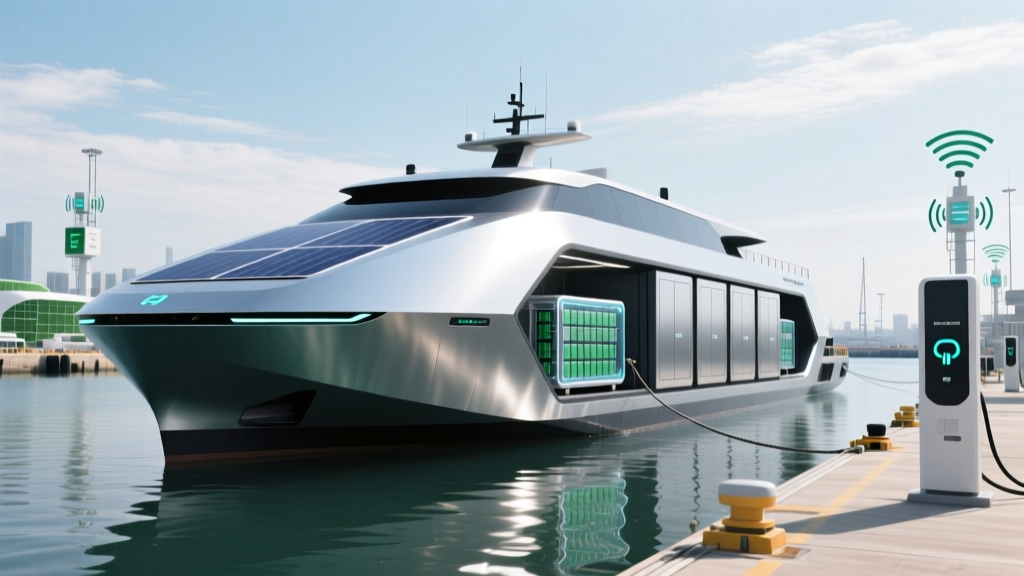
An electric cargo ship replaces diesel engines with battery-electric propulsion (typically lithium iron phosphate, or LFP, battery packs ranging from 1,000 to 10,000+ kWh) and, in some designs, hydrogen fuel cells. As of 2026, fully electric cargo vessels operate primarily on short-sea and inland routes (50–200 nautical miles), while hybrid-electric and methanol-assisted designs handle longer ocean crossings. The Yara Birkeland, the world's first fully electric autonomous container ship, remains the benchmark with a 7.2 MWh (7,200 kWh) LFP battery and a 60-nautical-mile operational range.
Why EV Owners Should Care About Electric Cargo Ships
If you drive an EV, the cargo arriving at your port likely traveled on a diesel-burning vessel emitting 3% of global CO₂. Maritime electrification directly affects the upstream carbon footprint of your vehicle, its battery minerals, and the grid you charge from. The International Maritime Organization (IMO) targets net-zero shipping emissions by 2050, and electric cargo ships are a core pillar of that strategy.
For EV buyers in 2026, the connection is practical: vehicles shipped via electric or hybrid-electric routes carry a lower embedded carbon cost, which increasingly factors into corporate sustainability disclosures and, potentially, future §30D tax credit critical-mineral sourcing requirements.
How Electric Cargo Ships Compare to Diesel Vessels
| Metric | Diesel Cargo Ship (Typical Feeder) | Electric Cargo Ship (Short-Sea, 2026) |
|---|---|---|
| Propulsion Energy | Heavy fuel oil (HFO) or marine diesel | LFP battery (1,000–10,000 kWh) |
| Range | 5,000+ nautical miles | 50–200 nautical miles (fully electric) |
| Energy Cost per Nautical Mile | $120–$200 (fuel-dependent) | $30–$80 (electricity-dependent) |
| CO₂ Emissions (Tank-to-Wake) | ~15–40 tons per voyage (feeder route) | 0 (direct); grid-dependent upstream |
| Maintenance Cost (Annual) | $500K–$1.2M (engine overhaul, filters, SCR systems) | $150K–$400K (battery thermal management, fewer moving parts) |
| Crew Required | 12–20 | 5–12 (some autonomous designs: 0 onboard) |
| Upfront Vessel Cost | $25M–$40M (feeder-class) | $35M–$60M (battery premium) |
The parallel to passenger EVs is direct: higher upfront capital cost, dramatically lower operating cost, zero tailpipe emissions, and a range constrained by battery energy density. LFP chemistry dominates maritime applications for the same reason it's growing in passenger EVs — lower cost per kWh, superior cycle life (6,000+ cycles to 80% capacity retention), and no cobalt or nickel supply-chain risk.
Real-World Range and Battery Specs: The Physics Problem
The fundamental constraint on electric cargo ships is the same one EV drivers know well: energy density. Marine diesel packs roughly 12,000 Wh per kilogram. The best LFP cells in 2026 deliver around 180–200 Wh/kg at the cell level, or roughly 120–140 Wh/kg at the pack level once you include thermal management, structural housing, and marine-grade waterproofing.
That means a 7,200 kWh battery pack — like the one in the Yara Birkeland — weighs approximately 50–60 metric tons. For a 120-TEU (twenty-foot equivalent unit) container ship, that's manageable. For a 20,000-TEU transoceanic mega-ship, battery weight would consume the entire cargo capacity.
Common Misconceptions About Electric Cargo Ships
| Myth | Fact |
|---|---|
| "Electric ships will cross the Pacific by 2030." | Battery energy density must improve 10–20x for transoceanic routes. Hybrid-electric with green methanol or ammonia is the realistic 2030 pathway for deep-sea shipping. |
| "They're just like EVs but bigger." | Marine environments demand IP68-rated battery enclosures, saltwater corrosion resistance, and redundant thermal management. Failure at sea has no roadside-assistance equivalent. |
| "Shore power at port solves everything." | Cold-ironing (plugging into shore power at berth) eliminates port-idling emissions but doesn't address voyage propulsion. It's complementary, not a replacement. |
| "Electric ships are always cheaper to operate." | Only on short routes with cheap grid power ($0.08–$0.12/kWh). On longer routes or in regions with $0.25+/kWh industrial electricity, diesel remains cheaper per nautical mile in 2026. |
Cost Breakdown: Building and Operating an Electric Cargo Ship
| Cost Category | Diesel Feeder Ship | Electric Short-Sea Ship (2026) | Notes |
|---|---|---|---|
| Vessel Purchase | $30M (avg.) | $48M (avg.) | Battery pack accounts for ~35–40% of electric vessel cost |
| Battery Replacement (Year 12–15) | N/A | $8M–$14M | LFP packs reaching 70–80% SoH; some operators plan second-life grid storage |
| Annual Fuel/Energy | $2.5M–$4M | $600K–$1.5M | Depends on route length and local electricity pricing |
| Annual Maintenance | $800K | $250K | No engine oil, filters, SCR catalysts, or fuel-injection systems |
| Crew Costs (Annual) | $1.2M (15 crew) | $500K (8 crew) or $0 (autonomous) | Autonomous designs like Yara Birkeland eliminate onboard crew entirely |
| Port Charging Infrastructure | $0 | $2M–$6M per port | High-power shore chargers (2–5 MW) required at each terminal |
| 5-Year Total Operating Cost | $22.5M–$30M | $12M–$18M | Electric vessel breaks even on operating cost within 3–5 years |
The economics mirror passenger EV ownership: you pay more upfront and save on every mile traveled. The difference is scale — a $14M battery replacement is the maritime equivalent of a $15,000 passenger-EV battery swap, proportionally speaking. Operators who can secure long-term route contracts and cheap port-side electricity see payback fastest.
Charging Infrastructure: The Port-Side Challenge
Charging a 7,200 kWh battery at a standard Level 2 rate (19.2 kW) would take over 15 days. That's obviously not viable for commercial shipping. Electric cargo ships use high-power shore charging at 2–5 megawatts (MW), which can replenish a 7,200 kWh pack from 20% to 80% in roughly 2–4 hours — comparable to a container ship's typical port turnaround window.
Some operators are experimenting with battery-swap systems, where pre-charged containerized battery packs are craned aboard in under 30 minutes. This mirrors the battery-swap concepts NIO has deployed for passenger EVs in China, scaled to 20-ton battery modules.
For context on power levels:
- 2 MW shore charger: Adds ~2,000 kWh per hour — equivalent to charging roughly 28 Tesla Model Ys simultaneously
- 5 MW shore charger: Adds ~5,000 kWh per hour — enough to refill most short-sea electric ships in under 90 minutes
- Port grid upgrade cost: $2M–$8M per terminal, depending on existing transformer capacity and local utility interconnection requirements
What This Means for EV Buyers: The Upstream Connection
You might wonder why a car buyer should care about cargo ship propulsion. Here's the practical framework:
If You Care About Total Lifecycle Emissions of Your EV
- If you buy a vehicle manufactured in Asia and shipped to the US West Coast: The ~6,000-nautical-mile journey currently requires heavy fuel oil. No fully electric ship handles this route in 2026. Hybrid-electric with LNG or methanol assist is the cleanest available option. Manufacturers like Volvo and BMW now disclose shipping emissions in sustainability reports.
- If you buy a vehicle manufactured domestically or in a nearshoring hub (Mexico, Canada): Shorter shipping distances mean lower embedded transport emissions regardless of vessel type. Overland rail transport (increasingly electrified) is another low-carbon option.
- If you buy from a brand committed to electric shipping corridors: Companies like Volvo Group and Wallenius Wilhelmsen are piloting zero-emission shipping routes. Check manufacturer sustainability disclosures before purchasing if this matters to you.
The broader grid connection matters too: ports installing multi-megawatt chargers for cargo ships are simultaneously building the high-capacity electrical infrastructure that supports heavy-duty EV trucking, which in turn strengthens the case for EV ownership in port-adjacent communities.
Electric Cargo Ship Ownership: Who's Actually Running These Vessels in 2026?
The operators leading electric cargo ship deployment share a profile: short, fixed routes; reliable port infrastructure; and regulatory or contractual pressure to decarbonize.
- Yara International (Norway): Operates the Yara Birkeland on a 60-nautical-mile route between Porsgrunn and Brevik/Larvik, carrying fertilizer. Fully autonomous (no crew onboard), 7.2 MWh LFP battery, zero direct emissions. Replaced ~40,000 diesel truck trips annually.
- China COSCO Shipping: Deployed the Green Water 01, a 700-TEU electric container ship with a swappable battery system, operating on Yangtze River routes. Battery capacity: ~50,000 kWh across modular packs.
- European short-sea operators: Several ferry and RoRo (roll-on/roll-off) operators in Scandinavia and the Baltic have adopted hybrid-electric or fully electric vessels for routes under 100 nautical miles, driven by EU Emissions Trading System (ETS) costs on marine fuel.
According to data from DNV, over 300 battery-electric or hybrid-electric ships were in operation or on order globally as of early 2026, with the majority being ferries, short-sea cargo vessels, and harbor tugs.
Decision Framework: Is Maritime Electrification Relevant to Your EV Purchase?
| Your Situation | Relevance | Action |
|---|---|---|
| You prioritize lowest total lifecycle carbon footprint | High | Research manufacturer shipping disclosures; favor domestically assembled vehicles or brands using electric/hybrid shipping corridors |
| You're evaluating §30D tax credit eligibility for critical minerals | Medium (emerging) | Monitor IRS guidance on whether battery mineral shipping emissions factor into future sourcing rules |
| You live near a major port and care about local air quality | High | Support port electrification ballot measures and shore-power mandates; electric cargo ships eliminate diesel particulate in port communities |
| You're a commercial fleet operator considering EV trucks | High | Port electrification for cargo ships builds the MW-scale charging infrastructure your electric trucks will eventually use |
| You just want the best EV for your commute | Low | Focus on vehicle EPA range, charging speed (kW), and total cost of ownership — ship propulsion won't change your daily driving experience |
Frequently Asked Questions
Can electric cargo ships cross the ocean?
Not in 2026. Current LFP battery energy density (~140 Wh/kg at pack level) limits fully electric ships to short-sea routes of 50–200 nautical miles. Transoceanic shipping will likely require green methanol, green ammonia, or hydrogen fuel cells as the primary energy source, potentially supplemented by battery-electric hybrid systems for port maneuvering and peak shaving.
How much does it cost to charge an electric cargo ship?
At industrial electricity rates of $0.10/kWh, fully charging a 7,200 kWh battery costs approximately $720. Compare that to $8,000–$15,000 in marine diesel for an equivalent voyage on the same route. The per-nautical-mile energy cost advantage is typically 50–70% in favor of electricity on short routes.
What battery chemistry do electric cargo ships use?
Almost exclusively LFP (lithium iron phosphate), the same chemistry found in the Tesla Model 3 Standard Range and Ford Mustang Mach-E Select. LFP is preferred for its thermal stability (critical in a marine environment where battery fires are catastrophic), long cycle life (6,000+ cycles), and absence of cobalt and nickel, which simplifies supply chains.
Are electric cargo ships autonomous?
Some are. The Yara Birkeland operates fully autonomously on a fixed route with no crew onboard, monitored remotely. However, most electric cargo ships in 2026 still carry a reduced crew of 5–12. Autonomous maritime operations are regulated by the IMO and individual flag states, and widespread adoption depends on evolving legal frameworks for collision liability and insurance.
Will electric ships make my EV cheaper?
Not directly in the short term. The capital cost of electric vessels is higher than diesel equivalents. However, as operating costs decline and carbon pricing (like the EU ETS) makes diesel shipping more expensive, the cost parity is expected to shift. By the late 2020s, goods shipped via electric vessels may carry a cost advantage over diesel-shipped goods on comparable short-sea routes.
How does cold weather affect electric cargo ship range?
Just like passenger EVs, LFP batteries lose efficiency in cold water and air temperatures. Operators in Scandinavian waters report 10–15% range reduction in winter months, mitigated by battery thermal management systems that preheat cells using shore power before departure. This is functionally identical to EV battery preconditioning before DC fast charging.
Electric cargo ships are not a future concept — they're operating today on short routes, proving the economics, and building the charging infrastructure that will serve the broader electrified transport ecosystem. For EV owners, the relevance is upstream and systemic: every diesel ship displaced by an electric vessel reduces the embedded carbon cost of the goods, vehicles, and battery minerals that make electric mobility possible.