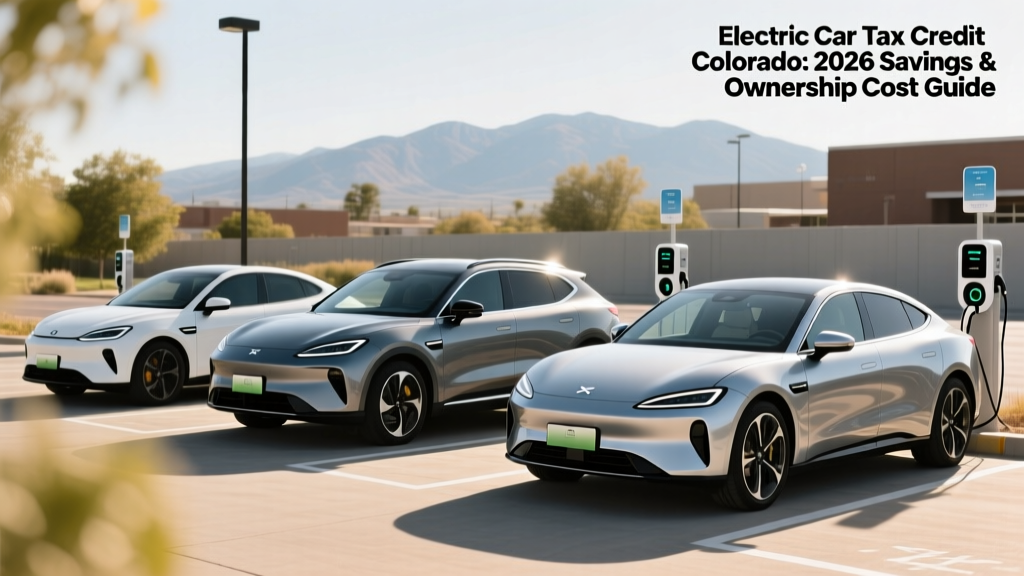
If you live in Colorado and are shopping for an electric vehicle, you are sitting in one of the best incentive environments in the country. The federal IRS §30D clean vehicle credit can knock up to $7,500 off your tax bill — or, as of 2024, off the purchase price at the dealership — and Colorado layers on its own state tax credit that stacks on top. But the rules are specific, the eligibility caps are real, and the total cost of ownership (TCO) equation involves more than just the sticker price and the rebate.
This guide walks through exactly what you can claim for the electric car tax credit in Colorado for the 2026 tax year, how the federal and state incentives interact, and what owning an EV actually costs over five years when you factor in charging, insurance, maintenance, and depreciation.
Federal §30D Tax Credit: The $7,500 Question
The federal clean vehicle credit under Internal Revenue Code §30D remains the single largest incentive for EV buyers. For 2026, the maximum credit is $7,500, split into two components:
- $3,750 for meeting critical-minerals sourcing requirements
- $3,750 for meeting battery-component manufacturing requirements
A vehicle can qualify for one half, both halves, or neither. Many popular models in 2026 — including the Tesla Model Y, Ford F-150 Lightning, and Chevrolet Equinox EV — qualify for the full $7,500, while others like certain Hyundai and Kia trims may only capture $3,750 depending on battery sourcing. Always verify on the fueleconomy.gov tax credit tracker before purchasing.
§30D Eligibility Checklist (2026 Tax Year)
- Vehicle type: New battery-electric (BEV) or plug-in hybrid (PHEV) with ≥7 kWh battery capacity
- MSRP caps: Vans, SUVs, and pickups ≤ $80,000; sedans and other vehicles ≤ $55,000
- Buyer income caps (modified AGI): Joint filers ≤ $300,000; Head of household ≤ $225,000; Single/other ≤ $150,000
- North American final assembly: Required — check your VIN on the NHTSA decoder
- Battery sourcing: Critical minerals and components must meet phased percentage thresholds (stricter each year through 2032)
- Point-of-sale transfer: Eligible buyers can transfer the credit to the dealer at purchase, reducing the price immediately rather than waiting to claim it on their tax return
- Frequency limit: One new-vehicle credit per taxpayer every three years
Critical caveat: Battery-sourcing rules tighten annually. A vehicle that qualifies in January may lose eligibility later in the year as supply chains shift. The IRS updates the qualified vehicle list periodically — do not rely on a dealer's verbal assurance. Confirm the exact model, trim, and build date against the current IRS list.
Colorado's State EV Tax Credit: Stacking on Top
Colorado offers one of the most generous state-level EV incentive structures in the U.S. As of 2026, the state provides an income tax credit of up to $5,000 for the purchase or lease of a new electric vehicle. Key details:
- $5,000 for new EVs with an MSRP of $80,000 or less
- $2,500 for new plug-in hybrid electric vehicles (PHEVs) with an MSRP of $80,000 or less
- The credit is refundable, meaning you can receive it even if your Colorado state tax liability is lower than the credit amount
- There is no separate state income cap — the credit applies regardless of your AGI
When stacked with the full federal §30D credit, a Colorado buyer could see up to $12,500 in combined tax incentives on a qualifying new EV. On a $45,000 vehicle like the Equinox EV LT, that drops the effective cost to approximately $32,500 — a transformative discount that brings EV pricing in line with comparable gas-powered crossovers.
Utility & Local Rebates in Colorado
Beyond federal and state tax credits, many Colorado utility companies offer additional rebates:
- Xcel Energy: Up to $550 rebate for Level 2 home charger installation (income-qualified customers may receive more)
- Colorado Springs Utilities: Periodic EV purchase rebates — check current availability
- La Plata Electric / Holy Cross Energy: Various EV and charger rebate programs for rural members
- Denver AQIRMD: "Switch to Electric" programs for income-qualified residents, sometimes covering used EV purchases
These programs change frequently. Check your specific utility's website and the DOE state incentive database for current offerings.
The Real 5-Year Cost of Owning an EV in Colorado
Tax credits reduce your purchase cost, but ownership is a five-year (or longer) commitment. Let's model the total cost of ownership for a popular mid-range EV — the 2026 Tesla Model Y Long Range AWD — compared to a similarly equipped gas-powered crossover (the Toyota RAV4 AWD) over 60 months and 75,000 miles.
| Category | Tesla Model Y LR AWD | Toyota RAV4 AWD |
|---|---|---|
| Base MSRP | $44,990 | $33,500 |
| Federal tax credit (§30D) | −$7,500 | $0 |
| Colorado state credit | −$5,000 | $0 |
| Effective purchase price | $32,490 | $33,500 |
| Fuel / charging (75k mi) | $3,938 | $8,571 |
| Maintenance (5 years) | $1,800 | $4,500 |
| Insurance (5 years) | $11,400 | $7,800 |
| Estimated depreciation | $14,500 | $10,200 |
| Total 5-year cost | $64,128 | $64,571 |
| Cost per mile (all-in) | $0.855 | $0.861 |
Assumptions: Electricity at $0.14/kWh (Colorado residential average with home charging), gas at $3.50/gallon, Model Y efficiency of 28 kWh/100 mi (EPA combined), RAV4 at 28 MPG combined. Insurance based on national averages adjusted for EV premium. Depreciation based on current 5-year resale projections.
The takeaway: after incentives, the Model Y's effective purchase price is actually lower than the RAV4's. Combined with fuel and maintenance savings that exceed the insurance premium, the EV edges out the gas car on total cost — even before accounting for the intangible benefit of never visiting a gas station.
Charging vs. Gas: The $/Mile Math
This is where EV ownership delivers the most consistent savings, but the number varies dramatically depending on how and where you charge.
| Scenario | Rate | Cost per Mile (Model Y) | Cost per Mile (RAV4, 28 MPG) |
|---|---|---|---|
| Home Level 2 (Colorado avg) | $0.14/kWh | $0.039 | $0.125 |
| Xcel off-peak EV rate | $0.07/kWh | $0.020 | $0.125 |
| Public DC fast charging | $0.40/kWh avg | $0.112 | $0.125 |
| Tesla Supercharger | $0.28/kWh avg | $0.078 | $0.125 |
At home on standard residential rates, you're paying roughly 3.9 cents per mile in a Model Y versus 12.5 cents in the RAV4 — a savings of nearly $0.09/mile, or $6,750 over 75,000 miles. If you qualify for Xcel Energy's off-peak EV rate and charge overnight, that drops to 2 cents per mile.
The catch: if you rely exclusively on public DC fast charging at $0.40/kWh, your cost per mile ($0.112) approaches gas parity. Home charging access is the single biggest variable in EV economics. If you cannot install a Level 2 charger at home or at work, the fuel-cost advantage shrinks significantly.
Maintenance Savings: Where EVs Win Clearly
EVs have far fewer moving parts than internal-combustion vehicles. No engine oil, no transmission fluid, no spark plugs, no timing belt, no exhaust system. Regenerative braking dramatically reduces brake pad wear — many EV owners report original brake pads at 80,000+ miles.
| Service | EV (Model Y) | Gas (RAV4) |
|---|---|---|
| Oil changes | $0 | $1,500 (10 changes × $150) |
| Brake pads | $0–$200 | $800 (2 sets) |
| Cabin air filter | $150 | $200 |
| Tire rotation | $300 | $300 |
| Coolant / fluid service | $200 | $400 |
| Transmission fluid | $0 | $300 |
| Wiper blades, misc. | $150 | $200 |
| Tire replacement (1 set) | $1,000 | $800 |
| Total (5 years) | $1,800 | $4,500 |
Net maintenance savings: approximately $2,700 over five years. The one area where EVs can cost more is tires — the instant torque and heavier weight of EVs accelerate tire wear. Budget for one set of replacement tires during a five-year ownership period, and choose EV-rated tires (marked with HL or EV on the sidewall) for better efficiency and noise performance.
Insurance: The Uncomfortable Reality
EV insurance premiums are typically 15–30% higher than equivalent gas vehicles. The reasons are structural, not arbitrary:
- Higher repair costs: EV battery packs are expensive to replace if damaged, and minor collisions can total a vehicle if the battery enclosure is compromised
- Specialized labor: Fewer body shops are certified for high-voltage EV repair, driving up labor rates
- Parts scarcity: EV-specific body panels and structural components can have longer lead times
- Vehicle value: Higher MSRP before incentives means higher insured value (insurers generally base premiums on pre-incentive MSRP)
For the Model Y, expect annual premiums of roughly $2,200–$2,400 in Colorado (varies by driver profile, ZIP code, and coverage level), compared to $1,500–$1,700 for the RAV4. That's an additional $3,600 over five years — a real cost that partially offsets fuel and maintenance savings.
Mitigation strategies: Shop quotes from at least three insurers before purchasing. Tesla offers its own insurance product in Colorado that uses real-time driving data and is often competitive. Bundling home and auto, maintaining a clean record, and choosing higher deductibles all help.
Depreciation and Resale Value
EV depreciation has been volatile. In 2023–2024, Tesla's aggressive price cuts caused a sharp decline in used EV values, and the broader market followed. By 2026, the depreciation curve has stabilized somewhat, but EVs still generally lose value faster than high-demand gas vehicles like the RAV4.
Current 5-year depreciation estimates:
- Tesla Model Y: ~45–50% value retention after 5 years / 75,000 miles
- Toyota RAV4 AWD: ~60–65% value retention after 5 years / 75,000 miles
On a $44,990 Model Y, that translates to roughly $14,500 in depreciation (post-incentive basis) versus $10,200 for the RAV4. However, this gap is narrowing as battery longevity data improves and the used-EV market matures. Vehicles with LFP (lithium iron phosphate) batteries — like the standard-range Model Y — may hold value better long-term due to LFP's superior cycle life and lower degradation.
Leasing as a hedge: If depreciation concerns you, leasing transfers that risk to the lessor. Many 2026 EV leases also allow the leasing company to pass the $7,500 federal credit to you as a capitalized-cost reduction, and some leases qualify for the credit even when purchases would not (due to the commercial-vehicle loophole under §45W). Ask the dealer how the credit is applied on a lease.
Colorado-Specific EV Ownership Factors
Living in Colorado introduces a few unique variables that affect your EV cost equation:
- Altitude and cold: Colorado's cold winters reduce EV range by 15–30% (battery chemistry slows in low temperatures, and cabin heating draws significant energy). A Model Y rated at 330 miles EPA may deliver 240–260 miles on a 20°F January day. Preconditioning while plugged in mitigates this.
- Mountain driving: Climbing I-70 to the ski resorts consumes energy rapidly (uphill grades can double your kWh/mile), but regenerative braking on the descent recovers a significant portion — sometimes 40–60% of the uphill energy.
- Solar synergy: Colorado has excellent solar resources. If you have rooftop solar, your marginal charging cost can approach zero, dramatically improving the TCO equation.
- Charging infrastructure: The I-25 and I-70 corridors are well-served by Superchargers, Electrify America, and other networks. Rural western Colorado remains a charging desert in some stretches — plan accordingly if you drive to the Western Slope or Four Corners frequently.
Frequently Asked Questions
How much does it really cost to own an EV over 5 years in Colorado?
With full incentives applied ($7,500 federal + $5,000 Colorado state), a $45,000 EV can have an effective purchase price near $32,500. Over five years and 75,000 miles, total ownership costs (purchase, charging, insurance, maintenance, depreciation) run approximately $60,000–$68,000 for a mid-range EV — comparable to or slightly below a gas equivalent, depending on how much you drive and whether you charge at home.
Do I qualify for the federal electric vehicle tax credit?
You likely qualify if your modified AGI is under $150,000 (single) or $300,000 (joint), the vehicle MSRP is under the applicable cap ($55,000 for sedans, $80,000 for SUVs/trucks), the vehicle was assembled in North America, and the battery meets critical-mineral and component sourcing thresholds. Check the specific model on fueleconomy.gov and confirm with a tax professional.
Can I get both the federal and Colorado state tax credit?
Yes. The federal §30D credit and Colorado's state EV tax credit are independent programs that stack. A qualifying buyer can claim up to $7,500 federal + $5,000 state = $12,500 in combined credits on a single new EV purchase in 2026.
How much do I save on fuel and maintenance?
Charging at home at Colorado's average residential rate of $0.14/kWh, a typical EV costs about 3.9 cents per mile to fuel versus 12.5 cents for a 28-MPG gas vehicle. Over 75,000 miles, that's roughly $6,400 in fuel savings. Add approximately $2,700 in maintenance savings for a combined operating-cost reduction of about $9,100 over five years.
Are EVs more expensive to insure in Colorado?
Yes, typically 15–30% more than comparable gas vehicles. Expect to pay $2,200–$2,400/year for a Model Y versus $1,500–$1,700 for a RAV4. Higher repair costs, specialized labor, and elevated vehicle values drive the premium. Shop multiple quotes and consider Tesla's own insurance product.
How well do EVs hold their value?
EV depreciation has been steeper than gas vehicles, with 5-year retention around 45–50% versus 60–65% for popular gas crossovers. The gap is narrowing as battery longevity data improves. Leasing is a viable strategy if you want to avoid depreciation risk entirely.
Does Colorado's cold weather significantly hurt EV range?
Yes. Expect 15–30% range loss in sustained sub-freezing temperatures. A 330-mile EPA-rated EV may deliver 240–260 real-world miles in January. Preconditioning your battery while plugged in, using seat heaters instead of cabin heat, and planning for charging stops on longer winter drives all help manage this.
Bottom Line: Is the Colorado EV Tax Credit Worth It?
For most Colorado buyers who can charge at home, the answer is yes — the math works. The combination of the federal §30D credit (up to $7,500), Colorado's state credit ($5,000), utility rebates, and five years of fuel and maintenance savings can make an EV cheaper to own than a comparable gas vehicle, even accounting for higher insurance and steeper depreciation.
The key variables that determine whether the economics work for you:
Choose an EV if:
- You can install a Level 2 charger at home (or have reliable workplace charging)
- Your income is under the §30D caps ($150K single / $300K joint)
- Your target vehicle qualifies for the full $7,500 federal credit
- You drive 12,000+ miles per year (higher mileage = greater fuel savings)
- You have or plan to install rooftop solar (marginal charging cost approaches zero)
Consider a hybrid or wait if:
- You rent and cannot install home charging
- Your income exceeds the §30D caps
- You frequently drive to Colorado's rural charging deserts
- Your budget is tight and insurance premiums would strain your monthly costs
Always verify current incentive eligibility on IRS.gov and the DOE incentive database before committing — rules change, and the final determination rests with your tax professional.