The Short Answer: What Is an Electric Car Route Planner?
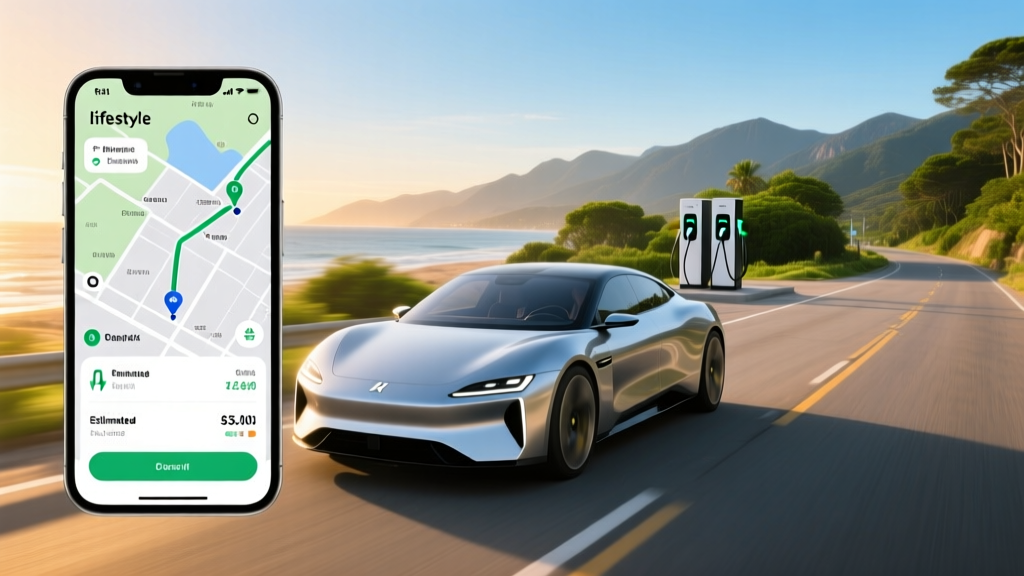
An electric car route planner is a navigation tool that maps long-distance EV trips by combining your vehicle's real-world range, charging station locations, connector types (NACS, CCS, CHAdeMO), and DC fast-charge speeds (kW) to calculate where and how long you'll stop. Unlike gas-car navigation that only considers distance and traffic, an EV route planner factors in battery state of charge (SoC), elevation changes, outside temperature, and charge-curve taper to give you accurate arrival times. The best options in 2026 include A Better Route Planner (ABRP) for multi-network trip optimization, PlugShare for charger reliability reviews, and OEM-integrated planners (Tesla, Hyundai, Ford) that precondition the battery before you arrive. For a typical 400-mile road trip in a 2026 Hyundai Ioniq 5, expect 2 charging stops totaling ~35 minutes and roughly $28-$42 in DC fast-charging costs, compared to ~$52 in gasoline for a 28 MPG compact SUV.
Why EV Route Planning Is Different From Gas-Car Navigation
When you drive a gasoline car on a road trip, fuel stops are an afterthought. A gas station appears every 15-20 miles on most US interstates, refueling takes 4 minutes, and your car's range barely changes whether it's 30°F or 90°F outside. EV road trips require more deliberate planning because three variables shift constantly:
- Range isn't static. The EPA-estimated 310-mile range on a 2026 Tesla Model Y Long Range shrinks to roughly 230-250 miles at sustained 75 MPH highway speeds, and can drop another 15-25% in freezing temperatures due to cabin heating demands and increased battery resistance.
- Charging speed isn't linear. A vehicle rated for 250 kW peak DC fast charging only sustains that rate between roughly 10-40% SoC. Above 80%, speeds taper dramatically — often to 40-60 kW — to protect battery health. This "charge curve" means a 10-80% session takes 18-22 minutes, but 80-100% can take another 25+ minutes.
- Charger availability varies by network. Tesla Superchargers (now open to NACS-equipped non-Tesla EVs) average 99.6% uptime. Electrify America and EVgo stations are improving but still show intermittent outages. An EV route planner must account for fallback options.
A good electric car route planner solves all three problems by modeling your specific vehicle's efficiency curve, the charger network topology, and ambient conditions along your route.
The Best Electric Car Route Planner Apps in 2026
Here's how the major route planning tools compare for real-world EV road trips:
| App / Tool | Best For | Vehicle Support | Live Battery SoC | Charge-Curve Modeling | Cost |
|---|---|---|---|---|---|
| A Better Route Planner (ABRP) | Multi-stop trip optimization across networks | 400+ EV models with custom charge curves | Yes (via OBD-II dongle or OEM API on select models) | Advanced — models taper by SoC, temperature, terrain | Free basic; $4.99/mo premium |
| Tesla In-Car Navigation | Tesla owners using Supercharger network | Tesla vehicles only | Native integration | Accurate — battery preconditioning on route | Included |
| Hyundai / Kia EV Route Planner | E-GMP platform owners (Ioniq 5/6, EV6/EV9) | Hyundai/Kia/Genesis EVs | Native integration | Good — includes battery conditioning | Included |
| FordPass / BlueOval Charge Network | Ford EV owners (Mustang Mach-E, F-150 Lightning) | Ford EVs | Native integration | Moderate | Included |
| PlugShare | Charger reliability research + trip overlay | All EVs (manual input) | No | Basic range circle only | Free |
| Google Maps (EV routing) | Casual trip planning with charger suggestions | All EVs (limited vehicle profiles) | Select OEM integrations | Basic | Free |
| Chargeway | Connector/color-coded network filtering | All EVs | No | None | Free |
Our Pick: ABRP for Serious Trip Planning
For any road trip over 200 miles in a non-Tesla EV, A Better Route Planner remains the gold standard. You select your exact vehicle model and year, input your starting SoC, and ABRP generates an optimized itinerary showing each charging stop, expected SoC on arrival, session duration, and total trip time. The premium tier adds live weather and wind data, which meaningfully affects range — a 20 MPH headwind can reduce highway efficiency by 8-12%.
OEM Planners Win on Battery Preconditioning
The critical advantage of using your car's built-in route planner (Tesla, Hyundai, Ford) is battery preconditioning. When you navigate to a DC fast charger, the vehicle's thermal management system warms or cools the battery pack to the optimal temperature window (typically 86-104°F / 30-40°C) before you arrive. This can be the difference between peaking at 230 kW vs. 80 kW on a cold morning. Third-party apps like ABRP cannot trigger preconditioning on most vehicles — though some OEM integrations now support this via API.
Real-World Range vs. EPA Sticker: What Your Route Planner Should Calculate
EV Route Planning Rule of Thumb: Plan your charging stops using 75-80% of the EPA-estimated range as your working number for highway driving at 70-75 MPH. In winter (below 32°F), reduce that to 60-65% of EPA range. This accounts for the combined effects of high-speed aerodynamic drag, cabin heating, and battery thermal losses.
Here's how EPA range translates to realistic road-trip range for popular 2026 EVs:
| Vehicle | Battery (kWh usable) | EPA Range | Real Highway (75 MPH, 65°F) | Cold Weather Highway (30°F) | MPGe (combined) |
|---|---|---|---|---|---|
| Tesla Model Y Long Range AWD | 78.1 kWh (NMC) | 320 mi | ~260-275 mi | ~200-220 mi | 117 MPGe |
| Hyundai Ioniq 5 Long Range RWD | 77.4 kWh (NMC) | 303 mi | ~245-260 mi | ~190-210 mi | 114 MPGe |
| Ford Mustang Mach-E Extended Range | 91.0 kWh (NMC) | 320 mi | ~255-270 mi | ~200-215 mi | 101 MPGe |
| Chevrolet Equinox EV RS AWD | 85.0 kWh (NMC) | 307 mi | ~245-260 mi | ~190-205 mi | 99 MPGe |
| BMW iX xDrive50 | 105.2 kWh (NMC) | 324 mi | ~275-290 mi | ~220-235 mi | 87 MPGe |
Sources: fueleconomy.gov, manufacturer spec sheets. Real-world estimates based on controlled highway testing at 75 MPH; individual results vary by tire pressure, payload, elevation, and wind.
How Elevation Changes Your Route Plan
Most route planners underestimate the impact of elevation. Climbing 5,000 feet over a mountain pass (think I-70 through Colorado) can consume 30-40% more energy than the same distance on flat terrain. However, regenerative braking on the descent recovers roughly 50-65% of that energy. ABRP and Tesla's navigator model this; Google Maps does not factor elevation into range estimates reliably.
Road Trip Charging Costs: EV vs. Gas Breakdown
The economics of an EV road trip depend heavily on which charging networks you use. Public DC fast-charging prices vary enormously — from $0.25/kWh at some utility-operated stations to $0.58/kWh at peak-rate Electrify America chargers. Here's a concrete comparison for a 400-mile trip:
| Vehicle / Scenario | Energy Used | Cost per Unit | Total Trip Cost | Cost per Mile |
|---|---|---|---|---|
| 2026 Tesla Model Y LR (DC fast charging @ $0.35/kWh avg) | ~128 kWh | $0.35/kWh | $44.80 | $0.112 |
| 2026 Hyundai Ioniq 5 (DC fast charging @ $0.35/kWh avg) | ~132 kWh | $0.35/kWh | $46.20 | $0.116 |
| 2026 Toyota RAV4 Gas AWD (28 MPG combined @ $3.45/gal) | ~14.3 gallons | $3.45/gal | $49.34 | $0.123 |
| 2026 Model Y LR (home L2 charging before trip + 1 DC stop @ $0.35/kWh) | ~64 kWh home + ~64 kWh DC | $0.14/kWh home + $0.35 DC | $31.36 | $0.078 |
Assumptions: Highway efficiency of 3.1 mi/kWh (Model Y), 3.0 mi/kWh (Ioniq 5) at 75 MPH. Gas prices from EIA weekly retail survey. Home electricity at US average of $0.14/kWh.
The Home-Charging Advantage on Road Trips
If you have Level 2 home charging (a 240V / 40-amp circuit delivering ~9.6 kW), you'll leave every road trip with a full battery at residential electricity rates — typically $0.10-$0.18/kWh depending on your utility. That 78 kWh Tesla battery costs roughly $11 to fill at home vs. $27-$45 at a DC fast charger. This is why home charging access is the single biggest factor in EV ownership satisfaction and total cost of ownership.
How to Plan Your First EV Road Trip: A Step-by-Step Framework
EV Road Trip Planning Decision Framework
- If your trip is under 200 miles round-trip → Charge fully at home (Level 2 overnight). No en-route charging needed for most 2026 EVs. Skip the route planner entirely.
- If your trip is 200-350 miles one-way → Use ABRP or your OEM planner. Expect 1 DC fast-charging stop of 15-25 minutes. Plan the stop around a meal or rest break.
- If your trip is 350-600 miles one-way → Expect 2-3 charging stops. Use ABRP to optimize stop placement. Target chargers near amenities (restaurants, restrooms). Add 15-20 minutes of buffer per stop for slower-than-expected charge rates.
- If your trip exceeds 600 miles → Plan an overnight stop with Level 2 destination charging (hotel, Airbnb). Starting day two with a full battery eliminates range stress and saves $30-$50 in DC fast-charging costs.
- If you're driving in sub-freezing weather → Reduce your working range to 60-65% of EPA. Add an extra charging stop to your plan. Precondition the battery by navigating to each charger in your OEM system.
- If you're towing or carrying heavy cargo → Reduce working range by 25-40%. A Ford F-150 Lightning towing a 5,000-lb trailer may see real-world range drop from 230 mi EPA to 130-150 mi at highway speeds.
The 20% Buffer Rule
Never plan to arrive at a charger with less than 10% SoC — and ideally target 15-20%. Chargers can be out of service, occupied, or slower than advertised. Having a 20% buffer means you can skip a problematic station and reach the next one without panic. ABRP lets you set a minimum arrival SoC in its settings; we recommend 15%.
Common EV Route Planning Misconceptions
| Myth | Fact |
|---|---|
| "EV road trips take twice as long because of charging." | Partially true for very long trips. A 400-mile trip in a Model Y requires ~35 minutes of total charging. That same trip in a gas car requires ~10 minutes of fueling. The difference is 25 minutes — often absorbed by a meal stop you'd take anyway. For trips under 250 miles, there's no time penalty if you leave with a full battery. |
| "You can't drive an EV cross-country." | False. The US DC fast-charging network exceeded 55,000 ports in 2025. A New York to Los Angeles trip (~2,800 miles) requires roughly 10-12 charging stops totaling 4-5 hours of charging across 4 days of driving. Tesla Superchargers now cover every major interstate corridor. |
| "All DC fast chargers are equally fast." | False. A 350 kW Electrify America stall won't charge your 2026 Ioniq 5 faster than a 250 kW stall because the car peaks at ~240 kW. But a 50 kW CHAdeMO charger will take 90+ minutes for a 10-80% session. Always check charger power ratings in your route planner. |
| "I need a Tesla to road-trip reliably." | Mostly false as of 2026. With the NACS (North American Charging Standard) now adopted by Ford, GM, Hyundai, Rivian, BMW, and most major automakers, non-Tesla EVs can access Supercharger stations using a NACS port or adapter. The reliability gap between networks is narrowing. |
| "Cold weather makes EV road trips impossible." | False, but it requires planning. Cold reduces range 15-30% and slows charging speeds. Preconditioning (heating the battery before arriving at a charger) mitigates the charging slowdown. EVs with heat pumps (standard on most 2026 models) reduce cabin-heating energy draw by 30-50% compared to resistive heaters. |
Charging Network Reliability: What Route Planners Can't Always Predict
Even the best electric car route planner can't guarantee a charger will be working when you arrive. Here's how the major networks stack up in 2026 based on industry uptime data:
- Tesla Supercharger: ~99.5% uptime. The gold standard. Now open to NACS-equipped non-Tesla EVs at select locations, expanding rapidly.
- Electrify America: ~93-96% uptime. Improved significantly since 2024 with new Gen4 chargers, but screen/payment glitches persist at older stations.
- EVgo: ~92-95% uptime. Strong urban coverage. Partnership with GM is adding 350 kW stalls along highway corridors.
- ChargePoint: ~88-92% uptime for DC fast chargers. Excellent Level 2 network. DC reliability remains inconsistent at some locations.
Pro tip: Before any road trip, check PlugShare user reviews for each charger on your route. Recent reviews (past 30 days) flag broken stalls, construction closures, or access issues that route planners don't capture. If a station has multiple "doesn't work" reviews in the past month, plan an alternate.
First-Time EV Road Trip Checklist
Before you hit the road, make sure you've addressed these items:
- Download and set up charging network apps. Create accounts with Electrify America, EVgo, and ChargePoint before your trip. Link a payment method. Fumbling with app registration at a charger in the rain is miserable.
- Know your connector type. 2026 EVs use either NACS (Tesla-style), CCS1 (most legacy non-Tesla), or CHAdeMO (Nissan Leaf only). If your EV has CCS1 and you plan to use Tesla Superchargers, you'll need a manufacturer-approved CCS-to-NACS adapter ($150-$250).
- Verify your NACS adapter compatibility. Ford, GM, Rivian, and others now ship with native NACS ports. If you have a 2024-2025 CCS vehicle, confirm your adapter is approved for Supercharger use — some third-party adapters void warranties.
- Set your route planner's arrival SoC to 15%. This gives you buffer for charger outages or detours.
- Check for charger power ratings. Aim for 150 kW+ chargers. A 50 kW charger will triple your stop time.
- Plan stops around amenities. The best charging stops have restrooms, food, and WiFi. ABRP and PlugShare both show nearby amenities.
- Precondition before fast charging. Navigate to the charger in your OEM system 20-30 minutes before arrival to warm the battery.
- Carry a mobile Level 1 backup charger. The 120V cord that came with your EV adds 3-5 miles of range per hour. It's a slow lifeline, but in a true emergency it can get you to the next fast charger.
Frequently Asked Questions
Do I really need a route planner for short EV trips?
For any trip within your vehicle's real-world range (typically 200-280 miles highway for most 2026 EVs), you don't need a dedicated route planner. Charge to 100% at home and go. Route planners become essential when your trip exceeds your single-charge range and you need to identify optimal charging stops.
Can I use Google Maps as my electric car route planner?
Google Maps now suggests charging stops for EVs and shows basic charger info, but it lacks the charge-curve modeling, battery preconditioning triggers, and multi-network optimization of ABRP or OEM systems. For a simple one-stop trip, Google Maps works. For multi-stop or cold-weather trips, use a dedicated EV planner.
How much does DC fast charging cost on a road trip?
DC fast-charging prices in 2026 range from roughly $0.25/kWh at utility-operated stations to $0.58/kWh at premium network chargers during peak hours. The national average is approximately $0.35/kWh. For a 2026 EV averaging 3.0 mi/kWh, that works out to about $0.12 per mile — comparable to a 29 MPG gas car at $3.45/gallon. Charging memberships (EA Pass, EVgo Plus) can reduce costs by 15-25%.
What happens if a planned charger is broken?
This is why the 20% SoC buffer rule matters. ABRP and most OEM planners will automatically reroute to the next nearest charger if you skip one. Before departing, identify backup chargers within 20-30 miles of each planned stop. PlugShare's real-time status updates and user check-ins are the best tool for confirming charger health before you arrive.
Does towing or a full car affect my route plan?
Significantly. Towing a trailer can reduce EV range by 30-50% depending on weight and aerodynamics. A fully loaded vehicle with roof cargo adds 10-15% to energy consumption. Always recalculate your route plan with adjusted efficiency figures — ABRP lets you input custom Wh/mi values and trailer parameters.
Are there EV charging deserts I should avoid?
Yes, though they're shrinking. Rural stretches of I-90 through South Dakota, parts of US-50 in Nevada, and some corridors in rural Mississippi and Arkansas still have gaps of 80-120 miles between DC fast chargers. If your route passes through these areas, ensure your EV's real-world range (not EPA sticker) comfortably exceeds the gap, and charge to 100% before entering the corridor. The Alternative Fuels Data Center maps all public charging infrastructure for pre-trip research.