Quick Answer: Do Electric Cars Have Transmissions?
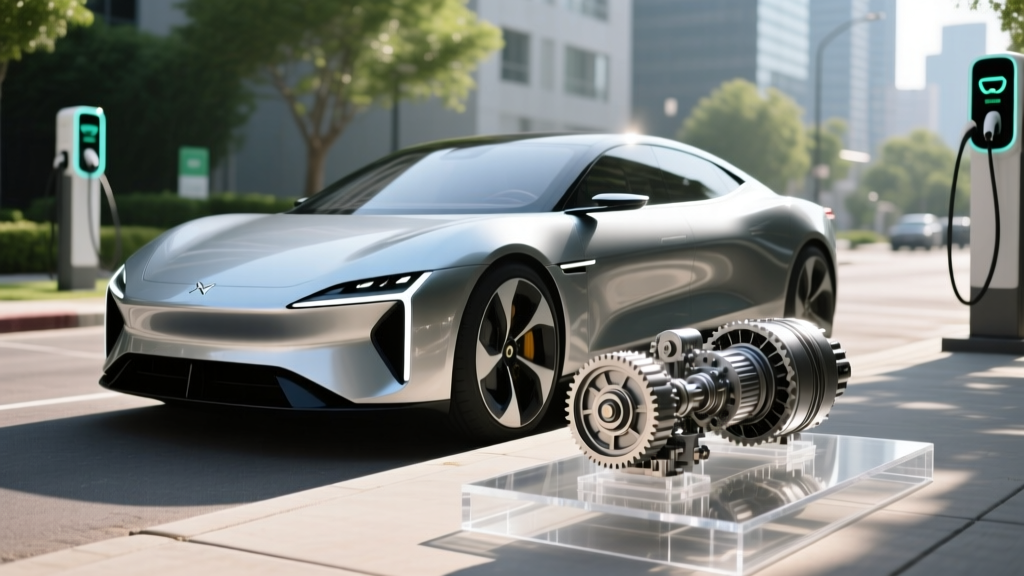
Most electric vehicles use a single-speed transmission — a fixed-ratio reduction gear (typically between 8:1 and 10:1) that transfers torque from the electric motor to the wheels. Unlike a gas car's 6-to-10-speed automatic, there are no gear shifts. The electric motor delivers peak torque from 0 RPM and can safely spin to 15,000–20,000 RPM, eliminating the need for multiple gears. A few exceptions exist — the original Porsche Taycan uses a 2-speed rear axle for high-speed efficiency — but for 95%+ of EVs on the road, one gear is all you need.
How an Electric Car Motor and Transmission Actually Work
When you press the accelerator in a battery-electric vehicle, the inverter converts DC energy from the battery pack into AC current that drives the motor. Most mainstream EVs use either a permanent magnet synchronous motor (PMSM) or an AC induction motor. Both produce maximum torque instantly from a standstill, which is why even a family crossover like the Hyundai Ioniq 5 (225 hp, single-motor RWD) hits 0–60 mph in about 7.4 seconds without a downshift.
The single-speed reduction gear serves one job: multiply the motor's high-RPM, low-torque output into the low-RPM, high-torque rotation your wheels need. A typical ratio is around 9:1. So if the motor spins at 12,000 RPM, the axle turns at roughly 1,333 RPM. That's enough to push most EVs past 110 mph without ever "shifting."
The entire drivetrain — motor, inverter, and reduction gear — often weighs under 200 lbs and fits in a housing the size of a carry-on suitcase. Compare that to a gas car's engine block, torque converter, multi-speed transmission, exhaust system, and cooling apparatus, which together can exceed 800 lbs.
EV Drivetrain vs. Gas Car Powertrain: By the Numbers
The simplicity of the electric car motor and transmission setup translates directly into measurable efficiency and maintenance advantages.
| Metric | EV (Single-Speed) | Gas Car (Multi-Speed AT) |
|---|---|---|
| Moving drivetrain parts | ~20 | ~200+ |
| Transmission fluid changes | Every 60,000–100,000 mi (some sealed-for-life) | Every 30,000–60,000 mi |
| Energy conversion efficiency | ~85–90% (battery-to-wheel) | ~20–30% (fuel-to-wheel) |
| Peak torque delivery | 0 RPM (instant) | 1,500–4,500 RPM band |
| Typical drivetrain weight | 150–200 lbs | 500–900 lbs (engine + trans) |
| Regenerative braking | Yes (recovers kinetic energy) | No (friction brakes only) |
According to fueleconomy.gov, electric motors convert over 85% of electrical energy into motion at the wheels. Internal combustion engines waste the majority of gasoline's energy as heat — only about 20–30% reaches the wheels. That fundamental physics gap is why a 2026 Tesla Model Y Long Range achieves 111 MPGe combined while a comparable gas crossover averages 25–28 MPG combined.
Why Don't Most EVs Need Multiple Gears?
Gas engines have a narrow power band. A typical four-cylinder produces useful torque only between roughly 1,500 and 5,000 RPM, and redlines near 6,500. To keep the engine in that sweet spot as vehicle speed increases from 0 to 80 mph, you need six, eight, or even ten forward ratios.
Electric motors don't have that limitation. A PMSM can produce strong, flat torque from 0 RPM all the way to 8,000–10,000 RPM, then taper gracefully to 15,000+ RPM. That enormous usable rev range covers city crawling and highway cruising in a single gear ratio.
The Porsche Taycan exception: Porsche fitted a 2-speed transmission on the Taycan's rear axle — first gear for explosive launches (0–60 in 2.6 seconds in Turbo S trim), second gear for high-speed efficiency above ~60 mph. This nets roughly a 3–5% highway range improvement but adds cost, weight, and complexity. Most automakers have concluded the trade-off isn't worth it.
Real Costs: EV Drivetrain Ownership vs. Gas
The reduced complexity of an electric car motor and transmission setup lowers ongoing costs — but EVs aren't cheaper in every category.
| Cost Category (5 yr / 75,000 mi) | EV (e.g., 2026 Chevy Equinox EV) | Gas (e.g., 2026 Chevy Equinox AWD) |
|---|---|---|
| Purchase price (base MSRP) | $33,400 | $28,600 |
| Federal tax credit (§30D, if eligible) | −$7,500 (point-of-sale) | $0 |
| Effective purchase price | $25,900 | $28,600 |
| Fuel / electricity | $3,400 (home L2, $0.14/kWh avg) | $8,100 ($3.40/gal, 27 MPG) |
| Transmission fluid service | $0–$150 | $450–$750 |
| Brake pad replacement | $0–$250 (regen extends life) | $600–$1,000 |
| Oil changes | $0 | $500–$750 |
| Insurance (avg premium delta) | +15–25% higher | Baseline |
| Estimated 5-yr total cost | ~$39,500–$42,000 | ~$46,000–$49,000 |
Fuel savings alone typically run $4,000–$5,500 over five years. Combine that with eliminated oil changes and reduced brake wear, and the EV's drivetrain simplicity saves $5,000–$8,000 in operating costs — enough to offset the higher sticker price in most cases, especially with the §30D federal tax credit applied at point of sale.
Caveat on the tax credit: Eligibility depends on your taxable income (≤$150,000 single / ≤$300,000 joint), the vehicle's MSRP (≤$55,000 sedans, ≤$80,000 SUVs/trucks), battery critical-mineral and component sourcing rules, and the manufacturer not having hit prior cap limits under the old rules. Always verify current-year requirements on IRS.gov or with a tax professional before committing.
Real-World Ownership: What First-Time EV Buyers Should Know
The motor and transmission are the least of your worries. The ownership questions that actually matter revolve around charging, climate, and battery longevity.
Home Charging Access Is the Biggest Variable
If you can install a Level 2 (240V) home charger, daily EV ownership is effortless — plug in at night, wake up with 200+ miles of range. A typical Level 2 installation runs $800–$2,000 total (charger hardware: $400–$700; electrician labor and permit: $400–$1,300). If your panel needs a 200-amp upgrade, add $1,500–$3,000.
If you cannot charge at home — apartment living, street parking, no garage — public DC fast charging becomes your lifeline. At current Electrify America and EVgo pricing ($0.40–$0.55/kWh), fueling costs can approach or exceed gas. This is the single biggest practical limitation of EV ownership, and no amount of drivetrain efficiency solves it.
Cold Weather Affects Range, Not the Transmission
The single-speed reduction gear works identically in Phoenix at 110°F and Minneapolis at −10°F. But the battery doesn't. Expect 20–35% range loss in sustained sub-freezing temperatures due to increased internal resistance and cabin heating load. A 300-mile EPA-rated EV may deliver 200–240 real-world winter miles. Models equipped with a heat pump (standard on the 2026 Tesla Model Y, Hyundai Ioniq 5, and others) recover some of that loss — typically 5–10 percentage points — by scavenging waste heat from the motor and inverter rather than relying solely on resistive heating.
Battery and Motor Warranty Coverage
Federal law mandates that EV battery and powertrain components (including the motor and reduction gear) carry a minimum warranty of 8 years / 100,000 miles. Many automakers match this; some exceed it. The warranty typically guarantees the battery will retain at least 70% of original capacity. Motor and reduction-gear failures are rare — these are sealed units with few wear items — but coverage gives long-term peace of mind.
Common Misconceptions About EV Motors and Transmissions
| Myth | Fact |
|---|---|
| "EVs have no transmission at all." | They have a single-speed reduction gear. It's technically a transmission — just one with a single fixed ratio. |
| "No gears means EVs are slow on the highway." | Most EVs reach 100–130 mph electronically limited. The motor's wide RPM range covers highway speeds easily. |
| "EV motors need regular maintenance." | AC and PMSM motors are essentially maintenance-free. No brushes, no commutators, no oil. The reduction gear fluid may be checked or replaced at high mileage intervals. |
| "The transmission will fail and cost $5,000 to replace." | Single-speed reduction gears have extremely low failure rates. There are no clutch packs, bands, or torque converters to wear out. If a motor or inverter does fail, it's covered under the 8-year/100k-mile powertrain warranty. |
| "More gears would make EVs more efficient." | Testing and simulation show a 2-speed setup gains only 2–5% efficiency at high speed — not enough to justify added weight, cost, and complexity for most vehicles. |
Decision Framework: Should You Care About the Drivetrain When Buying?
Choose a single-motor EV (one reduction gear, FWD or RWD) if:
- You prioritize maximum range and lowest purchase price
- Your driving is mostly commuting and city/suburban trips
- You don't need AWD for snow or towing
- Example: 2026 Hyundai Ioniq 5 SE RWD — 303 mi EPA, $43,975 MSRP, ~225 hp
Choose a dual-motor AWD EV if:
- You live in a snowy or rainy climate and want traction without a mechanical center differential
- You need faster acceleration (dual-motor setups typically add 100–200 hp)
- You tow or carry heavy loads regularly
- Example: 2026 Tesla Model Y Long Range AWD — 320 mi EPA, $44,990 MSRP, ~384 hp, 0–60 in 4.8s
Consider the rare multi-speed EV (e.g., Porsche Taycan) if:
- Track performance and high-speed Autobahn-style driving are priorities
- You're willing to pay a premium for 2–5% extra highway efficiency
- You accept slightly higher long-term maintenance complexity
Reconsider an EV entirely if:
- You have no access to home or workplace charging and your area has sparse DC fast-charging infrastructure
- You regularly drive 400+ miles in a single day in sub-freezing weather
- Your budget cannot absorb the higher upfront cost even after tax credits
- In these cases, a plug-in hybrid (PHEV) like the 2026 Toyota RAV4 Prime (42 mi electric-only, 38 MPG combined after depletion) may be a better bridge
Frequently Asked Questions
Do electric cars have a clutch?
No. Since there's only one fixed gear ratio and the electric motor can spin freely from 0 RPM, there's no need for a clutch to engage or disengage the drivetrain. The motor simply ramps torque up or down electronically via the inverter.
Can an electric car motor and transmission be repaired, or must they be replaced?
The reduction gear is a simple set of helical or spur gears in an oil bath — a qualified EV technician can service it. Motor failures are uncommon but typically involve the inverter or power electronics rather than the motor itself. Under the federally mandated 8-year/100,000-mile powertrain warranty, these repairs are covered. Out-of-warranty motor or inverter replacement can cost $3,000–$7,000 depending on the vehicle.
Why do some EVs have two motors?
Dual-motor EVs place one motor on each axle for all-wheel drive. This eliminates the need for a mechanical driveshaft, transfer case, or center differential — all heavy, lossy components in a gas AWD system. Each motor still uses its own single-speed reduction gear. The front motor often disconnects during light-load cruising to reduce drag losses and extend range.
How long do EV motors last compared to gas engines?
Electric motors have far fewer wear items than internal combustion engines — no piston rings, valve trains, timing chains, or head gaskets. With proper cooling and sealed bearings, EV motors are expected to last 300,000+ miles. The reduction gear is similarly durable. In practice, the battery pack is more likely to reach end-of-life before the motor fails.
Does regenerative braking put extra wear on the motor?
No. Regenerative braking simply reverses the motor's role — instead of consuming electricity to create rotation, the spinning wheels drive the motor as a generator, converting kinetic energy back into battery charge. This process creates no additional mechanical wear. In fact, regen reduces wear on the friction brake pads, which is why many EV owners report original brake pads lasting 100,000+ miles.
Will future EVs have multi-speed transmissions?
Most industry engineering teams have concluded that improving motor efficiency and battery energy density offers better returns than adding gears. As battery packs grow cheaper and motors become more efficient across their RPM range, the case for multi-speed transmissions gets weaker, not stronger. Expect single-speed reduction gears to remain the standard for the foreseeable future, with niche exceptions in high-performance applications.