The Short Answer: Is an Electric Car the Future for You?
Yes — but only if your situation fits. An electric car is the future for buyers who can charge at home, drive under 250 miles daily, and want to cut fuel and maintenance costs by 40–60%. It is not the future (yet) for apartment dwellers without charging access, frequent 400+ mile road-trippers in the Mountain West, or anyone who needs a sub-$25,000 new vehicle. The math works overwhelmingly in favor of EVs in 2026 — average electricity costs the equivalent of $1.20/gallon, and the federal §30D tax credit still offers up to $7,500 for qualifying models — but the upfront price premium and charging logistics remain real hurdles.
EV vs Gas vs Hybrid: The Numbers That Actually Matter
The phrase "electric car is the future" gets thrown around constantly, but your wallet doesn't care about slogans. Let's compare what three popular midsize options actually cost to buy and run in 2026. We'll use the Honda Prologue (EV), the Toyota Camry Hybrid (HEV), and the Honda Accord 1.5T (gas) as representative benchmarks.
| Metric | Honda Prologue (EV) | Camry Hybrid (HEV) | Accord 1.5T (Gas) |
|---|---|---|---|
| Base MSRP | $47,400 | $29,495 | $29,390 |
| Fed. Tax Credit (§30D) | Up to $7,500* | $0 | $0 |
| Effective Price After Credit | ~$39,900 | $29,495 | $29,390 |
| EPA Range / MPG | 296 mi / 99 MPGe | 51/44/48 MPG | 29/37/32 MPG |
| Annual Fuel/Energy Cost (15k mi) | ~$540 | ~$1,050 | ~$1,640 |
| Annual Maintenance | ~$150 | ~$450 | ~$550 |
| 5-Year Fuel + Maint. Total | ~$3,450 | ~$7,500 | ~$10,950 |
*§30D credit eligibility depends on buyer income caps ($150k single / $300k joint), MSRP caps ($55k sedans, $80k SUVs/trucks), and battery critical-mineral sourcing. Always verify on IRS.gov before purchasing. Credit can now be transferred to the dealer at point of sale as an instant discount.
The EV's effective price drops to roughly $39,900 after the credit, still ~$10,000 more than the hybrid. But the annual operating savings are roughly $1,500–$2,000 per year versus gas, meaning break-even arrives around year 5–6 for the EV versus the gas Accord, and year 7–8 versus the hybrid. Keep the car 10 years and the EV wins decisively. Sell at year 3 and the hybrid or gas car likely costs less overall.
The Real Costs of EV Ownership in 2026
Too many "electric car is the future" articles gloss over the full financial picture. Here is every major cost category a first-time EV buyer needs to budget for.
| Cost Category | EV (Typical) | Gas Car (Typical) | Notes |
|---|---|---|---|
| Purchase Price (mid-size) | $40,000–$55,000 | $28,000–$40,000 | EV premium narrowing but still real |
| Home Charger (Level 2) | $500–$1,800 installed | $0 | 240V circuit; may need panel upgrade ($1,500–$3,000) |
| Fuel/Energy per Year (15k mi) | $400–$700 | $1,400–$2,000 | Home charging at $0.14/kWh avg; gas at $3.30/gal |
| Public DC Fast Charging | $0.30–$0.55/kWh | N/A | Road trips only; adds ~$10–$25 per session |
| Annual Maintenance | $100–$250 | $400–$700 | No oil changes, fewer brake replacements (regen) |
| Insurance (Annual) | $1,800–$2,600 | $1,400–$2,000 | EV premiums run 15–25% higher on average |
| Tire Replacement | Every 25k–35k mi | Every 40k–55k mi | EVs are heavier and have instant torque |
| Battery Warranty | 8 yr / 100k mi | N/A | Federal mandate; covers >70% capacity retention |
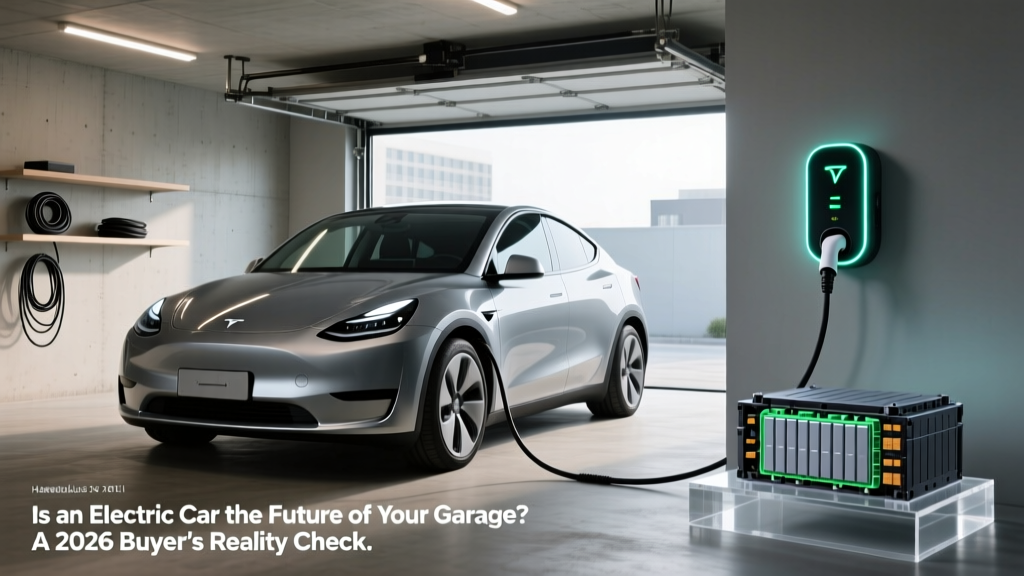
The hidden costs most buyers miss: Level 2 home charger installation is rarely just plugging in a box. A dedicated 240V/40A circuit typically requires an electrician visit ($500–$1,200 for straightforward installs). If your home has a 100A electrical panel — common in older homes — you may need a panel upgrade to 200A, adding $1,500–$3,000. Always get a quote before committing to an EV purchase.
Range, Charging, and the Real-World Caveats Nobody Mentions
When a manufacturer advertises 300 miles of EPA range, that is a laboratory-tested combined city/highway figure. Here is what to actually expect from a typical 2026 EV with an EPA rating of 300 miles:
- City driving (mild weather): ~290–310 mi — regenerative braking helps enormously
- Highway driving (70–75 mph): ~240–270 mi — aerodynamic drag dominates at speed
- Cold weather (below 30°F): ~200–240 mi — battery chemistry slows, cabin heating draws 2–5 kW
- Cold + highway combined: ~180–220 mi — worst-case scenario
Charging speed is equally nuanced. A vehicle rated for 250 kW peak DC fast charging does not sustain 250 kW for the entire session. The charge curve tapers significantly above 80% SoC to protect battery health. A typical 10–80% session on a 250 kW-capable EV takes 18–25 minutes, but going from 80–100% can add another 20–30 minutes. For road trips, plan to charge to 80% and move on — the time saved driving outweighs the slow final 20%.
Connector compatibility has largely consolidated around NACS (Tesla's standard) in North America as of 2025–2026. Ford, GM, Rivian, Hyundai, and others now ship with NACS ports, granting access to Tesla Superchargers. Legacy CCS vehicles still use adapters. Before buying, verify the vehicle's connector type and the charging networks available along your common routes.
Common EV Myths — Debunked with Data
| Myth | Fact (with data) |
|---|---|
| "EV batteries need replacing every 5 years" | Federal warranty mandates 8 yr/100k mi coverage. Real-world degradation data shows most NMC batteries retain 85–90% capacity at 100k miles. Fueleconomy.gov lists expected battery lifespans exceeding 150k–200k miles. |
| "EVs are worse for the environment because of electricity generation" | Even on a coal-heavy US grid, a 2026 EV produces roughly 50–60% fewer lifetime CO₂ emissions than a comparable gas car (Union of Concerned Scientists, 2025 update). On a clean grid (CA, NY, PNW), the advantage exceeds 75%. |
| "You can't take an EV on a road trip" | The US now has over 70,000 public DC fast-charging ports. A 300-mile-range EV charging to 80% in 20 minutes can cover 600+ miles in a day with two stops. Planning apps (A Better Routeplanner, PlugShare) make this routine. |
| "EVs cost more to insure and always will" | EV insurance premiums are 15–25% higher on average, but the gap is narrowing as repair data matures and EV market share grows. Some insurers now offer EV-specific discounts. |
| "The tax credit is gone / I definitely qualify" | Neither is universally true. The §30D credit still exists in 2026 but has strict income caps, MSRP caps, and battery-sourcing requirements that change annually. Some popular models qualify for the full $7,500; others qualify for $3,750 or nothing. Check the IRS qualified vehicle list before buying. |
Who Should Buy an EV — and Who Should Wait?
The decision framework below is based on thousands of real ownership scenarios. Use it honestly.
Buy an EV in 2026 if:
- You can install a Level 2 charger at home (garage, driveway, or workplace with charging)
- Your daily driving is under 200 miles round-trip
- You plan to keep the vehicle 5+ years (to recoup the upfront premium via fuel savings)
- You qualify for the §30D tax credit or your state offers meaningful rebates
- You value lower maintenance, instant acceleration, and one-pedal driving
- You live in a mild-to-moderate climate, or you accept 20–30% cold-weather range loss
Consider a hybrid (HEV/PHEV) instead if:
- You live in an apartment or street-park with zero charging access
- You regularly drive 350+ miles between stops in areas with sparse DC fast-charging infrastructure
- Your budget is strictly under $30,000 and you need a new vehicle
- You frequently tow heavy loads (trailers, boats) over long distances
- You live in an extreme-cold climate (–20°F regular) and cannot garage the vehicle
Wait on an EV if:
- You need a vehicle under $25,000 and the used EV market doesn't offer what you need
- Your local utility charges peak rates above $0.30/kWh with no off-peak discount
- You're buying primarily for resale value — EV depreciation is still steeper than gas/hybrid in many segments
What Every First-Time EV Buyer Needs to Know Before Signing
If you've decided an electric car is the future for your household, here are the practical steps that separate satisfied owners from frustrated ones:
- Get an electrician quote before buying. Know your panel capacity and installation cost. A $2,000 panel upgrade surprise can sour the experience.
- Test the actual commute. Drive the EV on your real route, at your real speed, in your real weather. EPA stickers don't account for your 75-mph highway with a mountain pass.
- Verify the tax credit for your exact VIN. The dealer may claim eligibility, but the IRS qualified vehicles list is the authoritative source. The credit can be transferred at point of sale as an instant price reduction.
- Understand charging times. A Level 1 (120V) outlet adds roughly 3–5 miles of range per hour — fine for a PHEV with 30 miles of electric range, inadequate for a BEV with a depleted 80 kWh battery. A Level 2 (240V) home charger adds 25–40 miles per hour. Plan accordingly.
- Download PlugShare or ChargePoint before delivery day. Know where your nearest reliable DC fast chargers are. Not all public chargers work — check recent user reviews and success rates.
- Precondition your battery before fast charging. Most EVs allow you to navigate to a charger in the infotainment system, which warms the battery to optimal temperature and can shave 5–10 minutes off your charge session.
- Budget for tires. EV-specific tires (like Michelin Pilot Sport EV or Hankook iON) cost $200–$350 per tire and wear 20–30% faster than gas-car tires due to vehicle weight and instant torque.
Frequently Asked Questions
How long do EV batteries actually last?
Based on fleet data from Tesla, Hyundai, and independent analysis, modern NMC and LFP batteries typically retain 85–92% of original capacity after 100,000 miles. Federal law requires manufacturers to warrant at least 70% capacity retention for 8 years or 100,000 miles (10 years/150,000 miles in CARB states like California). Full battery replacements are rare and typically cost $8,000–$18,000 depending on the vehicle, but most owners will sell the car before needing one.
Is home charging really cheaper than gas?
Yes, dramatically so. At the US average residential electricity rate of ~$0.16/kWh (EIA, 2025), charging an EV with a 75 kWh battery from empty to full costs roughly $12 — for 250–300 miles of range. That's equivalent to paying about $1.20 per gallon of gasoline. Even at higher state rates ($0.25–$0.30/kWh in CA, MA, NY), the per-mile cost is still 40–50% less than gas. Public DC fast charging is more expensive ($0.30–$0.55/kWh) but still generally cheaper per mile than gasoline.
Do I need a special electrical panel for an EV?
Not always, but possibly. Most Level 2 home chargers draw 32A–48A on a 240V circuit. If your home has a modern 200A electrical panel with available capacity, installation is straightforward ($500–$1,200). If you have an older 100A panel, you may need an upgrade ($1,500–$3,000) or a smart load-management device like the Emporia V2 with automatic circuit sharing, which can avoid a panel upgrade entirely.
What happens if I run out of charge on the road?
The same thing that happens if you run out of gas — you're stranded and need a tow. The difference is that EV range estimates in 2026 are highly accurate (within 5–10 miles), and navigation systems proactively route you through chargers. Running out is almost always a planning failure, not a technology failure. Most EVs also have a "turtle mode" that limits speed to ~15 mph for the final 5–10 miles to help you reach a charger.
Are EVs actually the future, or is hydrogen/hydrogen hybrid the answer?
For passenger vehicles, battery-electric has won the infrastructure race. As of 2026, there are over 70,000 public DC fast-charging ports in the US versus fewer than 60 public hydrogen stations (nearly all in California). Hydrogen fuel cells remain relevant for heavy trucking and industrial applications, but for cars and SUVs, the electric car is the future — it's just a matter of whether that future has arrived for your specific situation yet.