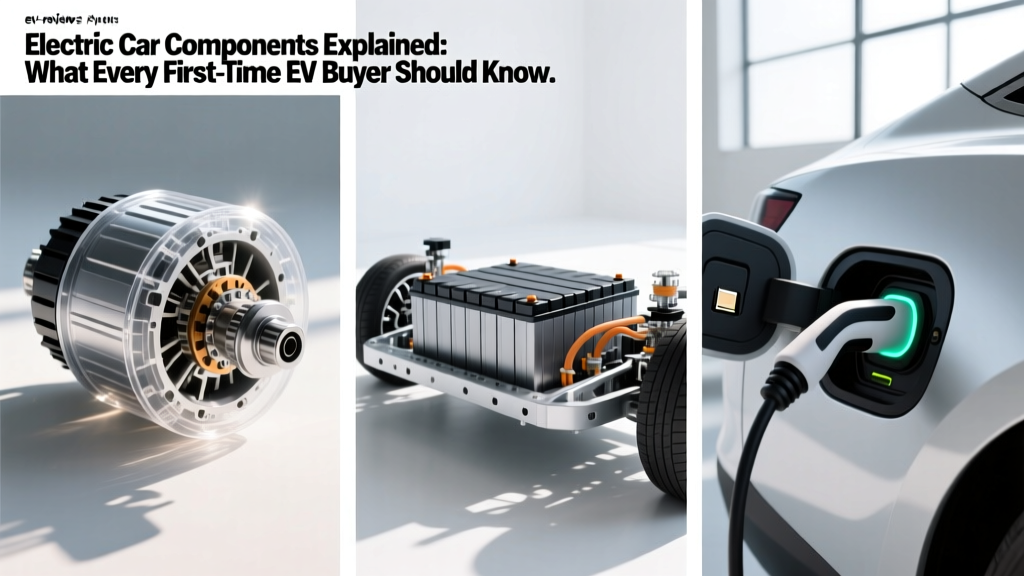
If you're shopping for your first EV, understanding electric car components isn't just academic—it directly affects what you'll pay, how far you'll drive, and how fast you'll charge. An electric vehicle replaces the gas engine, fuel tank, transmission, and exhaust system with four core electric components: a high-voltage traction battery (stores energy in kWh), an electric motor (converts energy to motion), a power inverter (converts DC battery power to AC motor power), and an onboard charger (manages AC-to-DC conversion for Level 1 and Level 2 charging). Together, these parts are simpler, have fewer moving pieces, and cost less to maintain than a gas powertrain—but they introduce new variables like battery chemistry, charge-curve taper, and cold-weather range loss that every buyer must evaluate.
⚡ Quick Answer: How EV Components Differ From Gas Cars
A gas car has ~2,000 moving parts in its powertrain. An EV has roughly ~20. The battery pack (60–100+ kWh) is the single most expensive component, typically costing $8,000–$18,000 to replace out of warranty, but it's covered for 8 years/100,000 miles federally. The electric motor and inverter rarely fail. Maintenance savings average $4,600 over the vehicle's lifetime versus a gas car, per fueleconomy.gov.
The 4 Core Electric Car Components and What They Do
Every battery-electric vehicle (BEV) shares the same fundamental architecture. Here's what each component actually does, with real-world numbers from current 2026 models.
1. Traction Battery Pack (kWh Capacity)
The battery is the EV's fuel tank. Capacity is measured in kilowatt-hours (kWh)—the total energy stored, not the rate of delivery. A 2026 Hyundai Ioniq 5 carries a 84 kWh usable battery (NMC chemistry); a Tesla Model Y Long Range uses approximately 75 kWh (NMC); a base Tesla Model 3 RWD uses ~57.5 kWh (LFP chemistry).
Chemistry matters: NMC (nickel-manganese-cobalt) batteries offer higher energy density, translating to more range in a lighter package. LFP (lithium iron phosphate) batteries are heavier and less energy-dense but tolerate daily 100% charging, last more cycles, and cost less. If you charge at home nightly and want maximum longevity, LFP is the pragmatic pick. If you road-trip frequently and need maximum range, NMC delivers.
2. Electric Motor (Horsepower and Torque)
Electric motors deliver peak torque at 0 RPM—no revving needed. A single-motor 2026 Chevrolet Equinox EV produces 213 hp; a dual-motor Tesla Model Y Performance makes 456 hp and hits 0-60 mph in 3.5 seconds. Most daily-driver EVs use a single permanent-magnet synchronous motor on one axle; dual-motor setups add a second (often induction-type) motor for all-wheel drive and extra power.
3. Power Inverter
The inverter converts DC power from the battery into AC power for the motor, and modulates frequency to control motor speed. It also handles regenerative braking—when you lift off the accelerator, the motor becomes a generator, the inverter converts AC back to DC, and energy flows back into the battery. This is what enables one-pedal driving and reduces brake-pad wear to the point where many EV owners replace pads only every 80,000–100,000+ miles.
4. Onboard Charger (kW Rating for AC Charging)
The onboard charger converts AC power from your home outlet or Level 2 station into DC power for the battery. Its capacity, measured in kW (kilowatts—power, not energy), determines your Level 2 charging speed. A 2026 Ford Mustang Mach-E has an 11.5 kW onboard charger, meaning it can accept up to 11.5 kW from a Level 2 source, adding roughly 30–33 miles of range per hour. DC fast charging bypasses the onboard charger entirely, which is why DC speeds are so much higher (150–350 kW).
EV vs Gas Car: Component and Cost Comparison
Understanding the parts is useful, but most buyers want to know: does an EV actually save money? Here's a 5-year ownership comparison between a 2026 Tesla Model 3 RWD ($38,990 MSRP) and a comparably equipped 2026 Toyota Camry LE gas sedan ($29,995 MSRP), assuming 12,000 miles/year, home Level 2 charging at $0.14/kWh national average, and gas at $3.30/gallon.
| Category | 2026 Tesla Model 3 RWD | 2026 Toyota Camry LE |
|---|---|---|
| Base MSRP | $38,990 | $29,995 |
| Federal Tax Credit (§30D) | –$7,500 (if eligible) | $0 |
| Effective Purchase Price | $31,490 | $29,995 |
| Fuel/Energy (5 years, 60k mi) | ~$3,400 (26 kWh/100mi × $0.14) | ~$6,600 (32 MPG × $3.30/gal) |
| Maintenance (5 years) | ~$1,200 | ~$3,400 |
| Insurance (5-year avg.) | ~$9,500 | ~$7,200 |
| 5-Year Total (est.) | ~$45,590 | ~$47,195 |
The EV wins on energy and maintenance by a wide margin—saving roughly $5,400 over five years. But higher insurance premiums (typically 15–30% more for EVs, per industry data) eat into that advantage. The breakeven point depends heavily on your local electricity rate, annual mileage, and whether you qualify for the federal tax credit. Check current §30D eligibility rules—income caps ($150k single / $300k joint), MSRP caps ($55k sedans / $80k SUVs/trucks), and battery-sourcing requirements—on irs.gov before assuming you'll receive the full $7,500.
What Electric Car Components Cost to Replace
The biggest fear among first-time EV buyers is a catastrophic battery bill. Here's what out-of-warranty replacement actually looks like for major components, alongside the warranty coverage that protects you.
| Component | Est. Replacement Cost | Federal Min. Warranty | Failure Likelihood |
|---|---|---|---|
| Traction Battery | $8,000–$18,000 | 8 yr / 100,000 mi (capacity ≥70%) | Very Low (<2% within warranty) |
| Electric Motor | $3,000–$7,000 | 8 yr / 100,000 mi (powertrain) | Extremely Low |
| Power Inverter | $2,000–$5,000 | 8 yr / 100,000 mi (powertrain) | Low |
| Onboard Charger | $1,500–$3,500 | 3–5 yr / 36k–60k mi (varies) | Low–Moderate |
| 12V Auxiliary Battery | $200–$500 | 3 yr / 36,000 mi | Moderate (every 3–5 years) |
Battery degradation is real but gradual. Most NMC packs lose roughly 10–15% capacity over 150,000 miles. LFP packs degrade even slower. The federal warranty mandates that if your battery drops below 70% capacity within 8 years or 100,000 miles, the manufacturer must repair or replace it at no cost. In practice, very few batteries require full replacement—most warranty claims involve module-level repairs.
Common Misconceptions About EV Components
| Myth | Fact |
|---|---|
| "EV batteries need replacing every 5 years." | Modern packs are engineered for 15–20 years of service. Most retain 85–90% capacity at 100,000 miles. Data from Tesla's 2025 Impact Report shows ~12% average degradation at 200,000 miles. |
| "EVs have no maintenance costs." | Lower, not zero. You still need tire rotations (EVs wear tires ~20% faster due to weight and torque), cabin air filters, brake fluid checks, windshield washer fluid, and 12V battery replacement. |
| "Electric motors wear out like gas engines." | Electric motors have one moving part (the rotor). There are no pistons, valves, timing chains, or oil to degrade. Motor failures before 200,000 miles are rare. |
| "Regenerative braking means you never replace brake pads." | Regen dramatically reduces friction brake use—many owners see 80,000–120,000+ miles on original pads. But brake fluid still needs flushing every 2–3 years, and rotors can corrode from underuse in mild climates. |
| "Cold weather destroys EV batteries." | Cold reduces range temporarily (20–30% loss at 20°F), but doesn't damage the battery. Preconditioning—warming the battery before driving or charging—mitigates most of the loss. This is a seasonal efficiency issue, not a longevity problem. |
Real-World Ownership: What First-Time Buyers Must Consider
Knowing the components is step one. How those components perform in your specific life is what actually determines satisfaction.
Home Charging Access Is the Make-or-Break Factor
If you can install a Level 2 (240V) home charger, EV ownership is effortless—you wake up every morning with a full battery. A typical Level 2 installation costs $800–$2,500 (equipment + electrician + permit), depending on whether your electrical panel needs an upgrade. A 200-amp panel usually suffices for a 48-amp (11.5 kW) charger. If you're renting, live in a condo without charging access, or rely entirely on street parking, EV ownership becomes significantly harder. Public DC fast charging costs 2–4× more per kWh than home charging and isn't designed for daily use—frequent DC fast charging can accelerate battery degradation.
Climate and Driving Patterns Affect Range
EPA range estimates are measured in mild conditions at mixed city/highway speeds. Real-world results differ:
- Highway driving (70–80 mph): Expect 10–20% less than EPA range due to aerodynamic drag.
- Cold weather (below 32°F): Expect 20–30% range reduction from battery chemistry slowdown and cabin heating demands. A heat pump (standard on most 2026 EVs) reduces this penalty to ~15–20%.
- Mountain driving: Climbing consumes extra energy; regenerative braking on descents recovers some of it.
A 2026 Hyundai Ioniq 5 with an EPA-estimated 310 miles of range might deliver ~250 miles on a 75°F highway trip, ~220 miles in 25°F conditions, and ~200 miles on a cold highway run. Plan trips around these real numbers, not the sticker.
Decision Framework: Is an EV Right for Your Situation?
🔍 Choose Based on Your Actual Situation
Choose a BEV (full electric) if:
- You have home or workplace Level 2 charging access
- Your daily commute is under 80 miles round-trip
- You qualify for the §30D federal tax credit (check income and MSRP caps)
- You want minimum maintenance and lowest per-mile fuel cost
- You're comfortable planning road trips around DC fast-charging stops
Choose a PHEV (plug-in hybrid) if:
- You can charge at home but frequently drive 200+ miles without stopping
- You want 25–50 miles of daily electric-only range with gas backup for long trips
- You live in an area with sparse public charging infrastructure
- You're not ready to commit to full electric but want to reduce fuel consumption
Stick with a gas car or HEV (hybrid) if:
- You have no access to any level of home or workplace charging
- You regularly tow heavy loads (trailers, boats) over long distances
- You live in an extreme cold-weather region and drive long distances daily
- Your budget can't absorb the higher upfront cost, even with incentives
Frequently Asked Questions About Electric Car Components
Do electric car components require special maintenance?
Not really. The traction battery, motor, and inverter are essentially sealed, maintenance-free units. You'll never need an oil change, spark plug replacement, timing belt service, or transmission fluid flush. Your recurring maintenance items are tire rotations (every 5,000–7,500 miles), cabin air filter replacement (~$30–$60 every 15,000–20,000 miles), brake fluid flush (every 2–3 years), wiper blades, and windshield washer fluid. Total annual maintenance runs $200–$400 for most EVs versus $600–$1,200 for gas equivalents.
What happens if the 12V battery dies in an EV?
EVs have a standard 12V auxiliary battery (some newer models use a 12V lithium unit) that powers the computer, lights, door locks, and infotainment. If it dies, the car won't start—even if the main traction battery is full. You can jump-start the 12V battery just like a gas car. Most EVs automatically maintain the 12V battery from the main pack when plugged in, so keeping your EV plugged into Level 2 at home prevents this issue entirely.
Can I upgrade my EV's battery for more range later?
Practically, no. Battery packs are vehicle-specific, integrated into the chassis, and cost $8,000–$18,000+. No manufacturer currently offers a consumer "range upgrade" battery swap program in the US market. Buy the range you need at purchase. A good rule of thumb: choose a battery with at least 30% more EPA-rated range than your typical daily driving to account for degradation, weather, and highway losses.
How long do electric motors last compared to gas engines?
Electric motors routinely outlast gas engines. A well-maintained gas engine might reach 150,000–200,000 miles before major work. An electric motor has no internal combustion wear—no piston rings, no valve train, no head gasket. Motors from early Tesla Model S vehicles (2012–2014) have exceeded 300,000 miles without replacement. The motor is one of the most reliable components in any vehicle, electric or otherwise.
Does DC fast charging damage electric car components?
Frequent DC fast charging (multiple times per week over years) can accelerate battery degradation by a few percentage points compared to exclusive Level 2 charging. Modern battery thermal management systems mitigate most of this damage by actively cooling the pack during fast charging. For daily use, Level 2 home charging is ideal. Use DC fast charging for road trips without worry—just avoid making it your only charging method. Per ENERGY STAR, Level 2 home chargers are the most efficient and cost-effective way to charge.
Are EV components covered if I buy used?
Yes. The federal 8-year/100,000-mile battery and powertrain warranty transfers to subsequent owners automatically. If you buy a 3-year-old EV with 40,000 miles, you still have 5 years / 60,000 miles of battery and powertrain coverage remaining. Always check the remaining warranty before purchasing a used EV, and consider a pre-purchase battery health check (some dealers and third-party services offer State of Health reports).