Quick Answer: All electric camper trailers exist in 2026, but they fall into two categories: electric-axle trailers (like the Lightship L1 and Airstream e-Travel Concept) that use their own battery to assist the tow vehicle, and off-grid camper builds with large LFP house batteries for living power. True electric-axle trailers can add 50–100 miles of range back to your EV tow vehicle on the highway, but they cost $60,000–$125,000+ and are still low-volume. If you want to camp off-grid without a generator, a conventional trailer with a 10–20 kWh LFP house-battery system ($8,000–$20,000 add-on) is the practical choice today.
What "All Electric Camper Trailer" Actually Means in 2026
The term is overloaded. When shoppers search for all electric camper trailers, they're usually looking for one of three things:
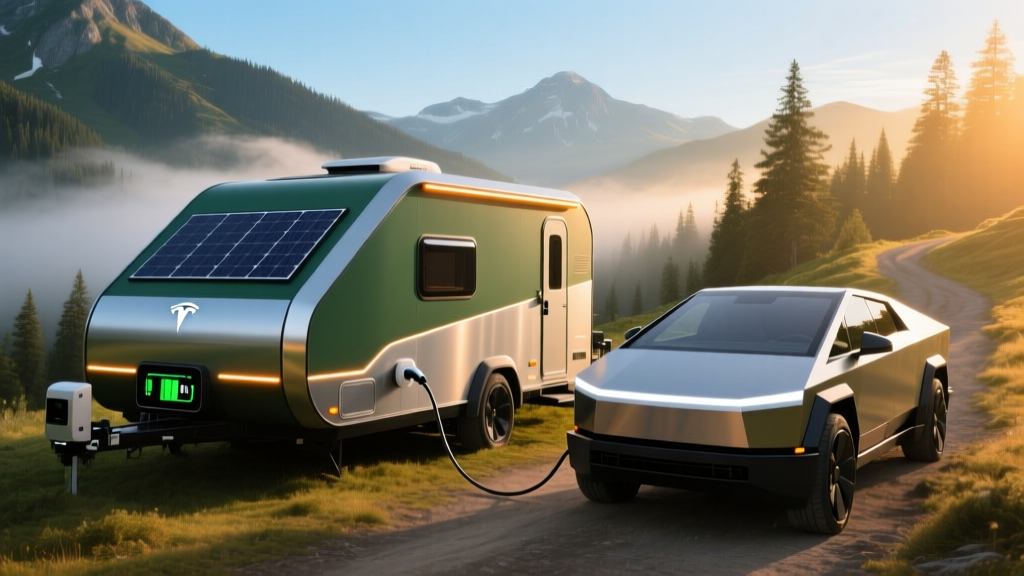
- Electric-axle travel trailers — trailers with their own drivetrain battery (40–80 kWh usable) and electric motors on the axle that provide propulsion assist to the tow vehicle. These reduce range loss while towing and can even power the trailer independently at low speeds (think: maneuvering at a campsite). Examples: Lightship L1 (announced deliveries 2025–2026), Airstream e-Travel Concept.
- Campers with large house-battery systems — conventional trailers or truck campers equipped with 10–20+ kWh of LFP batteries, solar arrays (400–1200W), and all-electric appliances (induction cooktop, heat pump HVAC, no propane). Examples: Winnebago Solis 59PX variants, Oliver Travel Trailers with lithium packages, and custom teardrop builds.
- Electric-powered campervans (Class B RVs) — built on EV van platforms. The Ford E-Transit-based Winnebago e-RV (limited pilot) remains the closest thing, but volume production of a fully electric Class B is still pre-2027.
This guide focuses primarily on the first two categories — trailers you tow behind an EV — because that's where the real buying decisions and range-tradeoff math happen in 2026.
The Range Problem: What Towing Does to Your EV
Before we get to trailer specs, let's anchor the physics. Towing a 4,000–5,500 lb travel trailer behind a battery-electric SUV roughly doubles the energy consumption at highway speeds. A Rivian R1S or Ford F-150 Lightning that achieves 2.0–2.2 mi/kWh solo will drop to 1.0–1.3 mi/kWh while towing on flat terrain at 65 mph — and as low as 0.8 mi/kWh in headwinds or grades.
| Vehicle | Solo range | Towing range (est.) | Energy/fuel cost per 100 mi towing |
|---|---|---|---|
| Ford F-150 Lightning (131 kWh, EPA 320 mi) | 320 mi | ~140–160 mi | ~$18–$22 (DC fast, $0.40/kWh avg) |
| Rivian R1T Dual Max (149 kWh, EPA 352 mi) | 352 mi | ~160–185 mi | ~$17–$21 |
| Chevy Silverado 1500 5.3L V8 (24 gal, EPA 22 mpg) | ~528 mi | ~200–240 mi (10–12 mpg) | ~$28–$34 ($3.40/gal) |
| Ford F-150 3.5L EcoBoost (36 gal, EPA 20 mpg) | ~720 mi | ~280–320 mi (8–9 mpg) | ~$38–$42 |
Real-world caveat: EPA range numbers are for the vehicle unloaded. When towing, expect a 45–55% reduction for BEVs on flat highway, worse in mountains or cold (sub-30°F adds another 15–20% loss). Plan trips around ~100–120 usable miles between charging stops with a 5,000 lb trailer behind a long-range BEV pickup.
This is exactly the gap that electric-axle trailers aim to close.
Electric-Axle Trailers: The 2026 Contenders
Lightship L1
The Lightship L1 is the most production-advanced electric-axle travel trailer as of early 2026. Key specs (preliminary, based on manufacturer announcements and pre-production testing):
- Battery: ~80 kWh usable (NMC chemistry), integrated into the chassis
- Propulsion assist: electric motor on the trailer axle provides up to ~100 miles of range extension to the tow vehicle at highway speeds
- Weight: target ~7,500 lb GVWR — meaning you need a tow vehicle rated for at least that (R1T, F-150 Lightning, Silverado EV, Cybertruck)
- Aerodynamics: claimed Cd significantly lower than conventional boxy travel trailers, reducing towing drag by ~30% vs. equivalent-size conventional trailer
- House power: the 80 kWh pack also serves as a massive off-grid house battery — enough for 5–7 days of all-electric living (induction, heat pump HVAC, no propane)
- Price: announced starting around $125,000 before options
- Availability: limited initial deliveries began late 2025; 2026 is the first meaningful production year
Airstream e-Travel Concept / Production Direction
Airstream has shown the e-Travel Concept with an electric axle developed in partnership with ZF. As of early 2026, production timing and final pricing remain unannounced, but the engineering direction is similar: 40–60 kWh trailer battery, propulsion assist, and full-electric living. Expect MSRP in the $90,000–$130,000 range when it reaches production.
House-Battery Campers: The Practical 2026 Option
If you don't need propulsion assist and just want to ditch the generator and propane, a conventional travel trailer with a robust LFP house-battery system is achievable now at much lower cost.
| Feature | Propane + AGM battery setup | LFP + solar all-electric setup |
|---|---|---|
| House battery capacity | ~1–2 kWh (lead-acid/AGM) | 10–20 kWh (LFP) |
| Solar array | 0–200W typical | 600–1,200W roof + portable |
| Cooktop | Propane 2-burner | Induction (1,800W) |
| Heat | Propane furnace | Heat pump (3,000–5,000 BTU, ~800W draw) |
| Hot water | Propane tank heater | Electric tankless (high draw) or heat-pump water heater |
| Off-grid duration (no shore power) | 5–14 days (propane refill needed) | 3–7 days (sun-dependent) |
| Added cost vs base trailer | — (standard) | $8,000–$20,000 |
| Annual maintenance | Propane recert, regulator, leak checks | Minimal (BMS monitoring) |
LFP (lithium iron phosphate) is the right chemistry here: it tolerates daily deep cycling, has a 10–15 year calendar life, and is safer (no thermal runaway risk at the cell level) than NMC. The tradeoff is weight and volume — a 20 kWh LFP bank adds ~350–400 lbs and needs a dedicated, ventilated compartment.
Tow-Vehicle Compatibility: What Can Actually Pull These
Not every EV is a tow vehicle. Here's what matters:
- Max tow rating: You need at least 1,500 lbs of margin above the loaded trailer weight. A 5,000 lb trailer loaded to 5,800 lb needs a vehicle rated for 7,500+ lbs.
- Payload capacity: Tongue weight (typically 10–15% of trailer weight = 500–750 lbs) eats into the EV's payload. Many EV SUVs have payload ratings of 900–1,200 lbs total — two adults + cargo + tongue weight adds up fast.
- Battery size: For any meaningful towing range, you want 130+ kWh usable. Smaller packs (75–100 kWh) make towing a local-only affair.
- Charging port access: With a trailer hitched, you can't back into many DC fast-charger stalls. Pull-through chargers exist but are still rare. Plan your route around pull-through sites (search for "EV pull-through" on PlugShare/A Better Routeplanner).
| Vehicle | Max tow rating | Battery (usable) | EPA range | Est. towing range (5k lb) | Base MSRP |
|---|---|---|---|---|---|
| Ford F-150 Lightning Ext. Range | 10,000 lb | 131 kWh | 320 mi | ~140–160 mi | ~$72,000 |
| Rivian R1T Dual Max | 11,000 lb | 149 kWh | 352 mi | ~160–185 mi | ~$87,000 |
| Chevrolet Silverado EV 4WT | 10,000 lb | 200 kWh (est.) | 400+ mi | ~190–220 mi | ~$75,000 |
| Tesla Cybertruck AWD | 11,000 lb | ~123 kWh | 325 mi | ~140–160 mi | ~$80,000 |
| Kia EV9 GT-Line AWD | 5,000 lb | 99.8 kWh | 270 mi | ~115–130 mi (light trailer) | ~$74,000 |
Real-World Ownership Costs: EV Towing vs Gas Towing
Towing is where EVs lose the energy-cost argument — at least on public DC fast charging. At home on Level 2, the math flips.
| Cost category | F-150 Lightning (EV) | F-150 3.5L EcoBoost (gas) |
|---|---|---|
| Energy/fuel — towing miles (home L2 @ $0.14/kWh / $3.40 gal) | $2,520 (5 yr) | $8,500 (5 yr) |
| Energy/fuel — towing miles (DCFC @ $0.40/kWh) | $7,200 (5 yr) | $8,500 (5 yr) |
| Maintenance (5 yr) | ~$1,500 | ~$4,500 |
| Insurance (avg annual premium, towing use) | ~$2,400/yr | ~$1,900/yr |
| Purchase price delta (Lightning vs EcoBoost) | +$10,000–$15,000 | baseline |
Bottom line: If you tow mostly on weekend trips where you can charge at home before and after, the EV wins on operating cost. If you tow cross-country and rely on DC fast charging, the fuel-cost advantage largely disappears — and you'll spend significantly more time at charging stops (30–45 minutes to 80% at a 150–250 kW stall, vs. 5 minutes at a gas pump).
Common Misconceptions About Electric Camper Trailers
| Myth | Fact |
|---|---|
| "Electric trailers recharge themselves while driving." | No. Electric-axle trailers use stored battery energy to assist propulsion, reducing tow-vehicle load. Regen on downhill grades recovers some energy, but net consumption is still positive. |
| "You can tow any camper with any EV." | Most EV SUVs (Ioniq 5, Model Y, EV6) are rated for 1,600–3,500 lbs — enough only for teardrops and small pop-ups. Full-size travel trailers require an EV pickup or large SUV with a 7,500+ lb rating. |
| "Solar on the trailer roof will keep the battery full." | Typical roof space fits 400–800W of solar, producing 1.5–4 kWh/day depending on latitude and season. That's enough for lights and a fridge, not air conditioning or induction cooking (which can draw 1.5 kW continuous). |
| "All-electric campers qualify for the §30D $7,500 federal tax credit." | The §30D credit applies to qualified plug-in electric motor vehicles — the tow vehicle, not the trailer. A trailer is not a motor vehicle under IRS rules. However, the LFP house-battery system may qualify as a residential energy-storage credit under §25D (30% of cost) if it meets the 3 kWh minimum — consult a tax professional. |
| "Towing voids the EV battery warranty." | Towing within the manufacturer's rated capacity does not void the battery or powertrain warranty. Exceeding the rating, or modifying the hitch/tow software, can. |
For the §30D federal EV tax credit on your tow vehicle, 2026 rules under IRS guidelines include MSRP caps ($80,000 for pickups/SUVs), buyer AGI limits ($300k joint / $150k single), and critical-mineral/battery-component sourcing requirements that exclude many models. Always verify eligibility at purchase — rules can shift mid-year.
Charging Logistics: What Trip Planning Actually Looks Like
Towing with an EV in 2026 is feasible on well-developed corridors (I-5, I-10, I-70, I-80, I-95) but still painful on secondary routes. Plan for:
- Charging frequency: every 100–130 miles with a 5,000 lb trailer behind a long-range EV pickup.
- Session time: 25–45 minutes per stop (10–80% at a 150–250 kW DCFC; towing heats the battery faster, which can trigger thermal throttling and slow the charge curve).
- Pull-through availability: growing but still limited. Electrify America and Tesla Supercharger networks are adding pull-through stalls; PlugShare filters can identify these.
- Campsite charging: Level 1 (120V/12A) adds ~3–4 miles of range per hour — useless for the tow vehicle but fine for topping a camper's house battery. Many state parks and private campgrounds now offer 30A or 50A NEMA 14-50 outlets; a portable Level 2 EVSE (like the Tesla Mobile Connector or Lectron V-Box) can pull 7–11 kW from a 50A/240V outlet.
Cold-weather towing warning: Below 30°F, expect another 15–25% range loss on top of the towing penalty. A 320-mile EPA EV pickup pulling a trailer in January in Colorado may realistically deliver only 90–110 miles between charges. Precondition the battery (most EVs do this automatically when a charger is set in nav) before every DCFC stop to maintain charge speed.
Decision Framework: Which Electric Camper Setup Is Right for You?
Choose an electric-axle trailer (Lightship L1, future Airstream) if:
- You tow frequently (10+ trips/year) and want to extend EV towing range
- You have a 10,000+ lb-rated EV pickup (R1T, Lightning, Silverado EV)
- Budget allows $100,000+ for the trailer
- You want 5–7 days of off-grid living with no propane and no generator
Choose a conventional trailer + LFP house battery if:
- Budget is under $60,000 total for the trailer
- You primarily want off-grid comfort (no generator noise, no propane refills)
- You accept that the tow vehicle's range will drop 45–55% while towing
- You want something you can buy and configure in 2026 from an established manufacturer
Stick with a hybrid or gas truck for towing if:
- You tow cross-country multiple times per year
- Your routes go through charging deserts (rural Midwest, parts of the Mountain West)
- You need 400+ mile towing range without stopping
- Your existing EV's tow rating is below the trailer weight you need
Frequently Asked Questions
Do all electric camper trailers exist that I can buy today?
Electric-axle trailers like the Lightship L1 are in early production as of 2026, with limited availability and long waitlists. Conventional travel trailers with large LFP house-battery systems and all-electric appliances are widely available from manufacturers like Oliver, Escape, and Airstream (as options/packages) and from custom upfitters.
Can I charge my EV tow vehicle while the electric camper is hooked up?
Yes, but only at pull-through charging stalls or sites where the cable reaches the charge port with the trailer attached. Backing a trailer into a standard head-in DCFC stall is impractical. Plan routes with tools like A Better Routeplanner (ABRP) using the "towing" mode.
Does the §30D federal tax credit apply to electric camper trailers?
No. Per IRS §30D rules, the credit applies to qualified motor vehicles — a trailer is not self-propelled and does not qualify. The tow vehicle may qualify, subject to MSRP, income, and sourcing limits. A standalone LFP house-battery system installed at your home may qualify under the §25D residential clean energy credit (30% of equipment + installation cost).
What's the best EV for towing a camper trailer in 2026?
For maximum towing range, the Chevrolet Silverado EV with its ~200 kWh pack and 400+ mile EPA rating offers the most buffer. For tow rating and charging network access, the Rivian R1T (NACS-equipped for 2026) and Ford F-150 Lightning remain top picks. Verify fueleconomy.gov for the latest EPA range figures by model year and trim.
How much does an electric-axle trailer cost vs a conventional one?
Electric-axle trailers (Lightship L1 at ~$125,000) cost roughly 2–3× a comparably-sized conventional travel trailer ($40,000–$60,000 for a 25–30 ft model). The value proposition rests on range extension, off-grid capability without propane, and lower per-trip energy cost — but the payback period is long unless you tow very frequently.
Will towing an electric camper damage my EV's battery?
No, when done within the manufacturer's rated tow capacity. Towing does increase battery cycling and thermal load, which accelerates degradation slightly over years — but modern EV thermal management systems handle this. The 8-year/100,000-mile federal battery warranty (mandated minimum) still applies.