The Short Answer on All Electric Camper Trailers
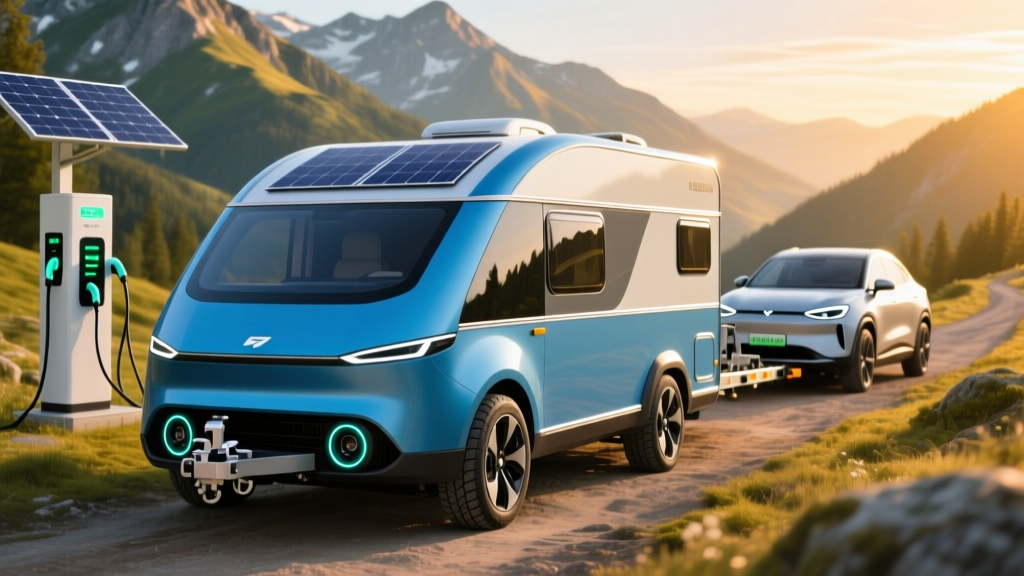
An all electric camper trailer is a lightweight, aerodynamic teardrop or micro-camper designed specifically to minimize range loss when towed by an electric vehicle. Unlike traditional travel trailers weighing 3,500–7,000 lbs, electric-optimized campers typically weigh 1,200–2,500 lbs and feature low-drag profiles that reduce energy consumption at highway speeds. Expect a 25–45% reduction in your EV's EPA-rated range when towing, depending on trailer weight, frontal area, speed, and terrain. For a 300-mile EPA-rated EV, that translates to roughly 165–225 real-world towing miles before needing a charge.
Why Towing With an EV Changes the Equation
Electric vehicles excel at low-speed efficiency but face steep energy penalties at sustained highway speeds — especially when pulling additional mass and frontal area. An EV's regenerative braking recovers far less energy when towing because the trailer's momentum and lack of trailer brakes (on lighter models) limits regen effectiveness on descents.
The physics are straightforward: towing adds rolling resistance proportional to weight and aerodynamic drag proportional to frontal area squared. At 65 mph, aerodynamic drag dominates. A boxy 5,000-lb travel trailer can double your EV's energy consumption per mile, cutting range in half. An aerodynamic electric camper trailer with a teardrop profile might only increase consumption by 30–40%.
| Metric | EV (e.g., Ford F-150 Lightning) | Gas Truck (e.g., Ford F-150 3.5L EcoBoost) |
|---|---|---|
| Energy use while towing | ~550–650 Wh/mile | ~12–14 mpg |
| Effective range while towing | ~170–210 miles | ~280–340 miles (36-gal tank) |
| Refuel/recharge time | 25–40 min (DC fast, 10–80%) | 5–8 min (gas station) |
| Energy cost per mile (towing) | $0.07–$0.18 (varies by rate) | $0.25–$0.35 (at $3.50/gal) |
| Regen braking on descents | Recovers energy (partial) | None — brake wear instead |
The EV's advantage is cost per mile, which can be 50–70% cheaper than gas when charging at home. The disadvantage is range and refill time on road trips. This is why the all electric camper trailer category exists: to shrink the gap by reducing the energy penalty.
What Defines an Electric-Optimized Camper Trailer
Not every lightweight camper qualifies as "electric-optimized." The category has emerged since 2023 as EV owners sought trailers that respect their vehicle's range limitations. Key design features include:
- Sub-2,500-lb GVWR: Keeps gross combined weight within the efficient range of most EVs and crossovers.
- Aerodynamic teardrop or tapered profile: Frontal area under 25 sq ft, compared to 40–60 sq ft for conventional travel trailers.
- Low center of gravity: Battery-electric campers with onboard lithium house batteries place mass low, reducing sway.
- Electric-only appliances: Induction cooktops, heat pump HVAC, and electric water heaters eliminate propane, simplifying campsite logistics and reducing fire risk.
- Solar integration: Roof-mounted 200–400W solar panels to maintain house battery state of charge during boondocking.
2026 Models Worth Tracking
The market for electric-optimized campers is growing but still niche. Key players in 2026 include:
| Model | Dry Weight | Sleeps | Key Feature | Starting MSRP |
|---|---|---|---|---|
| Lightship L1 (announced) | ~4,500 lbs (aero-focused) | 4–6 | Solar roof + optional EV range-extender axle | ~$75,000 (est.) |
| Colorado Teardrops Canyon | ~1,200 lbs | 2 | Ultra-light, fits any EV crossover | ~$15,500 |
| Escapod TOPO2 | ~1,650 lbs | 2 | Off-road capable, Timbren axle | ~$33,500 |
| Polydrop P17 | ~1,100 lbs | 2 | Aluminum exoskeleton, extreme aero | ~$26,000 |
Important note on the Lightship L1: This is an announced/preliminary product as of early 2026. Final specs, pricing, and availability are subject to change. Its self-propelling axle concept — where the trailer has its own battery and motors to offset towing drag — is innovative but unproven at production scale.
Real-World Range Impact: What the Numbers Actually Look Like
EPA range ratings assume no towing, moderate temperatures, and mixed driving. When you hitch up an all electric camper trailer, those numbers change dramatically. Here's what testing and owner data show:
| Trailer Type | Weight | Frontal Area | Typical Range Loss | Example: 320-mi EPA EV |
|---|---|---|---|---|
| Aero teardrop camper | 1,100–1,600 lbs | ~18–22 sq ft | 25–35% | ~210–240 real miles |
| Mid-size electric camper | 2,000–2,800 lbs | ~22–28 sq ft | 35–45% | ~175–210 real miles |
| Traditional travel trailer | 4,000–6,000 lbs | ~40–55 sq ft | 50–65% | ~110–160 real miles |
Cold weather compounds the loss. At 30°F, lithium-ion battery internal resistance increases and cabin heating draws additional power. Expect an additional 15–25% range reduction on top of the towing penalty. A 320-mile EV towing a teardrop in winter might realistically deliver 160–180 miles between charges.
Speed matters enormously. Aerodynamic drag increases with the square of velocity. Driving 70 mph vs. 60 mph can cost 15–20% additional energy. When towing, staying at 60–65 mph is the single most effective range-extending behavior.
Charging While Towing: The Logistics Challenge
This is where most first-time EV-towing buyers underestimate the friction. DC fast charging with a trailer attached presents real obstacles:
- Pull-through chargers are rare. Most DC fast charging stations require you to back in or pull into a standard parking spot. With a trailer, you may need to unhitch, move the trailer aside, charge, then re-hitch — adding 15–30 minutes per stop.
- Some networks are adding pull-through stalls. Electrify America, Tesla Supercharger, and EVgo have begun deploying pull-through stations at highway locations, but coverage is limited as of 2026.
- Charge speed while towing. Most EVs will limit DC fast charge rates when a trailer is connected due to thermal management load. Expect peak rates 10–20% lower than unhitched.
- Destination charging is your friend. Campgrounds with Level 2 (240V, 6–10 kW) charging let you charge overnight — typically adding 25–45 miles per hour of charging, enough to fully replenish most EVs in 8–10 hours.
| Charging Level | Power (kW) | Miles Added/Hour | Time 10–80% (est.) | Trailer Compatible? |
|---|---|---|---|---|
| Level 1 (120V) | 1.2–1.9 kW | 3–5 mi/hr | N/A (too slow for road trips) | Yes (standard outlet) |
| Level 2 (240V, 48A) | 11.5 kW | 30–40 mi/hr | ~8–10 hours (full charge) | Yes (campground pedestal) |
| DC Fast (unhitched) | 150–250 kW | 500–1,000 mi/hr (peak) | ~20–35 min | Usually requires unhitching |
| DC Fast (pull-through) | 150–250 kW | 500–1,000 mi/hr (peak) | ~25–40 min | Yes — limited availability |
Cost Breakdown: EV + Camper vs. Gas Truck + Camper
Let's compare the total cost of a weekend camping trip (400-mile round trip, 2 nights) for two setups:
| Cost Category | EV + Electric Camper (e.g., Lightning + Escapod) | Gas Truck + Travel Trailer (e.g., F-150 Gas + 4,500-lb TT) |
|---|---|---|
| Vehicle energy/fuel (round trip) | $35–$70 (home + DC fast mix) | $100–$140 (at 10–12 mpg towing) |
| Campsite (2 nights, electric hookup) | $60–$100 | $60–$100 |
| Propane for appliances | $0 (all-electric camper) | $15–$25 |
| DC fast charging time cost | ~45–60 min extra per trip | ~10–15 min (gas stops) |
| Total trip energy cost | $35–$70 | $115–$165 |
Over a year of 6 camping trips (2,400 towing miles), the EV setup can save $480–$570 in energy costs alone. However, the EV towing setup requires a higher upfront investment in the vehicle itself, and DC fast charging on remote routes may not always be available.
Home Charging Access: The Make-or-Break Factor
Towing with an EV is dramatically more practical if you have reliable Level 2 home charging. Replenishing 200 miles of towing range overnight (roughly 60–70 kWh) requires a 240V/48A circuit delivering ~11.5 kW. Without home charging, you'll depend on public DC fast chargers — which, as noted, often require unhitching.
If you live in an apartment or lack garage access, a gas truck remains significantly more practical for frequent towing. Be honest about your charging situation before committing.
Common Misconceptions About EV Towing
| Myth | Fact |
|---|---|
| "EVs can't tow campers at all." | Most EVs rated for towing handle 1,500–10,000 lbs. The F-150 Lightning tows 10,000 lbs; the Rivian R1T tows 11,000 lbs. Range is the constraint, not capability. |
| "You'll run out of charge in the middle of nowhere." | With route planning (A Better Route Planner, PlugShare), DC fast chargers exist along most US highway corridors. The real risk is remote forest roads and BLM land — where solar-equipped campers help. |
| "Towing destroys the EV battery." | Towing increases charge cycles, but modern thermal management systems protect the pack. Battery degradation from towing is marginal — expect <1% additional annual degradation for moderate towing use. |
| "All campers work the same behind an EV." | Aerodynamics matter enormously. A 2,000-lb teardrop with 20 sq ft of frontal area uses far less energy than a 2,000-lb box trailer with 45 sq ft of frontal area at highway speed. |
| "The federal EV tax credit covers camper trailers." | It does not. The IRS §30D credit applies to the tow vehicle (if eligible), not the trailer itself. |
Tax Credit and Incentive Context for the Tow Vehicle
While the all electric camper trailer itself does not qualify for federal EV tax credits, the vehicle towing it might. Under current IRS §30D rules, eligible new EVs can receive up to $7,500 in federal tax credits, subject to:
- MSRP caps: $80,000 for SUVs/pickups/vans; $55,000 for sedans.
- Buyer income limits: AGI ≤ $150,000 (single) or ≤ $300,000 (joint).
- Battery sourcing requirements: Critical minerals and battery components must meet escalating domestic/free-trade-agreement thresholds — rules that tighten annually and disqualify some models.
- Point-of-sale transfer: You can transfer the credit to the dealer for an immediate price reduction rather than claiming it on your tax return.
Always verify eligibility at fueleconomy.gov and consult a tax professional. Rules change frequently, and manufacturer/sourcing eligibility shifts throughout the year.
Decision Framework: Is an Electric Camper Trailer Right for You?
Choose an All Electric Camper Trailer If:
- You own or plan to buy an EV with ≥250 miles of EPA range and a tow rating of ≥2,000 lbs.
- You have Level 2 home charging and can replenish overnight.
- Your typical camping trips are within 150–200 miles one-way, or you're willing to plan DC fast charge stops.
- You camp 4–10 nights per year and want to minimize per-trip energy costs.
- You value propane-free camping (no tank refills, no carbon monoxide risk, simpler winterization).
- You prioritize aerodynamics and are willing to accept a smaller, teardrop-style living space.
Stick With a Gas/Diesel Tow Vehicle and Traditional Camper If:
- You regularly tow to remote areas with no DC fast charging infrastructure.
- You need a full-size travel trailer (30+ ft, 5,000+ lbs) with slide-outs and full amenities.
- You lack home charging access and rely on street parking or apartment living.
- You take frequent long-distance towing trips (500+ miles) and cannot accept 30–45 minute charge stops every 150–180 miles.
- You live in a region with extreme cold (below 10°F for extended periods) where compounded range loss makes EV towing impractical for your routes.
What First-Time EV Towing Buyers Should Know
If you're new to both EVs and camper trailers, these practical realities will save you frustration:
- Check your EV's tow rating — and the fine print. Some manufacturers void the battery warranty for sustained towing above certain weights. Read your owner's manual.
- Install a trailer brake controller. Most EVs require an aftermarket or OEM-integrated brake controller for trailers over 1,500 lbs. Electric trailer brakes are mandatory in most states above this threshold.
- Precondition before you tow. Warming or cooling the battery to optimal temperature before a highway tow session improves efficiency and charge acceptance. Most EVs let you precondition via app.
- Use a weight-distribution hitch for heavier loads. Proper tongue weight (10–15% of trailer weight) and a WDH improve stability and reduce energy-wasting sway.
- Plan routes with ABRP or PlugShare. Filter for pull-through or truck-accessible chargers. Not all stations accommodate trailers.
- Budget for higher tire wear. The added mass accelerates tire wear on both the EV and the trailer. Expect to replace EV tires 15–25% sooner if you tow regularly.
- Insurance will cost more. Adding a trailer endorsement and the higher replacement cost of an EV typically increases premiums 10–20%. Get quotes before purchasing.
Frequently Asked Questions
Can any EV tow an all electric camper trailer?
Not every EV has a tow rating. Sedans like the Tesla Model 3 and Hyundai Ioniq 6 have no official tow rating in the US. Crossovers and trucks like the Tesla Model Y (3,500-lb rating), Ford F-150 Lightning (7,700–10,000 lbs), Rivian R1S/R1T, and Hyundai Ioniq 5 (up to 2,300 lbs in select markets) can handle electric-optimized campers. Always verify your specific model year and trim's tow rating — it varies.
How much range will I lose towing a teardrop camper with my EV?
Expect 25–40% range reduction with an aerodynamic teardrop (1,100–2,000 lbs) at 60–65 mph on flat terrain. Cold weather, headwinds, and mountain grades can push this to 45–50%. A 300-mile EPA EV will realistically deliver 180–225 miles while towing a teardrop in moderate conditions.
Do electric camper trailers need their own battery?
Yes — the house battery (separate from the EV's traction battery) powers lights, appliances, HVAC, and USB outlets in the camper. Most electric-optimized campers use 100–200 Ah lithium iron phosphate (LFP) house batteries charged via solar, shore power, or a DC-DC converter from the tow vehicle. This battery is independent and does not affect your EV's driving range.
Can I charge my EV at a campground?
Many campgrounds offer 30A or 50A 240V outlets (NEMA 14-50 or TT-30). A 50A/240V outlet can deliver up to 12 kW — adding roughly 35–45 miles of range per hour. Overnight charging at a campground can fully replenish most EVs. Bring a mobile EVSE (like the Tesla Mobile Connector or JuiceBox) with appropriate adapters.
Is towing with an EV bad for the battery long-term?
Towing increases energy throughput, which means more charge cycles over time. However, modern EV battery management systems actively cool the pack and limit charge/discharge rates to protect longevity. Real-world data from high-mileage EV owners who tow shows only marginally higher degradation — typically 1–2% additional capacity loss over 5 years compared to non-towing use. Your 8-year/100,000-mile battery warranty (federally mandated minimum) still applies.
Does the federal EV tax credit apply to the camper trailer?
No. The IRS §30D clean vehicle credit applies only to the motor vehicle, not to trailers. However, if your tow vehicle is a qualifying new EV, you may be eligible for up to $7,500 depending on MSRP, income, and battery sourcing requirements. Used EV tax credits (§25E, up to $4,000) may also apply if purchasing a pre-owned qualifying EV as your tow vehicle.