The Short Answer on Cadillac's 2025 Electric SUVs
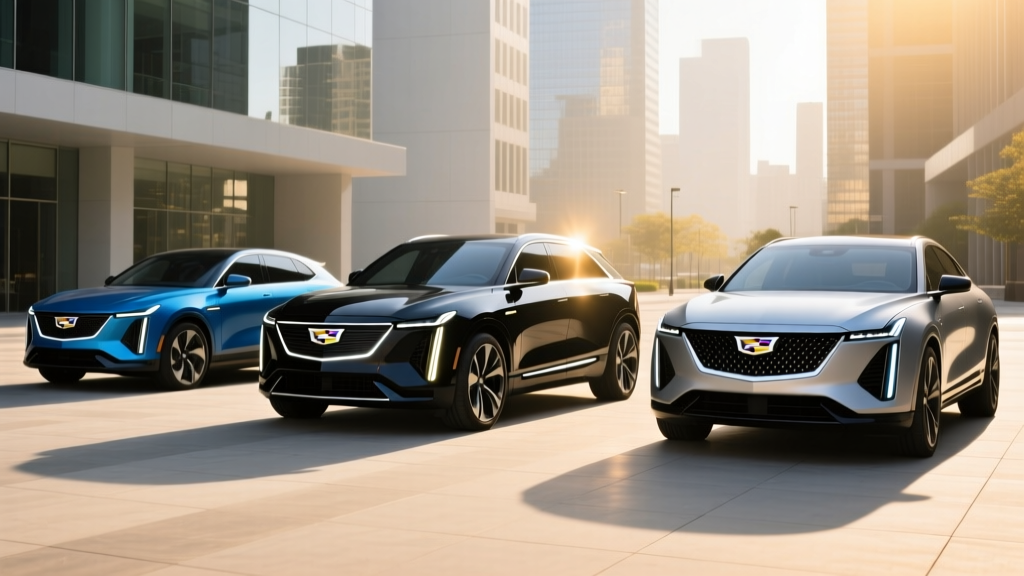
Cadillac offers three electric SUVs for the 2025 model year, all built on GM's Ultium platform with NACS (Tesla-style) charge ports. The Lyriq (midsize, starting at $58,590) delivers up to 314 miles EPA range and is the most proven option. The Optiq (compact, starting at $54,090) is the newest and most affordable entry with 303 miles of range. The Vistiq (three-row, starting at ~$78,790) targets families needing six or seven seats but carries a ~300-mile range penalty for its size. All three support up to 190 kW DC fast charging (10–80% in roughly 30 minutes) and qualify for partial or full §30D federal tax credits depending on trim, buyer income, and battery sourcing — verify current eligibility at IRS.gov before purchasing.
Cadillac's Electric SUV Lineup at a Glance
GM has committed Cadillac to an all-electric future, and the 2025 model year represents the brand's broadest EV SUV lineup yet. Each model occupies a distinct segment and price bracket, which matters because the ownership experience, charging logistics, and total cost of ownership differ meaningfully across the three.
| Spec | 2025 Cadillac Lyriq | 2025 Cadillac Optiq | 2025 Cadillac Vistiq |
|---|---|---|---|
| Segment | Midsize 2-row | Compact 2-row | Large 3-row |
| Starting MSRP | $58,590 | $54,090 | ~$78,790 |
| EPA Range (max) | 314 mi (RWD) | 303 mi | ~300 mi |
| Battery (usable) | 102 kWh, NMC | 85 kWh, NMC | 102 kWh, NMC |
| Horsepower | 340 hp (RWD) / 500 hp (AWD) | 300 hp (AWD) | 500 hp (AWD) |
| 0–60 mph | 6.3s (RWD) / 4.6s (AWD) | ~6.0s (est.) | ~5.0s (est.) |
| Max DC Charge Rate | 190 kW | 150 kW | 190 kW |
| 10–80% DCFC Time | ~33 min | ~34 min | ~33 min |
| Level 2 Rate (240V) | 19.2 kW (11.5 kW std) | 11.5 kW | 19.2 kW (11.5 kW std) |
| Charge Port | NACS (native) | NACS (native) | NACS (native) |
| MPGe (combined) | 89 MPGe | ~90 MPGe (est.) | ~80 MPGe (est.) |
| Cargo (rear seats up) | 28.0 cu ft | ~26.0 cu ft | ~15.0 cu ft |
| Drivetrain | RWD or AWD | AWD | AWD |
| Battery Warranty | 8 yr / 100,000 mi | 8 yr / 100,000 mi | 8 yr / 100,000 mi |
Sources: fueleconomy.gov, Cadillac official specifications. Vistiq and Optiq figures marked (est.) are preliminary for the 2025 model year — confirm with your dealer before purchase.
Real-World Range: What the EPA Sticker Doesn't Tell You
The EPA range figure is a blended city/highway estimate under moderate conditions. Real-world results depend heavily on your climate, driving style, and terrain. Here's what to actually expect from each model:
Lyriq Real-World Range Reality
EPA sticker: 314 miles (RWD Luxury) / 307 miles (AWD)
Highway driving at 70–75 mph: Expect 250–275 miles
Cold weather (below 30°F): Expect 210–250 miles without preconditioning; 240–270 miles with battery preconditioning active
Mixed suburban/commute: 280–310 miles — closest to EPA sticker
The Lyriq's 102 kWh NMC battery provides a substantial energy buffer, which is why its real-world range holds up reasonably well compared to smaller-battery competitors. The AWD variant sacrifices only about 7 miles of EPA range, a modest penalty. The Ultium platform's thermal management system is effective — preconditioning the battery before DC fast charging or during cold-weather driving recovers meaningful range.
Optiq and Vistiq Range Expectations
Optiq (303 mi EPA): Its smaller 85 kWh pack means cold-weather losses hit harder proportionally — plan for 200–230 miles in freezing temps. Highway-only trips at speed yield ~245–265 miles.
Vistiq (~300 mi EPA): The heavy three-row body and large frontal area mean highway efficiency drops faster than the Lyriq. Expect ~240–260 miles on a road trip, and potentially 190–220 miles in cold, mountainous driving.
Charging Infrastructure: Home, Public, and the NACS Advantage
All 2025 Cadillac EVs use the North American Charging Standard (NACS) connector natively — no adapter needed. This is a significant ownership advantage, as it grants direct access to Tesla Supercharger stations, which currently represent the most reliable and extensive DC fast-charging network in the U.S.
Home Charging: What You Actually Need
Most Cadillac EV owners will do 80–90% of their charging at home. Here's the practical breakdown:
| Charging Level | Power | Miles Added/Hour (Lyriq) | Best For |
|---|---|---|---|
| Level 1 (120V outlet) | ~1.4 kW | ~4–5 mi/hr | Emergency / overnight trickle |
| Level 2 (240V, 48A) | 11.5 kW | ~32–35 mi/hr | Daily home charging |
| Level 2 (240V, 80A) | 19.2 kW | ~52–56 mi/hr | Lyriq/Vistiq optional fast Level 2 |
| DC Fast Charge | Up to 190 kW | ~190 mi in 10 min (peak) | Road trips |
Home installation cost reality: A Level 2 home charger (like the Cadillac PowerShift or a ChargePoint Home Flex) runs $500–$700 for the unit. Professional electrical installation typically costs $600–$2,000 depending on your panel's proximity to the garage and whether you need a panel upgrade (200A service is recommended for 48A chargers; a 19.2 kW charger may require panel work). Total installed cost: $1,100–$2,700 in most homes. Always get a quote from a licensed electrician before committing.
Without home charging: If you live in an apartment or lack garage access, public charging becomes your primary fuel source. At current Electrify America and Supercharger rates ($0.30–$0.50/kWh nationally), expect to pay $0.10–$0.16 per mile — still cheaper than gas for most drivers, but the convenience gap is real. Factor this into your purchase decision honestly.
DC Fast Charging Curve: The 80% Reality
Cadillac advertises "190 kW max charge rate" for the Lyriq and Vistiq, but peak rate is not sustained rate. The actual charging curve looks like this:
- 10–30% SoC: Ramps to peak ~190 kW
- 30–60% SoC: Sustains 150–190 kW
- 60–80% SoC: Tapers to 80–120 kW
- 80–100% SoC: Drops sharply to 20–50 kW (why 10–80% is the standard metric)
For road-trip planning, plan stops around 10–80% charges (~33 minutes). Charging past 80% at a DC fast charger is painfully slow and wastes time — charge to 80% and get back on the road.
Cost of Ownership: Electric Cadillac SUV vs. Gas Equivalent
The purchase price of a Cadillac EV is higher than a comparable gas SUV, but the total cost of ownership (TCO) story depends on your driving volume, electricity rates, and whether you qualify for federal and state incentives.
| Cost Factor (5 years / 75,000 mi) | Lyriq AWD ($62,590) | Cadillac XT5 AWD (~$50,000) |
|---|---|---|
| Purchase Price | $62,590 | $50,000 |
| Federal Tax Credit (§30D) | –$7,500 (if eligible) | $0 |
| Net Purchase | $55,090 | $50,000 |
| Energy/Fuel (75k mi) | $3,750 (home) – $7,500 (public) | $9,375 (22 MPG, $2.75/gal) |
| Maintenance | ~$1,200 | ~$3,500 |
| Insurance (est. avg) | ~$9,500 | ~$7,500 |
| Estimated Depreciation | ~$22,000 | ~$18,000 |
| 5-Year TCO | ~$69,540 – $73,290 | ~$68,375 |
Assumptions: $0.14/kWh home electricity; 2.5 mi/kWh Lyriq efficiency; XT5 at 22 MPG combined. Insurance premiums are typically 15–25% higher for EVs due to repair costs. Depreciation figures are estimates based on current EV resale trends. Consult IRS.gov for current §30D eligibility — the credit now transfers at point of sale.
Federal Tax Credit: What Actually Applies in 2025
The §30D Clean Vehicle Credit offers up to $7,500, split into two halves ($3,750 for battery components, $3,750 for critical minerals). Eligibility depends on:
- Buyer income caps: $150K single / $225K head of household / $300K joint (modified AGI)
- MSRP cap: SUVs must be under $80,000 — all Lyriq and Optiq trims qualify; Vistiq trims above $80K do not
- Battery sourcing: Increasingly strict critical-mineral and component requirements mean the credit amount varies by model year and build date
- Point-of-sale transfer: You can now transfer the credit to the dealer at purchase, reducing your out-of-pocket cost immediately rather than waiting for tax filing
The Optiq and most Lyriq trims are positioned to capture the full or partial credit. Always verify the specific VIN's eligibility with your dealer and cross-reference with the IRS portal before signing.
First-Time EV Buyer: What Cadillac Dealers Won't Emphasize
If this is your first EV purchase, several ownership realities deserve upfront attention:
| Common Misconception | The Reality |
|---|---|
| "314 miles means I'll always get 314 miles" | Highway speeds, cold weather, and elevation reduce range 15–35%. Plan around 250 miles for road trips. |
| "I'll save a fortune on maintenance" | You will save on oil changes, spark plugs, and brake pads (regen braking). But tire wear is 15–20% higher due to vehicle weight and instant torque. Budget for tires every 25–35K miles. |
| "The battery will need replacing soon" | GM's Ultium NMC batteries are warranted for 8 years / 100,000 miles with a capacity-retention threshold (typically 60–70% SoH). Real-world degradation data from GM's earlier Ultium vehicles shows ~5–8% loss over the first 3 years — well within warranty. |
| "I can charge anywhere with an adapter" | NACS-native Cadillacs access Tesla Superchargers directly — a major advantage. But CCS-only networks (some Electrify America, EVgo stations) now require a CCS-to-NACS adapter for your Cadillac. Confirm adapter availability with your dealer. |
| "Insurance will be the same as my gas car" | EV insurance premiums run 15–25% higher on average. Get quotes from your insurer before purchasing to avoid surprises. |
| "Super Cruise drives the car for me" | Super Cruise is a SAE Level 2 hands-free driver-assist system on pre-mapped highways. You must remain attentive — an infrared camera monitors your eyes. It is NOT autonomous driving. |
Super Cruise: SAE Level 2, Not Self-Driving
Cadillac's Super Cruise is available on the Lyriq and Vistiq (standard on higher trims, optional on others). It enables genuine hands-free driving on over 750,000 miles of pre-mapped divided highways in the U.S. and Canada. However, it is an SAE Level 2 system — the driver must remain engaged, monitor the road, and be prepared to take over immediately. The system will slow and stop the vehicle if it detects driver inattention, but it does not handle construction zones, unmapped roads, or complex urban driving. Compare this to Level 4 robotaxi services (Waymo) which operate without a driver — those are geofenced to specific metro areas and are a fundamentally different technology class.
Decision Framework: Which 2025 Electric Cadillac SUV Fits You?
Choose the Lyriq if:
- You want the most proven Ultium vehicle with the widest trim and option availability
- Your daily commute is under 60 miles and you can install Level 2 at home
- You prioritize range (314 mi EPA) and a smooth, quiet luxury ride over third-row seating
- Budget target: $58K–$68K before incentives
Choose the Optiq if:
- You want Cadillac's most affordable EV entry point and don't need maximum cargo space
- You primarily drive in urban/suburban environments where compact size is an advantage
- You're upgrading from a compact gas SUV (XT4, Audi Q3, BMW X1) and want to go electric
- Budget target: $54K–$62K before incentives
Choose the Vistiq if:
- You need three rows of seating and refuse to compromise on an EV powertrain
- You're replacing a Cadillac XT6, BMW X7, or Mercedes GLS
- You can accept the ~300-mile range trade-off and higher purchase price
- Budget target: $78K–$90K+ before incentives (note: trims above $80K MSRP lose §30D eligibility)
Stick with gas or consider a PHEV if:
- You cannot install home charging and your area has limited public DC fast chargers
- You regularly tow heavy loads (EV towing range drops 40–50%)
- You take frequent 400+ mile road trips through rural areas with sparse charging infrastructure
- Your budget is firmly under $45,000
Ownership Logistics: Climate, Driving Patterns, and Charging Access
Your specific situation determines whether a 2025 electric Cadillac SUV is a practical choice or a frustrating one. Be honest about these factors:
Climate Impact
If you live in the northern U.S. (Minnesota, Michigan, New England), expect 20–30% range loss in sustained sub-freezing temperatures. The Ultium platform's heat pump and battery preconditioning mitigate this, but they don't eliminate it. Garage parking helps enormously — a battery starting at 60°F rather than 10°F recovers range and charges faster. Southern-climate owners see minimal range penalty but should note that extreme heat (>100°F) can slightly accelerate long-term battery degradation.
Driving Patterns
- Daily commute under 50 miles: Any of these SUVs will handle a full work week on a single charge. You'll rarely visit a public charger.
- Weekend road trips (200–350 miles): The Lyriq handles these with one short DC fast-charge stop. The Vistiq may require two stops on longer routes.
- Frequent 500+ mile trips: Plan 2–3 charging stops at 25–35 minutes each. Supercharger reliability makes this manageable, but it's a real time commitment versus a 5-minute gas stop.
Charging Access Audit
Before buying, map your reality:
- Home: Do you have a garage or dedicated parking spot with access to a 240V circuit? If yes, you're set for daily charging.
- Work: Does your employer offer workplace charging? Even Level 2 at work can cover a full day's driving.
- Public: Use the Alternative Fuels Data Center map to check DC fast-charger density within 10 miles of your home and along your most common road-trip routes.
Frequently Asked Questions
Does the 2025 Cadillac Lyriq qualify for the $7,500 federal tax credit?
Most Lyriq trims fall under the $80,000 MSRP cap for SUVs and are assembled in North America with Ultium batteries. However, the exact credit amount ($3,750, $7,500, or $0) depends on the specific build date's battery-component and critical-mineral sourcing compliance. Always verify the VIN's eligibility through your dealer and the IRS portal. The credit can now be transferred at point of sale, reducing your purchase price directly.
How long does it take to charge a Cadillac Lyriq at home overnight?
With a standard 11.5 kW Level 2 connection (48A, 240V), a fully depleted Lyriq (102 kWh battery) charges from 0–100% in roughly 9.5 hours. In practice, most owners plug in at 30–40% remaining and wake up to a full battery in 5–6 hours. A 19.2 kW (80A) Level 2 charger cuts this to about 6 hours for a full charge, but requires a dedicated 100A circuit — consult your electrician.
Is the Cadillac Optiq smaller than the Lyriq?
Yes. The Optiq is a compact SUV (similar footprint to the gas Cadillac XT4), while the Lyriq is midsize (closer to the XT5). The Optiq offers less rear-seat legroom and cargo volume but costs roughly $4,500 less at the base trim and is easier to park in urban settings.
Can I tow with a 2025 electric Cadillac SUV?
The Lyriq is rated for up to 1,500 lbs of towing capacity — suitable for a small utility trailer or bike rack, but not a boat or camper. The Vistiq is expected to offer higher towing capacity (GM has suggested up to 4,000 lbs), but towing reduces EV range by 40–50%, so plan accordingly. Neither is a serious towing vehicle compared to a body-on-frame SUV.
What happens if the battery degrades significantly?
GM warrants the Ultium battery for 8 years or 100,000 miles against defects and excessive capacity loss. "Excessive" is typically defined as dropping below 60–70% of original capacity. Based on data from earlier Ultium-platform vehicles, most owners see 5–8% degradation in the first 2–3 years, plateauing afterward. A full battery replacement outside warranty would cost an estimated $15,000–$20,000+ based on current Ultium pack pricing, though this is rare within the first decade of ownership.
Is Super Cruise included or does it cost extra?
Super Cruise availability varies by trim. On the Lyriq, it's standard on Sport and higher trims and available as a package on Luxury. It typically includes 3 years of connectivity; after that, a subscription (~$25/month or $250/year) is required to keep the feature active. Confirm the exact terms for your specific trim and model year with your dealer.