The Quick Answer: Which Electric Cadillac Fits Your Budget and Driving Needs?
Bottom line: The 2026 Cadillac Lyriq (starting ~$58,590) is the volume electric Cadillac most buyers should consider — it delivers an EPA-estimated 314 miles of range, peaks at 190 kW DC fast charging, and qualifies for partial federal tax credit depending on your income and sourcing. The smaller 2026 Optiq (starting ~$54,090) targets urban buyers needing ~300 miles of range in a compact crossover. The Celestiq remains a hand-built, $340,000+ ultra-luxury halo with limited production. If you have reliable Level 2 home charging and drive under 40 miles daily, any of these will eliminate fuel stops. If you rely solely on public charging or regularly drive 300+ mile routes in winter, factor in 20-30% range loss and plan accordingly.
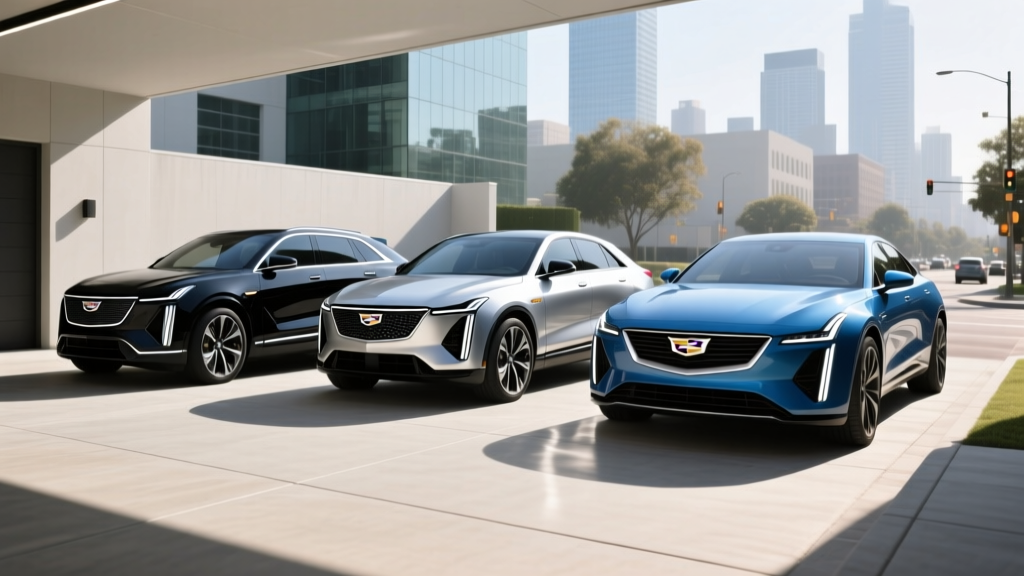
Cadillac's transition to an all-electric lineup has produced three distinct vehicles on General Motors' Ultium platform. Each serves a different buyer profile, and the ownership economics vary sharply depending on your charging access, local electricity rates, and whether you qualify for the IRS §30D federal tax credit. This guide breaks down every critical number — range, charging curves, real costs, and the gas-vs-EV math — so you can decide without dealership guesswork.
2026 Electric Cadillac Lineup: Lyriq, Optiq, and Celestiq at a Glance
| Spec | 2026 Lyriq | 2026 Optiq | 2026 Celestiq |
|---|---|---|---|
| Body Style | Midsize SUV | Compact SUV | Ultra-luxury sedan |
| Battery (usable) | 102 kWh (NMC) | ~85 kWh (NMC) | ~111 kWh (NMC) |
| EPA Range | 314 mi (RWD) | ~300 mi (est.) | ~300 mi (est.) |
| Drivetrain | RWD / AWD | AWD | AWD |
| Horsepower | 340 (RWD) / 500 (AWD) | ~350 (est.) | ~600 |
| 0-60 mph | 6.0s (RWD) / 4.6s (AWD) | ~5.5s (est.) | ~3.8s |
| Max DC Fast Charge | 190 kW | ~150 kW (est.) | ~200 kW |
| 10-80% DCFC Time | ~33 min | ~30 min (est.) | ~35 min (est.) |
| Level 2 Charge Rate | 19.2 kW (77 mi/hr) | ~11.5 kW | ~19.2 kW |
| Base MSRP | $58,590 | $54,090 | $340,000+ |
| Battery Warranty | 8 yr / 100,000 mi | 8 yr / 100,000 mi | 8 yr / 100,000 mi |
The Lyriq's 102 kWh usable NMC (nickel manganese cobalt) battery is the workhorse here. On a fueleconomy.gov EPA test cycle, the rear-wheel-drive Lyriq achieves 314 miles. The all-wheel-drive variant drops to approximately 307 miles due to the additional front motor's weight and drivetrain losses. The Optiq, built on a shorter Ultium wheelbase, sacrifices some battery capacity for a lower entry price and tighter turning radius suited to city driving.
Charging Speed and Infrastructure: What Cadillac Owners Actually Experience
Understanding the difference between kW (power — how fast energy flows) and kWh (energy — how much the battery holds) is essential. A 190 kW peak charge rate does not mean the Lyriq sustains that speed for the entire session. Like all EVs, the charge curve tapers significantly above 80% state of charge to protect battery longevity.
| Charging Level | Power | Lyriq Miles Added/Hour | Typical Use Case |
|---|---|---|---|
| Level 1 (120V) | ~1.4 kW | ~4-5 miles | Emergency / overnight trickle |
| Level 2 (240V, 48A) | 11.5 kW | ~35 miles | Standard home charging |
| Level 2 (240V, 80A) | 19.2 kW | ~52 miles | Hardwired home / workplace |
| DC Fast (peak) | 190 kW | ~500+ miles/hr (peak) | Road trips, 10-80% in ~33 min |
The Lyriq's 19.2 kW Level 2 capability is among the best in its class — it requires a hardwired 100-amp circuit and a capable ChargePoint Home Flex or similar station. Most homes with a 200-amp electrical panel can accommodate this, but older homes with 100-amp service may need a panel upgrade ($1,500-$3,000) before installation. A standard 48-amp Level 2 on a 60-amp breaker delivers 11.5 kW, adding roughly 35 miles per hour of charging — sufficient for most daily driving needs overnight.
On the DC fast-charging front, the Lyriq uses the CCS1 connector standard (GM has not yet transitioned to NACS for 2026 models, though adapters for Tesla Supercharger access are available). At Electrify America or EVgo 350 kW stations, the Lyriq peaks near 190 kW between 10-40% SoC, then gradually tapers to roughly 90 kW by 70%, and below 50 kW past 85%. A typical 10-80% session takes about 33 minutes. Plan road-trip stops accordingly — the advertised peak rate is not the sustained rate.
Electric Cadillac vs. Gas Cadillac: The Real Cost of Ownership
The purchase price of an electric Cadillac carries a premium over comparable gas models, but the five-year ownership equation depends on fuel savings, maintenance reduction, insurance costs, and available incentives. Here's how the Lyriq stacks up against the gas-powered Cadillac XT5, its closest internal-combustion counterpart.
| Cost Factor (5-Year) | 2026 Lyriq RWD | 2026 Cadillac XT5 (Gas) |
|---|---|---|
| Purchase Price (base) | $58,590 | $47,990 |
| Federal Tax Credit (§30D) | Up to $7,500* | $0 |
| Effective Purchase Price | ~$51,090 | $47,990 |
| Fuel / Electricity (15k mi/yr) | $3,750 ($0.14/kWh avg) | $10,125 ($3.50/gal, 22 MPG) |
| Maintenance (5 years) | ~$1,200 | ~$3,800 |
| Insurance (avg annual) | ~$2,400/yr ($12,000 total) | ~$1,900/yr ($9,500 total) |
| Estimated Depreciation | ~$22,000 | ~$18,000 |
| 5-Year Total Cost | ~$90,040 | ~$79,415 |
*Federal §30D credit eligibility depends on buyer income caps ($150k single / $300k joint), vehicle MSRP caps ($80k for SUVs), and battery critical-mineral sourcing requirements that change annually. Verify current-year rules at IRS.gov. Point-of-sale transfer is available at participating dealers.
The Lyriq saves roughly $6,375 on fuel and $2,600 on maintenance over five years — about $9,000 combined. However, higher insurance premiums (EVs typically cost 15-25% more to insure due to repair complexity and battery replacement risk) and steeper depreciation partially offset those gains. The break-even point versus the XT5 arrives around year 5-6 for buyers who qualify for the full tax credit and charge primarily at home on residential electricity rates.
For buyers in states with high electricity costs (California at $0.30+/kWh, for example), the fuel savings shrink to roughly $4,500 over five years. Conversely, those with solar panels or access to off-peak utility rates ($0.08-$0.10/kWh) can cut the Lyriq's "fuel" bill to under $2,000 over the same period.
Federal Tax Credit Eligibility: What Cadillac Buyers Must Know for 2026
§30D Clean Vehicle Credit — 2026 Requirements:
- Vehicle MSRP cap: $80,000 for SUVs (Lyriq, Optiq); $55,000 for sedans (Celestiq exceeds this — ineligible)
- Buyer income cap: $150,000 (single) / $225,000 (head of household) / $300,000 (joint filing) modified AGI
- Battery sourcing: Critical minerals and battery components must meet escalating domestic/free-trade-agreement percentages — check current-year IRS guidance for exact thresholds
- Assembly: Vehicle must undergo final assembly in North America (all Cadillacs qualify)
- Credit amount: Up to $7,500 ($3,750 for critical minerals + $3,750 for battery components), varies by sourcing compliance
- Point-of-sale transfer: Available at participating dealers — reduces purchase price at closing rather than waiting for tax filing
The Lyriq and Optiq fall under the $80,000 SUV MSRP cap, making them potentially eligible. However, the critical-mineral and battery-component sourcing rules tighten each year. As of 2026, a significant percentage of battery minerals must be extracted or processed in the US or a free-trade-agreement country, and battery components cannot contain materials from a "foreign entity of concern." GM has worked to localize its Ultium supply chain, but the exact credit amount (full $7,500 vs. partial $3,750) depends on the specific build date and battery batch. Always confirm with the dealer and your tax professional before assuming the full credit.
Common Misconceptions About Owning an Electric Cadillac
| Myth | Fact |
|---|---|
| "The battery will need replacing in 5 years for $20,000" | GM's Ultium batteries carry an 8-year/100,000-mile warranty against defects and excessive degradation (below 70% capacity). Real-world data from similar NMC packs shows 8-12% degradation over 100,000 miles with normal use. Full replacement, if needed out of warranty, runs $12,000-$18,000, but is rare. |
| "You can't road-trip an EV" | The Lyriq's 314-mile EPA range and 190 kW DCFC capability make 300-mile segments feasible with a single 30-minute stop. The CCS network (Electrify America, EVgo) covers major US interstates, though reliability varies — plan stops using the vehicle's built-in route planner or A Better Routeplanner. |
| "EVs are worse in cold weather" | Range drops 20-30% in sub-freezing temperatures — real and measurable. However, preconditioning while plugged in, using seat/steering wheel heaters instead of cabin air, and the Lyriq's available heat pump (standard on AWD trims) mitigate this significantly. Winter driving is viable with planning. |
| "Home charging installation is always expensive" | A basic 48-amp Level 2 install on an existing 200-amp panel with a nearby outlet runs $500-$1,200 (electrician labor + ChargePoint or Emporia station). Only homes needing panel upgrades or long conduit runs hit the $2,000-$4,000 range. Many utilities offer rebates of $250-$500. |
| "Super Cruise means the car drives itself" | Super Cruise is an SAE Level 2 driver-assistance system. It handles steering, acceleration, and braking on mapped divided highways, but requires continuous driver attention monitored by a camera. You are legally and practically responsible at all times. This is not autonomous driving. |
Decision Framework: Should You Buy an Electric Cadillac?
Choose the Lyriq if:
- You have Level 2 home charging (or can install it) and drive under 60 miles daily
- You want a premium midsize SUV with 300+ miles of range and don't need third-row seating
- You qualify for the §30D credit (income under $300k joint, MSRP under $80k)
- You value quiet, instant-torque acceleration and want to eliminate oil changes and transmission service
Choose the Optiq if:
- You want Cadillac luxury at the lowest electric entry price (~$54,090)
- You primarily drive in urban/suburban environments where a compact crossover excels
- 300 miles of range covers your needs and you rarely road-trip beyond 200-mile segments
Wait or reconsider if:
- You lack any access to Level 2 charging (home or workplace) and your area has sparse DC fast-charging infrastructure
- You regularly tow (the Lyriq is rated for only 1,500 lbs — inadequate for most trailers)
- You need a third row (look at the Cadillac Escalade IQ, a separate full-size electric SUV)
- Your winter commutes exceed 200 miles one-way in sub-freezing temperatures without en-route charging
- Your household income exceeds §30D caps, making the effective price premium harder to justify
What First-Time EV Buyers Should Know Before Signing
Charging access is the single biggest ownership variable. If you can install a Level 2 charger at home, daily EV ownership is effortless — plug in overnight, wake up to 250+ miles every morning, and visit a gas station never again. If you live in an apartment without charging, or your workplace lacks chargers, you'll depend on public DC fast-charging, which adds time, cost ($0.35-$0.55/kWh at most networks), and reliability risk. Test your nearest Electrify America or EVgo station before buying.
Insurance costs more. EV insurance premiums run 15-25% higher than equivalent gas vehicles. The Lyriq's battery replacement cost, specialized repair requirements, and higher purchase price all factor in. Get quotes from Geico, Progressive, and State Farm before committing — the annual difference ($400-$700 more) affects the total-cost equation.
Tires wear faster. The Lyriq's instant torque and heavier curb weight (~5,700 lbs) accelerate tire wear by roughly 20-30% compared to a gas XT5. Budget for replacement tires every 25,000-35,000 miles. Choose EV-specific tires (Michelin Pilot Sport EV, Pirelli Elect) designed for lower rolling resistance and noise reduction.
One-pedal driving changes your habits. The Lyriq's regenerative braking modes (including a true one-pedal setting) recapture energy during deceleration and reduce brake pad wear dramatically. Most owners report using the friction brakes only for hard stops or holding at lights. Expect brake pads to last 80,000+ miles.
Frequently Asked Questions
Does the electric Cadillac Lyriq qualify for the full $7,500 federal tax credit?
It depends on your income, the vehicle's MSRP, and the battery's critical-mineral sourcing for the specific model year. The Lyriq's base MSRP is under the $80,000 SUV cap, and it's assembled in North America. However, the sourcing requirements tighten annually. Some Lyriq builds may qualify for the full $7,500, others for $3,750, and buyers exceeding income caps ($150k single / $300k joint) qualify for nothing. Confirm with your dealer and review IRS §30D guidance.
How long does it take to charge a Cadillac Lyriq at home?
On a hardwired 19.2 kW Level 2 station (80-amp circuit), a full 0-100% charge takes approximately 5.5 hours. On a more common 11.5 kW (48-amp) Level 2, it takes roughly 9 hours. Most owners charge from 20-80% overnight, which takes 3-5 hours depending on station amperage. A standard 120V outlet adds only 4-5 miles per hour — useful for emergencies but impractical as a primary charging method.
Is the Cadillac Lyriq reliable compared to gas Cadillacs?
EVs have far fewer moving parts than gas vehicles — no engine, transmission, exhaust system, or spark plugs. The primary long-term reliability question centers on the battery pack, which GM warranties for 8 years / 100,000 miles. Early Lyriq model years (2023-2024) had some software-related recalls and build-quality complaints typical of a new platform. By 2026, most of these issues have been addressed through OTA updates and production refinements. Check NHTSA.gov for the latest recall status.
Can I use Tesla Superchargers with a Cadillac Lyriq?
As of 2026, the Lyriq uses the CCS1 connector natively. GM offers a NACS adapter that enables access to Tesla's Supercharger network (V3 and V4 stalls with Magic Dock). Charging speeds on Superchargers are limited to the stall's output and the Lyriq's 190 kW peak — expect roughly 150 kW average on V3 stalls. The adapter costs approximately $225 and is available through Cadillac dealers.
What happens if the Lyriq battery degrades significantly?
GM's Ultium battery warranty guarantees the pack will retain at least 70% of its original capacity for 8 years or 100,000 miles, whichever comes first. If your Lyriq's range drops from 314 miles to below 220 miles within that window, GM will repair or replace the battery at no cost. Real-world data from similar NMC packs suggests 8-12% degradation over the first 100,000 miles — well within the warranty threshold. Beyond warranty, individual module replacement (rather than full pack) may be possible, reducing out-of-pocket costs.