Quick Answer: Are Electric Buses Worth It in 2026?
Electric buses now deliver 150–250 miles of real-world range on battery packs ranging from 220 kWh to 440 kWh (mostly NMC chemistry), with DC fast charging at 150–350 kW adding 60–80% in 90–150 minutes. Upfront cost runs $750,000–$1,100,000 per unit (vs. $500,000–$600,000 for diesel), but the EPA Clean School Bus Program and state incentives can offset $200,000–$375,000 per bus. Over a 12-year lifecycle, electric buses typically save $150,000–$400,000 in fuel and maintenance, making TCO favorable for fixed-route fleets with depot charging access.
Electric Bus Range, Battery & Charging Specs
Range is the first question fleet managers ask—and the answer depends heavily on route topography, HVAC load, passenger weight, and climate. EPA-equivalent range testing (using the Altoona Bus Research and Testing Center protocols) provides baseline figures, but real-world deployment routinely shaves 15–35% off sticker range.
| Model | Battery (kWh) | Chemistry | EPA/Altoona Range (mi) | Real-World Range (mi) | Peak DC Charge (kW) | 10–80% Time | Base MSRP |
|---|---|---|---|---|---|---|---|
| New Flyer Xcelsior CHARGE NG (40-ft) | 350–525 | NMC | ~220 | 150–185 | 350 | ~120 min | $1,050,000 |
| Proterra ZX5 (40-ft) | 220–440 | NMC | ~250 | 170–210 | 320 | ~105 min | $950,000 |
| Blue Bird Vision Electric (School) | 155–195 | NMC | ~130 | 90–120 | 150 | ~90 min | $390,000 |
| Thomas Built Saf-T-Liner eC2 (School) | 155–226 | NMC | ~150 | 100–130 | 150 | ~100 min | $410,000 |
Real-World Range Warning
Cold climates (below 32°F) can reduce usable range by 25–40% due to cabin heating loads and battery chemistry limitations. A bus rated for 220 miles may deliver only 130–165 miles in Minnesota winter conditions. Fleets in northern states should spec 20–30% additional battery capacity or plan mid-route opportunity charging.
Electric Bus vs. Diesel: Total Cost of Ownership
The purchase price of an electric bus is 60–80% higher than a diesel equivalent, but the operating economics flip dramatically over a 12-year lifecycle. Here's what the numbers look like for a typical 40-foot transit bus running 45,000 miles/year:
| Cost Category | Electric Bus | Diesel Bus | Difference |
|---|---|---|---|
| Purchase Price | $1,000,000 | $550,000 | +$450,000 |
| Federal/State Incentives | -$300,000 | $0 | -$300,000 |
| Depot Charger Installation | $80,000 | $0 | +$80,000 |
| Fuel/Energy (12 yr) | $110,000 | $380,000 | -$270,000 |
| Maintenance (12 yr) | $95,000 | $220,000 | -$125,000 |
| Battery Replacement (yr 8–10) | $120,000 | $0 | +$120,000 |
| Total 12-Year Cost | $1,105,000 | $1,150,000 | -$45,000 |
Electric buses eliminate oil changes, diesel particulate filter replacements, transmission overhauls, and exhaust system repairs. Brake wear drops 50–70% thanks to regenerative braking. The trade-off is a potential mid-life battery replacement ($100,000–$180,000 depending on pack size), though most manufacturers warrant batteries to 70–80% capacity retention for 8–12 years.
Charging Infrastructure: What Fleets Need to Know
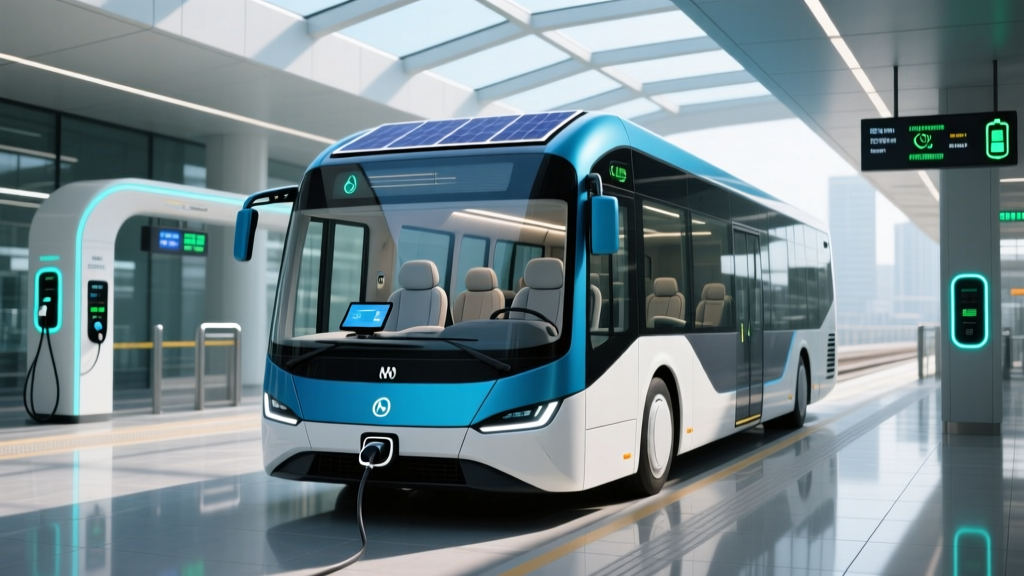
Depot charging is the backbone of most electric bus operations, but the electrical infrastructure investment is substantial. A single 150 kW DC fast charger costs $60,000–$120,000 installed, and a 10-bus fleet may need 4–6 chargers plus a utility service upgrade to 1–2 MW.
| Charging Type | Power (kW) | Miles Added/Hour | Use Case |
|---|---|---|---|
| Level 2 AC (J1772/CCS AC) | 19.2 | ~8–12 | Overnight depot (school buses) |
| DC Fast (CCS1) | 50–150 | ~25–60 | Depot charging (transit) |
| High-Power DC (CCS1) | 150–350 | ~60–120 | Fast depot / opportunity charging |
| Pantograph (SAE J3105) | 150–450 | ~80–150 | On-route opportunity charging |
Key infrastructure considerations:
- Utility coordination: Start 12–18 months before bus delivery. Service upgrades can cost $200,000–$1M+ for large depots.
- Smart charging software: Stagger charge cycles to avoid demand charges. Off-peak charging can cut electricity costs 40–60%.
- Connector standards: Most 2026 models use CCS1 for plug-in charging; pantograph systems (SAE J3105) are common for on-route top-ups.
- Future-proofing: Install conduit and panel capacity for 2× your initial charger count. Fleet expansion without electrical upgrades saves $50,000–$150,000 later.
Incentives & Funding: Federal, State & Utility Programs
Federal incentives for electric buses are substantial but competitive and application-based:
- EPA Clean School Bus Program: Up to $375,000 per electric school bus + $20,000 for charging infrastructure (2026 funding rounds)
- FTA Low-No Program: 80% federal cost share for transit bus purchases (up to $2M+ per project)
- State incentives: California HVIP ($120,000–$240,000), New York Truck Voucher ($150,000–$200,000), and similar programs in 15+ states
- Utility make-ready programs: Con Ed, PG&E, Xcel and others fund 50–100% of charger installation costs
- IRA §45W Commercial Clean Vehicle Credit: Up to $40,000 for vehicles over 14,000 lbs (note: this is a business tax credit, not §30D—consult your tax advisor)
Funding availability varies by jurisdiction and application cycle. Check EPA's Clean School Bus page and your state energy office for current deadlines.
Common Misconceptions About Electric Buses
| Myth | Fact |
|---|---|
| "Electric buses can't handle cold weather." | Range drops 25–40% in sub-freezing temps, but proper route planning, battery oversizing, and depot preheating mitigate this. Cities like Duluth, MN and Oslo, Norway operate year-round. |
| "Batteries won't last the 12-year bus lifecycle." | Modern NMC packs are warrantied to 70–80% SoH at 8–12 years. Mid-life replacements are expensive ($100K–$180K) but are a known, budgetable cost. |
| "Charging takes too long for transit operations." | Overnight depot charging (6–8 hours) covers most routes. Opportunity charging (10–15 min at 350 kW) enables 24/7 service on high-frequency corridors. |
| "Electric buses are unreliable." | Early models (2018–2020) had teething issues. 2026-generation buses from New Flyer, Proterra, and Blue Bird show 85–95% uptime in mature fleets—comparable to diesel. |
| "The grid can't handle a bus depot." | A 20-bus depot draws 1.5–3 MW—equivalent to a small shopping center. Utility upgrades are feasible but require 12–24 months lead time. |
Decision Framework: Should Your Fleet Go Electric?
If-Then Guide for Fleet Electrification
- Choose electric if: Your routes are under 150 miles/day (or 120 miles in cold climates), you have depot ownership or long-term lease for charger installation, and you qualify for federal/state incentives that close the purchase-price gap.
- Wait or consider hybrid if: Routes exceed 200 miles/day with no opportunity charging, you operate in extreme cold (–20°F or below) without garage storage, or your depot lease expires within 5 years.
- Start with a pilot if: You're uncertain about real-world range on your specific routes. Order 2–3 buses, instrument them for 6–12 months, and use the data to spec your full order.
- Consult a specialist if: Your utility quotes a $500K+ service upgrade, you need pantograph opportunity charging, or your fleet exceeds 50 buses (complex load management).
Frequently Asked Questions
How long does it take to charge an electric bus?
A 350 kWh battery charging at 150 kW DC takes roughly 2.5–3 hours from 10–80% SoC. At 50 kW (Level 2 equivalent for large batteries), expect 7–8 hours—suitable for overnight depot charging. Charge curves taper above 80%, so most fleets charge to 80–90% daily and only hit 100% for route-max days.
What's the lifespan of an electric bus battery?
Most 2026 electric bus batteries are warrantied for 8–12 years or 250,000–400,000 miles to 70–80% State of Health (SoH). Real-world degradation data from early-adopter fleets shows 2–3% annual capacity loss in moderate climates, accelerating to 4–5% in extreme heat or with frequent DC fast charging.
Can electric buses handle hilly routes?
Yes, but energy consumption increases 30–50% on sustained grades. Regenerative braking recovers significant energy on descents. Fleets in Seattle and San Francisco spec larger battery packs (440+ kWh) to compensate for topography.
Do electric buses qualify for the $7,500 federal tax credit?
No. The §30D Clean Vehicle Credit applies to light-duty vehicles under 14,000 lbs GVWR. Electric buses qualify for the §45W Commercial Clean Vehicle Credit (up to $40,000) and grant programs like EPA Clean School Bus and FTA Low-No, which provide far larger subsidies.
What happens if a battery fails out of warranty?
Replacement costs $100,000–$180,000 depending on pack size. Some fleets budget for mid-life battery swaps; others purchase extended warranties. Third-party battery refurbishment is emerging as a lower-cost option ($60,000–$90,000) but is not yet widely proven.
Are hydrogen fuel cell buses a better alternative?
Fuel cell buses (e.g., New Flyer Xcelsior CHARGE H2) offer 300+ mile range and 10-minute refueling, but hydrogen costs $10–$20/kg (equivalent to $6–$12/gallon diesel) and fueling infrastructure is extremely limited. Battery-electric remains the lower-TCO choice for routes under 200 miles; fuel cells make sense for long intercity routes or extreme-cold operations where battery range is prohibitive.
Bottom Line for Fleet Buyers
Electric buses in 2026 are a mature, TCO-positive technology for fixed-route fleets with depot charging access and routes under 150–200 miles. The upfront premium ($400K–$500K over diesel) is offset by $300K–$500K in incentives and $270K–$400K in lifetime fuel/maintenance savings. The critical success factors are route-range analysis, early utility coordination, and smart charging software to manage demand charges. Fleets that pilot 2–3 buses before committing to full electrification report the highest satisfaction and lowest operational surprises.