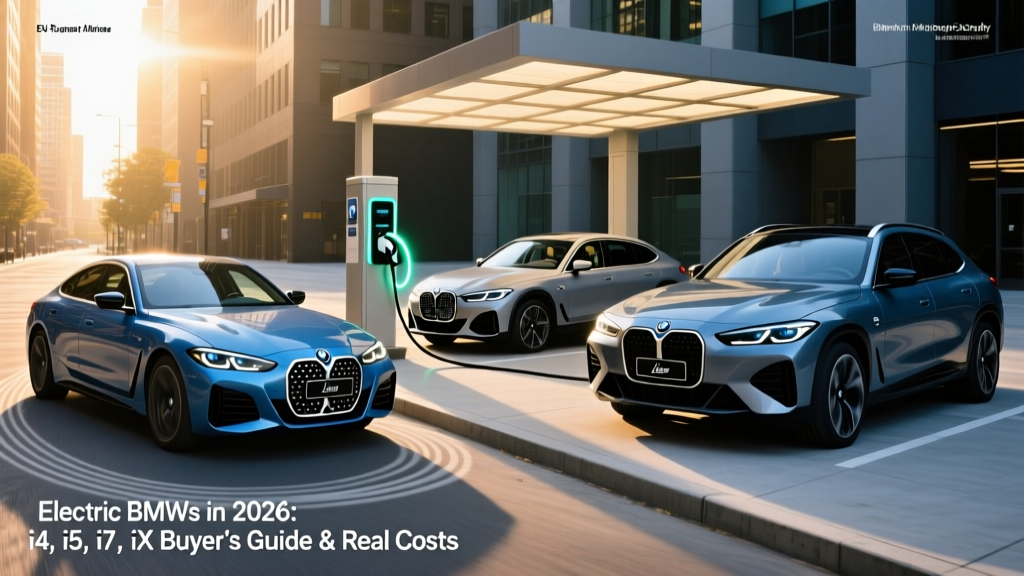
If you're researching electric BMWs in 2026, here's the fast answer: BMW's current EV lineup spans four core models — the i4 gran coupe, i5 sedan, iX SUV, and flagship i7 — with EPA ranges from 256 to 318 miles, DC fast-charging peaks between 200 and 205 kW, and starting MSRPs from roughly $52,200 to $124,200. Most 2026 electric BMWs qualify for partial or full federal tax credits under IRS §30D depending on trim, battery sourcing, and your income, and the i4 eDrive40 is the value sweet spot at ~$52,200 before incentives. Below, we break down every model with real numbers — range, charging curves, ownership costs, and how they compare to the gas BMWs they replace.
Quick Verdict: Which Electric BMW Is Right for You?
- Best value: BMW i4 eDrive40 — 307 mi EPA, ~$52,200, 205 kW DC charging
- Best daily sedan: BMW i5 eDrive40 — 295 mi EPA, ~$70,200, Level 2 highway assist
- Best family SUV: BMW iX xDrive50 — 307 mi EPA, ~$87,250, spacious cabin
- Best flagship luxury: BMW i7 eDrive50 — 318 mi EPA, ~$124,200, theater screen
2026 Electric BMW Lineup: Specs at a Glance
BMW's "Neue Klasse" EVs share a flexible architecture with fifth-generation eDrive motors and NMC (nickel-manganese-cobalt) battery packs. Here's how the 2026 lineup stacks up on paper and in real-world driving.
| Model | Battery (usable kWh) | EPA Range | Real-World Range* | Peak DC Charge | 10–80% Time | 0–60 mph | HP | Base MSRP |
|---|---|---|---|---|---|---|---|---|
| i4 eDrive40 | 81.5 kWh (NMC) | 307 mi | 250–275 mi | 205 kW | ~31 min | 5.5 sec | 335 | $52,200 |
| i4 M50 | 81.5 kWh (NMC) | 270 mi | 220–240 mi | 205 kW | ~31 min | 3.7 sec | 536 | $67,300 |
| i5 eDrive40 | 84.3 kWh (NMC) | 295 mi | 240–265 mi | 205 kW | ~30 min | 5.7 sec | 335 | $70,200 |
| i5 M60 | 84.3 kWh (NMC) | 256 mi | 210–230 mi | 205 kW | ~30 min | 3.7 sec | 593 | $84,100 |
| iX xDrive50 | 111.5 kWh (NMC) | 307 mi | 250–275 mi | 200 kW | ~35 min | 4.4 sec | 516 | $87,250 |
| i7 eDrive50 | 101.7 kWh (NMC) | 318 mi | 260–285 mi | 205 kW | ~34 min | 4.5 sec | 449 | $124,200 |
*Real-world range reflects mixed highway/city driving at 70–80 mph. Expect 15–30% loss in sub-freezing temperatures depending on cabin heating use and whether your model includes BMW's heat pump (standard on most 2026 trims).
Range Reality Check
EPA range numbers assume a mix of city and moderate-speed driving. On a 75-mph highway road trip, plan for roughly 80–85% of the sticker range. In winter conditions (below 30°F), NMC batteries lose efficiency — budget for 70–80% of EPA range unless you precondition the battery while plugged in. The i7 eDrive50's 318-mile EPA rating, for example, translates to roughly 260 miles on a cold-weather highway run.
Charging Speeds: Home and Public
Every 2026 electric BMW uses the J1772 connector for Level 2 AC charging and the CCS1 connector for DC fast charging (BMW has confirmed NACS adoption for future models, but 2026 vehicles ship with CCS1). Here's what charging actually looks like across different scenarios.
| Charging Level | Power (kW) | Miles Added per Hour | Typical Use Case | Cost per Session |
|---|---|---|---|---|
| Level 1 (120V) | 1.4 kW | 3–5 mi/hr | Emergency / overnight trickle | $0.03–0.06/mi |
| Level 2 (240V home) | 7.4–11 kW | 22–35 mi/hr | Daily home charging | $0.03–0.06/mi |
| DC Fast (public) | 50–205 kW | 150–650 mi/hr (peak) | Road trips, quick top-ups | $0.10–0.18/mi |
Charging curve reality: BMW's 205 kW peak rate applies only between roughly 10–40% state of charge. Above 80%, charging slows dramatically to protect the NMC battery — expect the final 80–100% to take as long as the 10–80% session. For road trips, plan stops at 10–80% for maximum efficiency.
Home charging setup: BMW's Wallbox Professional (Level 2, up to 11 kW / 48 amps) costs around $700 for the unit. Professional installation by a licensed electrician runs $500–$2,000 depending on whether your electrical panel needs a 240V/50-amp circuit added. Total home setup: $1,200–$2,700 in most cases. A full panel upgrade (200-amp service) can add $1,500–$3,000 if your home has older 100-amp service.
Electric BMW vs Gas BMW: Cost Comparison
The most common question from BMW shoppers: does going electric actually save money? Let's compare the i4 eDrive40 against its closest gas sibling, the BMW 430i Gran Coupe, over five years and 75,000 miles.
| Cost Factor | BMW i4 eDrive40 | BMW 430i Gran Coupe | 5-Year Difference |
|---|---|---|---|
| Base MSRP | $52,200 | $49,900 | +$2,300 (i4) |
| Fed. Tax Credit (§30D) | Up to $7,500* | $0 | –$7,500 (i4) |
| Fuel/Energy (75k mi) | $2,850 (home) / $5,400 (public mix) | $9,375 (28 MPG, $3.50/gal) | –$3,975 to –$6,525 (i4) |
| Maintenance | ~$1,800 | ~$3,600 | –$1,800 (i4) |
| Insurance (avg) | ~$10,500 | ~$8,400 | +$2,100 (i4) |
| Estimated Depreciation | ~$22,000 | ~$19,500 | +$2,500 (i4) |
| Total 5-Year Cost | ~$39,850–$41,900 | ~$41,275 | –$1,375 to +$625 |
*§30D tax credit eligibility depends on your modified adjusted gross income (AGI ≤ $150K single / $300K joint), vehicle MSRP caps ($55K for sedans, $80K for SUVs), and battery component/critical-mineral sourcing requirements. The i4 eDrive40 at $52,200 falls under the sedan MSRP cap. Verify current-year eligibility at IRS.gov or consult a tax professional. Point-of-sale transfer is available at participating dealers.
The math shows the i4 roughly breaking even or saving modestly over five years — but the value proposition improves significantly if you charge primarily at home (lower energy cost), live in a state with additional EV rebates, or keep the car longer than five years (where maintenance savings compound and depreciation stabilizes).
Real-World Ownership: What First-Time EV Buyers Must Know
Buying an electric BMW isn't the same as buying a gas BMW. Here are the ownership factors that matter most, drawn from real-world experience with these platforms.
Home Charging Is Non-Negotiable for Most Owners
If you can install a Level 2 home charger, an electric BMW is a delight — you wake up every morning with a "full tank." If you rely solely on public charging, the cost per mile roughly triples and the convenience drops substantially. Before purchasing, confirm you can install a 240V circuit at home or have reliable workplace charging. According to the U.S. Department of Energy, home-charged EVs cost roughly $0.03–$0.06 per mile versus $0.10–$0.18 on public DC fast chargers.
Cold Weather Changes Everything
NMC batteries lose efficiency in freezing temperatures. On a 20°F day with highway driving, expect your i4's real-world range to drop from ~275 miles to ~200–220 miles. BMW's heat pump (standard on most 2026 trims) recovers some efficiency by scavenging waste heat from the drivetrain, but it doesn't eliminate cold-weather loss. If you live in the upper Midwest or Northeast, plan your road-trip stops accordingly.
Battery Longevity and Warranty
BMW provides an 8-year / 100,000-mile high-voltage battery warranty that guarantees at least 70% of original capacity retention. Real-world degradation data from earlier BMW EV platforms (i3, iX3) suggests NMC packs lose roughly 8–12% capacity over the first 100,000 miles under normal use. Best practices for longevity: avoid routinely charging to 100% (set daily limit to 80–90%), minimize repeated DC fast-charging, and precondition the battery in extreme temperatures.
Insurance Costs More
EV insurance premiums run 15–25% higher than equivalent gas models, driven by higher repair costs for battery and structural components. Budget an extra $30–$50/month compared to a gas BMW. Get quotes from multiple carriers before purchasing — some insurers (like State Farm and Geico) have narrowed the EV gap more than others.
Common Misconceptions About Electric BMWs
| Myth | Fact |
|---|---|
| "The battery will need replacing in a few years" | BMW warranties the pack for 8 years/100K miles at ≥70% capacity. Most NMC packs last 150K–200K+ miles before significant degradation. |
| "Electric BMWs are slow" | The i4 M50 does 0–60 in 3.7 seconds (536 HP). Even the base i4 eDrive40 hits 60 mph in 5.5 seconds with instant torque. |
| "I can't take road trips" | With 250+ real-world highway miles and 10–80% charging in ~30 minutes, road trips require a 30-minute stop every 2.5–3 hours — similar to gas-car rest stops. |
| "All electric BMWs qualify for the $7,500 tax credit" | Credit eligibility depends on MSRP caps, buyer income, and battery sourcing. The i7 ($124,200) exceeds the MSRP cap entirely. Check IRS §30D rules for your situation. |
| "Public charging is unreliable" | Major networks (Electrify America, EVgo, ChargePoint) have improved uptime to 90%+ at DC stations. CCS1 compatibility is universal for non-Tesla public chargers. |
| "Maintenance savings are negligible" | No oil changes, no transmission fluid, fewer brake replacements (regen braking extends pad life 2–3x). Owners typically save $300–$600/year on maintenance. |
Decision Framework: Which Electric BMW Should You Buy?
If/Then Buyer Guide
- If you want the best value in the lineup: Choose the i4 eDrive40. At $52,200 MSRP (under the §30D sedan cap), 307 miles EPA, and 205 kW DC charging, it's the most accessible entry point. Best for commuters, couples, and those who want BMW dynamics without the flagship price.
- If you need a proper executive sedan: Choose the i5 eDrive40. Larger cabin, 295 miles EPA, available Highway Assistant (Level 2 hands-off with eyes-on at up to 85 mph on divided highways). Ideal for professionals who drive 15K+ miles/year and want rear-seat space.
- If you need SUV practicality for a family: Choose the iX xDrive50. 307 miles EPA, 111.5 kWh battery (largest in the lineup), spacious five-seat cabin with 35.5 cu ft cargo. The MSRP ($87,250) falls under the §30D SUV cap of $80K only on lower trims — check eligibility carefully.
- If budget is no object and you want flagship luxury: Choose the i7 eDrive50. 318 miles EPA (best in lineup), 31-inch 8K theater screen, executive rear seating. At $124,200 it does not qualify for the federal credit (exceeds MSRP cap), so factor in the full purchase price.
- If performance is your priority: Choose the i4 M50 or i5 M60 for M-car acceleration (3.7 sec 0–60) with electric instant torque. Trade-off: 35–50 fewer miles of EPA range versus the eDrive40 trims.
- If you don't have home charging access: Reconsider whether a full BEV fits your lifestyle. A BMW plug-in hybrid (like the X5 xDrive50e PHEV) may be a better bridge — it offers ~38 miles of electric-only range for daily commuting plus a gas engine for longer trips, with no charging-infrastructure dependency.
Federal Tax Credit Eligibility for Electric BMWs
The federal EV tax credit under IRS §30D can reduce your effective purchase price by up to $7,500, but eligibility is nuanced. Here's a checklist for 2026:
- Income cap: Modified AGI ≤ $150,000 (single) / $225,000 (head of household) / $300,000 (joint)
- MSRP cap: ≤ $55,000 for sedans (i4, i5, i7) / ≤ $80,000 for SUVs (iX)
- Battery sourcing: A percentage of critical minerals and battery components must be sourced from the U.S. or FTA partners (thresholds increase annually)
- Point-of-sale transfer: You can transfer the credit to the dealer at purchase for an immediate price reduction, rather than waiting to claim it on your tax return
- Final assembly: Vehicle must be assembled in North America (BMW's U.S. EV production is expanding — verify the VIN on fueleconomy.gov)
Which electric BMWs likely qualify? The i4 eDrive40 ($52,200) is the strongest candidate — it sits under the $55K sedan cap. The i5 eDrive40 ($70,200) exceeds the sedan MSRP cap and may not qualify unless reclassified. The iX xDrive50 ($87,250) exceeds the $80K SUV cap. The i7 ($124,200) does not qualify. Always verify your specific vehicle and tax situation with a qualified tax professional and the official IRS guidance.
Frequently Asked Questions
Are electric BMWs reliable?
BMW's fifth-generation eDrive powertrain has proven solid in real-world use. The electric drivetrain has far fewer moving parts than a gas engine — no timing chain, no turbo, no transmission to fail. Most reported issues center on software and infotainment (iDrive 8.5), which BMW addresses via over-the-air updates. The NHTSA and IIHS rate BMW's EV models well in crash safety.
How much does it cost to charge an electric BMW at home?
At the U.S. average electricity rate of ~$0.16/kWh, fully charging an i4's 81.5 kWh battery costs about $13 — good for ~275 real-world miles. That works out to roughly $0.047 per mile, compared to $0.12–$0.14 per mile for a gas BMW 430i at $3.50/gallon and 28 MPG combined.
Can I use Tesla Superchargers with an electric BMW?
As of 2026, BMW electric vehicles ship with CCS1 connectors. Tesla Superchargers are transitioning to NACS (North American Charging Standard). Some Supercharger stations offer CCS1 Magic Dock adapters, but coverage is limited. BMW has announced NACS adoption for future models — check with your dealer for the latest adapter availability.
What happens if the battery fails out of warranty?
Out-of-warranty high-voltage battery replacement for a BMW EV currently ranges from $15,000 to $25,000 depending on the model and pack size. However, real-world data shows most NMC packs retain 85–92% capacity at 100,000 miles. Full pack failure is rare — individual module replacement (at lower cost) is sometimes possible.
Is BMW's Highway Assistant actually self-driving?
No. BMW's Highway Assistant is an SAE Level 2 driver-assistance system. It can manage steering, acceleration, and braking on divided highways at speeds up to 85 mph, and it allows hands-off operation with eyes-on monitoring (via an interior camera). However, the driver must remain attentive and ready to take over at any time. This is not autonomous driving — it's an advanced cruise control with lane-centering.
Should I wait for BMW's Neue Klasse next-generation EVs?
BMW's next-generation "Neue Klasse" platform (debuted with the iX3 successor in Europe) promises improved energy density, faster charging, and a new iDrive interface. U.S. models on this platform are expected for the 2027–2028 model years. If you need a car now, the current lineup is mature and well-equipped. If you can wait 18–24 months, the next-gen models may offer meaningful improvements in range and charging speed.