Quick Answer: Which Electric BMW Should You Buy?
BMW's 2026 electric lineup spans five core models ranging from the compact iX3 SUV (~$52,000) to the flagship i7 luxury sedan (~$120,000+). The best-selling choice for most buyers is the BMW i4 eDrive40 (EPA 307 miles, ~$57,900), which balances real-world usability with 200 kW DC fast charging. If you need SUV cargo space, the BMW iX xDrive50 (EPA 324 miles, ~$87,000) delivers. All current electric BMWs use the flexible CLAR/Neue Klasse architecture with NMC battery chemistry, and none currently qualify for the full $7,500 federal §30D tax credit due to battery-sourcing requirements — always verify eligibility at IRS.gov before purchasing.
The Full 2026 Electric BMW Lineup at a Glance
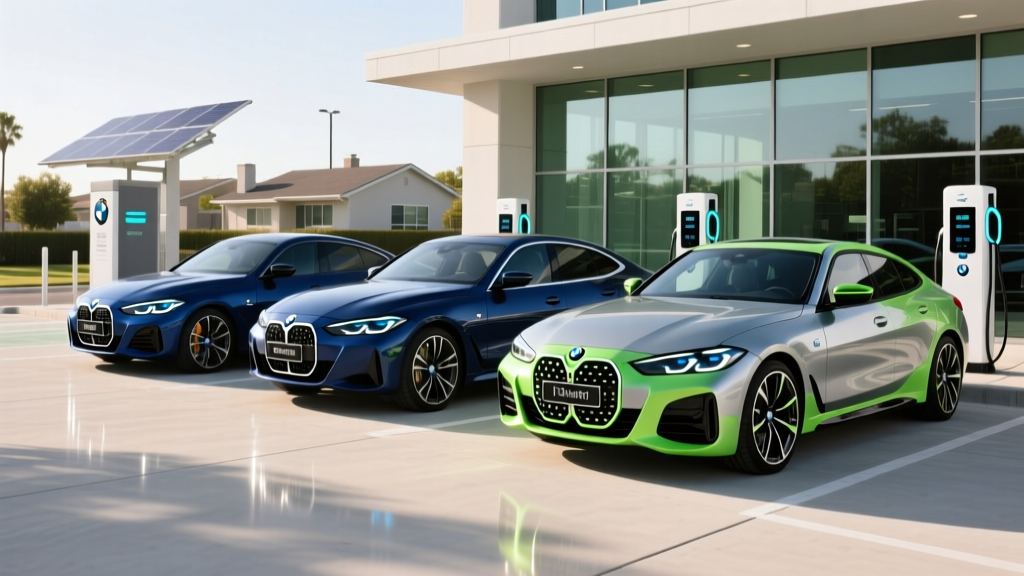
BMW has committed to electrification without creating a separate sub-brand, meaning its EVs share design language, interior layouts, and driving dynamics with their gas counterparts. That's either a pro or a con depending on whether you want your EV to look futuristic or simply look like a BMW. Here is the current lineup with hard specs:
| Model | Body Style | EPA Range | Battery (usable kWh) | Peak DC Charge | 10–80% Time | 0–60 mph | HP | Base MSRP |
|---|---|---|---|---|---|---|---|---|
| BMW iX3 (Neue Klasse) | Compact SUV | ~290 mi (est.) | ~80 kWh, NMC | ~200 kW | ~22 min | ~5.8s | ~335 | ~$52,000 |
| BMW i4 eDrive40 | Gran Coupe | 307 mi | 81 kWh, NMC | 205 kW | ~21 min | 5.5s | 335 | $57,900 |
| BMW i4 M50 | Gran Coupe | 269 mi | 81 kWh, NMC | 205 kW | ~21 min | 3.7s | 536 | $69,900 |
| BMW i5 eDrive40 | Midsize Sedan | 295 mi | 84 kWh, NMC | 205 kW | ~22 min | 5.7s | 335 | $71,200 |
| BMW i5 M60 | Midsize Sedan | 256 mi | 84 kWh, NMC | 205 kW | ~22 min | 3.7s | 590 | $87,200 |
| BMW iX xDrive50 | Midsize SUV | 324 mi | 105 kWh, NMC | 200 kW | ~25 min | 4.4s | 516 | $87,250 |
| BMW iX M60 | Midsize SUV | 288 mi | 105 kWh, NMC | 200 kW | ~25 min | 3.6s | 610 | $111,500 |
| BMW i7 eDrive50 | Full-Size Sedan | 318 mi | 102 kWh, NMC | 195 kW | ~28 min | 4.5s | 449 | $105,700 |
| BMW i7 M70 | Full-Size Sedan | 285 mi | 102 kWh, NMC | 195 kW | ~28 min | 3.5s | 650 | $167,700 |
Sources: EPA / fueleconomy.gov, BMW USA press materials. iX3 specs are preliminary estimates for the Neue Klasse generation; final EPA figures pending certification. All MSRP figures exclude destination charges.
Real-World Range vs. EPA Sticker
EPA estimates assume a mix of city and moderate-speed driving. In our experience and consistent with third-party highway tests:
- Highway driving at 70–80 mph: Expect 15–22% less than the EPA sticker. An i4 eDrive40 rated at 307 miles will deliver roughly 240–260 miles on a flat, warm-weather highway run.
- Cold weather (below 32°F): Range drops 20–35% depending on severity and whether you precondition. The iX xDrive50 at 324 EPA miles may deliver 210–250 miles in sub-freezing conditions.
- Mountainous terrain: Ascending passes consumes heavily, but regenerative braking on descents recovers a meaningful portion — typically 15–25% of the climb energy.
BMW's thermal management system with heat pump (standard on most 2026 models) mitigates cold-weather losses better than many competitors, but physics still applies.
Electric BMW vs. Gas BMW: The Real Cost Comparison
The sticker price of an electric BMW is typically $5,000–$15,000 higher than a comparably equipped gas model. The question is whether operational savings close that gap. Here's a five-year comparison using the i4 eDrive40 versus the gasoline BMW 430i Gran Coupe (MSRP ~$49,900), assuming 12,000 miles/year, $0.14/kWh home electricity, $3.60/gallon premium fuel, and no tax credit:
| Cost Category (5 Years / 60k Miles) | BMW i4 eDrive40 | BMW 430i Gran Coupe (Gas) | Difference |
|---|---|---|---|
| Purchase Price (MSRP) | $57,900 | $49,900 | +$8,000 (i4) |
| Fuel / Electricity | $3,024 | $7,560 | −$4,536 (i4 saves) |
| Maintenance (oil, filters, brakes) | $1,800 | $3,600 | −$1,800 (i4 saves) |
| Insurance (avg.) | $9,600 | $8,400 | +$1,200 (i4 costs more) |
| Tires (EVs wear faster due to weight/torque) | $1,600 | $1,200 | +$400 (i4 costs more) |
| 5-Year Total (excl. depreciation) | $73,924 | $70,660 | +$3,264 (i4) |
The takeaway: Without a tax credit, the i4 costs roughly $3,000–$3,500 more over five years on a pure cash basis. If you qualify for the full $7,500 §30D credit (which, as of 2026, requires battery component and critical-mineral sourcing compliance that most BMWs do not fully meet), the math flips to a ~$4,000 savings. Depreciation is the wild card — BMW EVs have historically depreciated faster than their gas counterparts, though the gap is narrowing as EV demand stabilizes.
Charging at Home and on the Road: What You Need to Know
Every electric BMW sold in the US for 2026 comes with a NACS (Tesla-style) charge port or an included NACS adapter, giving access to the Tesla Supercharger network alongside Electrify America, EVgo, and ChargePoint stations. Here's what charging looks like in practice:
| Level | Power | Typical Miles Added/Hour | Use Case | Cost to Install/Use |
|---|---|---|---|---|
| Level 1 (120V) | 1.4–1.9 kW | 4–6 mi/hr | Emergency / overnight trickle | $0 (standard outlet) |
| Level 2 (240V home) | 7.4–11.5 kW | 25–40 mi/hr | Daily home charging | $500–$2,500 install |
| DC Fast Charge | Up to 205 kW | N/A (minutes-based) | Road trips | $0.30–$0.55/kWh public |
Understanding the Charge Curve (Why Peak kW Misleads)
BMW advertises "up to 205 kW" DC fast charging on the i4 and i5. That peak rate is real — but it's only sustained between roughly 10% and 35% State of Charge (SoC). Above 50%, the rate tapers to ~120 kW, and above 80%, it drops below 50 kW to protect the NMC cells. This is why BMW quotes 10–80% times (~21 minutes) rather than 0–100%. If you're planning a road trip, budget 25–30 minutes per stop for a practical 10–80% fill, and never plan to charge past 80% unless you're ending your driving day at that charger.
Home Charging Installation: Budget Realistically
Most electric BMW owners install a Level 2 wallbox (BMW's recommended Wallbox Home Charger or a third-party unit like ChargePoint Home Flex). Here's what to budget:
| Item | Low End | High End | Notes |
|---|---|---|---|
| Level 2 Charger Unit | $400 | $750 | BMW Wallbox or ChargePoint Home Flex |
| Electrician Labor | $600 | $2,000 | Depends on panel distance and conduit run |
| Permit & Inspection | $50 | $300 | Varies by municipality |
| Panel Upgrade (if needed) | $1,500 | $4,000 | Required if your panel lacks a spare 50A breaker slot |
| Total (no panel upgrade) | $1,050 | $3,050 | |
| Total (with panel upgrade) | $2,550 | $7,050 |
Always get a quote from a licensed electrician before committing to an EV purchase if you lack a 240V outlet in your garage. Some utility companies offer rebates of $250–$1,000 for Level 2 installations — check your local provider.
Federal Tax Credits and Incentives: The BMW Complication
As of 2026, the federal §30D clean vehicle credit offers up to $7,500 for qualifying new EVs, but eligibility hinges on three criteria that create problems for BMW:
- MSRP Cap: Sedans must be under $55,000; SUVs/trucks under $80,000. This eliminates the i5, i7, and most iX trims. The i4 eDrive40 at $57,900 exceeds the sedan cap.
- Buyer Income Cap: Modified AGI must not exceed $150,000 (single), $225,000 (head of household), or $300,000 (joint).
- Battery Sourcing: Battery components must be manufactured or assembled in North America, and critical minerals must be sourced from the US or FTA partners. BMW sources battery cells primarily from CATL (China) and Samsung SDI (South Korea), which has historically disqualified most BMW models from the full credit.
Bottom line: Do not assume any electric BMW qualifies for the $7,500 credit. Check the latest eligibility list at fueleconomy.gov and confirm with your dealer. The point-of-sale transfer option (where the dealer applies the credit as a price reduction at purchase) is available if the vehicle qualifies — but the sourcing rules have been the dealbreaker for BMW buyers.
State incentives may partially offset this. California, Colorado, New York, and several other states offer their own EV rebates of $1,000–$5,000 that have no battery-sourcing restrictions. Check your state energy office for current programs.
Common Misconceptions About Electric BMWs
| Myth | Fact |
|---|---|
| "BMW EV batteries need replacing after 5 years" | BMW warrants the high-voltage battery for 8 years / 100,000 miles against capacity loss below 70%. Real-world degradation data from i4/iX owners shows roughly 5–8% capacity loss at 60,000 miles. Full replacement (if ever needed out of warranty) costs $15,000–$22,000 depending on model. |
| "Electric BMWs aren't real BMWs — they don't handle well" | The i4 M50 (536 HP, 3.7s 0–60) and iX M60 (610 HP, 3.6s 0–60) outperform most gas M-lite models in straight-line acceleration. The low center of gravity from the floor-mounted battery pack reduces body roll. Weight is higher (~4,800–5,800 lbs), which you feel in tight transitions, but not in daily driving. |
| "I can't road trip in an electric BMW" | With NACS access to 18,000+ Tesla Superchargers and BMW's integrated route planner that preconditions the battery for each charging stop, a 500-mile trip requires one 25-minute stop. That's manageable. The challenge is rural routes with sparse charging — plan ahead. |
| "Charging an EV is more expensive than gas" | At the national average of $0.14/kWh and the i4's efficiency of ~3.2 mi/kWh, your cost per mile is roughly $0.044. A 430i at 28 MPG combined on $3.60 premium fuel costs $0.129/mile. Public DC fast charging at $0.45/kWh costs ~$0.14/mile — comparable to gas, which is why home charging is the economic key. |
| "All electric BMWs qualify for the $7,500 tax credit" | As detailed above, battery-sourcing and MSRP-cap rules disqualify most BMW EVs as of 2026. Always verify before purchasing. |
Decision Framework: Which Electric BMW Is Right for You?
Choose the BMW i4 eDrive40 if:
- You want the best range-to-price ratio in the BMW EV lineup
- You primarily commute and take occasional road trips under 300 miles
- You prefer a sporty gran coupe profile over an SUV
- Budget target: ~$58,000–$65,000 as equipped
Choose the BMW i4 M50 if:
- Performance is a priority (536 HP, M-tuned suspension, M Sport brakes)
- You're cross-shopping the Tesla Model 3 Performance or Polestar 2 BST
- You accept the 38-mile range penalty for the power upgrade
Choose the BMW i5 eDrive40 if:
- You need 5 Series interior space and rear-seat comfort
- You want a traditional executive sedan with EV running costs
- You have home Level 2 charging and drive under 60 miles daily
Choose the BMW iX xDrive50 if:
- You need SUV cargo space (35.5 cu ft behind rear seats, 77.9 cu ft folded)
- You want the longest range in the BMW SUV lineup (324 mi EPA)
- You regularly carry rear passengers and value the airy, lounge-like cabin
- Budget target: ~$87,000–$95,000 as equipped
Choose the BMW i7 eDrive50 if:
- You're cross-shopping the Mercedes EQS or Lucid Air and want full-size luxury
- Rear-seat comfort and the available Theater Screen are dealmakers
- Budget is not your primary constraint ($105,000+)
Do NOT buy an electric BMW if:
- You lack access to home or workplace Level 2 charging AND your area has sparse public charging infrastructure
- You regularly tow heavy loads (the iX is rated for only 3,500 lbs; the i4/i5 are not rated for towing)
- You need the lowest possible total cost of ownership — a Toyota RAV4 Hybrid or Prius will cost significantly less over 5 years, though it won't deliver BMW driving dynamics
First-Time EV Buyer Checklist: What to Know Before You Sign
If this is your first electric vehicle, these are the ownership realities that catch new buyers off guard:
- Home charging is non-negotiable for most owners. Public-only charging is 3–5x more expensive per mile and adds 30–60 minutes of weekly errand time. If you can't install Level 2 at home, reconsider or explore workplace charging options.
- Insurance premiums run 10–20% higher for BMW EVs versus their gas equivalents, driven by higher repair costs and parts pricing. Get quotes from your insurer before purchasing.
- Tire wear accelerates. The combination of heavy curb weight (4,800+ lbs) and instant torque wears tires 20–30% faster than a gas BMW. Budget for replacement every 25,000–35,000 miles with EV-specific tires (like the Michelin Pilot Sport EV or Hankton iON).
- Preconditioning matters. Use the BMW app to set departure-time preconditioning while plugged in. This warms or cools the battery using grid power rather than battery power, preserving 5–10% of range in extreme temperatures and enabling faster DC charging.
- Regenerative braking takes adaptation. BMW's adaptive regen is excellent but not true one-pedal driving in all modes. Expect a 1–2 week adjustment period if you're coming from a gas car.
- Software updates change the car. BMW pushes over-the-air updates that can alter range estimates, charging behavior, and iDrive features. Not all updates are improvements — follow owner forums to understand what each update changes.
Frequently Asked Questions
Do electric BMWs use LFP or NMC batteries?
All current electric BMWs use NMC (nickel manganese cobalt) chemistry. NMC offers higher energy density than LFP, which is why BMW achieves competitive range figures in relatively compact battery packs. The trade-off: NMC batteries degrade slightly faster than LFP and BMW recommends keeping daily charge at 80–90% rather than 100% for longevity. Reserve 100% charges for road trips.
What is BMW's battery warranty?
BMW covers the high-voltage battery for 8 years or 100,000 miles, whichever comes first, against defects and capacity loss below 70% of original capacity. This is industry-standard and matches Tesla, Mercedes, and Audi. If your battery drops below 70% within the warranty period, BMW will repair or replace modules to restore it above the threshold.
Can I charge an electric BMW at a Tesla Supercharger?
Yes. Starting with the 2025 model year, BMW switched to the NACS connector standard for North American models. All 2026 electric BMWs have a native NACS port, providing direct access to Tesla's Supercharger network (now 18,000+ stalls in the US) without an adapter. You can also use Electrify America, EVgo, and ChargePoint CCS stations with the included adapter.
How does an electric BMW compare to a Tesla Model S or Model 3?
The BMW i5 competes with the Tesla Model S on price and size, but the Model S offers more range (EPA 402 mi for Long Range) and faster peak charging. The i4 competes with the Model 3; BMW wins on interior material quality and ride refinement, while Tesla wins on range efficiency, Supercharger network seamlessness, and software. The iX has no direct Tesla rival — it competes more with the Rivian R1S and Mercedes EQE SUV.
Is BMW's driver-assistance system self-driving?
No. BMW's Driving Assistant Professional (available on all electric models) is a SAE Level 2 system. It combines adaptive cruise control, lane-keeping, and automatic lane changes, but the driver must keep hands on the wheel and remain fully engaged at all times. BMW does not currently offer a hands-free highway system comparable to GM's Super Cruise or Ford's BlueCruise. Never treat Level 2 assist as autonomous driving.
What happens if the battery fails out of warranty?
Full high-voltage battery replacement for an electric BMW costs between $15,000 and $22,000 depending on the model (i4 vs. iX). However, catastrophic out-of-warranty failures are rare. More commonly, individual modules can be replaced for $2,000–$4,000 each if localized degradation occurs. Third-party EV battery repair shops are emerging as a lower-cost alternative to dealer replacement.
Are electric BMWs reliable?
Early reliability data from the i4 and iX (introduced for 2022–2023) is mixed but trending positive. The powertrain and battery have proven robust, while iDrive software glitches and minor electrical gremlins are the most common complaints. IIHS has given the i4 and iX top safety ratings, and BMW's build quality remains a strong point. Long-term data (100,000+ miles) is still limited given the newness of the platform.
Editorial note: EV incentives, pricing, and specifications change frequently. All figures in this guide reflect 2026 model-year data available at time of publication. Always confirm final pricing, tax-credit eligibility, and specifications with your local BMW dealer and IRS.gov before purchasing.