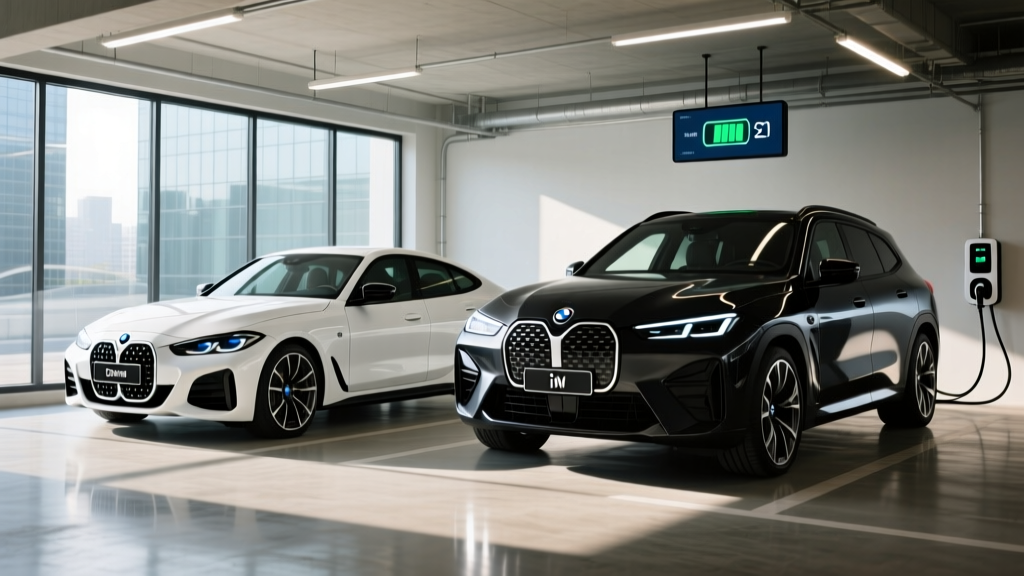
Shopping for electric BMW lease deals in 2026 means navigating a complex web of incentives, charging economics, and depreciation realities. The BMW i4 and iX represent two very different value propositions — one a sport sedan starting under $55,000, the other a luxury SUV pushing past $90,000. But which actually delivers better long-term value, and how do current federal tax credit rules affect the math?
This guide breaks down the real numbers behind owning (or leasing) BMW's electric lineup, including the often-overlooked costs that dealer brochures won't mention.
2026 BMW i4 and iX: Quick Specs Before the Math
Before calculating ownership costs, let's establish what you're actually buying. The 2026 BMW i4 comes in eDrive40 and M50 trims, while the iX offers xDrive50 and M60 variants. Battery chemistry matters here — BMW uses NMC (nickel manganese cobalt) cells, which offer higher energy density than LFP but come with different degradation characteristics and warranty terms.
| Specification | i4 eDrive40 | i4 M50 | iX xDrive50 | iX M60 |
|---|---|---|---|---|
| Base MSRP | $57,900 | $69,900 | $91,900 | $111,500 |
| Battery Capacity (usable) | 81.5 kWh (NMC) | 81.5 kWh (NMC) | 105.2 kWh (NMC) | 105.2 kWh (NMC) |
| EPA Range | 307 mi | 245 mi | 324 mi | 288 mi |
| Real-World Range (highway/cold) | ~250-270 mi | ~200-220 mi | ~270-290 mi | ~240-260 mi |
| Peak DC Fast Charge | 205 kW | 205 kW | 195 kW | 195 kW |
| 10-80% DCFC Time | ~31 min | ~31 min | ~35 min | ~35 min |
| Level 2 Charge Rate | 11 kW | 11 kW | 11 kW | 11 kW |
| Horsepower | 335 hp | 536 hp | 516 hp | 610 hp |
| 0-60 mph | 5.5 sec | 3.7 sec | 4.4 sec | 3.6 sec |
| Efficiency (MPGe) | 97 MPGe | 87 MPGe | 86 MPGe | 78 MPGe |
| Battery Warranty | 8 yr / 100k mi | 8 yr / 100k mi | 8 yr / 100k mi | 8 yr / 100k mi |
Federal Tax Credit Eligibility: The $7,500 Question
Here's where BMW leasing gets complicated. The IRS §30D clean vehicle credit offers up to $7,500, but eligibility depends on multiple factors that change frequently — and BMW's battery sourcing has been a moving target.
2026 §30D Credit Requirements
- Income Caps: Modified AGI ≤ $150,000 (single), $225,000 (head of household), $300,000 (joint)
- MSRP Caps: ≤ $55,000 for sedans (i4), ≤ $80,000 for SUVs/pickups (iX qualifies)
- Battery Sourcing: Critical minerals and battery components must meet escalating domestic/free-trade-agreement percentages
- Point-of-Sale Transfer: You can transfer the credit to the dealer as a down payment reduction (new for 2024+)
- Assembly: Vehicle must be assembled in North America (BMW i4 and iX are built in Germany — this disqualifies them from the purchase credit)
The lease loophole has been controversial and may face legislative changes. Always verify current eligibility with your tax professional and the dealer's finance department before signing.
Charging Costs vs Gas: The Per-Mile Reality
Electric BMWs deliver meaningful fuel savings, but the actual number depends heavily on your charging setup. Home Level 2 charging at residential rates offers the best economics, while DC fast charging on road trips costs significantly more.
Cost Per Mile: BMW i4 vs Gas Equivalent
Assumptions: 15,000 miles/year, $3.50/gallon gas, 30 MPG gas car, $0.14/kWh home electricity, $0.45/kWh DCFC
| Scenario | Cost Per Mile | Annual Cost (15k mi) |
|---|---|---|
| Gas car (30 MPG) | $0.117 | $1,750 |
| BMW i4 (100% home L2) | $0.040 | $600 |
| BMW i4 (50% home / 50% DCFC) | $0.085 | $1,275 |
| BMW i4 (100% DCFC) | $0.130 | $1,950 |
Key Insight: Home charging saves $1,150/year vs gas. But if you rely entirely on public DC fast charging (common for apartment dwellers), you'll actually spend more than a gas car. The i4's 2.8 kWh/mile efficiency means electricity costs scale directly with your local rates.
For the iX, efficiency drops to around 3.1 kWh/mile, increasing costs by ~10%. Cold weather also increases consumption by 15-25% due to battery heating and cabin climate demands.
Maintenance Savings: Where EVs Actually Win
BMW's traditional maintenance schedule is notoriously expensive — oil changes, spark plugs, transmission fluid, and brake service add up fast. Electric BMWs eliminate most of these, but not all maintenance costs disappear.
5-Year Maintenance Cost Comparison
| Service Item | Gas BMW (5 years) | Electric BMW (5 years) | Savings |
|---|---|---|---|
| Oil changes (annual) | $1,200 | $0 | $1,200 |
| Brake pads/rotors | $1,800 | $400 (regen extends life 3-4x) | $1,400 |
| Transmission fluid | $400 | $0 | $400 |
| Air filters | $300 | $150 (cabin only) | $150 |
| Coolant service | $600 | $600 (battery thermal) | $0 |
| Tire rotation | $400 | $400 | $0 |
| Total 5-Year Maintenance | $4,700 | $1,550 | $3,150 |
Regenerative braking dramatically extends brake life — many EV owners report original brake pads at 80,000+ miles. However, EVs are heavier (the iX weighs ~5,700 lbs), which can accelerate tire wear. Budget for premium tire replacement every 35,000-45,000 miles.
Insurance Costs: The Uncomfortable Truth
Electric BMWs cost more to insure than their gas counterparts, typically 15-25% higher premiums. Several factors drive this:
- Repair complexity: High-voltage battery damage often requires full replacement ($20,000-$30,000 for iX)
- Specialized labor: Fewer certified EV technicians increase labor rates
- Parts cost: Battery modules, power electronics, and EV-specific components are expensive
- Vehicle value: Higher MSRP means higher comprehensive/collision premiums
Expect annual insurance costs of $2,400-$3,200 for the i4 and $3,000-$4,000 for the iX, depending on your driving record, location, and coverage levels. Always get quotes before committing — the premium difference can erase some fuel savings.
5-Year Total Cost of Ownership Breakdown
Let's put it all together for a realistic 5-year, 75,000-mile ownership scenario. We'll assume home Level 2 charging, moderate DCFC use for road trips, and current insurance/maintenance rates.
5-Year TCO: BMW i4 eDrive40 vs iX xDrive50
| Cost Category | i4 eDrive40 | iX xDrive50 |
|---|---|---|
| Purchase price (after incentives) | $57,900 (no federal credit) | $91,900 (no federal credit) |
| Charging (75k mi, 70% home/30% DCFC) | $3,750 | $4,650 |
| Insurance (5 years) | $14,000 | $17,500 |
| Maintenance | $1,550 | $1,800 |
| Depreciation (estimated resale at 5yr/75k) | -$23,000 (40% retained) | -$36,800 (40% retained) |
| Total 5-Year Cost | $54,200 | $79,050 |
| Cost Per Mile (all-in) | $0.72 | $1.05 |
For comparison: A gas BMW 3 Series (similar size to i4) costs roughly $0.65-$0.75/mile all-in, while a gas X5 (iX equivalent) runs $0.95-$1.10/mile. The electric versions are competitive but not dramatically cheaper when you factor in higher insurance and no tax credit.
Depreciation and Resale Value: The Wild Card
EV depreciation has been volatile. Early adopters faced steep drops as battery tech improved and prices fell. For 2026 BMW EVs, expect:
- Year 1: 15-20% drop (typical new-car hit)
- Years 2-3: 10-12% annually
- Years 4-5: 8-10% annually
- 5-year retention: 35-45% of MSRP (vs 40-50% for gas BMWs)
Battery health is the key variable. BMW's 8-year/100,000-mile battery warranty covers defects and capacity loss below 70%, which provides some resale protection. However, out-of-warranty battery replacement costs $15,000-$25,000, making high-mileage used EVs risky purchases.
Leasing can hedge depreciation risk — you return the car and walk away. But lease money factors (interest rates) and residual values are set by BMW Financial Services, and they've been conservative with EVs.
State and Local Incentives: The Bonus Layer
While federal credits may not apply to BMW EVs, state and utility incentives can still help. These vary dramatically by location and change frequently:
- California: Up to $2,000 CVRP rebate (income-dependent), plus HOV lane access
- New York: Up to $2,000 Drive Clean Rebate
- Colorado: $2,500 state tax credit (no MSRP cap)
- Utility rebates: Many offer $500-$1,500 for home charger installation or off-peak charging credits
Check your state's energy office and local utility for current programs. Some stack with federal credits; others have income or vehicle-price caps.
Lease vs Buy: Which Makes Sense for BMW EVs?
Given the tax credit complexity and depreciation uncertainty, leasing often makes more sense for BMW EVs — but not always.
Choose leasing if:
- Your dealer offers pass-through lease cash (commercial credit loophole)
- You want to hedge against battery degradation and tech obsolescence
- You drive under 15,000 miles/year (typical lease limit)
- You prefer predictable monthly payments and don't mind perpetual car payments
Choose buying if:
- You drive high annual miles (20,000+)
- You plan to keep the car 7+ years (past the depreciation cliff)
- You qualify for state incentives that apply to purchases
- You want to modify the vehicle or avoid lease-end wear charges
FAQ: Electric BMW Ownership Costs
How much does it really cost to own a BMW i4 over 5 years?
Expect ~$54,000 all-in for 75,000 miles, or $0.72/mile. This includes purchase, charging, insurance, maintenance, and depreciation. Without federal tax credits (due to German assembly), the i4 is slightly more expensive than a gas 3 Series but offers instant torque, home charging convenience, and lower maintenance.
Do I qualify for the federal tax credit on a BMW i4 or iX?
For purchasing, no — BMW's EVs are assembled in Germany, failing the North American assembly requirement. For leasing, you may benefit from the commercial vehicle credit (§45W) that BMW Financial can pass through as lease cash. This varies monthly and isn't guaranteed — always confirm with your dealer before signing.
How much do I save on fuel and maintenance?
With home charging, expect ~$1,100-$1,200 annual fuel savings vs a 30 MPG gas car. Maintenance savings run ~$600-$700/year (no oil changes, longer brake life). Combined, that's $1,700-$1,900/year in operational savings. Over 5 years, you'll save ~$8,500-$9,500 in fuel and maintenance.
Are BMW EVs more expensive to insure?
Yes, typically 15-25% higher than gas BMWs. Expect $2,400-$3,200/year for the i4 and $3,000-$4,000/year for the iX. Higher repair costs (especially battery replacement) and vehicle values drive premiums up. Get quotes before committing — the insurance premium increase can offset 30-40% of your fuel savings.
How well do electric BMWs hold their value?
Expect 35-45% value retention after 5 years/75,000 miles, slightly below gas BMWs (40-50%). Battery health uncertainty and rapid EV tech evolution create depreciation risk. BMW's 8-year/100,000-mile battery warranty helps, but out-of-warranty replacement costs ($15,000-$25,000) make high-mileage used EVs risky. Leasing transfers this risk to BMW Financial.
What about home charging installation costs?
A Level 2 home charger (240V, 40-amp circuit) typically costs $1,200-$2,500 installed, including the charger unit ($500-$800), electrical work, and permits. If your electrical panel needs an upgrade to 200 amps, add $1,500-$3,000. Many utilities offer $500-$1,000 rebates — check before installation.
Is the BMW i4 or iX better value?
The i4 eDrive40 offers better efficiency (97 MPGe vs 86 MPGe), lower insurance, and a more manageable price. The iX provides SUV practicality, more range (324 vs 307 miles), and standard AWD, but costs ~$25,000 more over 5 years. If you need SUV cargo space and can absorb the cost, the iX works. Otherwise, the i4 delivers better value per mile.
Electric BMW lease deals can make sense if you navigate the incentive landscape carefully and understand the real ownership costs. The fuel and maintenance savings are real, but insurance premiums and depreciation keep the total cost competitive with — not dramatically lower than — gas alternatives. Run your own numbers based on local electricity rates, insurance quotes, and available incentives before deciding.