Quick Answer: Are Electric Bikes Allowed on Rail Trails?
Most rail trails in the U.S. permit Class 1 e-bikes (pedal-assist only, motor cuts off at 20 mph) but restrict or ban Class 2 (throttle-equipped) and Class 3 (28 mph assist) models. Trail access is determined by local land managers, not federal law, so rules vary by county and state. Before heading out, check the specific trail's posted regulations or the managing agency's website. For EV owners considering adding an e-bike to their garage, this guide covers the range, charging, cost, and practical ownership details you need.
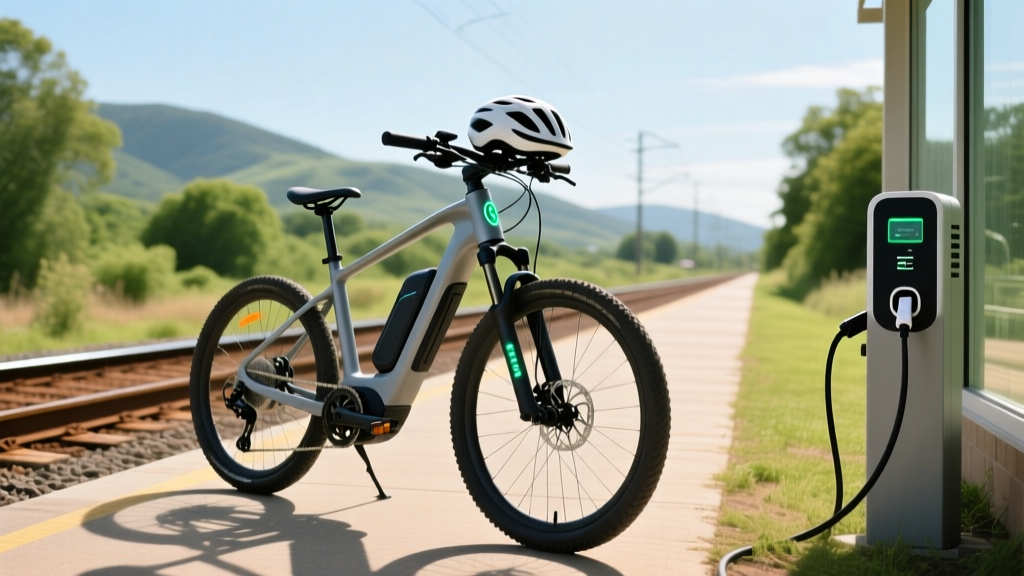
If you own an electric vehicle and enjoy weekend rides, an e-bike on a rail trail might seem like a natural extension of your electrified lifestyle. Rail trails — former railroad corridors converted into multi-use paths — total over 25,000 miles in the U.S., according to the Rails-to-Trails Conservancy. They offer flat, scenic, car-free riding that pairs well with e-bike pedal assist. But the intersection of e-bike technology and trail regulation is surprisingly complex, and the ownership economics differ significantly from what EV buyers are used to evaluating.
E-Bike Classes Explained: What's Legal Where
The three-class e-bike system, adopted by over 40 states, is the foundation of every trail-access decision:
| Class | Motor Type | Max Assisted Speed | Typical Trail Access |
|---|---|---|---|
| Class 1 | Pedal-assist only | 20 mph | Generally permitted on rail trails |
| Class 2 | Throttle + pedal-assist | 20 mph | Often restricted; check locally |
| Class 3 | Pedal-assist only | 28 mph | Rarely permitted on shared-use trails |
The key distinction: Class 1 e-bikes behave like traditional bicycles with a boost — the motor only engages when you pedal. Land managers tend to view these as compatible with trail safety. Class 2 models with throttles raise concerns about motorized-vehicle precedent, and Class 3 speeds are considered too fast for mixed-use paths with pedestrians, children, and horses.
Real-world tip: Many e-bikes sold in the U.S. can be switched between classes via a settings menu. Riding a Class 3-capable bike in Class 1 mode on a restricted trail is technically legal in some jurisdictions, but enforcement officers may not distinguish between modes. Carry documentation of your bike's configured class if your model supports this.
E-Bike Range, Battery Specs, and What the Numbers Mean
Just like EVs, e-bike range claims deserve scrutiny. Here's how e-bike battery and motor specs translate to real-world rail-trail riding:
| Spec | Typical Range | Real-World Rail Trail Expectation |
|---|---|---|
| 400 Wh battery (e.g., Trek, Specialized mid-range) | 40–60 mi (manufacturer claim) | 30–45 mi on flat trail, assist level 2 of 4 |
| 500 Wh battery (e.g., Rad Power, Aventon) | 45–70 mi | 35–55 mi with moderate assist |
| 700+ Wh battery (e.g., cargo e-bikes, dual-battery setups) | 60–100+ mi | 50–80 mi realistic on mixed terrain |
Understanding Wh (watt-hours) on e-bikes: Just as EV buyers learn that kWh measures battery capacity, e-bike shoppers need to focus on Wh. A 500 Wh battery stores 0.5 kWh — roughly 1/150th of a Tesla Model Y's 75 kWh pack. Range depends heavily on assist level, rider weight, wind, and terrain. On a flat rail trail with moderate assist, expect to consume roughly 10–15 Wh per mile. Cranking assist to maximum on hilly sections can push consumption past 25 Wh/mile.
Cold-weather note: E-bike lithium-ion batteries lose 15–30% of usable capacity below 40°F, similar to EV battery behavior. If you ride rail trails in shoulder seasons, plan for reduced range and store your battery indoors between rides.
Charging Logistics: Home, Garage, and Trailhead
E-bike charging is dramatically simpler than EV charging, but it has its own quirks:
- Charge rate: Most e-bike chargers deliver 2A to 4A at 36V or 48V, equating to roughly 70–200 watts (0.07–0.2 kW). Compare that to a Level 2 EV charger at 7–11 kW.
- Charge time: A depleted 500 Wh battery takes 3–6 hours on a standard charger. Fast chargers (if the battery management system supports them) can cut this to 2–3 hours.
- Energy cost: Fully charging a 500 Wh battery costs approximately $0.06–$0.10 at the U.S. average electricity rate of ~$0.16/kWh (per EIA data).
- Outlet access: Every e-bike charger uses a standard 120V household outlet. No special electrical work required — a major advantage over Level 2 EV home charging, which can cost $500–$2,000 for installation.
Trailhead charging reality: Don't count on finding an outlet at a trailhead. Plan your rides around your battery's real-world range, and treat any available outlet as a bonus. Some rail-trail towns have bike shops or cafes where you can negotiate a quick top-up, but this is not infrastructure you should rely on.
Cost Comparison: E-Bike vs. EV vs. Gas Car for Recreation
If you're evaluating whether an e-bike makes financial sense alongside your EV, here's a concrete breakdown comparing the cost of a typical weekend recreation trip — say, a 40-mile round-trail ride vs. a 40-mile drive to a trailhead:
| Cost Factor | E-Bike (Riding the Trail) | EV (Driving to Trailhead) | Gas Car (Driving to Trailhead) |
|---|---|---|---|
| Purchase price (mid-range) | $1,500–$3,500 | $38,000–$55,000 | $30,000–$45,000 |
| Energy cost per 40 mi | ~$0.08 (500 Wh battery) | ~$1.20 (12 kWh at $0.16/kWh) | ~$4.50 (1.3 gal at $3.40/gal) |
| Annual maintenance | $100–$300 (tires, chain, tune-up) | $200–$400 (tire rotation, cabin filter) | $500–$900 (oil, filters, brakes) |
| Insurance (annual) | $0–$150 (optional specialty policy) | $1,200–$2,200 | $1,000–$1,800 |
| Federal tax credit | None (e-bike credit proposals have not passed as of 2026) | Up to $7,500 under IRS §30D (income/MSRP/sourcing limits apply) | None |
The e-bike is not a car replacement — it's a recreation and short-commute tool. But for EV owners who already have a vehicle for longer trips, adding an e-bike for rail-trail weekends and neighborhood errands can reduce short car trips, saving wear on the EV and cutting overall household transportation costs.
Common Misconceptions About E-Bikes on Trails
| Myth | Fact |
|---|---|
| "E-bikes are motorized vehicles, so they belong on roads, not trails." | Class 1 e-bikes are legally classified as bicycles in most states (under the 2002 federal CPSC definition and state adoptions). They are not classified as motorcycles or mopeds. |
| "All e-bikes are allowed wherever regular bikes go." | Trail access is set by local land managers. Many trails allow Class 1 but ban Class 2 and 3. Some natural-surface mountain bike trails prohibit all e-bikes. |
| "E-bike batteries are a fire hazard on trails." | UL-certified e-bike batteries (look for UL 2849 certification) carry minimal fire risk. The documented fire incidents involve uncertified, cheaply imported batteries charged with incompatible chargers — largely an indoor storage issue, not a trail issue. |
| "You need a driver's license or registration for an e-bike." | In states that have adopted the three-class system, Class 1 and 2 e-bikes generally require no license, registration, or insurance. Class 3 may have age restrictions (typically 16+). Always verify your state's specific rules. |
| "E-bikes damage trail surfaces more than regular bikes." | Studies from IMBA and trail agencies have found that e-bikes exert similar or only marginally greater trail impact than conventional mountain bikes, primarily due to slightly higher weight. On paved or crushed-stone rail trails, the difference is negligible. |
Decision Framework: Should You Add an E-Bike to Your EV Household?
Use this framework to decide whether an e-bike makes sense for your situation:
- Choose a Class 1 e-bike if: You primarily want to ride rail trails and shared-use paths, your local trails permit pedal-assist, and you want the widest possible trail access with the least regulatory friction. Budget: $1,500–$3,000 for a quality model with a UL 2849-certified battery.
- Choose a Class 2 e-bike if: You need throttle assist for stop-and-go commuting or have a physical limitation that makes consistent pedaling difficult, AND your local trails explicitly permit throttle-equipped bikes. Budget: $1,000–$2,500.
- Choose a Class 3 e-bike if: Your primary use is road commuting at higher speeds, you don't plan to ride shared-use trails, and your state permits Class 3 on roads/bike lanes. Budget: $2,000–$4,500.
- Skip the e-bike (for now) if: Your nearest rail trail explicitly bans all e-bikes, you have no secure storage (e-bike theft is a growing problem — expect to spend $100–$200 on a quality U-lock or chain), or your only riding plan is occasional weekend use where a conventional bike would suffice.
Transporting Your E-Bike With Your EV
A practical consideration EV owners face: getting the e-bike to the trailhead. Most e-bikes weigh 45–70 lbs (cargo models can exceed 80 lbs), which rules out trunk storage for many vehicles.
- Hitch racks: The best option for EVs. Look for a rack rated for e-bike weight (e.g., Thule EasyFold XT, rated for 65 lbs per bike, ~$900). A 2-inch hitch receiver is required. Note: adding a hitch to some EVs may affect warranty or require dealer installation.
- Roof racks: Lifting a 55-lb e-bike onto a roof rack is impractical for most people and increases aerodynamic drag, which can reduce EV range by 10–15% at highway speeds.
- In-vehicle storage: Some SUVs and wagons (Tesla Model Y, Ford Mustang Mach-E, Hyundai Ioniq 5) can accommodate a folded or front-wheel-removed e-bike with the rear seats down. Measure your cargo area (typically 30–35 cu ft with seats up, 65–75 cu ft folded) against the bike's dimensions.
- Range impact: A hitch rack with two e-bikes adds roughly 120–150 lbs of rear weight and significant aerodynamic drag. Expect a 15–25% reduction in EV highway range when loaded. On a vehicle with 300 miles of EPA range, plan for 225–255 real-world miles with the rack installed.
Frequently Asked Questions
Do I need a helmet for e-bike riding on rail trails?
Helmet laws vary by state and municipality. Most states require helmets for riders under 16–18. For adults, it's not universally mandated on trails, but a CPSC-certified helmet (or NTA 8776 for e-bike-specific certification) is strongly recommended regardless of legal requirements. Class 3 riders face helmet mandates in more jurisdictions.
Can I charge my e-bike battery from my EV's 120V outlet?
Technically, yes — if your EV has a standard 120V auxiliary outlet (some trucks and SUVs do, like the Ford F-150 Lightning's bed outlet), you can plug in an e-bike charger. However, the e-bike charger draws only 70–200W, which is negligible relative to an EV's battery. Just ensure the outlet is rated for continuous use and your e-bike charger's plug is compatible.
Are there any federal tax credits for e-bikes in 2026?
As of 2026, there is no federal tax credit for e-bike purchases. Proposed legislation (such as the E-BIKE Act) has been introduced in Congress but has not been enacted. Some states and localities offer rebates — check your state energy office or local bike advocacy group for current programs. Unlike the IRS §30D clean vehicle credit for EVs, no e-bike equivalent exists at the federal level.
How long do e-bike batteries last before needing replacement?
Most quality e-bike batteries (Samsung, LG, Bosch cells) are rated for 500–1,000 full charge cycles before degrading to 70–80% of original capacity. At typical rail-trail usage (1–2 rides per week, partial discharges), expect 4–7 years of serviceable life. Replacement batteries cost $400–$900 depending on capacity and brand. Store batteries at 40–60% charge in a cool, dry place during off-seasons to maximize longevity — the same best practices that apply to EV traction batteries.
What's the best way to find rail trails that allow e-bikes near me?
Start with the Rails-to-Trails Conservancy TrailLink map, which lists trail surfaces, lengths, and access rules. Cross-reference with your state's e-bike legislation (PeopleForBikes maintains a state-by-state database). When in doubt, call the trail's managing agency directly — county parks departments, state DNR offices, or local land trusts. Posted trailhead signage is the final authority, and rules do change seasonally.