The Short Answer: Electric Bikes and EVs on Mackinac Island
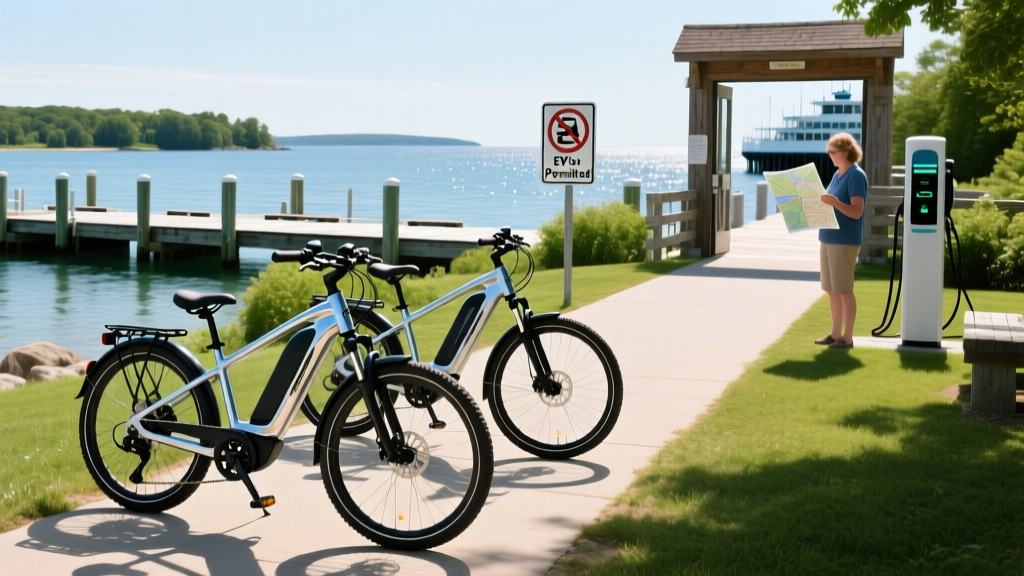
Mackinac Island has banned nearly all motorized vehicles since 1898. That means electric bikes (e-bikes) are not permitted on Mackinac Island for general visitors, and electric cars are also prohibited from the island's roads. The island allows only bicycles (human-powered), horse-drawn carriages, and a handful of emergency/service vehicles. If you're planning a Michigan EV road trip that includes Mackinac Island, you'll need to leave your EV on the mainland and park your e-bike before boarding the ferry.
If you landed here searching for electric bikes Mackinac Island, you're likely planning a northern Michigan getaway and wondering whether your e-bike or electric vehicle can make the crossing. This guide breaks down the island's vehicle restrictions, explains what's actually allowed, and provides a practical EV road-trip framework for getting to the Mackinac Island ferry docks — including real-world charging logistics in the Upper Peninsula.
Mackinac Island's Motorized Vehicle Ban: What's Actually Prohibited
Mackinac Island's prohibition on motorized vehicles is one of the oldest transportation ordinances in the United States, enacted in 1898 after early automobiles frightened the island's horses. The ban is codified in city ordinance and has been consistently enforced for over 125 years.
Here's what the restriction covers in practical terms:
- Electric cars (BEVs): Not permitted on island roads. You cannot drive a Tesla, Ford Mustang Mach-E, Chevrolet Equinox EV, or any other electric vehicle onto the island.
- Plug-in hybrids (PHEVs) and gas cars: Also prohibited. The ban applies to all motorized vehicles, regardless of powertrain.
- Electric bikes (e-bikes): Class 1, Class 2, and Class 3 e-bikes are generally not allowed for visitors. The island treats motor-assisted bicycles as motorized vehicles under the ordinance.
- Electric scooters, mopeds, and motorcycles: Prohibited.
- Standard bicycles: Fully permitted and the primary mode of personal transportation on the island. Rentals are widely available.
The only motorized vehicles allowed on Mackinac Island are emergency vehicles (ambulance, fire, police), city service vehicles, and mobility devices for individuals with disabilities (such as electric wheelchairs and certain approved mobility scooters). Snowmobiles are permitted during winter months when the island's harbor is frozen and ferry service is suspended.
Getting to Mackinac Island in an EV: Mainland Charging Logistics
While you can't bring your EV to Mackinac Island itself, you absolutely can drive an EV to the ferry departure points on the mainland. Two ferry companies serve the island — Shepler's Ferry (departing from Mackinaw City) and Star Line Ferry (departing from both Mackinaw City and St. Ignace). Here's what EV travelers need to know about charging near the docks.
Charging Infrastructure Near Mackinac Island Ferry Docks
| Location | Charger Type | Connector | Max Power | Notes |
|---|---|---|---|---|
| Mackinaw City (near Shepler's) | DC Fast Charger | CCS / NACS | 150 kW | Charge while you take the ferry (4-8 hour island visits) |
| Mackinaw City (downtown) | Level 2 | J1772 / NACS | 7.2–19.2 kW | Multiple public Level 2 stations within walking distance of docks |
| St. Ignace (near Star Line) | DC Fast Charger | CCS | 50–150 kW | Limited availability — check PlugShare before relying on this |
| St. Ignace (downtown) | Level 2 | J1772 | 7.2 kW | Adequate for topping off during a half-day island visit |
| I-75 corridor (Cheboygan to Sault Ste. Marie) | DC Fast (Meijer, Tesla SC) | CCS / NACS | 150–250 kW | Multiple options along the route for trip planning |
Pro tip for EV road-trippers: A typical Mackinac Island day trip lasts 4 to 8 hours. That's more than enough time to add meaningful range on a Level 2 charger (7.2 kW adds roughly 25–30 miles of range per hour for most EVs) or complete a full DC fast-charge session. If you're driving a vehicle like the Hyundai Ioniq 5 (which charges from 10–80% in approximately 18 minutes at a 240 kW charger), a quick stop before boarding the ferry eliminates any range concern for the return drive.
The EV Road Trip to Northern Michigan: Range, Charging, and Real-World Considerations
Mackinac Island sits at the top of Michigan's Lower Peninsula (Mackinaw City) or a short ferry ride from the Upper Peninsula (St. Ignace). For most EV travelers, the bigger question isn't the island itself — it's whether the drive north is practical in an electric vehicle.
Here's a realistic breakdown of what that trip looks like from major Michigan cities:
EV vs. Gas: Detroit to Mackinaw City (Approx. 280 Miles)
| Factor | Electric Vehicle (e.g., Tesla Model Y LR) | Gas Vehicle (e.g., Toyota RAV4 AWD) |
|---|---|---|
| EPA Range / Tank Range | 310 miles (EPA) | ~440 miles (14.5 gal × 30 MPG hwy) |
| Real-World Highway Range | ~250–270 miles (70+ mph, A/C) | ~400 miles |
| Cold-Weather Range (Jan/Feb) | ~200–220 miles (20–30% loss) | ~370 miles (minor MPG reduction) |
| Stops Required | 1 DC fast charge (15–25 min) | 0–1 fuel stops (5–10 min) |
| Energy/Fuel Cost (one-way) | ~$12–$18 (public DCFC at $0.35–$0.48/kWh) | ~$28–$35 (at $3.30/gal) |
| Total Travel Time | ~4 hr 45 min (including charge stop) | ~4 hr 15 min |
The EV trip is entirely feasible, but you need to plan around one charging stop. The I-75 corridor north of Saginaw has improved significantly for EV charging, with DC fast chargers available at Meijer locations, Tesla Superchargers, and Electrify America stations. However, this is still a region where charging infrastructure is thinner than in metro Detroit — treat it as a route where you plan your stop in advance rather than improvising.
Cold-weather reality check: If you're visiting Mackinac Island in late fall or winter (ferry service typically runs May through October, with limited winter service), lithium-ion batteries lose 20–30% of their usable capacity in sub-freezing temperatures. A vehicle rated for 310 miles EPA may deliver only 200–220 miles at 20°F on the highway. Preconditioning your battery before a fast-charge stop — a feature available on most modern EVs — helps restore charge speed and recovers some of that lost efficiency.
What IS Allowed on Mackinac Island: Your Transportation Options
Once you've parked your EV (and your e-bike) on the mainland, here's how you'll actually get around the island:
- Walking: The island's downtown area is compact and walkable. M-185, the 8.2-mile road circling the island, is flat and scenic.
- Standard bicycle rental: Dozens of rental shops operate near both ferry docks. Expect to pay $10–$15/hour or $40–$60 for a full-day rental (2026 pricing). Bikes are the most popular way to circle the island.
- Horse-drawn carriage: Both private tours and the public carriage transit system operate on the island. A guided island tour by carriage runs approximately $30–$40 per person.
- Your own (non-electric) bicycle: You can bring a standard bicycle on the ferry for a small fee (~$10–$15 round trip).
If you have a disability and require a motorized mobility device, contact the ferry company and the City of Mackinac Island in advance to confirm that your specific device qualifies under the mobility exemption.
Common Misconceptions About Electric Vehicles and Mackinac Island
| Myth | Fact |
|---|---|
| "Electric bikes are eco-friendly, so they must be allowed on Mackinac Island." | The ban covers all motorized vehicles regardless of emissions. The ordinance predates environmental concerns — it exists to preserve the island's horse-drawn character and pedestrian safety. |
| "I can bring my e-bike if I don't use the motor." | Enforcement focuses on the vehicle type, not how you're using it. An e-bike with a motor is classified as motorized regardless of whether the assist is engaged. Leave it on the mainland. |
| "You can't drive an EV to Mackinac Island because there's no charging." | You can't drive an EV on the island (no motorized vehicles allowed), but charging near the ferry docks on the mainland is available. EV road trips to the Mackinac Straits region are practical with minimal planning. |
| "The island will eventually allow EVs because they're quiet and emission-free." | The island's transportation policy is rooted in historic preservation, not environmental compliance. There is no announced plan to modify the 1898 motorized vehicle ban for EVs. |
| "Electric wheelchairs are banned too." | ADA-qualified mobility devices, including electric wheelchairs and certain approved scooters, are exempt from the motorized vehicle ban. |
Decision Framework: Should You Drive an EV to the Mackinac Straits?
Use this framework to decide whether your EV is the right vehicle for a Mackinac Island trip:
Choose the EV if:
- Your EV has at least 250 miles of EPA-rated range (real-world highway range of ~200+ miles in summer conditions)
- You're traveling between May and October (ferry season, mild weather, minimal cold-weather range loss)
- You can charge at home before departure (starting at 100% SoC eliminates the need for a mid-route stop for many vehicles)
- You're comfortable planning one DC fast-charge stop using apps like PlugShare, A Better Routeplanner, or your vehicle's built-in navigation
- You want to save $15–$25 per trip on fuel costs vs. a comparable gas vehicle
Choose a gas vehicle or hybrid instead if:
- You're traveling in November–April when temperatures drop below freezing and range loss is significant
- Your EV has less than 200 miles of EPA range and you'd need two charge stops each way
- You're towing a boat or trailer to the Straits (towing reduces EV range by 30–50%)
- You don't have reliable home charging access and would start the trip at a partial state of charge
- You're making a multi-stop UP road trip beyond the Mackinac Straits into areas with sparse DC fast-charging (e.g., the Keweenaw Peninsula, Pictured Rocks)
Consider a PHEV (plug-in hybrid) as the compromise if:
The Real Cost of an EV Road Trip to Mackinaw City
For buyers weighing whether an EV makes sense for Michigan road trips, here's a concrete ownership cost comparison for the Detroit-to-Mackinaw City corridor:
| Cost Category | EV (Tesla Model Y LR, 2026) | Gas (Toyota RAV4 AWD, 2026) |
|---|---|---|
| Vehicle MSRP (base) | $44,990 | $32,350 |
| Federal tax credit (§30D) | Up to $7,500 (subject to income, MSRP, and battery sourcing rules — see IRS §30D guidelines) | $0 |
| Effective purchase price | ~$37,490 (if full credit applies) | $32,350 |
| Fuel/energy cost per round trip (560 mi) | $24–$36 (public DCFC) | $56–$70 (gas at $3.30/gal, 30 MPG hwy) |
| Annual fuel/energy (12,000 mi, home charging at $0.15/kWh) | ~$540 | ~$1,320 |
| Annual maintenance | ~$300 (no oil changes, fewer brake replacements due to regen) | ~$650 (oil changes, brake service, air filters) |
| 5-year fuel + maintenance total | ~$4,200 | ~$9,850 |
The EV saves approximately $5,650 over five years in fuel and maintenance alone. Even after accounting for the higher purchase price (and assuming you qualify for the full federal tax credit under current IRS §30D rules), the total cost of ownership favors the EV for most Michigan drivers — including those who take regular road trips to the Mackinac Straits.
Note on the §30D federal tax credit: Eligibility depends on your modified adjusted gross income (caps of $150,000 single / $300,000 joint), vehicle MSRP limits ($55,000 for cars, $80,000 for SUVs/trucks), battery component and critical mineral sourcing requirements, and the vehicle must be assembled in North America. The credit can now be transferred to the dealer at point of sale as an instant discount. Always verify current-year eligibility with a tax professional or the IRS directly, as sourcing requirements tighten annually.
Frequently Asked Questions
Can I bring any type of electric bike to Mackinac Island?
No. All classes of e-bikes (Class 1 pedal-assist up to 20 mph, Class 2 throttle-assist up to 20 mph, and Class 3 pedal-assist up to 28 mph) are considered motorized vehicles under Mackinac Island's ordinance and are not permitted. This applies to visitors and residents alike.
Can I rent an e-bike on Mackinac Island?
No. Rental shops on Mackinac Island offer standard (non-motorized) bicycles only. You'll find single-speed cruisers, multi-speed bikes, and tandem bicycles available, but no electric-assist models.
Is there EV charging on Mackinac Island itself?
No. There are no public EV chargers on Mackinac Island, and motorized vehicles are prohibited on island roads. Charge your EV at a mainland station near the Mackinaw City or St. Ignace ferry docks before crossing.
What's the best EV for a Michigan road trip to Mackinaw City?
Any EV with 250+ miles of EPA range handles the Detroit-to-Mackinaw City route (280 miles) with one DC fast-charge stop. Popular choices include the Tesla Model Y Long Range (310 miles EPA, 250 kW peak charging), Hyundai Ioniq 5 (305 miles EPA, 240 kW peak), and Chevrolet Equinox EV (319 miles EPA). For trips extending deeper into the Upper Peninsula where charging is sparse, a PHEV like the RAV4 Prime offers more flexibility.
Are there any exceptions to the motorized vehicle ban?
Yes. Emergency vehicles (police, fire, ambulance), authorized city service vehicles, and ADA-qualified mobility devices for individuals with disabilities are exempt. Construction vehicles may receive temporary permits for specific projects. Snowmobiles are allowed during winter when the island is accessible only by ice bridge or air.
How do I get my bicycle on the ferry to Mackinac Island?
Both Shepler's Ferry and Star Line Ferry allow standard bicycles on board for an additional fee (typically $10–$15 round trip in 2026). Walk your bike onto the ferry — no special reservation is needed, though arriving 30 minutes before departure is recommended during peak summer weekends.
Sources: City of Mackinac Island ordinances, Mackinac Island Tourism Bureau, IRS §30D Clean Vehicle Credit, fueleconomy.gov.