Quick Answer: Yes, Electric Bikes Are Legal in Florida
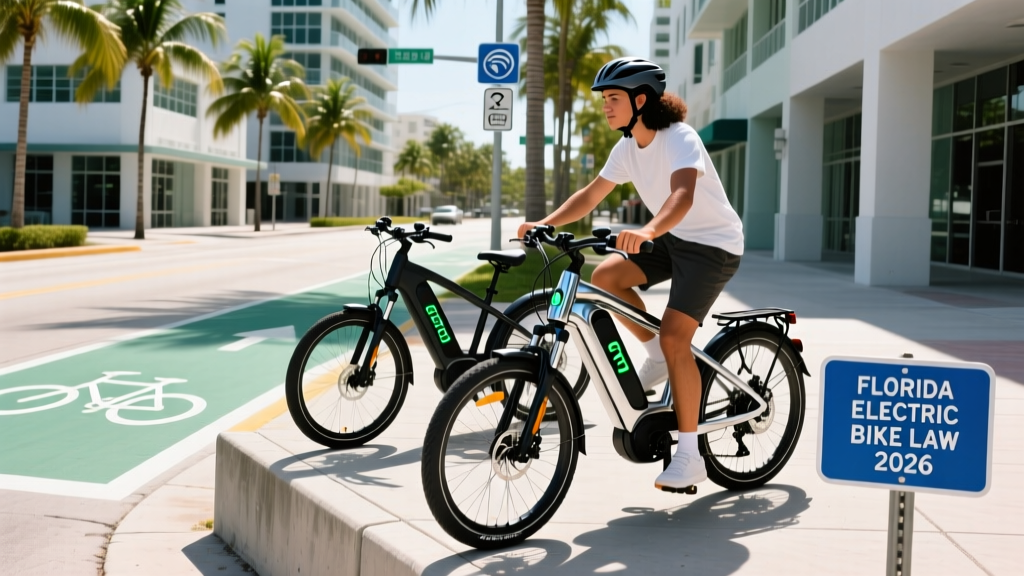
Electric bikes are fully legal in Florida under state law (Florida Statute §316.003). Since 2020, Florida defines e-bikes as "motorized bicycles" with three classes based on motor type and top assisted speed. No driver's license, registration, or insurance is required for any class. Riders must be at least 16 for Class 3 e-bikes (28 mph assist), and helmets are required for riders under 16.
Florida is one of the most e-bike-friendly states in the US, but local municipalities and trail authorities can impose additional restrictions. If you're considering an e-bike as a daily commuter, a weekend cruiser, or a car-replacement for short trips, understanding the legal framework — and the real costs of ownership — is essential before you buy.
Florida's Three E-Bike Classes Explained
Florida adopted the standard three-class e-bike system used by most US states. The classification determines where you can legally ride and what equipment is required.
| Class | Motor Type | Max Assisted Speed | Motor Wattage | License Required | Helmet (Under 16) |
|---|---|---|---|---|---|
| Class 1 | Pedal-assist only | 20 mph | ≤750W | No | Yes |
| Class 2 | Throttle + pedal-assist | 20 mph | ≤750W | No | Yes |
| Class 3 | Pedal-assist only | 28 mph | ≤750W | No | Yes (under 16 required) |
Key detail: The 750-watt (1 horsepower) motor limit applies to all classes. Any two-wheeled vehicle exceeding 750W or capable of speeds over 28 mph under motor power alone is classified as a moped or motorcycle in Florida, which requires registration, a driver's license, and insurance.
Where You Can (and Can't) Ride E-Bikes in Florida
The legality of e-bikes on specific paths and roads is where confusion typically arises. State law provides the baseline, but local jurisdictions have authority over trails, sidewalks, and bike paths.
Streets and Bike Lanes
All three classes of e-bikes are legal on public roads and designated bike lanes. You must follow the same traffic laws as traditional bicyclists: stop at red lights, yield to pedestrians, use hand signals for turns, and ride in the direction of traffic. Class 3 e-bikes (28 mph) are permitted in bike lanes, though some local ordinances may restrict them to roadways only.
Sidewalks
Florida state law does not prohibit e-bikes on sidewalks, but many cities — including Miami Beach, Fort Lauderdale, and parts of Tampa — have local ordinances banning motorized vehicles on sidewalks. Always check municipal codes. Class 1 and Class 2 e-bikes ridden on sidewalks must use pedal-assist mode only in most jurisdictions; throttle operation is often prohibited on pedestrian paths.
Multi-Use Trails and State Parks
This is where restrictions tighten significantly. Florida State Parks generally allow Class 1 e-bikes on paved trails but restrict or prohibit Class 2 and Class 3 on natural-surface trails. The Pinellas Trail, one of the longest urban rail-trails in the US at 54 miles, permits Class 1 and Class 2 e-bikes. The Withlacoochee State Trail allows Class 1. Always verify with the Florida State Parks website before heading out.
Beaches and Boardwalks
Most Florida beaches prohibit all motorized vehicles, including e-bikes, on sand. Boardwalk rules vary by city. Daytona Beach and Clearwater Beach generally allow Class 1 e-bikes on boardwalks during non-peak hours, but enforcement and rules change seasonally.
E-Bike vs. Car for Florida Commutes: Real Cost Comparison
Many Florida residents are turning to e-bikes as a practical alternative for short commutes, grocery runs, and beach trips. Here's how the economics stack up against a gas car and an electric vehicle for a 10-mile daily round-trip commute in Florida.
| Cost Factor | E-Bike (Class 2) | Gas Car (30 MPG) | EV (e.g., Chevy Equinox EV) |
|---|---|---|---|
| Purchase Price | $1,500–$3,500 | $28,000–$35,000 | $33,000–$43,000 |
| Fuel/Energy per Year | $30–$50 (electricity) | $600–$900 (gas at $3.20/gal) | $180–$300 (FL avg $0.14/kWh) |
| Annual Insurance | $0–$150 (optional) | $1,800–$2,400 | $1,500–$2,200 |
| Annual Maintenance | $100–$250 | $500–$1,200 | $200–$400 |
| Registration/Tag | $0 | $50–$100 | $50–$100 |
| Parking (Urban) | $0 | $600–$2,400/yr | $600–$2,400/yr |
| Year 1 Total | $1,630–$3,950 | $30,950–$41,600 | $35,530–$48,100 |
| Annual Ongoing Cost | $130–$450 | $2,950–$6,600 | $1,930–$5,100 |
The takeaway: For short urban commutes under 15 miles, an e-bike costs roughly 90% less to own and operate than a gas car in the first year, and 85–92% less annually thereafter. Even compared to an EV — which eliminates gas and reduces maintenance — the e-bike's dramatically lower purchase price and zero insurance requirement make it the cheapest option by a wide margin for trips where weather and cargo capacity allow.
However, this comparison assumes fair-weather riding. Florida's afternoon thunderstorms (the state averages 80+ thunderstorm days per year) and summer heat index regularly exceeding 105°F mean many riders will still need a car or EV for a significant portion of their trips.
What a First-Time E-Bike Buyer in Florida Should Know
If you're ready to purchase, here are the practical ownership realities that aren't covered in the legal statutes.
Battery Range and Real-World Expectations
Most mid-range e-bikes (2025–2026 model years) ship with 400–700 Wh lithium-ion batteries. Manufacturer claims of "40–60 mile range" assume ideal conditions: flat terrain, 150-lb rider, low assist level, no wind. In Florida's heat and humidity, with frequent stops and higher assist levels for comfort, expect 60–75% of the advertised range. A 500 Wh battery realistically delivers 20–30 miles of range at moderate assist.
Heat and Battery Degradation
This is Florida's biggest e-bike ownership challenge. Lithium-ion batteries degrade faster when stored or charged in high temperatures. Leaving your e-bike in a hot garage (120°F+ attic temps are common) or in direct sunlight will accelerate capacity loss. Store and charge indoors when possible. A battery that might last 5–7 years in a temperate climate may degrade noticeably in 3–4 years in Florida without climate-controlled storage.
Theft Protection
E-bike theft is rising sharply in Florida's urban areas. Budget $100–$200 for a U-lock and chain rated for e-bikes (look for Sold Secure Gold or Diamond ratings). Consider GPS trackers ($30–$80) and renter's or homeowner's insurance riders that specifically cover e-bikes, as standard policies may exclude motorized bicycles.
Charging Costs and Setup
Charging an e-bike is simple: plug the included charger into any standard 120V outlet. A full charge of a 500 Wh battery costs approximately $0.07 at Florida's average residential rate of $0.14/kWh. A full charge takes 3–5 hours. No special electrical work is needed. If you ride daily, monthly electricity cost is roughly $2–$4.
Common E-Bike Myths in Florida — Fact-Checked
| Myth | Fact |
|---|---|
| "You need a driver's license to ride an e-bike." | False. No license, registration, or tag is required for any class of e-bike in Florida. |
| "E-bikes are banned on all bike trails." | False. Class 1 e-bikes are allowed on most paved multi-use trails. Restrictions vary by trail authority and class. |
| "You must wear a helmet at all ages." | False for adults. Helmets are required only for riders under 16. However, they are strongly recommended for all riders, especially on Class 3 e-bikes at 28 mph. |
| "E-bikes can go as fast as you want." | False. Motor assist cuts off at 20 mph (Class 1/2) or 28 mph (Class 3). You can pedal faster, but the motor stops assisting. |
| "Any electric two-wheeler is an e-bike." | False. Vehicles exceeding 750W or 28 mph motor-assisted speed are classified as mopeds or motorcycles and require license, registration, and insurance. |
| "E-bikes can't be ridden in the rain." | Mostly false. Most modern e-bikes are IP65 or IP67 water-resistant for light rain. Avoid submerging the battery or riding through deep standing water. Check your manufacturer's IP rating. |
Florida E-Bike Tax and Incentive Landscape
Unlike electric cars, which may qualify for the federal §30D clean vehicle tax credit (up to $7,500 for qualifying new EVs, subject to MSRP caps, income limits, and battery sourcing requirements), e-bikes do not currently qualify for any federal tax credit as of 2026. The proposed E-BIKE Act, which would have provided a 30% credit (up to $1,500) for e-bike purchases, has not passed Congress.
Some Florida municipalities and employers offer local incentives. Check with your county's transportation authority and your employer's commuter benefits program — some offer pre-tax e-bike purchase programs or reimbursement up to $500–$1,000.
Decision Framework: Which E-Bike Class Is Right for You?
Choose Class 1 (pedal-assist, 20 mph) if:
- You plan to ride on multi-use trails and state park paths
- You want the widest legal access across Florida jurisdictions
- Your commute is under 10 miles with bike-lane infrastructure
- You prefer a more traditional cycling experience with a boost
Choose Class 2 (throttle + pedal-assist, 20 mph) if:
- You want throttle option for stop-and-go urban traffic without pedaling from a stop
- You have knee or mobility limitations that make starting from a stop difficult
- You primarily ride on streets and bike lanes, not shared trails
- You carry cargo (groceries, kids) and need instant torque from stops
Choose Class 3 (pedal-assist, 28 mph) if:
- Your commute is 10–20 miles and you need higher speed to keep travel time practical
- You ride primarily on roads with speed limits of 35–45 mph where 28 mph keeps you safer with traffic flow
- You are 16 or older (legal minimum for Class 3 in Florida)
- You don't need multi-use trail access (many trails restrict Class 3)
Consider a car or EV instead if:
- Your commute exceeds 20 miles one-way
- You regularly carry passengers or large cargo
- You need climate-controlled comfort during Florida's 95°F+ summer afternoons
- You need reliable transportation during hurricane season evacuations
Frequently Asked Questions
Do I need to register my e-bike in Florida?
No. Florida does not require registration, license plates, or tags for e-bikes meeting the Class 1, 2, or 3 definition (≤750W motor, max assisted speed of 20 or 28 mph depending on class).
Can I ride an e-bike on the beach in Florida?
Generally no. Most Florida beaches prohibit motorized vehicles on sand, and e-bikes fall under this restriction. Some beach-adjacent paved paths and boardwalks may allow Class 1 e-bikes — check local ordinances for the specific beach you plan to visit.
Is there an age limit for riding e-bikes in Florida?
There is no minimum age for Class 1 and Class 2 e-bikes under state law, though helmets are required for riders under 16. Class 3 e-bikes require the rider to be at least 16 years old. Parents should exercise judgment — a 20 mph throttle-assisted e-bike requires mature traffic awareness.
Can I modify my e-bike to go faster than 28 mph?
You can, but doing so reclassifies the vehicle as a moped or motorcycle under Florida law. You would then need a valid driver's license, vehicle registration, insurance, and DOT-approved helmet. Riding a modified e-bike without these is a traffic violation and voids any product liability protections.
Are e-bikes allowed on Florida highways?
No. E-bikes are prohibited on limited-access highways (interstates, turnpikes, and roads with minimum speed limits). They are legal on surface roads and roads with bike lanes or shoulders.
How much does it cost to replace an e-bike battery?
Replacement batteries for quality e-bikes typically cost $400–$800 depending on capacity (Wh) and brand. Budget e-bike batteries may be $200–$350 but often have shorter lifespans. Expect 500–1,000 full charge cycles before significant degradation (below 80% original capacity), which translates to roughly 3–6 years of typical use in Florida's climate.
Do e-bike riders need insurance in Florida?
No. Florida does not require insurance for e-bikes. However, if you cause an accident injuring someone or damaging property, you could be personally liable. A homeowner's or renter's insurance policy rider covering e-bikes (typically $5–$15/month) provides liability protection and theft coverage.
Sources: Florida Statutes §316.003 and §316.2065; Florida Department of Highway Safety and Motor Vehicles; Florida State Parks; PeopleForBikes e-bike law database.