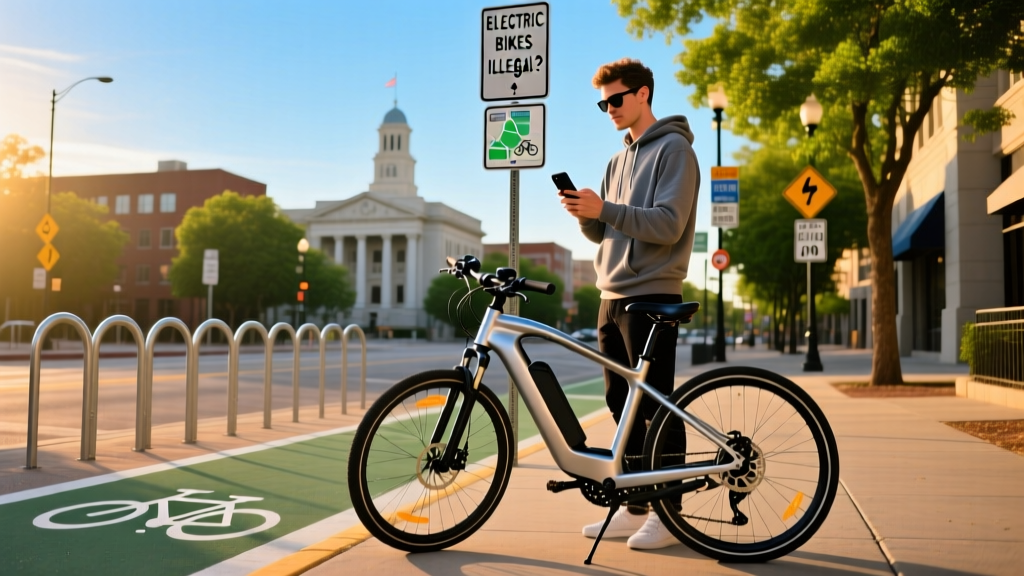
Searches for "electric bikes illegal" spike every time a city proposes new micromobility rules, but the reality is straightforward: electric bikes are legal in all 50 U.S. states under federal law, provided they meet specific power and speed criteria. However, where you can ride them, whether you need a license, and what class of e-bike you're allowed on trails varies significantly by state and municipality.
Quick Answer: Are Electric Bikes Illegal?
No. Under federal law (15 U.S.C. §2085), a low-speed electric bicycle with operable pedals, a motor under 750 watts (1 hp), and a top motor-assisted speed under 20 mph on level ground is classified as a consumer product, not a motor vehicle. It is regulated by the Consumer Product Safety Commission (CPSC), not the NHTSA, and does not require registration, insurance, or a driver's license at the federal level.
That said, e-bikes sit at the intersection of bicycle law, motor-vehicle law, and local land-use regulation — which is where confusion arises. If you're an EV owner or shopper weighing an e-bike as a last-mile commuter, a car replacement, or a supplement to your electric vehicle, understanding the legal landscape is essential before you buy.
The 3-Class E-Bike System: What the Law Actually Says
Most states have adopted a three-class framework originally developed by the bicycle industry and codified in legislation pioneered by California (AB 1096, 2015). Here's how the classes break down:
| Class | Motor Assist Type | Max Assisted Speed | Motor Wattage | Throttle? |
|---|---|---|---|---|
| Class 1 | Pedal-assist only | 20 mph | ≤750W | No |
| Class 2 | Pedal-assist + throttle | 20 mph | ≤750W | Yes |
| Class 3 | Pedal-assist (throttle limited to 20 mph) | 28 mph | ≤750W | Optional (≤20 mph) |
Critical distinction: If an e-bike exceeds 750W or can exceed 28 mph under motor power alone, it is no longer a "low-speed electric bicycle" under federal law. It becomes a motor vehicle — subject to NHTSA regulations, registration, licensing, and insurance, just like an electric car or motorcycle. This is where most "electric bikes illegal" concerns originate: riders unknowingly purchase high-power e-bikes (often marketed as "electric motorcycles" or "off-road e-bikes") that are illegal for road use without proper registration.
State-by-State Variations: Where E-Bike Laws Diverge
While 40+ states have adopted some version of the 3-class system, the details matter. Here are the most common areas of divergence:
Helmet Requirements
Class 3 e-bike riders must wear helmets in states like California, Colorado, and Georgia. Class 1 and 2 riders over 18 are often exempt. Some states (e.g., New Mexico) require helmets for all e-bike riders under 18 regardless of class.
Age Restrictions
Several states restrict Class 3 e-bike operation to riders 16 or older. Alabama and Alaska require a license to operate any e-bike class. Massachusetts treats all e-bikes as "motorized bicycles" requiring registration.
Trail and Path Access
This is the most contentious issue. Class 1 e-bikes are generally permitted on multi-use paths and bike trails. Class 2 and 3 e-bikes are frequently restricted from shared-use paths, natural-surface trails, and mountain bike trails — even where Class 1 is allowed. Local land managers (city parks departments, the U.S. Forest Service, BLM) set their own rules, which can differ block by block.
Where People Get in Trouble
The most common legal violations involve:
- Unregistered high-power e-bikes: 1,000W+ "e-bikes" that are legally mopeds or motorcycles, ridden without plates or insurance.
- Class 3 on prohibited trails: Riders on 28 mph e-bikes using Class 1-only paths.
- Modified e-bikes: Stock Class 1 or 2 bikes with aftermarket controllers that unlock speeds above 20 mph, reclassifying them as motor vehicles.
E-Bike vs. Electric Car: Commuting Cost Comparison
If you're an EV owner considering an e-bike for short commutes, the economics are compelling — but the use case is narrow. Here's a real-world comparison for a 10-mile round-trip commute:
| Factor | Class 3 E-Bike | 2026 Tesla Model 3 RWD | 2026 Toyota Corolla Hybrid |
|---|---|---|---|
| Purchase Price | $1,500–$3,500 | $38,990 MSRP | $23,500 MSRP |
| Energy Cost per Mile | ~$0.004 (0.5 kWh/mi × $0.16/kWh) | ~$0.04 (26 kWh/100mi × $0.16/kWh) | ~$0.07 (50 MPG × $3.50/gal) |
| Annual Fuel/Energy (250 days) | $10 | $100 | $175 |
| Insurance (Annual) | $0–$200 (optional) | $1,400–$2,200 | $1,100–$1,600 |
| Maintenance (Annual) | $100–$250 (tires, chain, brake pads) | $400–$700 (tires, cabin filter, wipers) | $500–$900 (oil, tires, brakes) |
| Federal Tax Credit | None (e-bikes not eligible under §30D) | Up to $7,500 (subject to income/MSRP/sourcing rules) | None |
| Parking | Free (bike rack) | $0–$250/month (urban) | $0–$250/month (urban) |
Bottom line: An e-bike saves $1,500–$3,000+ annually versus a car for short, fair-weather commutes. But it doesn't replace a car for highway travel, cargo hauling, extreme weather, or trips over ~15 miles. For EV owners, an e-bike is a complement, not a substitute — it extends your household's electric mobility footprint without the $38,000+ outlay of a second EV.
Real-World Ownership: What First-Time E-Bike Buyers Should Know
Battery Range Reality
E-bike manufacturers advertise 40–80 mile ranges, but real-world range depends on rider weight, terrain, assist level, wind, and temperature. A 500 Wh battery (common on mid-range Class 1 and 2 e-bikes) typically delivers:
- Eco/Low assist: 45–65 miles
- Medium assist: 25–40 miles
- High/Turbo assist: 15–25 miles
Cold weather (below 40°F) reduces lithium-ion battery performance by 15–30%. This mirrors the same cold-weather range loss seen in electric cars — the physics of lithium-ion cells applies regardless of pack size.
Charging Logistics
Most e-bike batteries charge on a standard 120V outlet using a proprietary charger. A 500 Wh battery takes 3–5 hours to charge from empty. Unlike EVs, there is no public charging infrastructure for e-bikes — you charge at home or at your destination. If you live in an apartment without ground-floor access or a dedicated outlet, charging becomes a real logistical challenge.
Insurance and Theft
E-bikes are high-theft items. Homeowners or renters insurance may cover theft, but many policies require a separate "scheduled personal property" rider for bikes over $1,000. Dedicated e-bike insurance (from providers like Velosurance or Sunday Insurance) runs $100–$300/year and covers theft, crash damage, and liability — important if you ride in traffic.
Safety
E-bike fatalities and serious injuries have risen sharply. A 2023 study published in JAMA Network Open found that e-bike injuries were more likely to result in hospitalization than traditional bicycle injuries, largely due to higher speeds and heavier bike weight (50–70 lbs vs. 20–30 lbs for a conventional bike). If you're used to the crash-safety engineering of a modern EV — crumple zones, airbags, AEB — remember that an e-bike offers none of that protection.
Common Misconceptions: Myth vs. Fact
| Myth | Fact |
|---|---|
| "E-bikes are illegal on all roads." | Class 1, 2, and 3 e-bikes are street-legal in all 50 states (with state-specific restrictions on Class 3). |
| "You need a driver's license to ride an e-bike." | Most states do not require a license for Class 1 or 2. A few states (Alabama, Alaska, Massachusetts, Missouri, North Dakota) require licenses or registration for some or all classes. |
| "E-bikes don't need insurance." | Not legally required in most states, but strongly recommended. Theft rates are high, and liability exposure in a car-bike collision is real. |
| "All e-bikes are the same under the law." | The 3-class system creates distinct legal categories. A Class 3 e-bike has different trail access, helmet rules, and age restrictions than a Class 1. |
| "You can modify your e-bike to go faster." | Removing a speed limiter or installing a higher-wattage motor reclassifies the bike as a motor vehicle, making it illegal for road use without registration, insurance, and a license. |
| "E-bikes qualify for the federal EV tax credit." | E-bikes are not eligible under IRS §30D. Some states and cities offer separate e-bike rebates (e.g., Colorado's e-bike tax credit, various utility rebates), but these are local programs. |
Decision Framework: Should You Buy an E-Bike, an EV, or Both?
If you're weighing an e-bike purchase alongside or instead of an electric vehicle, here's a practical framework:
Choose an e-bike if:
- Your daily commute is under 15 miles round-trip on bike-friendly roads.
- You live in a mild climate or are willing to ride in cold/rain with proper gear.
- You have secure storage and a place to charge (garage, shed, ground-floor outlet).
- You already own a car (EV or gas) for longer trips, cargo, and bad weather.
- You want to cut household transportation costs by $1,000–$3,000/year.
Choose an electric vehicle if:
- You commute over 15 miles or use highways regularly.
- You need to carry passengers, cargo, or tow.
- You live in an area with harsh winters or extreme heat where cycling is impractical for much of the year.
- You qualify for the federal §30D tax credit (income caps: $150K single / $300K joint; MSRP caps: $55K cars / $80K SUVs and trucks; battery sourcing requirements apply).
- You have access to home Level 2 charging (240V, 32–48A circuit).
Choose both if:
- You're a two-vehicle household that can replace one gas car with an EV and use an e-bike for short errands and commutes.
- You want to maximize electric miles while minimizing total household transportation spend.
Where E-Bikes Are Actually Restricted (and Why It Matters)
While e-bikes are broadly legal, specific restrictions catch riders off guard:
New York City
NYC has cracked down on high-power "e-bikes" (often 1,000W+ models sold online) that are legally classified as unregistered motorcycles. Several fatal fires linked to cheap, uncertified lithium-ion batteries in e-bikes and e-scooters prompted strict FDNY regulations on battery storage and charging in residential buildings. Legal, UL-certified Class 1–3 e-bikes remain street-legal.
National Parks and Federal Land
The National Park Service allows Class 1 e-bikes wherever traditional bicycles are permitted, per a 2020 policy update. Class 2 and 3 e-bikes may be restricted. The U.S. Forest Service treats all e-bikes as "motorized vehicles" on many trails, restricting them to designated motorized routes. Always check specific land-management unit rules before riding.
International Travel
If you travel with your e-bike, note that the EU limits e-bike motor assist to 250W and 25 km/h (15.5 mph) — significantly lower than U.S. limits. A U.S.-spec Class 3 e-bike (750W, 28 mph) is classified as a moped in most European countries and requires registration, insurance, and a helmet.
Frequently Asked Questions
Can I ride an e-bike on the sidewalk?
In most jurisdictions, no. Sidewalk riding is typically prohibited for all bicycles (including e-bikes) in commercial districts and many residential areas. Check your city's municipal code — some cities allow sidewalk riding for Class 1 only, while others ban it entirely.
Do e-bikes need to be registered?
In most states, Class 1 and 2 e-bikes do not require registration. A handful of states (Massachusetts, Alabama, Alaska, Missouri, North Dakota) require registration or licensing for some or all e-bike classes. Always verify with your state's DMV or department of transportation.
What happens if I ride an illegal e-bike?
Riding an unregistered high-power e-bike on public roads can result in citations for operating an unregistered motor vehicle, driving without a license, and operating without insurance. Fines range from $100 to $1,000+. In the event of a crash, you may be personally liable for damages with no insurance coverage.
Are e-bikes covered under the federal EV tax credit?
No. The IRS §30D Clean Vehicle Credit applies to four-wheeled electric vehicles meeting specific battery-sourcing, MSRP, and buyer-income requirements. E-bikes are not eligible. However, some states (Colorado, Hawaii, Massachusetts) and utility companies offer separate e-bike purchase rebates ranging from $200 to $1,500.
How do I know if my e-bike is legal?
Check the manufacturer's label. Legal U.S. e-bikes must display a permanent label stating the classification (1, 2, or 3), top assisted speed, and motor wattage. If your e-bike has no label, exceeds 750W, or exceeds 28 mph under motor power, it is not a legal "low-speed electric bicycle" and is subject to motor-vehicle regulations.
For the most current e-bike regulations in your state, consult your state legislature's website or the Consumer Product Safety Commission. If you're considering an e-bike as part of a broader household electrification strategy that includes an EV, review the EPA's fuel-economy database to compare total transportation energy costs across your options.