Quick Answer: Is an Electric Big Rig Worth It in 2026?
An electric big rig (Class 8 semi-truck) makes financial sense today only for regional and drayage routes under 250 miles with reliable depot charging. A Tesla Semi or Freightliner eCascadia can save $0.40–$0.65 per mile on fuel versus diesel, but the upfront premium of $150,000–$250,000 over a diesel rig demands high daily utilization and access to megawatt-class charging. Long-haul operators covering 500+ miles daily should wait for solid-state battery advances and wider MCS (Megawatt Charging System) infrastructure, expected post-2028.
The Electric Big Rig Landscape in 2026
The Class 8 electric truck market has consolidated around a handful of production-ready models after years of delays and startup failures. As of 2026, the primary options available to fleet buyers and owner-operators include:
| Model | Battery (kWh) | EPA Est. Range | Peak Charge Rate | Base Price (est.) | Production Status |
|---|---|---|---|---|---|
| Tesla Semi (300 mi) | ~500 kWh (NMC) | 300 mi (loaded) | ~1 MW (MCS) | $250,000 | Low-volume production |
| Tesla Semi (500 mi) | ~900 kWh (NMC) | 500 mi (loaded) | ~1 MW (MCS) | $290,000 | Limited deliveries |
| Freightliner eCascadia | 291–475 kWh (NMC) | 155–230 mi | 350 kW (CCS2) | $250,000–$320,000 | Full production |
| Volvo VNR Electric | 150–375 kWh (NMC) | 150–275 mi | 250 kW (CCS2) | $220,000–$300,000 | Full production |
| Kenworth T680E | 282–396 kWh (NMC) | 150–200 mi | 350 kW (CCS2) | $250,000–$310,000 | Full production |
Unlike passenger EVs, electric big rigs do not have EPA range estimates listed on fueleconomy.gov — the agency's consumer-facing database covers light-duty vehicles only. Range figures above come from manufacturer testing under loaded conditions (typically 80,000 lbs GVW) and should be treated with the same skepticism as any OEM claim.
Real-World Range Reality Check
Sticker range: 300–500 miles (Tesla Semi), 150–275 miles (legacy OEMs)
Real-world loaded range: Expect 20–30% reduction in cold weather (below 40°F), 10–15% reduction at sustained highway speeds above 65 mph, and further losses on steep grades. A Tesla Semi rated at 500 miles may deliver 350–400 miles in winter mountain routing. A Freightliner eCascadia rated at 230 miles may realistically cover 160–180 miles in demanding conditions.
Charging Infrastructure: The Biggest Bottleneck
Charging an electric big rig is fundamentally different from plugging in a passenger EV. The energy volumes are enormous, and the infrastructure is still catching up.
| Charging Level | Power (kW) | Connector | Time 10–80% (500 kWh pack) | Miles Added per Hour |
|---|---|---|---|---|
| Depot Level 2 (AC) | 19–40 kW | J1772 / CCS1 | Not practical (12+ hrs) | 15–35 mi/hr |
| DC Fast (CCS2) | 150–350 kW | CCS2 | ~90–180 min | 80–180 mi/hr |
| Megawatt Charging (MCS) | 600–1,200 kW | MCS connector | ~30–50 min | 350–600 mi/hr |
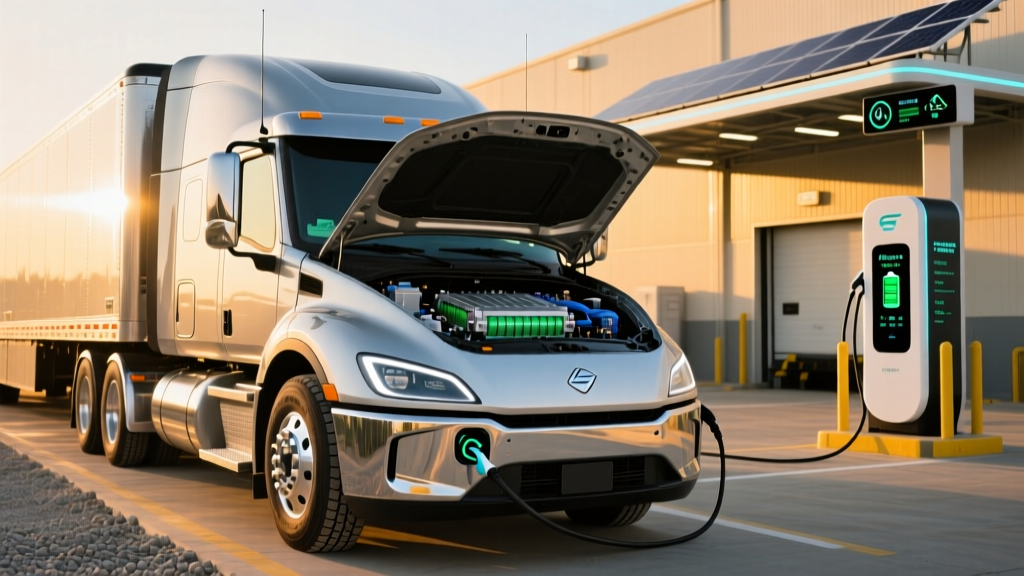
The Megawatt Charging System (MCS) is the critical standard for electric big rigs. Operating at up to 1.2 MW (1,200 kW), MCS can replenish a 500 kWh battery pack from 10% to 80% in roughly 30–40 minutes — comparable to a diesel fuel stop. However, as of early 2026, public MCS stations remain extremely limited. The Joint Office of Energy and Transportation has funded corridor deployments, but most MCS charging today happens at private fleet depots.
Depot Charging: The Operational Reality
Most electric big rig operators charge at their own depot overnight. A single 350 kW DC charger for a Class 8 truck requires:
- Electrical service: Dedicated 480V three-phase, 600A+ circuit
- Equipment cost: $80,000–$180,000 per 350 kW dispenser
- Installation: $50,000–$200,000+ depending on utility upgrades, trenching, switchgear, and transformer work
- Timeline: 6–18 months from permit to energization, largely dictated by utility interconnection queues
Fleet operators planning 10+ truck deployments should engage their utility immediately — demand charges and grid upgrades can represent the single largest infrastructure cost.
Total Cost of Ownership: Electric Big Rig vs. Diesel
The purchase-price gap between an electric big rig and a diesel equivalent is massive, but operating costs tell a different story over a 5–7 year ownership cycle.
| Cost Category | Diesel Class 8 (New) | Electric Class 8 | Notes |
|---|---|---|---|
| Purchase Price | $150,000–$200,000 | $250,000–$320,000 | EV premium: $80,000–$150,000 |
| Federal Tax Credit (§45W) | $0 | Up to $40,000 | Commercial clean vehicle credit; consult IRS guidelines |
| Fuel / Energy (per mile) | $0.75–$0.95 (diesel) | $0.20–$0.45 (electricity) | Varies by utility rate; depot charging cheapest |
| Maintenance (per mile) | $0.15–$0.22 | $0.06–$0.10 | No oil, DEF, DPF, fewer brake replacements (regen) |
| Annual Insurance | $8,000–$14,000 | $10,000–$18,000 | Higher replacement cost drives premiums |
| Depot Charging Install | N/A | $130,000–$380,000 | Amortized across fleet; per-truck share varies |
| Battery Replacement (yr 8+) | Engine rebuild: $15,000–$25,000 | $80,000–$150,000 | Major long-term risk for EV; warranty typically 8 yr / 1M mi |
Break-Even Analysis
At 60,000 miles/year and a $0.50/mile fuel savings, an electric big rig saves roughly $30,000/year on fuel alone. Add $6,000–$8,000 in maintenance savings. That's $36,000–$38,000 in annual operating savings versus diesel.
Against a $100,000 purchase premium (after the $40,000 §45W credit), the payback period is approximately 2.5–3 years for high-utilization regional fleets. Owner-operators running fewer miles or lacking depot charging access will see a longer payback — or none at all.
Common Misconceptions About Electric Big Rigs
| Myth | Fact |
|---|---|
| "Electric semis can't pull heavy loads" | The Tesla Semi and eCascadia are rated for 80,000 lbs GCW. Electric motors deliver peak torque at 0 RPM — grade performance often exceeds diesel equivalents at low speeds. |
| "You can charge at any public station" | Most public DC fast chargers max out at 50–150 kW and use CCS1 (light-duty). Class 8 trucks need CCS2 or MCS connectors, 350+ kW power, and pull-through lane geometry. Public options are scarce. |
| "Battery replacement will bankrupt you" | Current warranties cover 8 years / 1,000,000 miles at 70–80% capacity retention. LFP chemistry adoption for future models may extend cycle life beyond 5,000 cycles. Plan for replacement in year 10+, but technology costs are declining. |
| "Electric big rigs are zero-emission" | Tailpipe emissions are zero, but upstream emissions depend on your grid mix. Charging in a coal-heavy region reduces — but does not eliminate — the carbon advantage. Most grids are decarbonizing annually. |
| "The tax credit covers $40,000 for everyone" | The §45W Commercial Clean Vehicle Credit has specific requirements around vehicle weight, battery capacity, and manufacturer certification. Consult the IRS §45W guidelines and a tax professional for your situation. |
Incentives and Regulatory Drivers
Beyond the federal §45W credit, several incentive layers make electric big rigs more viable in specific markets:
- California HVIP (Hybrid and Zero-Emission Truck and Bus Voucher Incentive Project): Vouchers of $60,000–$120,000 per Class 8 vehicle, stackable with federal credits
- EPA Clean Trucks Plan: Tightening NOx standards push fleets toward zero-emission options
- State utility make-ready programs: Many utilities (PG&E, SCE, Con Edison) cover 50–100% of depot electrical infrastructure costs for fleet electrification
- CARB Advanced Clean Fleets rule: Requires drayage and certain fleet operators in California to transition to zero-emission trucks on a set timeline
Incentive amounts vary by jurisdiction and change annually. Always verify current program status with your state air quality district and utility before building a business case.
Who Should Buy an Electric Big Rig Today?
Decision Framework
Choose an electric big rig if:
- Your routes are regional or drayage, under 250 miles round-trip
- You have (or can build) depot charging with 480V three-phase service
- You operate in California or a state with strong ZEV truck incentives
- Your trucks run 5+ days/week at 50,000+ miles/year (maximizing fuel savings)
- You face regulatory mandates (CARB, port authority requirements) pushing toward zero-emission
- Your fleet has a sustainability mandate from corporate or shipper contracts
Stick with diesel (or wait) if:
- Your routes regularly exceed 350 miles between stops
- You operate OTR (over-the-road) long-haul with unpredictable routing
- You lack access to depot property or utility capacity for charger installation
- You're an owner-operator with a single truck — the infrastructure cost per unit is prohibitive
- You operate in extreme cold climates (northern MN, MT, AK) where range loss of 30%+ is routine
- Your state offers no ZEV truck incentives and your grid electricity costs exceed $0.20/kWh
Battery Degradation and Long-Term Ownership
Class 8 electric truck batteries face harsher duty cycles than passenger EVs — daily deep cycling, high charge rates, and heavy loads accelerate degradation. Key data points:
- Chemistry: Most current models use NMC (nickel manganese cobalt) for energy density. Tesla has signaled LFP interest for future production runs, which would trade range for longer cycle life (5,000+ cycles vs. ~1,500–2,500 for NMC).
- Warranty: Industry standard is 8 years / 1,000,000 miles with guaranteed 70–80% capacity retention. Some OEMs offer extended coverage for fleet buyers.
- Observed degradation: Early Freightliner eCascadia fleet data suggests 10–15% capacity loss after 300,000 miles of daily DC fast charging. This translates to a proportionate range reduction.
- Replacement cost: $80,000–$150,000 depending on pack size. This is the single largest long-term ownership risk and is not fully offset by current resale-value projections.
For a 7-year hold, plan for one battery refurbishment or replacement in the vehicle's second life. Factor this into your TCO model — ignoring it will make the economics look better than reality.
Frequently Asked Questions
How long does it take to charge an electric big rig?
At a 350 kW CCS2 depot charger, expect 90–180 minutes for a 10–80% charge on a 500 kWh pack. With MCS (megawatt charging) at 1 MW+, that drops to 30–50 minutes. Overnight depot charging at 40–80 kW takes 6–10 hours and is the standard operational model for regional fleets.
What is the real-world range of a Tesla Semi when fully loaded?
Tesla claims 500 miles for the long-range variant at 80,000 lbs GCW. Independent fleet testing in 2025 has shown 380–450 miles in moderate conditions, dropping to 300–350 miles in cold weather or mountainous terrain. The 300-mile variant delivers roughly 220–260 miles in real-world loaded use.
Can an owner-operator afford an electric big rig?
It's challenging. The $250,000+ purchase price, $130,000+ depot charging installation, and higher insurance costs create a high barrier. Owner-operators without guaranteed high-mileage contracts and depot property access will struggle to reach break-even. The economics currently favor mid-size and large fleets that can amortize infrastructure across many trucks.
Do electric big rigs qualify for the $7,500 consumer EV tax credit?
No. The §30D Clean Vehicle Credit applies to light-duty vehicles under 14,000 lbs GVWR. Class 8 trucks qualify for the §45W Commercial Clean Vehicle Credit, which provides up to $40,000 for vehicles over 14,000 lbs. Eligibility depends on battery sourcing, manufacturer certification, and your tax liability. See IRS §45W for current rules.
What happens if the battery fails out of warranty?
Out-of-warranty battery replacement costs $80,000–$150,000 depending on the pack. Some third-party firms are developing refurbishment and cell-replacement services at 40–60% of new-pack cost. Extended warranty packages from OEMs and third-party insurers are emerging but add $5,000–$12,000/year to operating costs.
How does cold weather affect electric big rig range?
Battery efficiency drops significantly below 40°F. Expect 20–35% range loss in freezing conditions, compounded by cabin and battery heating demands. Fleets in Minnesota, Montana, and New England report needing to plan routes at 65–70% of rated range during winter months. Battery preconditioning and heated depot storage mitigate but do not eliminate the loss.