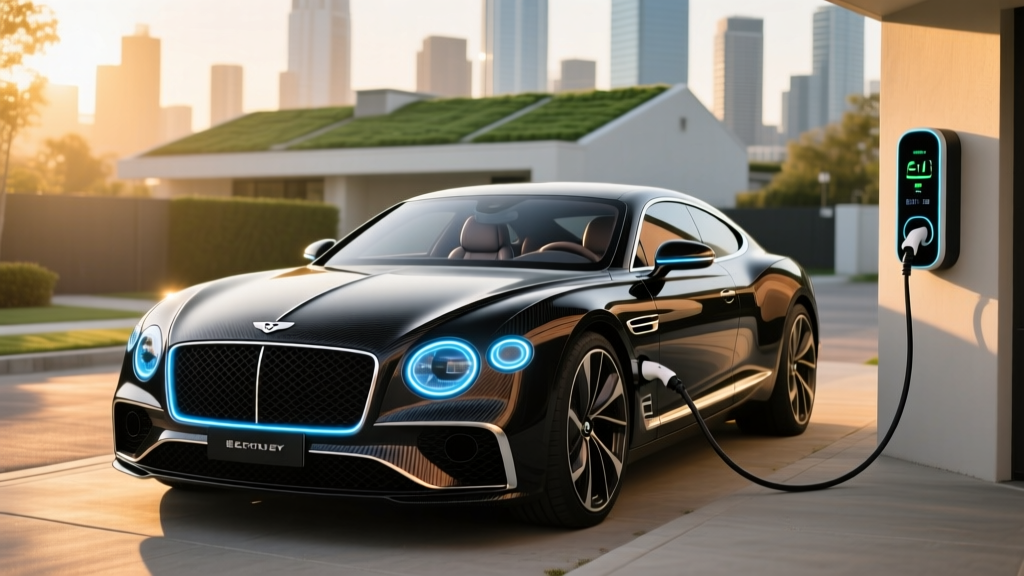
If you're researching an electric Bentley, here's the practical reality: Bentley's first dedicated battery-electric vehicle is not yet available for purchase in the United States. Bentley has publicly confirmed its transition to full electrification, but as of 2026, the brand's lineup still consists primarily of plug-in hybrid (PHEV) models like the Bentayga Hybrid and Flying Spur Hybrid. Bentley's first production BEV is expected to arrive for the 2027 model year, built on the Volkswagen Group's next-generation SSP (Scalable Systems Platform) architecture. Until then, luxury EV buyers eyeing the Bentley badge are weighing PHEV options against fully electric rivals from Rolls-Royce, Mercedes-Maybach, BMW, and Lucid.
Quick Answer: Electric Bentley Status in 2026
No production electric Bentley (BEV) is currently on sale. Bentley's first all-electric model is anticipated for the 2027 model year. Buyers wanting an electrified Bentley today can choose PHEV variants (Bentayga Hybrid, Flying Spur Hybrid). For a true all-electric ultra-luxury experience, competitors like the Rolls-Royce Spectre and Mercedes-Benz EQS Sedan are available now.
What Bentley's Electrification Roadmap Actually Means
Bentley's "Beyond100" strategy committed the brand to offering only plug-in hybrids and battery-electric vehicles by 2026, with full BEV-only sales targeted by 2030. In practice, the timeline has shifted. Bentley confirmed delays to its first BEV launch, pushing the debut past the originally announced 2025 target. The brand's first electric model will be a luxury SUV/crossover, leveraging the SSP platform shared with upcoming Porsche, Audi, and Lamborghini EVs.
What we know from Bentley's official Beyond100 communications and industry reporting:
- Platform: VW Group SSP (Scalable Systems Platform) — 800V architecture, enabling DC fast charging at up to 350 kW
- Battery (estimated): ~120 kWh usable capacity, likely NMC chemistry for energy density
- Target range: Bentley has referenced approximately 370-400 miles (WLTP), which typically translates to roughly 310-340 miles EPA in US testing
- Performance: Expect dual-motor AWD with 600+ horsepower and 0-60 mph in the low 4-second range
- Price (estimated): $200,000–$250,000+ base MSRP, consistent with Bentley's current positioning
These are preliminary figures. Final EPA certification, pricing, and trim details will not be confirmed until closer to launch.
The Electrified Bentleys You Can Actually Buy Today
While the all-electric Bentley remains forthcoming, two PHEV models are available for 2026 model-year purchase:
| Model | Powertrain | Electric-Only Range | Combined MPG / MPGe | 0-60 mph | Base MSRP |
|---|---|---|---|---|---|
| Bentayga Hybrid | 3.0L V6 PHEV (443 hp combined) | ~18 miles (EPA est.) | ~24 MPG combined (gas) / ~45 MPGe | 5.5 sec | ~$210,000 |
| Bentayga V8 (gas) | 4.0L V8 (542 hp) | N/A | ~17 MPG combined | 4.5 sec | ~$225,000 |
| Flying Spur Hybrid | 2.9L V6 PHEV (536 hp combined) | ~21 miles (EPA est.) | ~25 MPG combined / ~48 MPGe | 4.1 sec | ~$230,000 |
| Flying Spur V8 (gas) | 4.0L V8 (542 hp) | N/A | ~18 MPG combined | 4.0 sec | ~$245,000 |
The PHEV Bentleys offer modest electric-only range — enough for short city errands or silent departures from your driveway, but not meaningful for highway commuting on electricity alone. The 18-21 mile EV range means most daily driving will still rely on the combustion engine unless your trips are very short and you charge diligently.
Cost Breakdown: Electrified Bentley Ownership
At this price tier, fuel savings are not the primary motivation for going electrified — refinement, silent electric motoring, and environmental positioning are. Still, the numbers tell an interesting story.
| Cost Category | Bentayga Hybrid (PHEV) | Bentayga V8 (Gas) |
|---|---|---|
| Purchase Price (base MSRP) | $210,000 | $225,000 |
| Federal Tax Credit (§30D) | $0* | $0 |
| Fuel/Energy (5 yrs, 12K mi/yr) | ~$14,500 | ~$19,800 |
| Maintenance (5 yrs) | ~$8,500 | ~$10,000 |
| Insurance (5 yrs, est. avg) | ~$32,000 | ~$30,500 |
| Estimated Depreciation | ~$95,000 | ~$100,000 |
| Total 5-Year Cost (est.) | ~$260,000 | ~$285,300 |
*The Bentley Bentayga Hybrid and Flying Spur Hybrid do not qualify for the IRS §30D federal tax credit. The §30D credit has an MSRP cap of $80,000 for SUVs and $55,000 for sedans — far below Bentley pricing. Income caps and battery-sourcing requirements further restrict eligibility. At Bentley's price point, no federal EV incentive applies.
The Hybrid saves roughly $5,300 in fuel over five years (assuming 12,000 miles/year, $4.00/gallon premium, and regular charging). Insurance tends to run slightly higher on PHEV variants due to battery replacement cost exposure. The real financial case for the PHEV rests on marginally lower depreciation and the qualitative benefits of silent electric launch and reduced idling emissions.
How an Electric Bentley Would Compare to Luxury EV Rivals
If Bentley's 2027 BEV arrives as projected, it will compete directly with established ultra-luxury electric vehicles. Here's how the landscape looks:
| Vehicle | Status | EPA Range | Battery (kWh) | Peak DC Charge | 10-80% Time | 0-60 mph | Base MSRP |
|---|---|---|---|---|---|---|---|
| Rolls-Royce Spectre | On sale | 260 mi | 102 kWh (NMC) | 195 kW | ~34 min | 4.4 sec | $420,000 |
| Mercedes-Maybach EQS 680 SUV | On sale | 280 mi | 108.4 kWh (NMC) | 200 kW | ~31 min | 4.1 sec | $180,000 |
| BMW i7 xDrive60 | On sale | 318 mi | 101.7 kWh (NMC) | 195 kW | ~34 min | 4.5 sec | $120,000 |
| Lucid Air Grand Touring | On sale | 516 mi | 112 kWh (NMC) | 300 kW | ~15 min | 3.0 sec | $125,000 |
| Bentley BEV (projected) | Announced ~2027 | ~310-340 mi (est.) | ~120 kWh (est.) | ~350 kW (800V) | ~18-22 min (est.) | ~4.0-4.5 sec (est.) | $200,000-$250,000 (est.) |
The Rolls-Royce Spectre is the closest philosophical competitor — prioritizing silence, ride quality, and presence over outright range or charging speed. The Spectre's 260-mile EPA range and 195 kW peak charge rate are not class-leading, but Rolls-Royce buyers rarely cite these as dealbreakers. Bentley's 800V architecture should give its eventual BEV a meaningful charging advantage, with projected 10-80% times roughly half of the Spectre's.
For buyers who prioritize range and efficiency above brand cachet, the Lucid Air Grand Touring delivers 516 miles EPA at a fraction of the price — though it occupies a different segment entirely.
Real-World Ownership Considerations for Ultra-Luxury EVs
Buying a $200,000+ electric vehicle introduces practical factors that spec sheets don't capture:
Home Charging Is Non-Negotiable
At this tier, public charging should be an occasional convenience, not a routine. A Level 2 home charger (240V, 48-amp circuit delivering ~11.5 kW) is essential. For a ~120 kWh battery, expect a full Level 2 charge from 10-100% to take approximately 10-11 hours — overnight is ideal. Installation costs for a dedicated 60-amp circuit with a hardwired Level 2 unit typically run $1,200-$3,500 depending on panel proximity and local permitting. If your home has a 100-amp electrical panel, a panel upgrade to 200 amps may be required, adding $2,000-$5,000.
Cold-Weather Range Loss Is Real
Even with advanced thermal management, expect 20-30% range reduction in sustained sub-freezing temperatures. A projected 330-mile EPA range could shrink to 230-265 miles in January in northern climates. Battery preconditioning (heating the pack before fast charging) mitigates charge-speed loss but consumes energy.
Charging Infrastructure at the Luxury Tier
Bentley dealerships are installing high-power DC fast chargers, and the Electrify America and EVgo networks offer 350 kW stations in many metro areas. However, rural highway corridors remain spotty. On a 400-mile road trip through the Mountain West, you may encounter 50 kW chargers or nothing at all — route planning with apps like PlugShare or A Better Routeplanner is essential.
Insurance and Depreciation
Luxury EV insurance premiums run 15-30% higher than gas equivalents due to battery replacement costs ($25,000-$45,000 for a pack of this size) and specialized repair requirements. Depreciation on ultra-luxury EVs is still establishing itself — the Rolls-Royce Spectre's residual values are still maturing in the used market. Early adopters absorb more depreciation risk.
Common Misconceptions About Electric Bentleys
| Myth | Fact |
|---|---|
| "The electric Bentley is available now" | No BEV Bentley is on sale as of 2026. Only PHEV variants (Bentayga Hybrid, Flying Spur Hybrid) are available. The first BEV is expected for 2027. |
| "Bentley PHEVs can drive 50+ miles on electricity" | EPA-rated electric-only range is 18-21 miles — sufficient for short city trips, not highway commutes. |
| "I'll get the $7,500 federal tax credit" | The §30D credit caps MSRP at $80,000 for SUVs and $55,000 for sedans. No Bentley qualifies regardless of powertrain. |
| "Electric means zero maintenance" | EVs eliminate oil changes and spark plugs, but tire rotation, brake fluid, cabin filters, suspension components, and coolant systems still require service. At Bentley's complexity level, annual maintenance still costs $1,500-$2,500. |
| "The 800V system means it charges in 10 minutes" | Peak charge rate (e.g., 350 kW) is sustained for only a portion of the session. The charge curve tapers significantly above 80% SoC to protect battery health. Expect 10-80% in ~18-22 minutes under ideal conditions, not a full charge. |
Decision Framework: Should You Wait or Buy Now?
Choose Based on Your Situation
Buy a Bentley PHEV now (Bentayga Hybrid or Flying Spur Hybrid) if:
- You want the Bentley badge and driving experience today
- You have home charging and most daily trips are under 20 miles (maximizing electric-only driving)
- You value silent electric departure and reduced tailpipe emissions in city driving
- You're comfortable with $210,000-$230,000+ pricing and understand no federal tax credit applies
- You plan to keep the vehicle 5+ years and transition to a BEV later
Wait for the electric Bentley BEV (~2027) if:
- You want a true zero-tailpipe-emission Bentley with 300+ miles of range
- You're willing to wait 12-18+ months for availability and likely first-year production constraints
- You want 800V fast-charging capability and the latest SSP platform technology
- You're comfortable being an early adopter of Bentley's first BEV (potential first-year refinements)
Buy a rival luxury EV now (Rolls-Royce Spectre, Mercedes-Maybach EQS, BMW i7) if:
- You want a fully electric ultra-luxury vehicle today with established EPA ratings
- Brand loyalty to Bentley is flexible — you prioritize the electric experience over the badge
- You want proven charging infrastructure compatibility and existing service networks
- The Lucid Air Grand Touring's 516-mile range and $125,000 price appeals to your efficiency priorities
What First-Time Luxury EV Buyers Should Know
If this is your first electric vehicle — especially at the ultra-luxury price point — these fundamentals matter:
kW vs. kWh: Kilowatts (kW) measure power — how fast you charge or how hard the motors can push. Kilowatt-hours (kWh) measure energy — the battery's total capacity, like a fuel tank size. A 120 kWh battery charged at 350 kW peak doesn't fill in 20 minutes; the charge rate tapers as the battery fills, much like slowing the pump as a glass nears full.
Charge curve taper: Manufacturers advertise peak kW, but that rate applies only between roughly 10-50% state of charge. From 50-80%, the rate drops. From 80-100%, it drops dramatically to protect battery longevity. This is why 10-80% time is the standard metric — charging the final 20% can take as long as the first 70%.
MPGe explained: Miles Per Gallon equivalent converts electricity consumption into a gasoline-comparable number. One gallon of gasoline contains ~33.7 kWh of energy. A PHEV Bentley achieving 45 MPGe means it uses the energy equivalent of one gallon to travel 45 miles when operating in electric mode. For pure BEVs, kWh/100 miles is often a more useful efficiency metric.
State of Health (SoH): Over years and charge cycles, battery capacity degrades. Most luxury EV batteries retain 85-92% capacity after 8 years / 100,000 miles. Bentley's battery warranty terms for the upcoming BEV have not been published, but VW Group typically guarantees 70% capacity retention over 8 years/100,000 miles. At Bentley's price, expect the warranty to be competitive or exceed this threshold.
Frequently Asked Questions
Is there an all-electric Bentley I can buy in 2026?
No. Bentley currently sells PHEV (plug-in hybrid) versions of the Bentayga and Flying Spur, but no battery-electric vehicle (BEV) is in production. The first electric Bentley is expected for the 2027 model year, built on the VW Group's SSP platform with 800V architecture.
How much will the first electric Bentley cost?
Bentley has not announced official pricing. Based on current model positioning and the brand's placement above Porsche and below Rolls-Royce, industry estimates place the first electric Bentley at $200,000–$250,000+ base MSRP. Mulliner bespoke variants would push well beyond $300,000.
Does any Bentley qualify for the $7,500 federal EV tax credit?
No. The IRS §30D clean vehicle credit caps eligible MSRP at $80,000 for SUVs/vans/pickups and $55,000 for sedans. All Bentley models exceed these caps by a wide margin, regardless of powertrain. Buyer income limits ($150K single / $300K joint) and battery critical-mineral sourcing rules further restrict eligibility for vehicles that do meet the price cap.
What's the electric-only range on Bentley's PHEV models?
The Bentayga Hybrid delivers approximately 18 miles of EPA-rated electric-only range; the Flying Spur Hybrid delivers approximately 21 miles. These figures are sufficient for short neighborhood drives or silent departures but require gasoline for any meaningful highway travel.
How does the upcoming electric Bentley compare to the Rolls-Royce Spectre?
The Spectre is on sale now at ~$420,000 with 260 miles EPA range and 195 kW peak DC charging. Bentley's upcoming BEV is projected to offer more range (~310-340 miles EPA), faster charging (~350 kW via 800V), and a lower starting price (~$200,000-$250,000), though it remains 12-18+ months from availability. The Spectre prioritizes ultimate refinement and silence; Bentley typically leans toward a sportier driving dynamic.
Will Bentley's electric SUV tow?
Official towing capacity has not been published. The Bentayga Hybrid (PHEV) is rated for approximately 5,500 pounds. Given the Bentayga's role as a luxury SUV, the BEV variant will likely target a similar or slightly higher rating, though heavy towing significantly reduces EV range — expect a 40-60% range reduction when towing near max capacity.
Should I install a Level 2 charger before buying?
Yes — for any luxury EV or PHEV, a dedicated Level 2 (240V, 48-amp) home charger is essential. Budget $1,200-$3,500 for installation if your electrical panel has capacity, or $3,500-$8,000+ if a panel upgrade from 100A to 200A is needed. Consult a licensed electrician for a site assessment before vehicle purchase.