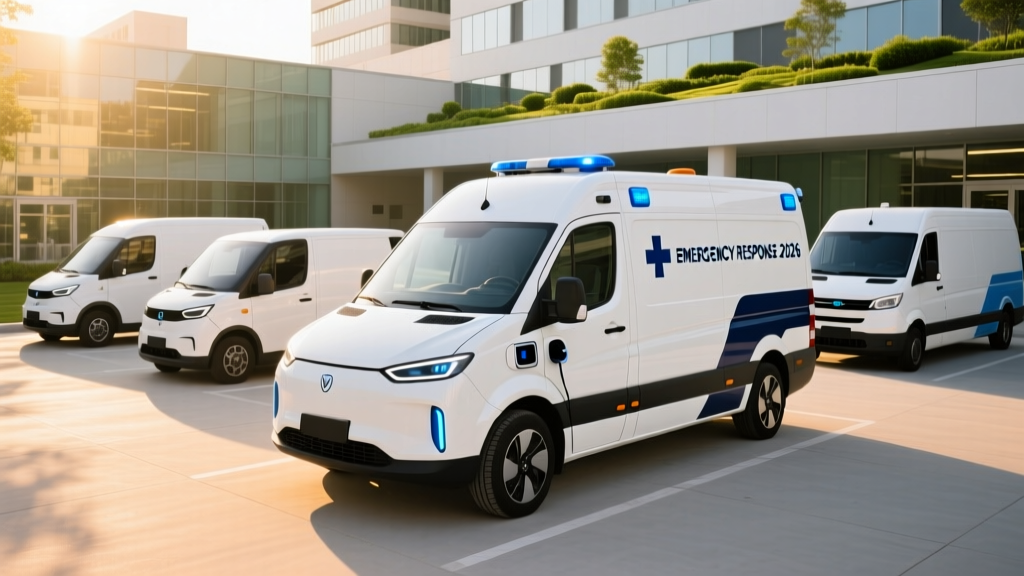
The short answer: Electric ambulances are viable today for high-call-volume urban and suburban 911 fleets with predictable routes and depot charging access — but remain a poor fit for rural ALS units covering 100+ mile responses or regions lacking DC fast-charging infrastructure. A 2026 electric ambulance like the Ford E-Transit cutaway ambulance upfit carries a ~$75,000–$95,000 acquisition cost (before incentives) versus ~$65,000–$80,000 for a comparable diesel Type I, but can save $8,000–$14,000 annually in fuel and maintenance in high-utilization scenarios. Real-world range for current electric ambulance platforms sits at 90–150 miles depending on payload, climate, and electrical load from medical equipment.
Why Electric Ambulances Are Gaining Traction in 2026
Municipal fleets face mounting pressure to reduce emissions and operating costs simultaneously. Ambulances, which average 15,000–30,000 miles annually in urban systems and burn 6–9 MPG in diesel form, represent some of the most fuel-intensive vehicles in any city's fleet. According to the U.S. Department of Energy's Alternative Fuels Data Center, medium-duty commercial EVs have reached a tipping point where total cost of ownership (TCO) undercuts diesel in high-mileage, depot-based applications.
Several major EMS systems — including those in New York City, Seattle, and parts of the UK's NHS — have deployed pilot electric ambulance units since 2023. By 2026, production-scale electric ambulance platforms from Lightning eMotors, REV Group (in partnership with Ford's E-Transit), and newcomer Harbinger (with its purpose-built medium-duty EV chassis) are entering volume delivery.
The economics hinge on three factors: annual mileage, idle-time fuel burn (which is enormous for diesel ambulances running HVAC and equipment power at scenes), and whether the fleet has depot-level Level 2 or DC fast-charging infrastructure.
Current Electric Ambulance Platforms: Specs and Capabilities
Let's look at what's actually orderable or in active deployment for 2026 model year. Note that "electric ambulance" is not a single OEM product — it's a chassis-cab platform that gets upfitted by ambulance manufacturers (Demers, AEV, Horton, Road Rescue, etc.) with a patient compartment.
| Platform | Battery (kWh) | EPA Est. Range | Real-World Range (Loaded) | Peak DC Charge (kW) | 10–80% Time | GVWR (lbs) | Base Chassis MSRP |
|---|---|---|---|---|---|---|---|
| Ford E-Transit Cutaway (Rev/REV upfit) | 68 kWh usable (NMC) | ~126 mi (low roof cargo van); cutaway est. 100–115 mi | 75–95 mi (full ambulance upfit, HVAC, equipment) | 115 kW | ~45 min | 9,500–10,000 | ~$55,000–$60,000 |
| Lightning eMotors Class 4 Ambulance | 120–160 kWh (NMC) | ~150 mi (Class 4 step van config) | 100–130 mi (loaded Type I/III equivalent) | 150 kW | ~50 min | 15,000–19,500 | ~$85,000–$105,000 |
| Harbinger Medium-Duty EV Chassis (announced) | 140 kWh (LFP available) | ~180 mi (preliminary, chassis only) | 120–150 mi (estimated, with patient module) | 175 kW | ~35 min (est.) | 15,000–26,000 | ~$90,000–$110,000 (preliminary) |
Key takeaway: The Ford E-Transit cutaway is the most accessible platform today but is limited by its 68 kWh battery. For a Type I ambulance (separate cab + box on a chassis-cab), the Lightning eMotors or Harbinger platforms offer more realistic range for sustained operations. The Harbinger's LFP (lithium iron phosphate) battery option is notable — LFP trades lower energy density for longer cycle life (3,000+ cycles vs ~1,500 for NMC) and better thermal stability, which matters for a vehicle expected to serve 10+ years.
Electric Ambulance vs Diesel: Cost and Efficiency Comparison
The purchase price of an electric ambulance is higher. The argument for going electric rests on operational savings over a 7–10 year service life. Here's a data-driven comparison for a typical urban 911 ambulance running ~22,000 miles/year:
| Cost Category | Diesel Type I Ambulance | Electric Ambulance (Lightning eMotors Class 4) |
|---|---|---|
| Fuel / Energy | $11,800 (7 MPG avg, $3.75/gal diesel) | $3,100 (2.1 kWh/mi, $0.14/kWh depot rate) |
| Idle Fuel Burn (scene + station) | $3,200 (~850 gal at idle, 0.8 gal/hr) | $0 (electric HVAC/equipment draws from battery, negligible cost at depot rates) |
| Maintenance (oil, filters, DEF, brakes) | $4,500 | $1,200 (no engine oil, DEF, or transmission; regen reduces brake wear ~60%) |
| Annual Total Operating Cost | ~$19,500 | ~$4,300 |
| Annual Savings (Electric) | — | ~$15,200/year |
Over a 10-year service life, that's roughly $152,000 in operational savings — more than covering the ~$25,000–$35,000 acquisition premium. These numbers align with findings from the National Renewable Energy Laboratory (NREL), which has published medium-duty EV fleet TCO analyses showing breakeven at 3–5 years for high-utilization vehicles.
Important caveats: These savings assume depot charging at commercial electricity rates (~$0.10–$0.18/kWh). Public DC fast charging at $0.35–$0.50/kWh erodes savings significantly. Rural fleets running 40,000+ miles/year with highway-speed responses may not see the same idle-burn advantage, and range limitations become a hard operational constraint.
Charging Infrastructure: The Make-or-Break Factor
An electric ambulance fleet lives or dies by its charging infrastructure. Unlike consumer EVs that can rely on a mix of home and public charging, ambulances need depot charging — chargers installed at the station or fleet yard.
| Charging Level | Power (kW) | Miles Added per Hour | Typical Use Case | Infrastructure Cost per Stall |
|---|---|---|---|---|
| Level 2 (AC) | 11.5–19.2 kW | 18–32 mi/hr | Overnight at station (8–12 hr shift) | $3,000–$7,000 (hardware + install) |
| DC Fast Charge | 50–150 kW | 80–200 mi/hr | Mid-shift top-up, quick turnaround | $25,000–$80,000 (hardware + install + utility upgrade) |
For a two-ambulance station running 24/7 shifts, a practical setup includes:
- 2× Level 2 chargers (19.2 kW): Enough to fully replenish a 120 kWh battery overnight (~6–7 hours). Total cost: $8,000–$14,000 installed.
- 1× DC fast charger (60–150 kW): For mid-shift top-ups when an ambulance returns from a long transport. Adds ~80 miles in 30 minutes on a Lightning eMotors platform. Cost: $40,000–$70,000 including potential panel upgrade.
Real-world consideration: Many fire stations and EMS depots were built with 200-amp electrical panels designed for lighting and basic HVAC. Adding even two Level 2 chargers at 19.2 kW each (38.4 kW combined) can require a panel upgrade to 400–800 amps, adding $5,000–$20,000 to the project. Some municipalities have leveraged IRS §30C Alternative Fuel Vehicle Refueling Property Credit, which covers up to 30% of charging equipment and installation costs (capped at $100,000 per item of property), though eligibility depends on census-tract requirements.
Range Reality: What Happens When You Load a Patient and Run the Lights
EPA range estimates for electric commercial vehicles are measured under ideal, unloaded conditions. An ambulance is the opposite of ideal:
- Payload: A fully equipped Type I ambulance patient module adds 3,000–5,000 lbs of equipment, stretcher, oxygen, and crew. This alone can reduce range by 15–25%.
- Electrical load: Medical equipment (cardiac monitors, ventilators, suction units), scene lighting, and HVAC draw 2–5 kW continuously. Over a 12-hour shift, that's 24–60 kWh — a significant portion of even a large battery pack.
- Cold weather: Battery efficiency drops 20–35% below freezing. A 130-mile-range ambulance in Minneapolis in January may deliver only 85–100 miles of real range. Cabin heating adds further drain unless the unit has a heat pump (most current commercial EV platforms do not).
- High-speed highway response: Efficiency drops sharply above 55 mph. An ambulance running Code 3 on a freeway at 75 mph may see 2.8–3.2 kWh/mile versus the rated 2.0–2.2 kWh/mile.
Real-World Range Expectations (Loaded Ambulance):
Urban 911 (stop-and-go, 25–40 mph avg, moderate climate): 85–95% of EPA rating
Suburban mix (40–55 mph, moderate climate): 70–85% of EPA rating
Highway transport (65–75 mph sustained): 55–70% of EPA rating
Cold weather (below 25°F, any driving pattern): subtract an additional 20–35%
This means a Lightning eMotors ambulance rated at 150 miles EPA realistically delivers 100–130 miles in normal urban service, and as little as 65–80 miles in cold-weather highway scenarios. For most urban 911 systems where average response distances are 3–8 miles and daily mileage is 60–100 miles, this is sufficient. For rural inter-facility transports or county-wide coverage areas, it is not.
Federal Incentives and Fleet Procurement Considerations
Fleet purchasers should be aware of several incentive programs, though rules differ from consumer tax credits:
- Commercial Clean Vehicle Credit (§45W): Under the Inflation Reduction Act, qualified commercial clean vehicles are eligible for a credit of up to $40,000 for vehicles over 14,000 lbs GVWR (or $7,500 for lighter vehicles). This is the fleet equivalent of the consumer §30D credit, but without income caps or MSRP limits. The vehicle must meet the same domestic battery-sourcing and critical-mineral requirements. Consult a tax professional — IRS rules are complex and subject to change.
- §30C Charging Infrastructure Credit: Up to 30% of charging equipment and installation costs, capped at $100,000 per item, available in qualifying low-income or non-urban census tracts.
- State and utility incentives: Many states (California's HVIP, New York's Truck Voucher Incentive Program) offer $20,000–$75,000 additional vouchers for medium-duty EV purchases. Utility companies may cover or subsidize depot charger installation. Check your state's clean-fleet program — these vary widely by jurisdiction.
For a municipal fleet buying through a cooperative purchasing agreement (e.g., Sourcewell, NJPA), the effective acquisition cost of an electric ambulance can drop from $95,000 to $55,000–$65,000 after stacking federal, state, and utility incentives — making it cost-competitive with diesel from day one.
Common Misconceptions About Electric Ambulances
| Myth | Fact |
|---|---|
| "An electric ambulance can't run a full 12-hour shift." | Urban 911 ambulances average 60–100 miles per shift. Current platforms deliver 100–130 real-world miles. Mid-shift DC fast top-up adds 40–60 miles in 20 minutes. Most urban shifts are covered; sustained high-mileage rural shifts are not. |
| "The battery won't last 10 years in an ambulance." | NMC batteries retain ~75–85% capacity at 150,000 miles / 10 years under normal cycling. LFP batteries (Harbinger option) retain ~85–90% at the same interval. Most OEMs warrant 8 years/100,000 miles at ≥70% capacity. Battery replacement at year 10+ costs $15,000–$30,000 depending on pack size. |
| "Electric ambulances can't power medical equipment." | Current platforms offer 2.4–7.2 kW of onboard AC power via inverters — enough for cardiac monitors, ventilators, IV pumps, and suction simultaneously. This eliminates the need for a separate diesel-powered auxiliary power unit (APU), a common feature on diesel ambulances that itself burns 0.5–1.0 gal/hr. |
| "They're too heavy for ambulance duty." | Electric chassis are heavier (battery weight adds 2,000–4,000 lbs), but EV powertrains deliver peak torque at 0 RPM, providing strong acceleration even at GVWR. The Lightning eMotors Class 4 produces 590 lb-ft of torque — comparable to a 6.7L diesel — with smoother, quieter operation that reduces crew fatigue. |
| "Charging takes too long during emergencies." | Ambulances don't charge during calls. They charge between calls at the station. A 20-minute DC fast charge during post-call cleaning and restocking adds 40–60 miles — typically sufficient for the next 3–5 responses in an urban system. |
Decision Framework: Should Your Fleet Go Electric?
Consider an electric ambulance if:
- Your ambulances average fewer than 120 miles per 12-hour shift
- Your fleet operates from fixed stations with overnight parking (depot charging feasible)
- Your service area is primarily urban or suburban (avg. response distance under 10 miles)
- Your electrical utility can support Level 2 or DC fast-charging infrastructure at stations
- Your state offers medium-duty EV fleet incentives (check DSIRE database or state energy office)
- You're replacing high-idle-time units where diesel fuel burn at scenes is a major cost line
Stick with diesel (or evaluate PHEV/hybrid options) if:
- Your ambulances regularly exceed 150 miles per shift (rural, county-wide, or long-distance inter-facility transport)
- Your region experiences sustained sub-zero (°F) winters and you lack heated station parking
- Your stations lack the electrical capacity for depot charging and utility upgrades are cost-prohibitive
- Your fleet requires mutual-aid response across large geographic areas without en-route charging options
- You operate volunteer or low-call-volume services (under 1,500 calls/year) where the acquisition premium can't be recouped through operational savings
Frequently Asked Questions
How long does an electric ambulance battery last before replacement?
Most NMC battery packs in commercial EV platforms are warranted for 8 years or 100,000 miles at a minimum of 70% state of health (SoH). Real-world fleet data from early deployments suggests 80–85% SoH retention at 150,000 miles. LFP chemistry, available on some platforms, shows slower degradation — typically 85–90% SoH at the same mileage. When replacement is needed, a 120–160 kWh pack costs $15,000–$30,000 in 2026, and prices continue to decline.
Can an electric ambulance tow or carry the same payload as a diesel unit?
Payload capacity is slightly reduced due to battery weight (typically 500–1,500 lbs less cargo capacity depending on platform). However, most Type I ambulance upfits fall within the GVWR of current electric chassis like the Lightning eMotors Class 4 (19,500 lbs GVWR). Towing is limited — most electric ambulance platforms are not rated for trailer towing, which may affect departments that pull equipment trailers.
What happens during a power outage?
This is a legitimate operational risk. Diesel ambulances can refuel from on-site fuel tanks. Electric ambulances depend on grid power. Fleet operators should evaluate backup generation or vehicle-to-everything (V2X) capabilities. Some platforms, like the Ford E-Transit, offer Pro Power Onboard — a bidirectional feature that can export up to 7.2 kW of AC power, potentially serving as an emergency generator for station operations during short outages.
Are electric ambulances eligible for the $7,500 consumer EV tax credit?
No. Consumer credits (§30D) apply to personal-use vehicles. Fleet and commercial purchases use the §45W Commercial Clean Vehicle Credit, which offers up to $40,000 for heavy-duty vehicles (over 14,000 lbs GVWR). Eligibility depends on battery sourcing requirements and final assembly in North America. Consult IRS guidelines and a tax professional for your specific procurement structure.
How does cold weather affect an electric ambulance's range?
Battery efficiency drops 20–35% in temperatures below 25°F, and cabin/patient-compartment heating adds significant energy draw. An ambulance rated at 130 miles may deliver 85–100 miles in cold conditions. Fleets in cold climates should specify heated battery preconditioning (available on most platforms), consider heat-pump HVAC systems, and plan for 25–30% range reduction in winter route planning. Depot charging in heated garages mitigates much of this loss.
What's the maintenance difference vs. a diesel ambulance?
Electric ambulances eliminate oil changes, fuel filter replacements, DEF fluid, exhaust aftertreatment (DPF/SCR), and transmission service. Regenerative braking reduces brake pad wear by an estimated 50–70%. Annual maintenance savings of $3,000–$5,000 per unit are typical. The main long-term maintenance item is battery health monitoring and eventual replacement at 10–15 years, though declining battery costs make this increasingly manageable.
Sources: U.S. Department of Energy Alternative Fuels Data Center (afdc.energy.gov), IRS Commercial Clean Vehicle Credit guidelines (irs.gov), National Renewable Energy Laboratory fleet TCO analyses (nrel.gov). Fleet specifications reflect 2026 model-year data from manufacturer publications and pilot program reports. Incentive amounts and eligibility rules are subject to change — verify current rules with your tax advisor and state energy office before procurement.