Quick Answer: Can You Tow an Electric Airstream?
Yes — but with major caveats. The Airstream eStream concept pairs a ~125 kWh battery pack with dual electric motors on the trailer axle to extend your EV's effective range by up to 50%. The Lightship L1 (formerly called the "Electric Airstream" in early press) is the production-ready solar-electric travel trailer with an estimated 125-mile self-propelled range and a ~$125,000 starting price. As of early 2026, the Lightship L1 is taking reservations with deliveries expected later in the year, while Airstream's eStream remains a concept without a confirmed production date. Neither trailer qualifies for the IRS §30D federal EV tax credit, which applies only to new clean vehicles driven on public roads — not towed trailers.
What Is an "Electric Airstream" Exactly?
The search term "electric Airstream" points to two distinct projects that get conflated in media coverage:
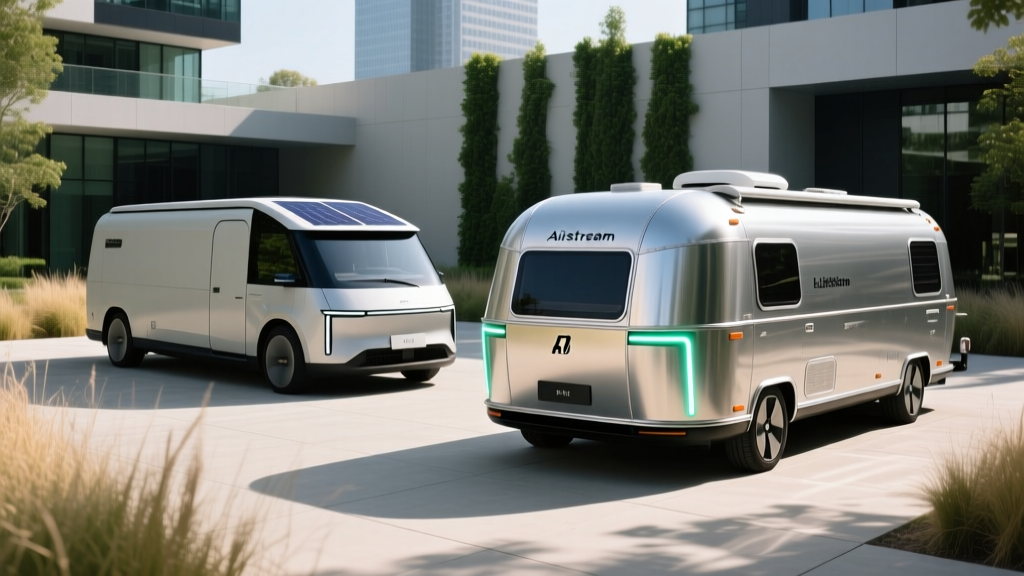
Airstream eStream Concept: Unveiled in 2022, this is Airstream's own vision for a battery-electric travel trailer. It features a large lithium-ion battery pack (approximately 125 kWh usable capacity), dual electric motors on the trailer's axle, and a proprietary wireless remote-control system for maneuvering the trailer at campsites without a tow vehicle. The motors can assist the tow vehicle on inclines and regenerate energy on descents. Airstream has not announced a production timeline or MSRP for the eStream as of 2026.
Lightship L1: Founded by former Tesla engineers, Lightship developed an aerodynamic electric travel trailer that was widely called an "electric Airstream" during its 2023 reveal. The L1 has an integrated ~110 kWh battery, up to 3 kW of rooftop solar, an all-electric kitchen, and a self-propelled range of approximately 125 miles at low speeds (useful for campground repositioning). Its key selling point is near-zero range impact on the tow vehicle thanks to its ultra-low drag coefficient (Cd ~0.20) and active aero. Lightship is targeting a base MSRP around $125,000 with deliveries anticipated in 2026.
Common Misconceptions About Electric Travel Trailers
| Myth | Fact |
|---|---|
| "I'll get a $7,500 tax credit for buying an electric Airstream." | Incorrect. The IRS §30D credit applies to qualified plug-in EVs and fuel-cell vehicles for road use. Trailers do not qualify. |
| "An electric trailer adds range to my EV." | Partially true. The trailer's motors assist propulsion, reducing the tow vehicle's energy consumption — but the trailer's own weight (7,000–8,000+ lbs) still imposes a significant efficiency penalty versus unladen driving. |
| "I can charge it at any Supercharger." | No. Electric trailers require high-power Level 2 (up to 19.2 kW) or DC fast charging at RV-capable stations. Most Supercharger stalls are not designed for towed-vehicle charging; you'd need a pull-through site or detach the trailer. |
| "It's available to buy right now." | Neither the Airstream eStream nor the Lightship L1 is in customer hands at scale as of early 2026. Both are in pre-production or reservation stages. |
How Towing With an EV Compares to Gas
Towing is where EVs face their harshest efficiency test. A gasoline truck like the Ford F-150 towing a conventional 5,000-lb travel trailer might see fuel economy drop from 22 MPG to 10–12 MPG — roughly a 50% reduction. An electric truck or SUV towing the same weight can see range cut by 40–60% depending on speed, terrain, and temperature.
EV vs Gas Towing: Real Numbers
| Metric | Ford F-150 Lightning (Extended Range) | Ford F-150 Gas (3.5L EcoBoost) |
|---|---|---|
| EPA range / tank range (unladen) | ~320 miles | ~530 miles (36-gal tank × ~15 MPG combined) |
| Range towing 5,000-lb trailer at 65 mph | ~150–190 miles (real-world) | ~270–320 miles |
| Energy/fuel cost per mile (towing) | ~$0.18–$0.25 (at $0.30/kWh public DC) | ~$0.30–$0.38 (at $3.60/gal) |
| Refuel/recharge time | 15–30 min (10–80% at 150+ kW) but few pull-through chargers | 5–8 min at any gas station |
| Trailer assist (electric trailer) | Reduces energy draw 20–40%; extends effective range ~50–80 mi | Reduces fuel draw similarly; extends range ~50–70 mi |
Sources: fueleconomy.gov, real-world EV towing tests.
The promise of an electric Airstream-style trailer is that its onboard motors and battery offset the tow vehicle's energy burden. If a 125 kWh trailer battery provides 30–40% propulsion assist on a 200-mile highway leg, that's roughly 25–35 kWh of energy the tow vehicle doesn't need to supply — translating to 50–80 additional miles of effective range for an F-150 Lightning or Rivian R1T.
Specs and Pricing: What We Know for 2026
| Specification | Airstream eStream (Concept) | Lightship L1 (Pre-Production) |
|---|---|---|
| Battery capacity | ~125 kWh (estimated) | ~110 kWh (estimated) |
| Self-propelled range | Not disclosed | ~125 miles (low speed, campground use) |
| Solar capacity | Not disclosed | Up to 3 kW rooftop |
| Trailer weight (GVWR) | ~7,000–8,000 lbs (est.) | ~7,500 lbs (target) |
| Drag coefficient | Not disclosed | ~0.20 Cd |
| Level 2 charging | TBD | Up to 19.2 kW (est. ~6 hrs for full charge) |
| DC fast charging | TBD | Expected CCS-compatible; rate TBD |
| Base MSRP | Not announced | ~$125,000 |
| Federal tax credit | Not eligible | Not eligible |
| Availability | Concept — no production date | Reservations open; deliveries expected 2026 |
Real Costs of Owning an Electric Travel Trailer
Beyond the trailer's purchase price, ownership economics differ sharply from a conventional travel trailer. Here's a realistic 5-year cost projection for the Lightship L1 versus a similarly sized conventional Airstream (e.g., the Airstream International 27FB at ~$140,000 MSRP):
5-Year Estimated Ownership Costs
| Cost Category | Lightship L1 (Electric Trailer) | Airstream International 27FB (Conventional) |
|---|---|---|
| Purchase price | $125,000 | $140,000 |
| Charging/fuel for trailer systems (5 yrs) | ~$1,500 (electricity for battery top-up, solar offsets most) | ~$3,000 (propane + generator fuel) |
| Tow vehicle fuel/energy savings vs baseline | Saves ~$2,000–$3,500 over 5 yrs (propulsion assist) | Baseline |
| Maintenance (trailer systems) | ~$500 (minimal — no propane system, no generator) | ~$2,500 (propane system, generator, more moving parts) |
| Battery degradation reserve | ~$0–$2,000 (potential module service after warranty) | N/A |
| Insurance (5 yrs) | ~$6,000–$9,000 (higher replacement value, battery risk) | ~$5,000–$7,000 |
| Estimated 5-year net cost | ~$131,000–$138,000 | ~$150,500–$152,500 |
Note: These are estimates based on 5,000 miles of towing per year. Actual costs vary by region, electricity rates, and usage patterns. Insurance premiums for electric trailers remain highly variable as carriers develop actuarial models.
Charging Logistics: The Hard Truth
Charging an electric trailer is the single biggest practical hurdle. Here's what you need to know:
At home (Level 2): A 240V / 48-amp circuit delivering 11.5 kW can replenish a 110 kWh trailer battery from 10% to 90% in roughly 8–9 hours. A 60-amp circuit at 14.4 kW cuts that to ~7 hours. You'll need a dedicated circuit — most homes require an electrician to install a NEMA 14-50 or hardwired EVSE in the garage or driveway. Expect $800–$2,500 for installation, potentially more if your electrical panel needs an upgrade to 200A service.
On the road (DC fast charging): This is where reality bites. Most DC fast-charging stations are designed for single vehicles, not truck-and-trailer combinations. You would need to either:
- Find a pull-through charging site (increasingly common at Electrify America and some Tesla Supercharger locations, but still rare)
- Detach the trailer and charge it separately (requiring a second charging session and a way to safely park the trailer)
- Charge only the tow vehicle and rely on regenerative systems to trickle-charge the trailer while driving
At the campsite: The Lightship L1's 3 kW solar array can add roughly 12–18 kWh per day in good sun — enough to power the all-electric kitchen, lighting, and climate systems without shore power. This is a genuine advantage over conventional trailers that depend on propane or loud generators for off-grid camping. A full solar recharge of the 110 kWh battery would take approximately 6–8 days of peak sun, however, so plan accordingly.
Decision Framework: Is an Electric Trailer Right for You?
Should You Buy an Electric Airstream-Style Trailer?
Choose an electric trailer (Lightship L1 or wait for eStream) IF:
- You already own or plan to buy a capable EV tow vehicle (Rivian R1T, F-150 Lightning Extended Range, Chevy Silverado EV, or similar with 7,500+ lb towing capacity)
- You have home Level 2 charging and can install a dedicated 48–60 amp circuit for the trailer
- Your typical towing trips are under 200 miles one-way, or you're willing to plan around pull-through DC charging
- You value off-grid, silent camping without propane or generators
- You can absorb a $125,000+ purchase price with no federal tax credit offset
- You're comfortable being an early adopter of pre-production hardware with potential first-year service limitations
Stick with a conventional travel trailer IF:
- You regularly tow 300+ miles and can't afford 30–60 minute charging stops every 150–200 miles
- You rely on apartment or street parking with no home charging access
- Your tow vehicle is a gas or diesel truck and you have no plans to switch to an EV
- You need a proven service network and dealer support in rural areas
- Your budget is under $80,000 for a trailer
What First-Time EV Trailer Buyers Should Know
1. Your tow vehicle matters enormously. An electric trailer's propulsion-assist benefit is maximized when paired with an EV tow vehicle. Towing with a gas truck still works, but you lose the ability to pre-condition the trailer battery via the tow vehicle's thermal management, and your fuel savings from trailer assist are modest versus the range extension an EV gets.
2. Cold weather hits twice. Just as EV range drops 20–40% in sub-freezing temperatures, your trailer's battery performance and the propulsion-assist efficiency will decline. A 125 kWh pack may deliver only 90–100 kWh of usable energy at 20°F. Factor this into winter trip planning.
3. Battery warranty is critical — and unknown. Neither Airstream nor Lightship has published detailed battery warranty terms as of early 2026. For reference, most EV manufacturers warrant their batteries for 8 years / 100,000 miles with a capacity retention threshold of 70%. Demand equivalent terms for a $125,000 trailer. A battery replacement on a pack this size could cost $15,000–$25,000 out of warranty.
4. Weight ratings still apply. An electric trailer's battery and motors add significant weight. Ensure your tow vehicle's Gross Combined Weight Rating (GCWR) and payload capacity can handle a 7,000–8,000 lb trailer plus passengers and cargo. The Rivian R1T Dual-Motor, for instance, has a maximum towing capacity of 11,000 lbs — adequate, but check your specific configuration.
5. Insurance is evolving. Many major carriers are still developing policies for electric trailers with large battery packs. Get quotes before committing. Some insurers may classify the battery as a separate insured component, similar to how EV traction batteries are sometimes handled.
Frequently Asked Questions
Does the electric Airstream eStream have a release date?
No. Airstream has presented the eStream as a concept and technology demonstrator. The company has not committed to a production timeline or pricing. Follow Airstream's official site for updates.
Can I charge the Lightship L1 at a Tesla Supercharger?
Not directly. Tesla Superchargers use the NACS connector and are designed for vehicles, not detached trailers. You would need an appropriate adapter and a pull-through site. Lightship has indicated CCS compatibility, but final connector details should be confirmed before purchase.
How much range does an electric trailer add to my EV?
It doesn't add range in the traditional sense. The trailer's motors reduce the energy your tow vehicle must supply, effectively extending your EV's range by an estimated 20–40% under highway towing conditions. For an F-150 Lightning that would normally achieve ~170 miles while towing, that could mean 210–240 miles of practical range — a meaningful but not transformative improvement.
Is an electric travel trailer eligible for any tax credits or incentives?
Not the federal §30D clean vehicle credit, which applies to motor vehicles. Some states or utilities may offer rebates for large battery storage systems or solar installations that could partially offset costs, but these are jurisdiction-specific. Consult a tax professional for your situation.
What happens if the trailer battery depletes completely on the road?
The trailer becomes a dead-weight conventional trailer. Your tow vehicle must handle the full load without propulsion assist, and you'll need to reach a suitable Level 2 or DC charging location to replenish the trailer battery. Plan trips with a 20–30% battery buffer, just as you would with an EV.