Can EVs Work in Agriculture? The Short Answer
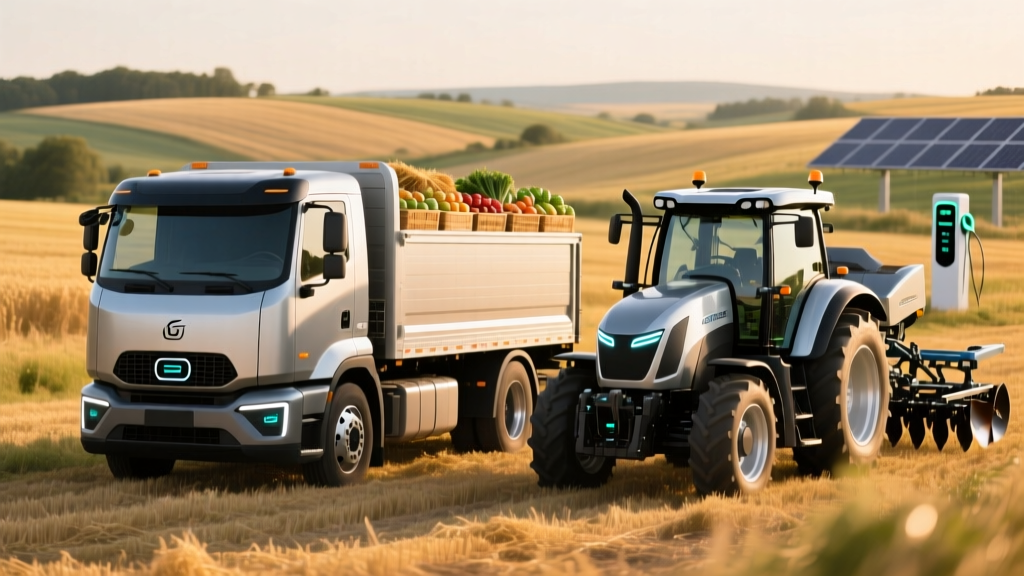
Yes — but selectively. For light-duty farm tasks (fence checking, feed runs, short-haul produce delivery, orchard work), electric trucks and UTVs in 2026 deliver compelling economics: fuel savings of 60-70% per mile, near-zero drivetrain maintenance, and instant torque for low-speed hauling. For heavy tillage, long-haul grain transport, or operations without reliable Level 2 charging access, diesel remains the pragmatic choice. The decision hinges on daily mileage (under 150 miles favors EV), charging infrastructure, and whether the vehicle primarily hauls or tows.
What Electric Agriculture Vehicles Actually Exist in 2026
The electric agriculture landscape has matured past the concept stage. Here's what farmers and ranchers can actually buy or order today:
| Vehicle | Type | Battery (kWh) | EPA Range | Towing (lbs) | Base MSRP |
|---|---|---|---|---|---|
| Ford F-150 Lightning (2026) | Full-size pickup | 131 (usable, NMC) | 320 mi | 10,000 | $54,995 |
| Rivian R1T Dual-Motor Max | Mid-size pickup | 141 (NMC) | 410 mi | 11,000 | $87,600 |
| Chevrolet Silverado EV 4WT | Full-size pickup | 200 (NMC) | 492 mi | 10,000 | $74,800 |
| Polaris Ranger XP Kinetic | UTV / side-by-side | 14.9 (LFP) | 45 mi (est.) | 2,500 | $24,999 |
| Monarch MK-V Tractor | Compact electric tractor | 42 (LFP) | 10+ hrs runtime | N/A (PTO-based) | ~$58,000 (est.) |
Heavy electric tractors (100+ HP class for row-crop tillage) remain in announced/preliminary status from companies like John Deere and Case IH — not yet available for purchase. For now, electric agriculture is strongest in the light-to-medium duty segment.
EV vs Diesel on the Farm: Real Cost Comparison
The purchase price of an electric truck is higher, but operational costs tell a different story — especially for stop-and-go farm use (feed delivery, fence repair, livestock checks) where regenerative braking shines and idling waste disappears.
| Cost Factor (5 yr / 75,000 mi) | Ford F-150 Lightning | Ford F-150 3.5L EcoBoost (Gas) | Ford F-250 6.7L Power Stroke (Diesel) |
|---|---|---|---|
| Purchase Price (base) | $54,995 | $43,570 | $52,500 |
| Federal Tax Credit (§30D) | Up to $7,500* | $0 | $0 |
| Fuel / Electricity | $3,750 (home L2 @ $0.13/kWh) | $9,375 (@ $3.50/gal, 20 MPG) | $13,125 (@ $4.50/gal, 15 MPG) |
| Maintenance | $1,200 (tires, cabin filter, wipers) | $3,500 (oil, filters, spark plugs) | $4,800 (oil, DEF, filters, fuel system) |
| Insurance (avg) | $9,500 | $7,200 | $7,800 |
| 5-Year Total Cost | $61,945 | $63,645 | $78,225 |
*§30D eligibility depends on MSRP caps, buyer income limits, and battery-sourcing requirements. Verify at IRS.gov. Point-of-sale transfer available from participating dealers.
The Lightning breaks even against the gas F-150 around year 3-4 in this scenario, and beats diesel decisively. The key assumption: home Level 2 charging. Without it, public DC fast charging costs roughly 2-3x more per kWh, erasing much of the fuel advantage.
Range, Towing, and the Real-World Farm Reality
EPA range stickers are optimistic starting points. On a farm, real-world range depends heavily on payload, towing, terrain, and temperature.
Real-World Range Expectations: Ford F-150 Lightning Extended Range
EPA Sticker: 320 miles
Empty, moderate driving: ~280-300 miles
With 1,500 lb payload (feed, tools, fencing): ~230-260 miles
Towing 7,000 lb trailer (livestock, equipment): ~140-180 miles
Cold weather (below 30°F), no towing: ~220-250 miles
Cold weather + towing: ~100-140 miles
This is the honest math: if your daily farm loop is 80 miles with a loaded trailer, the Lightning handles it fine. If you're running 200-mile round trips to market with a full trailer, you need the Silverado EV's 200 kWh pack or a mid-trip DC fast charge — which means route planning around charger availability.
Towing also exposes the charge-curve reality. A Lightning peaks at 230 kW on DC fast charging, but that rate is only sustained between roughly 15-55% State of Charge. A 10-80% session takes about 36 minutes at a capable station. Above 80%, charging slows dramatically to protect the battery — adding another 20+ minutes for the final 20%. Plan stops accordingly.
Charging Infrastructure: The Make-or-Break Factor
Electric agriculture lives or dies on charging access. Here's what a farm charging setup looks like:
| Item | Cost Range | Notes |
|---|---|---|
| Level 2 charger (48A, hardwired) | $500 - $800 | ChargePoint Home Flex, Emporia Vue, Wallbox Pulsar |
| 240V / 60A circuit installation | $800 - $2,500 | Depends on panel proximity; barn runs cost more |
| Electrical panel upgrade (if needed) | $1,500 - $4,000 | Older farm buildings may need 200A service |
| Permit & inspection | $150 - $500 | Varies by county |
| Total (typical farm install) | $1,450 - $7,800 | Get quotes from a licensed electrician |
Most electric trucks gain roughly 15-25 miles of range per hour on Level 2 (depending on kW — a 48A/11.5 kW charger delivers about 2.5 miles of range per minute for an F-150 Lightning). Overnight charging from 20% to 80% takes about 7-9 hours, which aligns perfectly with farm schedules: plug in after evening chores, wake up to a full battery.
For operations in remote areas without grid access or reliable 240V service, solar-plus-storage systems can power Level 2 charging — but add $15,000-$30,000+ in equipment costs. This is where electric agriculture faces its steepest barrier.
The Polaris Ranger XP Kinetic: Purpose-Built for Farm Work
While electric pickups get the headlines, the Polaris Ranger XP Kinetic is arguably the most practical electric agriculture vehicle available today. It's a UTV designed for the exact stop-and-go, low-speed, high-torque work that defines farm life.
With a 14.9 kWh LFP (lithium iron phosphate) battery, it offers roughly 45 miles of range — enough for a full day of fence checking, feed distribution, or orchard work. LFP chemistry is the right choice here: it tolerates daily 100% charges without accelerated degradation, handles heat well, and avoids the thermal runaway risks of NMC cells. The trade-off is lower energy density (heavier for the same kWh), but in a UTV that stays on-property, weight matters less than longevity.
The Kinetic's 110 HP electric motor delivers 140 lb-ft of torque from zero RPM — more low-end pulling force than the gas Ranger XP 1000. Towing capacity is 2,500 lbs, and payload is 1,000 lbs. It charges on a standard 120V outlet in about 5 hours, meaning no special electrical work is needed for most barns.
At $24,999, it's a premium over the gas Ranger (~$16,000), but fuel and maintenance savings close the gap within 2-3 years of heavy use. There's no oil, no air filter, no spark plugs, no transmission fluid, and no exhaust — just tires, brake pads (rarely, thanks to regen), and cabin air.
Common Misconceptions About Electric Agriculture
| Myth | Fact |
|---|---|
| "EVs can't tow anything real." | The F-150 Lightning tows 10,000 lbs; the Silverado EV tows 10,000 lbs. Range drops significantly under load (~50%), but capability is real. Plan charging stops for long hauls. |
| "Batteries won't last in farm conditions." | EV battery packs are sealed (IP67 or better) against dust and water. Ford, GM, and Rivian warranty batteries at 8 years / 100,000 miles minimum, with a capacity retention threshold of 70%. Real-world degradation data from fleet studies shows most packs retain 85-90% capacity at 100K miles. |
| "There's no EV tax credit for farm vehicles." | The §30D Clean Vehicle Credit applies to qualifying light-duty electric trucks used commercially or personally. The Monarch MK-V tractor may qualify under separate off-road/ag equipment incentive programs — check state-level resources. |
| "EVs are useless in cold weather." | Range drops 20-30% in sub-freezing temps due to battery chemistry and cabin heating. Preconditioning the battery while plugged in recovers some efficiency. Heat pumps (standard on many 2026 models) reduce cabin-heating energy draw by ~30%. |
| "Electric tractors are ready for big farms." | Compact electric tractors (40 HP class) like the Monarch MK-V are available. High-horsepower row-crop tractors (150+ HP) with electric drivetrains are announced but not yet purchasable. Battery energy density hasn't reached the threshold for 12-hour tillage days. |
Decision Framework: Is Electric Agriculture Right for Your Operation?
Choose Electric If:
- Your daily driving is under 150 miles (loaded) or under 250 miles (empty)
- You have access to 240V power at a barn, shop, or home for Level 2 charging
- Your work involves frequent stops, low speeds, and regenerative braking opportunities (orchards, feedlots, fence runs)
- You want to eliminate fuel storage, reduce maintenance complexity, and lower per-mile operating costs
- You operate in noise-sensitive areas (organic farms near residences, early-morning livestock work)
- You're looking at a UTV/side-by-side for on-property work — the Polaris Kinetic is a strong fit
Stick With Diesel or Gas If:
- You regularly tow heavy trailers over 150+ miles in a single day
- Your operation is in a charging desert with no Level 2 or DC fast charging within range
- You need a high-horsepower tractor for continuous tillage, baling, or combine work
- Your electrical service can't support a 240V/60A circuit without a costly panel upgrade ($4,000+)
- You operate in extreme cold (below 0°F) for extended periods and can't precondition the vehicle indoors
First-Time EV Buyer Essentials for Farm Operations
If you're considering your first electric vehicle for agricultural use, keep these practical points in mind:
kW vs kWh — know the difference. kWh (kilowatt-hours) measures battery capacity — how much energy the truck stores (like gallons in a fuel tank). kW (kilowatts) measures charging power — how fast energy flows into the battery (like the flow rate of a fuel pump). A 131 kWh battery charged at 11.5 kW (Level 2) takes about 11 hours from empty. At 230 kW (DC fast charge), it takes roughly 35 minutes from 10-80%.
Battery warranty matters. Look for 8 years / 100,000 miles minimum with a guaranteed capacity retention of at least 70%. Ford, Rivian, GM, and most major manufacturers meet this threshold. The warranty covers defects and excessive degradation — not damage from accidents or flooding.
Tax credit eligibility is not automatic. The §30D federal credit (up to $7,500) has MSRP caps ($80,000 for trucks/vans/SUVs), buyer income limits ($300K joint / $150K single), and battery mineral-sourcing requirements that change annually. Some trucks qualify for the full amount, some for partial, some for none. Check the current list at fueleconomy.gov and confirm with a tax professional.
Insurance costs more — budget for it. EV insurance premiums run 15-25% higher than equivalent gas vehicles due to battery replacement costs and specialized repair networks. Get quotes before purchasing.
Resale value is evolving. Early EV depreciation was steep (especially 2022-2024 models hit by price wars). By 2026, the market is stabilizing, but electric trucks still depreciate faster than proven diesel workhorses in rural markets. Factor this into your total cost of ownership.
Frequently Asked Questions
Can I use an electric pickup to pull a livestock trailer?
Yes, within range limits. The F-150 Lightning and Silverado EV both tow 10,000 lbs — enough for a loaded two-horse or small livestock trailer. Expect range to drop to roughly 140-180 miles under a 7,000 lb load. For trips longer than that, plan a DC fast-charging stop. Rivian's R1T Max Pack extends this to roughly 200 miles under load.
How long does a farm EV battery last before replacement?
Current NMC and LFP battery packs are designed for 150,000-200,000+ miles with gradual degradation. Real-world fleet data shows roughly 10-15% capacity loss at 100,000 miles for liquid-cooled packs. Full battery replacement costs $12,000-$22,000 depending on the vehicle but is rarely needed within the first decade of ownership.
Is the Polaris Ranger XP Kinetic eligible for the federal EV tax credit?
The §30D credit applies to on-road vehicles meeting specific criteria. Off-road UTVs like the Ranger Kinetic generally do not qualify for the federal Clean Vehicle Credit. However, some states offer separate incentives for off-road electric equipment — check your state energy office or department of agriculture.
Can solar panels on a barn power an EV charger?
Yes, but sizing matters. A typical 48A Level 2 charger draws about 11.5 kW continuously. You'd need a solar array of roughly 15-20 kW (plus battery storage or grid-tie net metering) to reliably charge an electric truck during daylight hours. Installation costs for a barn solar system range from $25,000-$50,000 before incentives, depending on size and complexity.
What about electric tractors for row-crop farming?
Compact electric tractors (30-40 HP) like the Monarch MK-V are available and work well for vineyards, orchards, and small-acreage specialty crops. For large-scale row-crop operations requiring 150+ HP and 12-hour continuous runtime, electric tractors are not yet commercially available. John Deere, Case IH, and AGCO have announced development programs, but production timelines remain unconfirmed.