The Bottom Line on Electric 18 Wheelers in 2026
An electric 18 wheeler (Class 8 battery-electric semi-truck) makes financial sense today for regional and drayage routes under 250 miles per day where depot charging is available. Expect to pay $250,000–$430,000 per truck before incentives — roughly 2–3x the cost of a diesel Class 8 — but save $40,000–$70,000 in fuel and maintenance over five years on high-utilization routes. The three dominant platforms are the Tesla Semi (up to 500-mile EPA range, ~$250K–$290K), Freightliner eCascadia (230-mile range, ~$300K+), and Volvo VNR Electric (275-mile range, ~$350K+). Federal tax credits up to $40,000 under IRC §30C plus state HVIP vouchers can close the purchase-price gap substantially, but charging infrastructure remains the largest operational hurdle.
What Is an Electric 18 Wheeler? Understanding Class 8 EV Semis
The term "electric 18 wheeler" refers to a battery-electric Class 8 tractor — the heavy-duty semi-truck pulling a 53-foot trailer that moves most of America's freight. Unlike passenger EVs with 60–130 kWh batteries, these trucks pack 200 to 900+ kWh of lithium-ion (predominantly NMC chemistry) battery capacity to move 80,000-pound gross combination weight (GCW) loads.
As of 2026, three production models dominate the North American market:
| Spec | Tesla Semi (Long Range) | Freightliner eCascadia | Volvo VNR Electric |
|---|---|---|---|
| Battery Capacity (usable) | ~900 kWh (estimated) | 438 kWh (gross) | 375 kWh (usable, 6-battery pack) |
| EPA Range (loaded) | 500 mi (mfr claim) | 230 mi (EPA est.) | 275 mi (EPA est.) |
| Real-World Range (loaded, mixed) | ~350–420 mi | ~150–190 mi | ~180–230 mi |
| Peak DC Charge Rate | ~1 MW (MCS connector) | 250 kW (CCS2) | 250 kW (CCS2) |
| 10–80% Charge Time | ~40 min (at 1 MW) | ~90 min (at 250 kW) | ~70–90 min (at 250 kW) |
| Motor Output | ~1,000+ hp (tri-motor) | ~425 hp (dual motor eAxle) | ~455 hp (dual motor) |
| 0–60 mph (loaded, 80K GCW) | ~20 sec | ~25–30 sec | ~25–30 sec |
| GCWR | 82,000 lb | 82,000 lb | 82,000 lb |
| Base Price (approx.) | $250,000–$290,000 | $300,000–$350,000 | $330,000–$390,000 |
| Warranty (battery) | Undisclosed | 5 yr / 600,000 mi (eAxle) | 5 yr / 600,000 mi |
Important note on kW vs kWh: Battery capacity is measured in kilowatt-hours (kWh) — the total energy stored. Charging speed is measured in kilowatts (kW) — the rate of energy delivery. A 900 kWh battery charging at 1,000 kW (1 MW) can theoretically absorb a significant charge in under an hour, but real-world charge curves taper significantly above 80% state of charge.
Electric 18 Wheeler vs Diesel: Real Cost Breakdown
The purchase price of an electric semi is the sticker shock. But fleet operators evaluate total cost of ownership (TCO), where fuel and maintenance savings can flip the equation — especially on high-mileage regional routes.
| Cost Category | Diesel Class 8 (New) | Electric 18 Wheeler (Avg.) |
|---|---|---|
| Purchase Price | $140,000–$180,000 | $280,000–$360,000 |
| Federal Tax Credit (§30C Commercial) | $0 | Up to $40,000 |
| State Voucher (e.g., CA HVIP) | $0 | $50,000–$120,000 (varies) |
| Net Effective Purchase | $140,000–$180,000 | $120,000–$270,000 |
| Fuel/Energy (5 yr, 300K mi) | $210,000–$270,000 (diesel @ $4.20/gal, 6.5 mpg) | $60,000–$105,000 (elec. @ $0.12–$0.21/kWh, 2.0 kWh/mi) |
| Maintenance (5 yr) | $45,000–$65,000 | $15,000–$25,000 |
| DEF / Exhaust Aftertreatment | $8,000–$12,000 | $0 |
| Depot Charging Infrastructure (allocated per truck) | $0 | $30,000–$80,000 |
| Estimated 5-Year TCO | $403,000–$527,000 | $225,000–$480,000 |
The crossover point where an electric 18 wheeler beats diesel on TCO typically arrives between years 3 and 5, depending on electricity rates, route mileage, and incentive availability. Fleets running 60,000+ miles per year on routes under 200 miles round-trip see the fastest payback. Low-mileage or long-haul routes tilt the math back toward diesel.
Fuel savings are the largest single advantage. According to the Alternative Fuels Data Center, electricity costs per diesel-gallon-equivalent (DGE) are typically 40–60% lower than diesel, especially when fleets charge during off-peak utility windows (overnight, $0.08–$0.12/kWh in many markets).
Charging Infrastructure: The Real Bottleneck
For fleet buyers, the truck is only half the equation. Depot charging infrastructure is the most capital-intensive and time-consuming part of electric 18 wheeler adoption.
Depot Charging Requirements
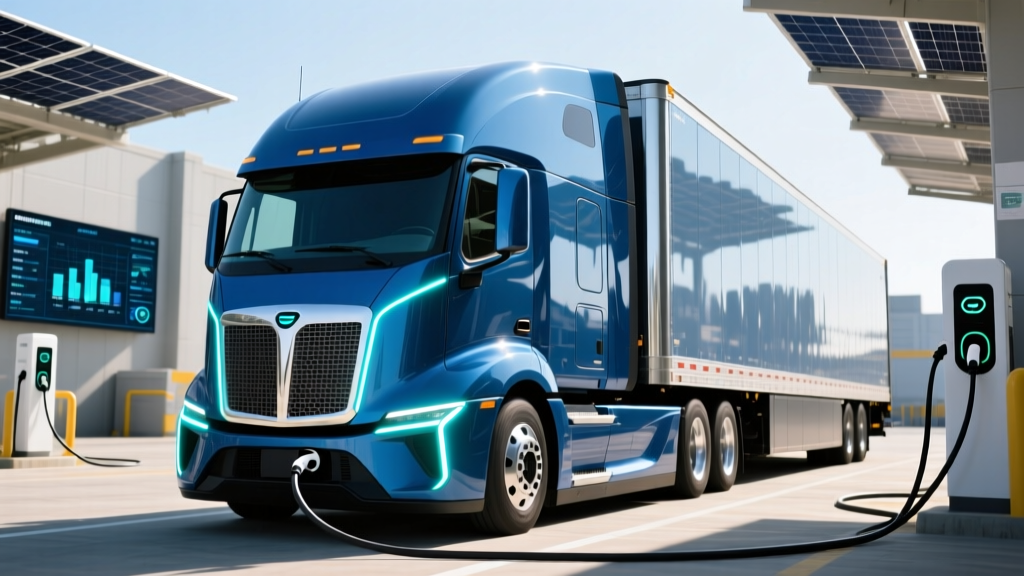
Most fleet operators install Level 2 or low-power DC chargers at their depot, where trucks sit for 8–12 hours overnight. A typical setup:
- Level 2 AC (40–80 kW per truck): Adds roughly 20–40 miles of range per hour. Sufficient for full overnight recharge on trucks with sub-300 kWh batteries. Cost: $15,000–$40,000 per stall installed.
- DC Fast Charging (150–350 kW per truck): Adds 75–175 miles per hour. Required for larger-battery trucks or multi-shift operations. Cost: $80,000–$200,000+ per stall installed.
- Megawatt Charging System (MCS, 1 MW+): The emerging standard for Class 8. Tesla's Semi already uses an MCS-adjacent connector. Industry-wide MCS rollout is underway through CharIN. Cost: $200,000–$500,000+ per stall.
Utility and Grid Considerations
A depot with 10 electric semis charging simultaneously at 150 kW each demands 1.5 MW of grid capacity — equivalent to a small neighborhood's peak load. Utility interconnection upgrades (new transformers, switchgear, service feeds) can take 12–24 months and cost $500,000–$2M+ depending on local grid capacity. This is the single most underestimated cost in electric fleet transitions.
Real-world tip: Begin utility engagement 18–24 months before your first truck delivery. Many fleets discover their depot's existing electrical service is woefully inadequate only after ordering trucks.
Real-World Range: What the Sticker Doesn't Tell You
Published range figures for electric 18 wheelers assume optimal conditions: moderate temperatures, flat terrain, steady 55–60 mph speeds, and a fully loaded trailer at 80,000 lb GCW. In practice, range varies dramatically.
Range Reality Check (80,000 lb GCW, Loaded)
| Condition | Tesla Semi (500 mi claim) | eCascadia (230 mi EPA) | Volvo VNR (275 mi EPA) |
|---|---|---|---|
| Ideal (65°F, flat, 55 mph) | ~420–460 mi | ~200–230 mi | ~240–275 mi |
| Highway (70 mph, moderate hills) | ~340–390 mi | ~160–190 mi | ~190–230 mi |
| Cold Weather (20°F, highway) | ~260–320 mi | ~120–155 mi | ~145–185 mi |
| Mountain Pass (loaded, 6% grade) | ~200–260 mi | ~90–130 mi | ~110–150 mi |
Cold weather reduces range 25–40% due to battery chemistry slowdown and cabin/battery heating demands. Mountain routes can cut range in half due to the physics of lifting 80,000 pounds uphill — though regenerative braking recovers some energy on descents.
Who Should Buy an Electric 18 Wheeler (and Who Shouldn't)
Fleet Decision Framework
Choose an electric 18 wheeler if:
- Your daily routes are under 200–250 miles round-trip (regional haul, drayage, local delivery)
- You have a fixed depot where trucks return nightly for 8+ hours of dwell time
- You operate in a state with strong incentive programs (CA HVIP, NY Truck Voucher, NJ ZEVRP, etc.)
- Your fleet runs 50,000+ miles per truck per year (fuel savings accelerate payback)
- You face regulatory mandates (e.g., California's Advanced Clean Fleets rule requiring zero-emission drayage and last-mile trucks)
- You have utility engagement underway or confirmed grid capacity at your depot
Stick with diesel (or wait) if:
- Your routes regularly exceed 300 miles per day or require multi-day long-haul runs
- You lack depot property or the ability to install charging infrastructure
- You operate in regions with no state incentive programs and high electricity rates ($0.20+/kWh commercial)
- Your fleet averages fewer than 30,000 miles per truck annually (savings won't offset the premium)
- You need immediate truck availability — production volumes are still limited, with lead times of 6–18 months for most models
Myths vs Facts: Clearing Up Common Misconceptions
| Myth | Fact |
|---|---|
| "Electric semis can't pull full loads." | All three major platforms are rated for 82,000 lb GCW — the federal maximum. Tesla Semi has demonstrated full-load PepsiCo and Schneider runs in production service. |
| "Batteries won't last." | NMC batteries in Class 8 applications are designed for 1,000,000+ mile lifespans with managed degradation. Freightliner and Volvo offer 5-year / 600,000-mile battery/eAxle warranties. Replacement costs are significant ($80K–$150K+), but full replacement within warranty is rare. |
| "Charging takes too long for trucking." | For overnight depot charging (8–12 hours), even Level 2 is sufficient for most regional routes. Mid-day DC top-ups at 250 kW add 100+ miles in 30–45 minutes — compatible with driver meal/rest breaks under HOS rules. |
| "The grid can't handle electric trucks." | Individual depot upgrades are expensive but feasible. Managed charging software staggers charge sessions to avoid peak-demand charges. Utilities in most major metro areas are actively building out commercial EV infrastructure capacity. |
| "Electric trucks are zero-emission." | Tailpipe emissions are zero. Upstream emissions depend on your regional grid mix — a depot in coal-heavy Wyoming has a larger carbon footprint than one in hydro-heavy Washington State. However, even on the dirtiest US grids, BEV trucks produce fewer lifecycle emissions than diesel (ICCT lifecycle analyses confirm this). |
Federal and State Incentives for Electric Class 8 Trucks
The incentive landscape for commercial electric trucks is significantly more generous than for passenger EVs, but it's complex and jurisdiction-dependent.
Federal: IRC §30C Commercial Clean Vehicle Credit
For Class 8 trucks, the §30C credit provides up to $40,000 per vehicle (15% of basis for depreciable property, or 30% if prevailing-wage and apprenticeship requirements are met, capped at $40,000 for vehicles over 14,000 lb GVWR). Key rules:
- The vehicle must be placed in service and used in a trade or business
- The credit applies per vehicle, not per taxpayer — a fleet of 10 trucks could claim up to $400,000 total
- Battery components and critical minerals sourcing requirements apply (phasing in through 2026)
- There is no per-manufacturer cap (unlike the consumer §30D credit)
- The credit is non-refundable but can offset tax liability; consult a tax professional for your specific structure
State Programs (Selected Examples, 2026)
- California HVIP (Hybrid and Zero-Emission Truck and Bus Voucher): Up to $120,000 per Class 8 BEV truck for drayage; $60,000–$90,000 for other vocations. First-come, first-served funding rounds.
- New York Truck Voucher Incentive Program: Up to $185,000 for Class 8 BEVs (funding-dependent).
- New Jersey ZEVRP: Voucher funding varies by round; Class 8 vouchers have reached $100,000+.
- Federal EPA Clean Ports / DERA Grants: Competitive grants covering drayage truck replacement at ports, often $200,000+ per unit.
State incentive amounts and availability change frequently. Always verify current funding status with your state air-quality board or energy office before committing to a purchase.
Frequently Asked Questions
How long does it take to charge an electric 18 wheeler?
It depends on the charger and battery size. A Tesla Semi with a ~900 kWh battery on a 1 MW Megawatt charger can go from 10–80% in roughly 40 minutes. A Freightliner eCascadia with a 438 kWh battery on a 250 kW DC charger takes about 90 minutes for the same window. Overnight depot charging at 40–80 kW Level 2 takes 6–10 hours for a full charge — perfectly aligned with fleet dwell schedules.
What does an electric 18 wheeler cost to operate per mile?
Energy cost per mile ranges from $0.16–$0.42/mile depending on electricity rate and efficiency (most Class 8 BEVs consume 1.8–2.2 kWh/mile loaded). Compare this to diesel at $0.55–$0.75/mile (at $4.00–$4.50/gal and 6–6.5 mpg). That's a $0.30–$0.50/mile energy savings, which at 60,000 miles/year equals $18,000–$30,000 in annual fuel savings per truck.
Can electric 18 wheelers handle cold weather?
Yes, but with significant range reduction. Expect 25–40% range loss at 20°F and below due to battery internal resistance increase and energy consumed by battery thermal management and cabin heating. Fleets in northern climates should spec routes 30–40% shorter in winter or add mid-day charging sessions. Battery preconditioning (warming the pack before charging) is critical for maintaining charge speed in cold weather — most OEMs include automated preconditioning routines.
What happens when the battery degrades?
Class 8 BEV batteries are engineered for 1 million+ mile lifespans with gradual capacity loss (typically 10–20% over 600,000 miles based on early field data). The Freightliner eCascadia and Volvo VNR Electric carry 5-year / 600,000-mile warranties on the battery and eAxle with capacity-retention thresholds (typically 70–80% SoH). Out-of-warranty battery replacement runs $80,000–$150,000+ depending on pack size, though prices are declining as battery costs fall industry-wide.
Are there enough public charging stations for electric semis?
No — not yet. Public DC fast charging for Class 8 trucks is extremely limited as of 2026. Most electric 18 wheelers operate exclusively on depot-charging models. Pilot public truck-charging corridors (e.g., WattEV in California, Greenlane in Southern California, TeraWatt Infrastructure nationally) are under construction but won't provide comprehensive national coverage until the late 2020s at the earliest. This is why electric semis currently make sense only for depot-return routes, not over-the-road long-haul.
How does the §30C tax credit differ from the passenger EV §30D credit?
The §30C Commercial Clean Vehicle Credit is designed for business-use vehicles and has no per-manufacturer cap and no buyer income limit. The maximum credit is $40,000 for vehicles over 14,000 lb GVWR (which includes all Class 8 trucks). Unlike §30D, there's no point-of-sale transfer option — the credit is claimed on the business tax return. Battery sourcing requirements are phasing in. Consult the IRS §30C guidance and a qualified tax professional for your specific situation.
The Road Ahead: What's Coming for Electric Class 8 Trucks
The electric 18 wheeler market is expanding rapidly. Beyond Tesla, Freightliner, and Volvo, manufacturers like Peterbilt (579EV, 520EV), Kenworth (T680E), Mack (LR Electric, Anthem EV), and International (eMV, RH Electric) offer or have announced Class 8 electric models. The Megawatt Charging System (MCS) standard is progressing through CharIN, promising 1 MW+ public charging purpose-built for heavy trucks.
Battery costs continue to decline — BloombergNEF tracks pack-level prices falling below $120/kWh in 2025, which will compress the purchase-price premium further. California's Advanced Clean Fleets regulation and similar rules in Oregon, Washington, New York, and New Jersey are creating regulatory tailwinds that make diesel purchases increasingly risky for fleets operating in those states.
The bottom line: if your fleet profile matches the regional-haul, depot-return, high-utilization sweet spot, an electric 18 wheeler is not a speculative bet — it's a calculable investment with a 3-to-5-year payback backed by real operational data from PepsiCo, Schneider, J.B. Hunt, and dozens of early-adopter fleets. If you're running long-haul OTR or lack depot charging access, diesel remains the practical choice for now, but the infrastructure and vehicle landscape will look materially different by 2028–2030.