Quick Answer: An early electric car purchase makes financial sense in 2026 if you can charge at home, drive under 40 miles daily, and qualify for the federal §30D tax credit (up to $7,500 at point of sale). Expect a real-world range of 220–320 miles on current models like the Chevy Equinox EV or Hyundai Ioniq 5, home-charging costs of roughly $0.13/kWh (about $0.04/mile), and 5-year fuel savings of $4,000–$7,000 versus a comparable gas car. If you lack home charging or regularly drive in sub-20°F weather, a plug-in hybrid may be the smarter bridge.
What "Early Electric Car" Actually Means for Today's Buyer
If you're researching your first EV, you're what the industry calls an early electric car adopter — not the earliest wave (that was the Nissan Leaf and Tesla Model S pioneers of 2011–2015), but someone entering the market as the technology has matured and infrastructure has expanded. In 2026, the average new EV delivers 283 miles of EPA-rated range, charges from 10–80% in under 25 minutes on a DC fast charger, and starts near $35,000 before incentives. That's a dramatically different proposition than even three years ago.
The question isn't whether EVs are viable — they are. The question is whether an EV is viable for you, given your home electrical setup, local climate, daily mileage, and budget. This guide gives you the exact numbers to decide.
EV vs. Gas vs. Hybrid: The Numbers Side by Side
Before committing to an early electric car, you need to understand how a battery-electric vehicle (BEV) stacks up against a conventional gas car and a hybrid or plug-in hybrid (PHEV). Here's a comparison using current 2026 models in the compact crossover segment — the most popular EV body style:
| Metric | BEV (Hyundai Ioniq 5 SE) | PHEV (Toyota RAV4 Prime) | Gas (Toyota RAV4 LE) |
|---|---|---|---|
| Base MSRP | $42,600 | $44,900 | $30,450 |
| Federal Tax Credit (§30D) | Up to $7,500 (if eligible) | Up to $7,500 (if eligible) | $0 |
| EPA Range / Efficiency | 303 mi / 117 MPGe | 42 mi electric + 38 MPG gas | 30 MPG combined |
| Fuel/Energy Cost per Mile | ~$0.04 (home charging) | ~$0.04 (electric) / $0.12 (gas) | ~$0.12 |
| Annual Fuel Cost (12,000 mi) | ~$480 | ~$720 (mixed) | ~$1,440 |
| Maintenance (5-year est.) | ~$1,500 | ~$2,800 | ~$3,200 |
| 0–60 mph | 7.4 sec (RWD) / 5.1 sec (AWD) | 5.7 sec | 8.1 sec |
Sources: fueleconomy.gov, manufacturer spec sheets. Fuel costs based on $3.60/gal gas and $0.13/kWh national average electricity.
The BEV wins on operating cost and performance. The PHEV wins on flexibility — you get 42 miles of electric-only range for commuting and a gas engine for road trips. The gas car wins only on upfront price. If the §30D tax credit applies, the BEV's effective purchase price drops to roughly $35,100, narrowing the gap significantly.
The Real Costs of Early EV Ownership
Marketing materials highlight fuel savings, but a first-time EV buyer needs the full financial picture. Here's a 5-year total cost of ownership (TCO) breakdown for a typical early electric car driven 12,000 miles annually:
| Cost Category | BEV (Ioniq 5) | Gas (RAV4 LE) |
|---|---|---|
| Purchase Price (after credit) | $35,100 | $30,450 |
| Home Charger Install (Level 2) | $800–$2,000 | $0 |
| 5-Year Fuel/Energy | $2,400 | $7,200 |
| 5-Year Maintenance | $1,500 | $3,200 |
| 5-Year Insurance (avg.) | $8,500 | $6,800 |
| Estimated Depreciation | $14,000 | $11,500 |
| 5-Year Total | $62,300–$63,500 | $59,150 |
The BEV costs roughly $3,000–$4,300 more over five years in this scenario, primarily due to higher insurance premiums and steeper depreciation. However, if you drive more than 15,000 miles per year, live in a state with expensive gas (California, Washington, New York), or benefit from cheaper overnight electricity rates ($0.08–$0.10/kWh), the BEV can break even or come out ahead.
Insurance note: EV insurance premiums run 15–25% higher than equivalent gas cars, according to industry data. The reasons include higher repair costs for battery-adjacent damage and limited body-shop familiarity. Always get quotes before purchasing.
Charging at Home: The Make-or-Break Factor
Here's the single most important question for any early electric car buyer: Can you charge at home? Roughly 80% of EV charging happens at home, and without it, EV ownership becomes significantly more expensive and inconvenient.
Level 1 Charging (120V Standard Outlet)
Every EV comes with a cable that plugs into a standard household outlet. This delivers about 1.4 kW of power — adding roughly 3–5 miles of range per hour. For a 300-mile battery, a full charge takes 60+ hours. Level 1 works only if you drive under 30 miles daily and can plug in overnight.
Level 2 Charging (240V — Recommended)
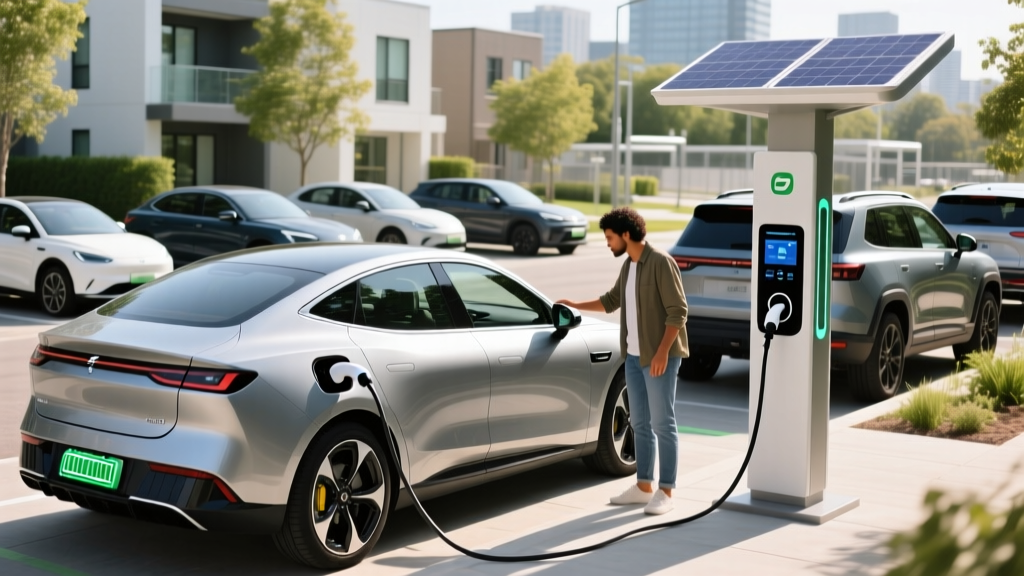
A Level 2 home charger delivers 7.2–11.5 kW, adding 25–45 miles of range per hour. A full overnight charge (8–10 hours) replenishes any daily driving. Installation typically requires:
- Charger hardware: $350–$700 (e.g., ChargePoint Home Flex, Emporia Vue)
- Electrical panel capacity: Most homes need a 200-amp panel; older homes with 100-amp service may need a $1,500–$3,000 panel upgrade
- Electrician labor + permit: $500–$1,500 depending on run length from panel to garage
- Total installed cost: $800–$2,000 in most cases; $2,500–$4,500 if a panel upgrade is needed
Always hire a licensed electrician for the final spec and installation. The IRS §30C credit may cover up to 30% of home charger installation costs (max $1,000) for eligible taxpayers.
Public Charging Reality
If you live in an apartment without charging access, you'll rely on public networks — Electrify America, EVgo, ChargePoint, and the Tesla Supercharger network (now open to NACS-equipped non-Tesla vehicles). DC fast charging costs $0.30–$0.50/kWh, making it 2–4× more expensive than home charging. Budget $1,200–$2,400 annually for public-only charging on 12,000 miles of driving.
Range, Cold Weather, and Real-World Expectations
The EPA range sticker is a starting point, not a guarantee. Here's what early electric car buyers must understand:
EPA vs. Real-World Range Reality:
- EPA combined: 303 miles (Ioniq 5 Long Range RWD)
- Highway driving (70+ mph): Expect ~250–270 miles — higher speeds increase aerodynamic drag significantly
- Cold weather (below 30°F): Expect 20–30% range loss, dropping to ~210–240 miles. Battery chemistry slows, and cabin heating draws substantial energy
- Cold + highway combined: Plan for ~190–220 miles of usable range
A heat pump (standard on many 2026 models including the Ioniq 5, Tesla Model Y, and BMW iX) reduces cold-weather loss by recapturing waste heat, but doesn't eliminate it.
For road trips, DC fast charging adds range quickly but follows a tapering charge curve. A 240 kW peak charger might deliver 10–80% in 18 minutes, but charging from 80–100% can take an additional 20+ minutes. Plan stops around the 80% mark to minimize time at the charger.
Federal Tax Credit: Do You Qualify?
The §30D Clean Vehicle Credit can reduce your effective purchase price by up to $7,500, but eligibility has strict requirements that change frequently. Here's the current checklist:
- MSRP cap: Vans, SUVs, and pickups must be under $80,000; sedans and other vehicles under $55,000
- Buyer income cap: Modified AGI must not exceed $150,000 (single), $225,000 (head of household), or $300,000 (married filing jointly)
- Battery sourcing: Increasing percentages of critical minerals and battery components must be sourced from the US or free-trade-agreement countries — this requirement tightens annually
- Final assembly: Vehicle must be assembled in North America
- Point-of-sale transfer: You can transfer the credit to the dealer for an immediate price reduction at purchase, or claim it on your tax return
- Transferability: The credit can be applied even if you have no tax liability when transferred at point of sale
Always verify current eligibility on irs.gov and consult a tax professional. Battery sourcing rules have disqualified several previously eligible models, and the list changes with new manufacturer supply-chain agreements.
Common EV Misconceptions — Myth vs. Fact
| Myth | Fact |
|---|---|
| "EV batteries need replacing every few years" | Federal law mandates battery warranties of at least 8 years / 100,000 miles. Most NMC and LFP batteries retain 85–92% capacity after 100,000 miles based on fleet data. |
| "EVs are worse for the environment because of electricity generation" | Even on a coal-heavy grid, an EV produces 50–70% fewer lifecycle emissions than a gas car. On cleaner grids, the advantage is 70–85%. Source: Union of Concerned Scientists. |
| "Charging takes too long" | Home Level 2 charging happens while you sleep — zero active time. DC fast charging adds 150–200 miles in 15–20 minutes on modern 800V architectures. |
| "EVs can't handle road trips" | With 250+ miles of range and DC fast-charger spacing of 25–50 miles on major US interstates, road trips require 15–20 minute stops every 2.5–3 hours — comparable to gas-car rest stops. |
| "The power grid can't handle EVs" | Most charging occurs overnight during off-peak hours. Utilities are upgrading distribution capacity, and vehicle-to-grid (V2G) technology may eventually let EVs support grid stability. |
Decision Framework: Is an Early Electric Car Right for You?
Choose a BEV (full electric) if:
- You have access to home or workplace Level 2 charging
- Your daily driving is under 60 miles round-trip
- You qualify for the §30D tax credit (reducing effective cost by $7,500)
- You want minimal maintenance (no oil changes, fewer brake replacements due to regenerative braking)
- You value instant torque and quiet operation
Choose a PHEV (plug-in hybrid) if:
- You can charge at home but frequently take road trips over 300 miles
- You live in an extreme cold-weather climate (below 0°F regularly) where range loss is severe
- You want electric-only commuting (25–42 miles) without any range limitation
- Your household has only one vehicle and you can't risk charging-desert scenarios
Stick with a gas car or HEV (conventional hybrid) if:
- You cannot install a home charger and public charging infrastructure is sparse in your area
- Your budget is strictly under $28,000 and you need the lowest possible upfront cost
- You regularly tow heavy loads (towing reduces EV range by 40–60%)
First-Time EV Buyer FAQ
How long do EV batteries actually last?
Current lithium-ion batteries (both NMC and LFP chemistries) are designed to last the life of the vehicle. Fleet data from high-mileage Tesla and Hyundai vehicles shows 85–92% capacity retention at 100,000 miles. Federal warranty requirements guarantee at least 8 years / 100,000 miles with a minimum 70% capacity retention threshold. A full battery replacement, if ever needed, costs $8,000–$18,000 depending on pack size, but is rarely required.
What's the difference between kW and kWh?
This is the most common point of confusion. kW (kilowatts) measures power — how fast energy flows, like water pressure in a hose. It determines your charging speed. kWh (kilowatt-hours) measures energy — the total amount stored, like the size of a water tank. It determines your range. A 77 kWh battery charged at 11 kW takes about 7 hours from empty to full.
Will an EV save me money?
On fuel alone, yes — typically $800–$1,200 per year for 12,000 miles of driving. Over five years, total savings on fuel and maintenance average $5,000–$8,000. However, higher insurance premiums ($1,500–$2,500 more over 5 years) and potentially steeper depreciation offset some of those savings. The §30D tax credit, if you qualify, is the single biggest financial advantage.
Do I need to worry about charging on road trips?
On major US interstate corridors, DC fast chargers are spaced every 25–50 miles. With apps like PlugShare, A Better Routeplanner, and built-in vehicle navigation, trip planning is straightforward. Expect to add 15–20 minutes of charging every 2.5–3 hours of highway driving. The main inconvenience is charger reliability — Electrify America and EVgo have improved uptime but still experience occasional outages. Tesla Superchargers remain the most reliable network.
What should I look for in my first EV?
Prioritize: (1) EPA range of at least 250 miles for a comfortable buffer, (2) DC fast-charge capability of at least 150 kW for reasonable road-trip stops, (3) a heat pump if you live in a cold climate, (4) the NACS connector (now the North American standard) or a CCS-to-NACS adapter for maximum network access, and (5) battery warranty of 8 years / 100,000 miles minimum.
Buying your first early electric car in 2026 is a data-driven decision, not a leap of faith. Run your personal numbers — daily miles, local electricity rate, tax-credit eligibility, and home-charging feasibility — against the figures above. For most suburban commuters with garage access, the math now favors electric. For apartment dwellers or frequent long-distance drivers, a PHEV remains an excellent bridge to full electrification.