The Short Answer
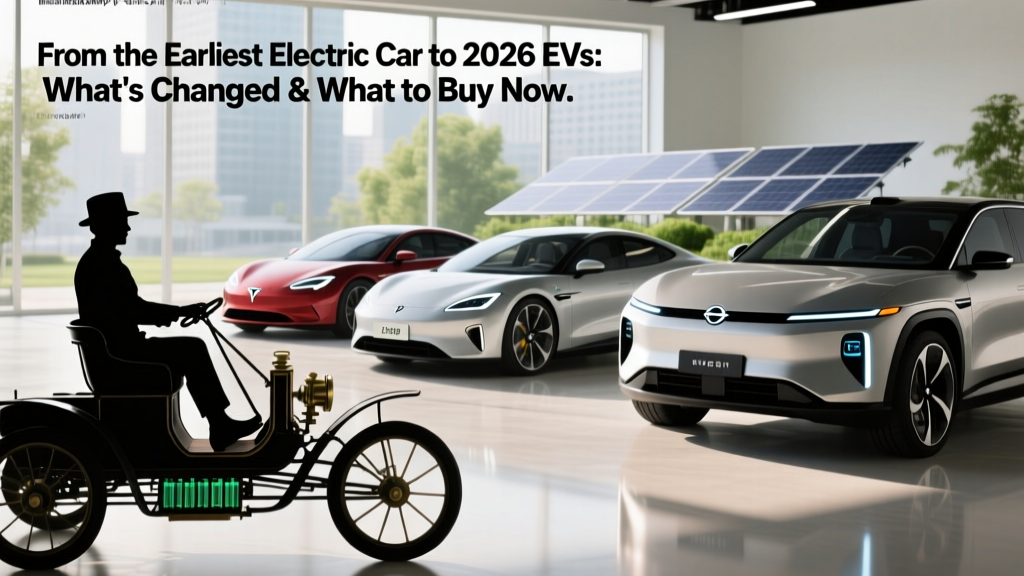
The earliest electric car dates to the 1830s, when Scottish inventor Robert Anderson built a crude electric carriage powered by non-rechargeable primary cells. By the 1890s, electric vehicles outsold gasoline cars in the U.S., but limited battery technology and cheap oil killed the movement by the 1920s. Today's EVs bear almost no resemblance to those ancestors: a 2026 Hyundai Ioniq 6 delivers an EPA-estimated 361 miles of range, charges at 240 kW (10–80% in ~18 minutes), and starts around $38,650 before incentives — a fundamentally different ownership proposition than even a 2018 EV.
The Earliest Electric Car: Where It All Started
Understanding where EVs came from helps calibrate expectations for where they're going — and why modern battery chemistry matters so much for buyers.
In 1834 or 1835 (records vary), Robert Anderson of Scotland mounted galvanic cells to a carriage, creating what historians widely credit as the earliest electric car. It couldn't be recharged. In 1889, Thomas Davenport's successors and European engineers like Gustave Trouvé built practical electric tricycles and carriages. By 1900, 38% of American automobiles were electric, 22% ran on gasoline, and 40% were steam-powered, according to the U.S. Department of Energy.
Early electrics like the Baker Electric (1899–1915) offered ~50 miles of range at 12–14 mph, weighed over 3,000 lbs due to lead-acid batteries, and cost $2,000–$4,000 — premium pricing even then. They were popular with urban drivers who valued quiet operation and no hand-cranking, but Henry Ford's $650 Model T and the electric starter (1912) made gasoline cars cheaper and more practical for long distances.
Why the First Wave Died
Three factors killed the earliest electric car movement:
- Energy density: Lead-acid batteries stored roughly 30–40 Wh/kg. Today's NMC lithium-ion cells store 250–300 Wh/kg — a 7x improvement.
- Refueling infrastructure: Gasoline stations proliferated while electricity remained scarce outside cities.
- Cost: Mass production crushed EV pricing advantages. A modern parallel exists — today's EV price premium over gas cars still drives many buyers toward hybrids.
2026 EV Ownership: What a First-Time Buyer Actually Needs to Know
If you're researching your first EV purchase, the technology gap between the earliest electric car and a 2026 model is staggering — but so is the information gap most buyers face. Here's what matters.
Range: EPA Sticker vs. Real World
EPA range estimates are measured under controlled conditions. Real-world results depend on speed, temperature, terrain, and climate control use. Here's how current popular models compare:
| Vehicle | Battery (kWh usable) | Chemistry | EPA Range | Real-World Highway (70 mph) | Cold Weather (20°F) |
|---|---|---|---|---|---|
| Tesla Model 3 Long Range | 75 kWh | NMC | 363 mi | ~290–310 mi | ~240–260 mi |
| Hyundai Ioniq 5 (LR RWD) | 77.4 kWh | NMC | 303 mi | ~250–270 mi | ~210–230 mi |
| Chevrolet Equinox EV 3RS | 85 kWh | NMC | 319 mi | ~265–280 mi | ~220–240 mi |
| BMW iX xDrive50 | 105.2 kWh | NMC | 324 mi | ~270–290 mi | ~230–250 mi |
Expect 15–20% range loss at sustained highway speeds and 25–35% loss in sub-freezing temperatures — especially without a heat pump. Vehicles equipped with heat pumps (standard on Tesla, Hyundai/Kia, BMW) mitigate cold-weather losses by 10–15% compared to resistive cabin heaters.
Charging Speed: kW vs. kWh and the Charge Curve
The most common EV confusion: kW (kilowatts) measures power — how fast energy flows. kWh (kilowatt-hours) measures energy — how much the battery holds. Think of kW as the width of a hose and kWh as the size of the bucket.
Peak DC fast-charging rates only apply at low state-of-charge (SoC). The charge curve tapers significantly above 80% to protect battery health:
| Vehicle | Peak DC Rate | 10–80% Time | Average Sustained Rate | Charging Architecture |
|---|---|---|---|---|
| Hyundai Ioniq 5 | 240 kW | ~18 min | ~175 kW | 800V |
| Tesla Model 3 LR | 250 kW | ~25 min | ~150 kW | 400V |
| Chevrolet Equinox EV | 150 kW | ~32 min | ~110 kW | 400V |
| BMW iX xDrive50 | 195 kW | ~31 min | ~140 kW | 400V |
For home charging, a Level 2 (240V) wallbox at 11.5 kW adds roughly 35–45 miles per hour of charging — enough to fully replenish any EV overnight. Level 1 (120V) adds 3–5 miles per hour, which works only for low-mileage drivers with small batteries.
EV vs. Gas vs. Hybrid: The Real Cost Breakdown
The earliest electric car lost to the Model T on cost. In 2026, the math is more nuanced — and depends heavily on your driving patterns, electricity rates, and whether you qualify for federal incentives.
5-Year Total Cost of Ownership: EV vs. Gas vs. PHEV (15,000 mi/year)
| Cost Category | EV (Tesla Model 3 LR) | Gas (Toyota Camry LE) | PHEV (Toyota RAV4 Prime) |
|---|---|---|---|
| Base MSRP | $42,380 | $28,700 | $43,690 |
| Federal Tax Credit (§30D) | Up to $7,500* | $0 | Up to $7,500* |
| Effective Purchase Price | ~$34,880 | $28,700 | ~$36,190 |
| Fuel/Energy (5 years) | ~$4,500** | ~$10,125*** | ~$5,800 |
| Maintenance (5 years) | ~$1,800 | ~$3,750 | ~$3,200 |
| Insurance (5 years) | ~$9,500 | ~$7,200 | ~$8,100 |
| Estimated Depreciation | ~$14,000 | ~$10,800 | ~$15,500 |
| 5-Year Total | ~$64,680 | ~$60,575 | ~$68,790 |
* §30D credit eligibility depends on buyer income caps ($150K single/$300K joint), MSRP caps ($55K cars/$80K trucks/SUVs), battery sourcing requirements, and point-of-sale transfer. See IRS.gov for current rules.
** Based on $0.14/kWh national average and 25 kWh/100mi efficiency.
*** Based on $3.375/gal and 32 MPG combined.
Key takeaway: The EV wins on operating costs (fuel + maintenance save ~$7,500 over 5 years), but higher insurance premiums and steeper depreciation partially offset those gains. If you qualify for the full $7,500 credit and take it at point-of-sale, the effective purchase price gap narrows dramatically.
Common EV Misconceptions — Fact-Checked
| Myth | Fact |
|---|---|
| "EV batteries need replacing every 5 years" | Federal law mandates 8-year/100,000-mile battery warranties (10 years in CARB states). Real-world data shows ~10–15% degradation at 150K miles for NMC, ~5–8% for LFP chemistry. |
| "EVs are worse in winter" | Range drops 25–35% in extreme cold, but EVs start instantly (no cold-crank issues), and preconditioning while plugged in preserves range. AWD EVs often outperform gas cars in snow due to instant torque and low center of gravity. |
| "The grid can't handle EVs" | Most EV charging happens overnight at 7–11 kW, equivalent to running an electric dryer. Utility time-of-use rates incentivize off-peak charging. The grid challenge is localized — some neighborhoods need transformer upgrades, not nationwide grid collapse. |
| "EVs produce more lifetime emissions" | Manufacturing an EV creates ~40% more CO₂ than a gas car, but the breakeven point arrives within 6,000–20,000 miles depending on grid mix (EPA data). On the average U.S. grid, lifetime emissions are 60–68% lower. |
| "Charging takes too long" | Home Level 2 charging is overnight — you wake up "full" every morning. Road-trip DC fast charging adds 150–200 miles in 15–20 minutes at 150+ kW chargers. Most drivers charge while eating or shopping. |
Real-World Ownership: Home Charging, Climate, and Driving Patterns
The single biggest predictor of EV satisfaction isn't the car — it's charging access.
Home Charging Installation: What to Budget
| Item | Typical Cost Range | Notes |
|---|---|---|
| Level 2 charger hardware (40–48A) | $350–$700 | ChargePoint Home Flex, Emporia, Wallbox Pulsar Plus |
| Electrician labor (240V/50A circuit) | $800–$2,500 | Depends on panel proximity and conduit run |
| Electrical panel upgrade (100A→200A) | $1,500–$4,000 | Needed if existing panel lacks capacity; ~20% of homes |
| Permits and inspection | $50–$300 | Varies by municipality |
| Total (no panel upgrade) | $1,200–$3,500 | Most common scenario |
| Total (with panel upgrade) | $2,700–$7,500 | Older homes with 100A service |
Always get a licensed electrician's assessment before committing to a vehicle. A 200-amp panel with spare breaker slots is ideal. Some utilities offer rebates of $250–$1,000 for charger installation — check your local provider.
Who Should (and Shouldn't) Buy an EV in 2026
Actionable Decision Framework
Choose a full EV (BEV) if:
- You can install a Level 2 charger at home or have reliable workplace charging
- Your daily commute is under 80 miles round-trip
- You take fewer than 4 road trips over 300 miles per year
- You qualify for the §30D tax credit (income and sourcing requirements met)
- You live in a region with moderate winters or have garage parking for preconditioning
Choose a PHEV if:
- You can't install home charging (apartment, street parking)
- You regularly drive 200+ miles in a day and don't want to plan charging stops
- You want electric commuting (25–42 miles EV range) with gas flexibility for longer trips
- You live in an area with sparse DC fast-charging infrastructure
Choose a conventional hybrid (HEV) if:
- You have zero charging access and no realistic path to getting it
- Your budget is under $30,000 and you need maximum upfront affordability
- You drive very high annual mileage (25,000+ miles) where a proven 50+ MPG hybrid minimizes fuel cost without charging dependency
Wait or reconsider if:
- You tow frequently over long distances — EV towing range drops 40–50%
- You live in a charging desert (rural routes with no DC fast chargers within 60+ miles)
- Your household income exceeds §30D caps ($150K single / $300K joint) and the MSRP premium over gas alternatives exceeds $10,000
What a First-Time EV Buyer Should Prioritize
After years of testing and ownership, here's the hierarchy of what actually matters — ranked by real-world impact:
- Home charging access. This determines whether an EV is a joy or a burden. Budget $1,200–$3,500 for a proper Level 2 install before buying the car.
- Usable battery capacity (kWh), not just EPA range. A larger buffer means less degradation anxiety and better road-trip flexibility. Aim for 70+ kWh usable for a primary vehicle.
- DC fast-charging architecture. 800V vehicles (Hyundai/Kia/Genesis/Porsche) charge meaningfully faster on road trips than 400V vehicles — the difference is 15 minutes vs. 30 minutes at a 350 kW station.
- Heat pump availability. If you live where temperatures regularly drop below 35°F, a heat pump is nearly as important as battery size. It preserves 10–15% more range in cold weather.
- Warranty terms. Federal minimum is 8 years/100,000 miles for battery and powertrain. Hyundai/Kia offers 10 years/100,000 miles. Check the capacity retention threshold — most warranties guarantee 70% of original capacity.
- Connector type. NACS (Tesla's connector, now adopted by Ford, GM, Rivian, Hyundai, and most major automakers for 2025+ models) is becoming the North American standard. CCS1 vehicles still access growing third-party networks but may need adapters for Superchargers.
FAQ: Early EV History Meets Modern Buying Questions
What was the earliest electric car ever made?
The earliest electric car is generally attributed to Robert Anderson of Scotland, who built a crude electric carriage between 1832 and 1839. It used non-rechargeable galvanic cells. The first practical, rechargeable electric car emerged in the 1880s, and by 1900, electric vehicles held land-speed records and outsold gasoline cars in the U.S.
Why did electric cars disappear after 1900?
Three factors converged: cheap Texas crude oil made gasoline affordable, Henry Ford's mass-produced Model T undercut EV pricing by 3:1, and the 1912 electric starter eliminated the dangerous hand-crank that was gas cars' biggest drawback. Lead-acid batteries couldn't match gasoline's energy density for long-distance travel, and rural electrification lagged decades behind gasoline distribution.
How much does it cost to charge an EV vs. fueling a gas car?
At the U.S. average electricity rate of ~$0.14/kWh and an efficient EV consuming 25 kWh/100 miles, fuel cost is roughly $0.035 per mile. A gas car at 30 MPG with $3.375/gallon fuel costs $0.113 per mile — about 3.2x more per mile. Over 15,000 miles per year, that's $525 for the EV vs. $1,688 for gas, saving ~$1,163 annually. Public DC fast charging at $0.35–$0.50/kWh narrows the gap on road trips.
Do I need a 200-amp electrical panel for an EV charger?
Not always, but it helps. A 48-amp Level 2 charger requires a 60-amp dedicated circuit. If your panel is 100 amps and already near capacity (common in older homes), you'll likely need an upgrade to 200 amps — costing $1,500–$4,000. A licensed electrician can perform a load calculation to determine if your existing panel supports the additional circuit. Some newer smart chargers can dynamically adjust amperage to avoid overloading a panel.
Are today's EV batteries really better than early EV batteries?
The improvement is extraordinary. The earliest electric car's lead-acid batteries stored ~35 Wh/kg and degraded rapidly. Modern NMC lithium-ion cells store 250–300 Wh/kg (a 7–8x improvement), while LFP (lithium iron phosphate) cells trade slightly lower energy density (~200 Wh/kg) for dramatically longer cycle life (3,000+ cycles vs. ~1,000–1,500 for NMC) and lower cost. Today's batteries are warrantied for 8–10 years and routinely outlast the vehicles they power.
Should I wait for solid-state batteries?
Solid-state batteries promise higher energy density (~400+ Wh/kg), faster charging, and improved safety. However, mass production at automotive scale remains in the 2028–2030+ window for most automakers. Toyota, Nissan, and Samsung SDI have announced pilot production, but costs will be high initially. For buyers needing a car now, current lithium-ion technology is mature, well-warrantied, and proven over billions of real-world miles. Waiting 3–5 years for solid-state means 3–5 more years of higher fuel costs in a gas car.
Sources: U.S. Department of Energy — History of the Electric Car, EPA Fuel Economy, IRS §30D Clean Vehicle Credits, EPA Green Vehicles — EV Myths.