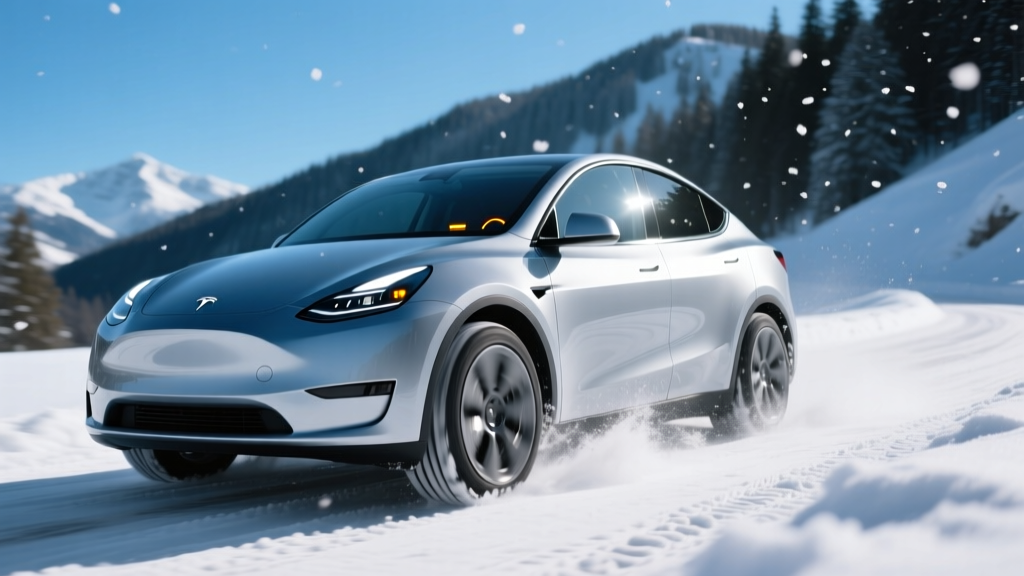
If you've ever watched an EV owner nervously check their range gauge as temperatures drop below freezing, you understand the core question: how do Teslas actually perform in winter conditions? The short answer is surprisingly well — but with measurable trade-offs in range, charging speed, and energy consumption that every cold-climate buyer should understand before signing a purchase agreement.
Tesla's dual-motor all-wheel-drive systems, low center of gravity, and sophisticated traction control make them competent snow vehicles. But the physics of lithium-ion batteries in cold weather don't care about brand loyalty. Expect 20-30% range reduction in sub-freezing temperatures, slower DC fast charging until the battery warms, and higher energy consumption from cabin heating. Let's break down exactly what driving Tesla in snow looks like across the current 2026 lineup.
Which Tesla Models Offer AWD for Snow Driving?
Not all Teslas are created equal when the roads turn white. Tesla currently offers dual-motor all-wheel drive on most trims, but the base rear-wheel-drive configurations (still available on Model 3 and Model Y) are less ideal for serious winter conditions. Here's the 2026 lineup relevant to snow-belt buyers:
| Model | Drivetrain | EPA Range | 0-60 mph | HP | Base MSRP |
|---|---|---|---|---|---|
| Model 3 Long Range AWD | Dual Motor AWD | 341 mi | 4.2 sec | ~346 | $47,740 |
| Model Y Long Range AWD | Dual Motor AWD | 320 mi | 4.8 sec | ~384 | $48,240 |
| Model S Long Range | Dual Motor AWD | 402 mi | 3.1 sec | ~670 | $79,990 |
| Model X Long Range | Dual Motor AWD | 335 mi | 3.8 sec | ~670 | $84,990 |
Key takeaway: The Model 3 Long Range AWD and Model Y Long Range AWD represent the volume sellers for snow-belt buyers. Both use Tesla's dual-motor system with independent front and rear motors, providing torque vectoring that outperforms most mechanical AWD systems in low-traction scenarios.
Real-World Winter Range: What the EPA Sticker Doesn't Tell You
EPA Combined Range (Model 3 LR AWD): 341 miles
Expected Winter Range (20°F-32°F): 240–275 miles
Severe Cold (below 0°F, highway): 200–230 miles
Cold weather reduces range 20-30% due to battery chemistry limitations, cabin heating load, and increased rolling resistance from snow/slush.
The EPA range figure is tested under controlled laboratory conditions at moderate temperatures. When you're driving Tesla in snow and cold, several factors conspire against you:
- Battery internal resistance increases — lithium ions move more sluggishly through cold electrolyte, reducing usable capacity
- Cabin and battery heating — Tesla's heat pump (standard on all 2026 models) is efficient, but still draws 2-5 kW continuously in cold weather
- Regenerative braking is limited — cold batteries can't accept charge as quickly, so regen is reduced until the pack warms, increasing brake wear and energy consumption
- Tire rolling resistance increases — winter tires and slush-covered roads require more energy per mile
According to fueleconomy.gov, EVs can lose 20-30% of their range in temperatures below 40°F, with the loss accelerating as temperatures drop further. Tesla's thermal management system — which actively preconditions the battery using grid power when plugged in — mitigates some of this loss, but physics is physics.
Cold-Weather Charging: Slower Speeds Until the Battery Warms
One of the most misunderstood aspects of driving Tesla in snow is how cold temperatures affect charging speed. Lithium-ion batteries cannot safely accept high charge rates when cold, so Tesla's battery management system throttles DC fast charging until the pack reaches optimal temperature (typically 95°F–110°F at the cell level).
| Charging Method | Power / Rate | Time (10-80%) | Notes |
|---|---|---|---|
| Level 1 (120V household) | ~1.4 kW | 40+ hours | 3-5 mi/hr; emergency use only |
| Level 2 (240V, 48A) | ~11.5 kW | ~8 hours | ~44 mi/hr; ideal for home |
| DC Fast (V3 Supercharger) | Peak 250 kW | ~25-30 min (warm) | 40-55 min in cold without preconditioning |
| DC Fast (V4 Supercharger) | Peak 250 kW | ~25 min (warm) | Current Model 3 architecture caps at 250 kW |
The preconditioning trick: If you navigate to a Supercharger using the Tesla navigation system, the car automatically begins warming the battery 10-20 minutes before arrival. This can cut cold-weather charging time by 15-20 minutes compared to arriving with a cold-soaked pack. Always precondition before DC fast charging in winter — it's the single biggest time-saver.
Battery chemistry matters here. The Model 3 RWD uses LFP (lithium iron phosphate) chemistry, which has slightly different cold-weather characteristics than the NMC (nickel manganese cobalt) cells in Long Range and Performance models. LFP cells are more tolerant of cold charging but have lower energy density, which is why the RWD model has less range despite a similar physical battery size.
AWD Traction and Snow Handling: How Teslas Compare
Tesla's dual-motor AWD system has distinct advantages over traditional mechanical AWD in snow:
- Instant torque vectoring — independent front and rear motors can shift torque in milliseconds, faster than any mechanical center differential
- Low center of gravity — the battery pack sits under the floor, reducing body roll and improving stability
- Weight distribution — heavy battery low and centered provides balanced grip
- Traction control sophistication — Tesla's software can detect slip and adjust motor torque faster than traditional ESC systems
That said, no AWD system overcomes the laws of physics on ice. Winter tires remain the single most impactful upgrade for snow driving. Tesla sells approved winter tire packages, and many owners report dramatically improved confidence with dedicated winter rubber (Nokian Hakkapeliitta, Bridgestone Blizzak, or Michelin X-Ice).
Ground clearance is a legitimate concern. The Model 3 sits at 5.5 inches of ground clearance, the Model Y at 6.6 inches, and the Model X at 8.1 inches (with air suspension). If you regularly encounter unplowed roads or deep snow, the Model Y or Model X offer more margin than the Model 3 sedan.
Efficiency and Operating Costs in Winter
Tesla publishes efficiency in MPGe (miles per gallon equivalent) and kWh per 100 miles. For the 2026 Model 3 Long Range AWD:
- EPA Combined Efficiency: 134 MPGe / 25 kWh per 100 miles
- Winter Real-World (observed): 95–110 MPGe / 30–35 kWh per 100 miles
That 30-40% efficiency penalty in winter directly translates to more frequent charging stops on road trips and higher electricity costs per mile. For a commuter driving 40 miles round-trip in winter, expect to use roughly 12-14 kWh per day versus 10 kWh in mild weather — a meaningful difference if you're paying $0.15-$0.20 per kWh at home.
Pricing, Tax Credits, and Total Cost
| Model | Base MSRP | As-Tested (typical) | §30D Credit Eligible? | Effective Price (if eligible) |
|---|---|---|---|---|
| Model 3 LR AWD | $47,740 | $50,240 | Yes (if income/sourcing rules met) | ~$40,240 |
| Model Y LR AWD | $48,240 | $51,740 | Yes (if income/sourcing rules met) | ~$40,740 |
| Model S LR | $79,990 | $84,990 | No (exceeds $55K sedan cap) | $79,990 |
| Model X LR | $84,990 | $89,990 | No (exceeds $80K SUV cap) | $84,990 |
The IRS §30D federal tax credit offers up to $7,500 for qualifying new EVs, but eligibility hinges on three factors:
- MSRP caps: $55,000 for sedans (Model 3), $80,000 for SUVs/trucks (Model Y qualifies; Model X does not in most trims)
- Buyer income limits: $150K single / $300K joint modified AGI
- Battery sourcing requirements: Critical minerals and battery components must meet escalating North American sourcing thresholds
As of 2026, Tesla Model 3 and Model Y qualify for the full $7,500 credit when purchased by eligible buyers, and the credit can be transferred to the dealer at point of sale as a purchase price reduction. Always verify current eligibility on the IRS website before committing, as sourcing rules tighten annually.
Who Should Buy a Tesla for Snow Driving?
- Daily commuters in snow-belt cities (Minneapolis, Chicago, Boston, Denver) with home Level 2 charging
- Tech-savvy drivers who value over-the-air updates and Supercharger network access
- Two-car households where the Tesla handles daily driving and a second vehicle covers extreme weather days
- You regularly drive 300+ miles in sub-zero weather without reliable charging access
- You need serious ground clearance for unplowed rural roads (consider Rivian R1S or Ford F-150 Lightning)
- You cannot install Level 2 home charging and must rely solely on public infrastructure
Pros and Cons: Tesla in Snow
- Excellent AWD traction with instant torque vectoring
- Heat pump standard (efficient cabin heating)
- Battery preconditioning for faster winter charging
- Low center of gravity improves stability
- Extensive Supercharger network for winter road trips
- Over-the-air updates continuously improve cold-weather algorithms
- 20-30% range loss in freezing temperatures
- Slower DC fast charging without preconditioning
- Limited ground clearance (Model 3 especially)
- Reduced regenerative braking when battery is cold
- Higher energy consumption increases charging costs
- No physical buttons — touchscreen-only controls can be distracting in winter driving
Frequently Asked Questions
What is the real-world range of a Tesla in winter?
Expect 20-30% less than the EPA sticker. A Model 3 Long Range AWD rated at 341 miles will typically deliver 240-275 miles in freezing temperatures, and as little as 200-230 miles in severe cold (below 0°F) at highway speeds.
How fast does a Tesla charge in cold weather?
DC fast charging can take 40-55 minutes (10-80%) in cold weather versus 25-30 minutes in warm weather, unless you use navigation-based battery preconditioning. Level 2 home charging is largely unaffected by cold (8 hours for a full charge).
Do Teslas qualify for the federal EV tax credit?
Model 3 and Model Y qualify for the full $7,500 §30D credit if you meet income limits ($150K single / $300K joint) and the vehicle meets battery sourcing requirements. Model S and Model X exceed MSRP caps and do not qualify. Verify current rules at irs.gov.
Is a Tesla better than gas AWD vehicles in snow?
Tesla's electric AWD provides excellent traction, often superior to mechanical AWD systems due to instant torque control. However, winter tires matter more than drivetrain type. A Tesla with winter tires will outperform most gas AWD vehicles with all-season tires.
Should I get a Tesla with LFP or NMC battery for cold weather?
NMC (Long Range models) offers higher energy density and better range, making it preferable for cold climates where range is already reduced. LFP (RWD models) is more durable and tolerant of cold charging but has less total range to begin with.
What's the biggest mistake Tesla owners make in winter?
Not preconditioning the battery before DC fast charging. Navigating to a Supercharger via the car's navigation triggers automatic battery warming, cutting charge time by 15-20 minutes in cold weather. Also: not installing winter tires, which are the single most impactful safety upgrade.
Final Verdict: Is Tesla the Right Snow Vehicle for You?
Driving Tesla in snow is a competent, confidence-inspiring experience — provided you understand the winter range penalty and plan accordingly. The dual-motor AWD system, heat pump, and battery preconditioning make Teslas legitimate winter vehicles, not just fair-weather commuters. But if you regularly face 300-mile winter road trips, live in an area with sparse charging infrastructure, or cannot install home Level 2 charging, a plug-in hybrid or efficient gas AWD vehicle may offer more flexibility.
For the majority of snow-belt commuters with home charging access and realistic range expectations, a Model 3 or Model Y Long Range AWD represents an excellent winter daily driver — especially after the $7,500 federal tax credit brings the effective price into the low $40,000s.