What Does a Down Payment on a Tesla Actually Look Like in 2026?
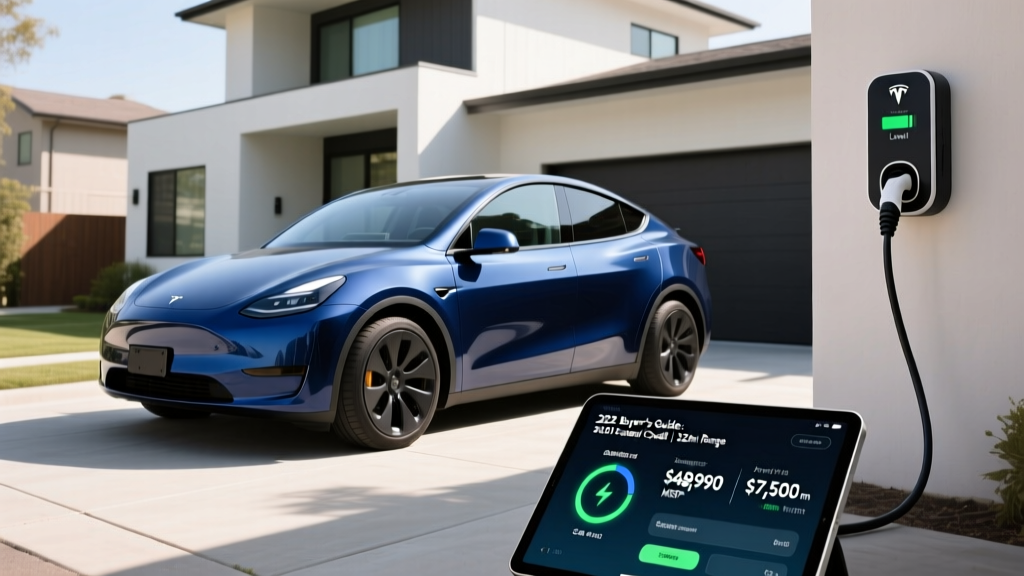
If you're researching a down payment on a Tesla, the number isn't fixed by the manufacturer — Tesla doesn't require a traditional dealer-style down payment when you order direct. Instead, what you pay upfront depends on your financing structure, trade-in equity, and whether you apply the federal §30D EV tax credit at the point of sale. For a 2026 Model 3 RWD starting at $38,990 or a Model Y Long Range AWD at $44,990, most buyers putting 10-20% down will need between $3,900 and $8,000 at signing before incentives.
This guide breaks down the total purchase picture for Tesla's two highest-volume vehicles — the Model 3 sedan and Model Y crossover — including real-world range, charging speeds, battery chemistry, tax-credit eligibility, and whether the math works versus key competitors like the Hyundai Ioniq 5 and Ford Mustang Mach-E.
The 2026 Model 3 Long Range carries an EPA-estimated 363 miles of range. In real-world highway driving at 70-75 mph, expect approximately 290-320 miles. In cold weather (below 32°F), that figure can drop to 240-270 miles due to battery chemistry limitations and cabin heating demand. The Model Y Long Range AWD (EPA 320 miles) typically delivers 260-285 miles on the highway and 215-240 miles in freezing conditions.
Tesla Model 3 and Model Y: 2026 Specs at a Glance
| Spec | 2026 Model 3 RWD | 2026 Model 3 Long Range AWD | 2026 Model Y Long Range AWD |
|---|---|---|---|
| Base MSRP | $38,990 | $44,990 | $44,990 |
| EPA Range | 272 mi | 363 mi | 320 mi |
| Battery (usable) | ~60 kWh (LFP) | ~79 kWh (NMC) | ~79 kWh (NMC) |
| Efficiency | 132 MPGe / 25 kWh/100mi | 134 MPGe / 25 kWh/100mi | 122 MPGe / 28 kWh/100mi |
| Max DC Fast Charge | 170 kW | 250 kW | 250 kW |
| 10-80% DCFC Time | ~30 min | ~25 min | ~27 min |
| Level 2 Home Charging | 11.5 kW (~44 mi/hr) | 11.5 kW (~44 mi/hr) | 11.5 kW (~37 mi/hr) |
| 0-60 mph | 5.8 sec | 4.2 sec | 4.8 sec |
| Horsepower | 271 hp | 346 hp | 384 hp |
| Drivetrain | RWD (single motor) | AWD (dual motor) | AWD (dual motor) |
| Cargo Volume | 23 cu ft (trunk+frunk) | 23 cu ft (trunk+frunk) | 76 cu ft (rear seats folded+frunk) |
| Rear Legroom | 35.3 in | 35.3 in | 41.6 in |
| Battery Warranty | 8 yr / 100,000 mi | 8 yr / 120,000 mi | 8 yr / 120,000 mi |
Sources: fueleconomy.gov, Tesla.com specifications. Efficiency figures are EPA combined estimates.
Battery Chemistry: LFP vs NMC and What It Means for You
Tesla uses two distinct battery chemistries across its lineup, and this matters for long-term ownership:
| Factor | LFP (Lithium Iron Phosphate) | NMC (Nickel Manganese Cobalt) |
|---|---|---|
| Used In | Model 3 RWD | Model 3 LR, Model Y LR, Performance trims |
| Energy Density | Lower (heavier pack for same range) | Higher (lighter, more range) |
| Charge to 100% Daily? | Yes — Tesla recommends periodic 100% charges | No — daily limit 80-90% recommended |
| Cold-Weather Performance | Greater range loss in freezing temps (~35-40%) | Better cold retention (~25-30% loss) |
| Cycle Life / Longevity | Higher cycle count, slower degradation | Slightly faster degradation, still strong |
| Cobalt Content | Zero cobalt | Contains cobalt |
If you're buying a Model 3 RWD to save on your down payment, know that the LFP pack sacrifices some cold-weather range and charges at a lower peak rate (170 kW vs 250 kW), but it offers excellent longevity and the flexibility to charge to 100% without degradation concerns.
Charging Speed: Home, Public, and the Supercharger Network
Charging infrastructure is Tesla's strongest competitive advantage. The Supercharger network in 2026 includes over 20,000 stalls across North America, and Tesla vehicles use the native NACS connector — now the industry standard adopted by Ford, GM, Rivian, and others.
| Charging Level | Power | Miles Added per Hour | Typical Use Case |
|---|---|---|---|
| Level 1 (120V outlet) | ~1.4 kW | ~4-5 mi/hr | Overnight trickle, emergencies |
| Level 2 (240V home) | 11.5 kW | ~37-44 mi/hr | Daily home charging |
| DC Fast Charge (Supercharger V3) | Up to 250 kW | ~1,000+ mi/hr (peak) | Road trips, 10-80% in ~25 min |
| DC Fast Charge (Supercharger V4) | Up to 350 kW (capable) | Future-proofed | Rolling out at select corridors |
Charging curve reality: The 250 kW peak on Model 3 LR and Model Y is only sustained between roughly 10-30% State of Charge. Above 50%, the rate tapers significantly — by 80%, you're typically at 40-60 kW. This is why Tesla (and all EV makers) quote 10-80% times rather than 0-100%. Plan road-trip stops around the 10-80% window for fastest throughput.
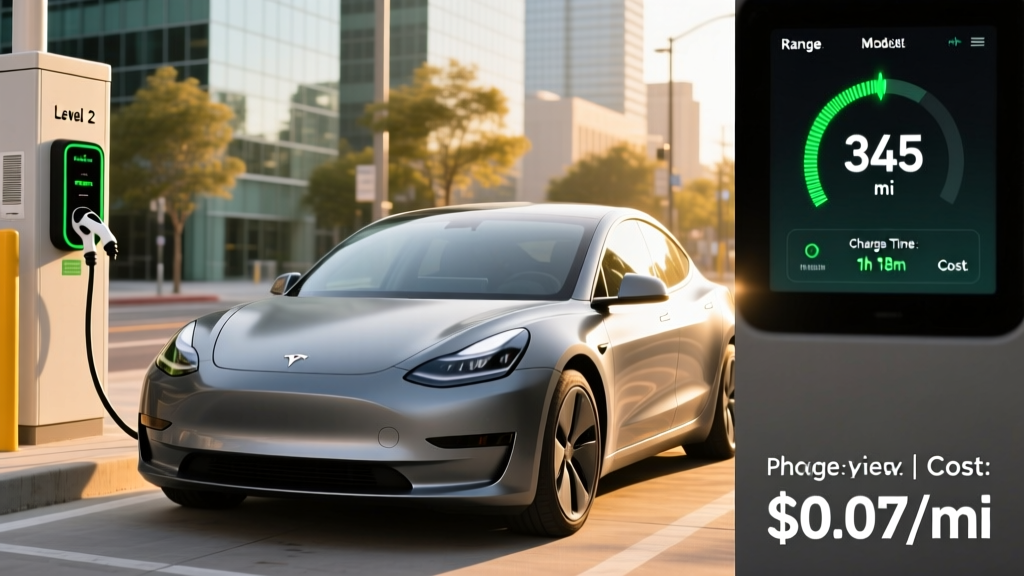
For home Level 2 charging, Tesla's Wall Connector costs around $475 (equipment only). Professional installation by a licensed electrician typically runs $500-$2,000 depending on panel proximity and whether a 200-amp service upgrade is needed. Most owners charging at home at $0.13-$0.16/kWh spend roughly $3.50-$5.00 per 100 miles of range — a fraction of gasoline costs.
Pricing, Down Payment Scenarios, and Federal Tax Credit Eligibility
Let's get to the core question: what will you actually pay upfront? Tesla sells direct, so there's no dealer markup negotiation. The "down payment" is whatever you choose to put down on a loan or lease, minus any trade-in equity and the point-of-sale tax credit transfer.
| Scenario | Model 3 RWD ($38,990) | Model 3 LR AWD ($44,990) | Model Y LR AWD ($44,990) |
|---|---|---|---|
| MSRP (before options) | $38,990 | $44,990 | $44,990 |
| Est. delivery + fees | +$1,390 | +$1,390 | +$1,390 |
| Max §30D Federal Credit | Up to $7,500 | Up to $7,500 | Up to $7,500 |
| Effective Price (after max credit) | ~$32,880 | ~$38,880 | ~$38,880 |
| 10% Down Payment (after credit) | ~$3,288 | ~$3,888 | ~$3,888 |
| 20% Down Payment (after credit) | ~$6,576 | ~$7,776 | ~$7,776 |
§30D Tax Credit Eligibility Checklist (2026 Rules)
The federal EV tax credit under IRS §30D is now available as a point-of-sale transfer, meaning you can apply the credit directly to reduce your down payment at purchase — you don't have to wait until tax filing. However, eligibility is not automatic. Per IRS guidelines, you must meet all of the following:
- Income caps: Modified AGI ≤ $150,000 (single), $225,000 (head of household), $300,000 (married filing jointly)
- MSRP cap: Vehicle MSRP must be ≤ $55,000 for sedans (Model 3) and ≤ $80,000 for SUVs/trucks (Model Y)
- Battery sourcing: Critical minerals and battery components must meet escalating domestic/free-trade-partner sourcing thresholds (phased in annually through 2029)
- Final assembly: Vehicle must undergo final assembly in North America (Tesla's Fremont and Austin plants qualify)
- One credit per vehicle: The specific VIN must not have previously been credited
Critical caveat: Battery sourcing requirements tighten each year. As of 2026, a growing percentage of battery components must come from the US or free-trade-agreement partners, and zero components may come from a "foreign entity of concern" (FEOC). Always verify current-year eligibility at fueleconomy.gov before purchasing, as credit qualification can change mid-year based on supply-chain shifts.
Tech, Driver Assistance, and Interior
Both the Model 3 and Model Y ship with Tesla's 15.4-inch center touchscreen running the latest vehicle software, which handles navigation, media, climate, and vehicle settings. There is no traditional instrument cluster — all driving information appears on the center screen.
Autopilot and FSD (Supervised): Every Tesla includes basic Autopilot (traffic-aware cruise control and lane-keeping) at no extra cost. Full Self-Driving (Supervised) is an $8,000 add-on (or $99/month subscription) that adds automated lane changes, traffic-light recognition, and city-street navigation. However, FSD is an SAE Level 2 system — the driver must remain fully engaged, hands on or near the wheel, eyes on the road at all times. This is not autonomous driving.
Tesla Autopilot and FSD (Supervised) are classified as SAE Level 2 driver-assistance systems. The human driver is responsible for all vehicle operation and must continuously supervise the system. True driverless operation (Level 4) is currently only available through commercial robotaxi services like Waymo in select metro areas.
Interior and cargo: The refreshed Model 3 ("Highland" architecture) features ventilated front seats, ambient lighting, rear-seat ventilation, and improved sound insulation over pre-2024 models. The Model Y ("Juniper" refresh for 2025-2026) offers similar upgrades with substantially more cargo room — 76 cu ft with rear seats folded, making it competitive with midsize SUVs. Both models include a front trunk (frunk) for additional storage.
Notable drawbacks: No physical turn-signal stalk (signals are on the steering wheel), no Apple CarPlay or Android Auto integration, minimal physical buttons, and the panoramic glass roof can create significant cabin heat in summer without aftermarket tinting or a sunshade.
Pros and Cons: Honest Assessment
- Supercharger network — the most reliable DC fast-charging ecosystem in North America
- Industry-leading efficiency (kWh/100mi) translates to lower charging costs
- Over-the-air updates continuously add features
- Strong resale value relative to most EV competitors
- Point-of-sale tax credit reduces effective down payment
- Excellent performance per dollar, especially dual-motor trims
- No Apple CarPlay / Android Auto
- Steering-wheel turn signals take significant adjustment
- LFP battery (Model 3 RWD) suffers more in cold weather
- FSD (Supervised) costs $8,000 extra and is still Level 2
- Ride quality on Model 3 can be firm on rough pavement
- Insurance premiums run 15-30% higher than comparable gas sedans
Is a Tesla Worth It vs. the Competition?
The Model 3 and Model Y compete against the Hyundai Ioniq 5, Ford Mustang Mach-E, Chevrolet Equinox EV, and the refreshed Nissan Ariya. Here's how the value proposition stacks up:
| Attribute | Tesla Model Y LR AWD | Hyundai Ioniq 5 Limited AWD | Ford Mustang Mach-E Premium AWD |
|---|---|---|---|
| MSRP (approx.) | $44,990 | $52,600 | $48,995 |
| EPA Range | 320 mi | 290 mi | 290 mi |
| Max DC Charge | 250 kW | 238 kW (350 kW capable) | 150 kW |
| 10-80% Time | ~27 min | ~18 min (on 350 kW) | ~40 min |
| Charging Network | Native Supercharger (NACS) | NACS adapter for Superchargers | NACS adapter for Superchargers |
| Cargo (rear folded) | 76 cu ft | 59 cu ft | 59 cu ft |
| Apple CarPlay | No | Yes (wireless) | Yes (wireless) |
The verdict: Tesla wins on efficiency, range-per-dollar, cargo space (Model Y), and native Supercharger access. Hyundai's Ioniq 5 charges faster on 350 kW-capable stations and offers CarPlay. Ford's Mach-E trails on charging speed but provides a more traditional interior layout. For buyers prioritizing the lowest effective down payment after tax credits and the lowest per-mile charging cost, the Model 3 RWD at ~$32,880 effective price is the value leader.
Choose Tesla Model Y LR AWD if: You need SUV cargo space, drive in snow/rain frequently, or take regular road trips and want maximum Supercharger convenience.
Choose Hyundai Ioniq 5 if: You want the fastest DC charging speeds, prefer physical controls and CarPlay, and don't mind a slightly higher MSRP.
Look elsewhere if: You require Apple CarPlay, prefer a traditional instrument cluster, or live in an area with limited Supercharger coverage and no home charging.
Warranty and Long-Term Ownership
Tesla's warranty structure is straightforward:
- Basic Vehicle Limited Warranty: 4 years / 50,000 miles, whichever comes first
- Battery and Drive Unit Warranty (Model 3 RWD, LFP): 8 years / 100,000 miles with minimum 70% capacity retention
- Battery and Drive Unit Warranty (Long Range / AWD, NMC): 8 years / 120,000 miles with minimum 70% capacity retention
The 70% retention threshold is standard across the industry. Real-world data from Tesla's fleet suggests average degradation of approximately 12-15% over 150,000 miles for NMC packs, with LFP packs showing slightly slower fade but more variability in cold climates. Battery replacement outside warranty, if needed, runs $12,000-$16,000 depending on pack size — though the vast majority of packs outlast the vehicle itself.
Insurance is a real cost factor: Tesla vehicles carry premiums 15-30% above comparable gas-powered vehicles due to higher repair costs and parts pricing. Get quotes before committing to your down payment amount.
Frequently Asked Questions
What is the minimum down payment on a Tesla?
Tesla does not mandate a specific down payment. If you finance through Tesla or a third-party lender, typical minimums range from 0% to 10% down depending on credit score. A 0% down loan will result in higher monthly payments and potentially negative equity. Most buyers aim for 10-20% down after applying the $7,500 point-of-sale tax credit.
Can I use the federal tax credit to reduce my Tesla down payment?
Yes. As of 2024 and continuing in 2026, the §30D credit can be transferred to the dealer (Tesla) at the point of sale, reducing the amount you finance or pay out of pocket. You must meet IRS income caps ($150K single / $300K joint), the vehicle must meet MSRP and battery-sourcing requirements, and you must not exceed the credit in a given tax year. Confirm eligibility with your tax professional and at irs.gov.
What is the real-world range of the Tesla Model 3 and Model Y?
The Model 3 RWD (EPA 272 mi) delivers roughly 220-240 miles on the highway and 180-200 miles in freezing weather. The Model 3 Long Range (EPA 363 mi) achieves 290-320 highway miles and 240-270 in cold weather. The Model Y Long Range (EPA 320 mi) returns 260-285 highway and 215-240 in winter. These ranges assume moderate speeds (65-75 mph) and standard climate-control usage.
How fast does a Tesla charge at home and on the road?
At home on a Level 2 (240V, 48-amp) Tesla Wall Connector, both the Model 3 and Model Y add approximately 37-44 miles of range per hour — a full overnight charge from 20% to 80% takes 5-7 hours. On a V3 Supercharger (250 kW peak), the Long Range models charge from 10-80% in about 25-27 minutes. The Model 3 RWD with its LFP battery peaks at 170 kW, taking roughly 30 minutes for the same window.
Does the Tesla Model 3 or Model Y qualify for the full $7,500 federal tax credit?
As of early 2026, both the Model 3 (sedan, MSRP under $55K cap) and Model Y (SUV, MSRP under $80K cap) assembled at Tesla's US plants qualify for up to $7,500 in federal credits — provided the buyer meets income thresholds and the specific vehicle's battery meets critical-mineral and component-sourcing requirements. Sourcing rules tighten annually; verify at fueleconomy.gov for the exact VIN you intend to purchase.
Is Tesla's FSD worth the $8,000 cost?
For most buyers, no. FSD (Supervised) remains an SAE Level 2 system requiring full driver attention. It performs well on highways and in stop-and-go traffic but can make errors at complex intersections and in construction zones. The monthly subscription ($99/month) is a lower-risk way to try the feature. Basic Autopilot, included free, handles highway cruising competently for most commutes.
Who is the Tesla Model Y best suited for?
The Model Y is ideal for families needing SUV cargo space (76 cu ft), couples who road-trip regularly and value Supercharger access, and commuters in regions with harsh winters who benefit from dual-motor AWD. It's less suited for buyers who prioritize Apple CarPlay, prefer a head-up display, or need third-row seating.