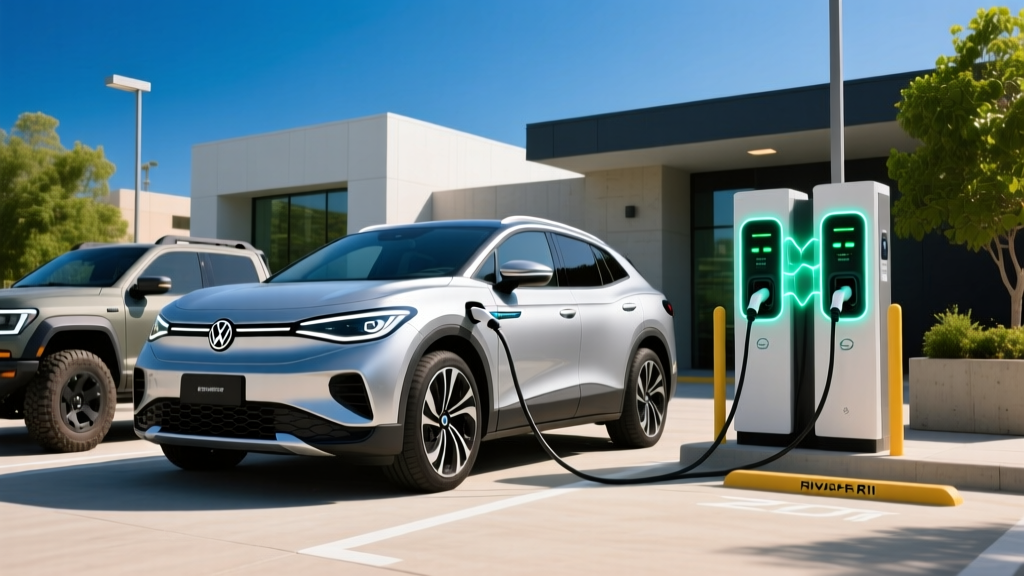
If you've been searching does Volkswagen own Rivian, you're not alone. The question has circulated ever since Rivian's 2024 announcement of a joint venture with Volkswagen Group, and the confusion is understandable. Let's clear it up immediately, then pivot to what it actually means for EV buyers: a thorough, numbers-first review of the 2026 Volkswagen ID.4 — the electric SUV that sits at the center of this corporate relationship.
Does Volkswagen Own Rivian? The Partnership Explained
No, Volkswagen does not own Rivian. What the two companies formed in late 2024 is a joint-venture technology partnership — not an acquisition. VW Group committed up to $5 billion in investment to co-develop electrical architecture and software platforms that both companies will use in future vehicles. Rivian remains an independent, publicly traded company (NASDAQ: RIVN). Volkswagen holds a minority investment stake, not a controlling ownership position.
For current buyers, this partnership matters in one concrete way: it signals long-term viability for both automakers and shared R&D in areas like zonal electrical architecture and over-the-air update infrastructure. But the 2026 VW ID.4 on dealer lots today is a fully Volkswagen-engineered vehicle built on the MEB platform — it doesn't share a powertrain, battery, or chassis with any Rivian product.
2026 VW ID.4 At a Glance: Specs That Matter
| Spec | ID.4 Standard (RWD) | ID.4 AWD Pro S |
|---|---|---|
| EPA Range | 291 miles | 263 miles |
| Battery (usable) | 82 kWh (NMC) | 82 kWh (NMC) |
| Horsepower | 282 hp | 335 hp |
| 0–60 mph | 7.7 sec | 5.4 sec |
| Drivetrain | Rear-Wheel Drive | Dual-Motor AWD |
| Max DC Fast Charge | 175 kW | 175 kW |
| 10–80% DC Time | ~28 min | ~28 min |
| Level 2 Home Charge | 11 kW (~37 mi/hr) | 11 kW (~37 mi/hr) |
| MPGe (combined) | 104 MPGe | 93 MPGe |
| Efficiency | 32 kWh/100 mi | 36 kWh/100 mi |
| Cargo (rear seats up) | 30.3 cu ft | 30.3 cu ft |
| Cargo (seats folded) | 64.2 cu ft | 64.2 cu ft |
| Rear Legroom | 37.6 in | 37.6 in |
| Towing Capacity | 2,200 lbs | 2,700 lbs |
| Battery Warranty | 8 yr / 100,000 mi | 8 yr / 100,000 mi |
| Base MSRP | $41,995 | $49,495 |
Source: fueleconomy.gov and Volkswagen of America official specifications. Destination charge additional.
Real-World Range: What the EPA Sticker Doesn't Tell You
EPA Estimate: 291 miles (RWD Standard) / 263 miles (AWD Pro S)
Real-World Highway (70 mph, mild weather): ~240–260 miles
Real-World Cold Weather (below 32°F, mixed driving): ~195–220 miles
Best-Case City (moderate temps, heavy regen): ~280–300 miles
The ID.4's 82 kWh usable NMC (nickel manganese cobalt) battery delivers competitive EPA numbers, but like most EVs, real-world results depend heavily on conditions. Highway driving at sustained speeds above 70 mph pushes consumption to roughly 38–40 kWh/100 mi, cutting range by 15–20% versus the combined EPA figure. Cold weather hits harder: NMC chemistry loses efficiency in freezing temps, and cabin heating draws significant energy. Expect a 25–35% range reduction in sub-freezing winter conditions unless you precondition the battery while plugged in.
On the positive side, the ID.4's regenerative braking system — including a B-mode for stronger regen — recovers meaningful energy in stop-and-go traffic. City drivers in temperate climates routinely report matching or slightly exceeding the EPA sticker.
Charging Speed: DC Fast, Level 2, and the Curve Reality
| Charging Level | Power / Voltage | Miles Added per Hour | Typical Use Case |
|---|---|---|---|
| Level 1 (120V) | ~1.4 kW | ~4–5 mi/hr | Overnight trickle, emergencies |
| Level 2 (240V, 48A) | 11 kW | ~37 mi/hr | Home daily charging |
| DC Fast Charge | Up to 175 kW | ~190 mi in 10 min (peak) | Road trips, highway stops |
The ID.4's peak DC fast-charge rate of 175 kW is adequate but no longer class-leading. Competitors like the Hyundai Ioniq 5 (peaking at 240 kW on 800V architecture) and Tesla Model Y (up to 250 kW) pull ahead at the fastest chargers. Here's what the charge curve actually looks like:
- 10–30% SoC: Ramps to peak ~175 kW
- 30–60% SoC: Sustains ~150–165 kW
- 60–80% SoC: Tapers to ~100–120 kW
- 80–100% SoC: Drops sharply below 50 kW (avoid charging past 80% on road trips)
The 10–80% time of approximately 28 minutes is measured under optimal battery temperature conditions. In practice, cold-soaked batteries will charge significantly slower unless you use the vehicle's navigation-based battery preconditioning — which activates thermal management when you route to a charger. Always precondition before DC fast charging in cold weather.
For home charging, the 11 kW onboard charger is a strong point. On a properly installed 48-amp Level 2 circuit (NEMA 14-50 or hardwired), you'll add roughly 37 miles of range per hour, meaning a full 10–100% charge takes about 8.5 hours — easily completed overnight.
Pricing, Trims, and Federal Tax Credit Eligibility
| Trim | MSRP | Drivetrain | Key Features |
|---|---|---|---|
| Standard | $41,995 | RWD | 291-mi range, 12" display, heated seats |
| Pro | $44,495 | RWD | Upgraded interior, panoramic roof |
| Pro S | $47,495 | RWD | Premium package, 20" wheels |
| AWD Pro | $47,995 | Dual-Motor AWD | 335 hp, 2,700-lb towing |
| AWD Pro S | $49,495 | Dual-Motor AWD | Fully loaded, gradient roof |
| AWD Pro S Plus | $53,495 | Dual-Motor AWD | Top trim, all options included |
Does the ID.4 Qualify for the Federal EV Tax Credit?
The 2026 VW ID.4 may qualify for up to $7,500 under IRS §30D, but eligibility depends on three moving targets that change annually:
- MSRP Cap: SUVs must be ≤$80,000 — all ID.4 trims qualify ✓
- Buyer Income Cap: AGI ≤$150K single / $225K head of household / $300K joint — verify against your tax return
- Battery Sourcing: Critical minerals and battery components must meet escalating North American content thresholds — VW has shifted ID.4 battery cell sourcing for US-built models (Chattanooga, TN assembly), but verify current-year compliance on the IRS eligible vehicle list
- Point-of-Sale Transfer: You can transfer the credit to the dealer at purchase for an immediate price reduction, or claim it on your tax return
If you qualify for the full $7,500, the ID.4 Standard drops to an effective price of $34,495 — placing it in direct competition with the base Tesla Model Y and Hyundai Ioniq 5 on cost.
Driving, Tech, and Daily Ownership
The ID.4 drives like a well-sorted compact crossover — which is both its strength and its limitation. The RWD model's 282 hp and 7.7-second 0–60 time are adequate for merging and passing, while the AWD's 335 hp and 5.4-second sprint gives it genuine quickness. Ride quality is composed, the turning circle is tight (31.5 ft, aided by the rear-mounted motor), and cabin noise is well-suppressed.
Standout Tech Features
- 12-inch infotainment display with wireless Apple CarPlay and Android Auto
- IQ.DRIVE ADAS suite: Travel Assist (adaptive cruise + lane centering), Emergency Assist, Park Assist — all SAE Level 2 driver-assist, requiring full driver attention
- Head-up display with AR elements (Pro S and above)
- Heat pump (standard on AWD, optional on RWD) — improves cold-weather range by reducing resistive heating load
- Over-the-air updates for infotainment and vehicle systems
Notable Drawbacks
- Infotainment latency: Earlier model years drew criticism for slow screen response; 2026 software updates have improved this, but it still trails Tesla and Hyundai's systems in snappiness
- No front trunk (frunk): The MEB platform's front-end packaging leaves no cargo space under the hood
- Rear drum brakes: VW uses drum brakes on the rear axle to reduce rolling resistance and regen drag — unusual at this price point, though functionally adequate
- DC charging speed: 175 kW peak is outpaced by 800V competitors
How It Stacks Up Against Key Competitors
| VW ID.4 (RWD) | Tesla Model Y (LR) | Hyundai Ioniq 5 (LR RWD) | Ford Mustang Mach-E (ER RWD) | |
|---|---|---|---|---|
| EPA Range | 291 mi | 320 mi | 303 mi | 300 mi |
| Battery | 82 kWh NMC | ~78 kWh NMC | 77.4 kWh NMC | 91 kWh NMC |
| Peak DC Charge | 175 kW | 250 kW | 240 kW (800V) | 150 kW |
| 10–80% Time | ~28 min | ~22 min | ~18 min | ~36 min |
| 0–60 mph | 7.7 sec | 5.0 sec | 7.2 sec | 6.1 sec |
| Base MSRP | $41,995 | $44,990 | $43,600 | $42,995 |
| Cargo (seats up) | 30.3 cu ft | 30.2 cu ft | 27.2 cu ft | 29.7 cu ft |
The ID.4's edge is cargo volume and passenger space — its 30.3 cu ft behind the rear row and generous 37.6 inches of rear legroom beat most rivals. The Tesla Model Y offers more range and Supercharger network access (though NACS adoption is opening other networks). The Hyundai Ioniq 5 charges dramatically faster thanks to 800V architecture. The ID.4 occupies a middle ground: competitive on space and comfort, average on charging speed, strong on value after tax credits.
Who Should Buy the 2026 VW ID.4?
- Families needing space: Best-in-class rear legroom and cargo volume for the segment
- Home chargers who commute under 60 miles/day: Overnight Level 2 charging covers daily needs easily
- Buyers who prioritize ride comfort over sportiness: Supple, quiet, and composed
- Tax-credit-eligible shoppers: At $34,495 effective price, it's one of the most affordable electric SUVs with this much room
- You frequently road-trip and need the fastest possible DC charging (consider Ioniq 5 or Model Y)
- You need 300+ miles of EPA range without stepping up to the Long Range versions of competitors
- You want cutting-edge infotainment or semi-autonomous driving features beyond SAE Level 2
Warranty and Long-Term Battery Outlook
Volkswagen backs the ID.4's battery and powertrain with an 8-year / 100,000-mile warranty that guarantees the battery will retain at least 70% of its original capacity. This is industry-standard and matches what Tesla, Hyundai, and Ford offer. The limited vehicle warranty is 4 years / 50,000 miles.
NMC battery chemistry in the ID.4 has shown moderate degradation in fleet data — roughly 5–8% capacity loss over the first 50,000 miles, after which the curve flattens. Owners who avoid frequent DC fast charging and keep state of charge between 20–80% for daily use will see the best long-term health. The ID.4's battery management system includes a buffer (the 82 kWh usable figure is less than the gross cell capacity) to protect against deep-cycle wear.
Frequently Asked Questions
Does Volkswagen own Rivian?
No. Volkswagen holds a minority investment stake in Rivian as part of a 2024 joint-venture technology partnership worth up to $5 billion. Rivian remains an independent public company. The partnership focuses on shared electrical architecture and software development for future vehicles — it does not affect the current ID.4's engineering.
What is the real-world range of the 2026 VW ID.4?
The EPA rates the RWD Standard at 291 miles and the AWD at 263 miles. In real-world highway driving at 70 mph in mild weather, expect 240–260 miles. In freezing temperatures, plan for 195–220 miles. City driving with regenerative braking in moderate temperatures can approach or slightly exceed the EPA figure.
How fast does the ID.4 charge at home and on the road?
On a 48-amp Level 2 home charger (240V), the ID.4 charges at 11 kW, adding about 37 miles of range per hour — a full charge takes roughly 8.5 hours. On DC fast chargers, it peaks at 175 kW and reaches 10–80% in approximately 28 minutes under optimal conditions. Cold batteries will charge slower without preconditioning.
How much does the ID.4 cost after the federal tax credit?
The base Standard trim starts at $41,995. If you qualify for the full $7,500 §30D credit (income, MSRP, and battery sourcing requirements apply), the effective price drops to $34,495. Verify eligibility on the IRS clean vehicle list and consult a tax professional.
Is the VW ID.4 worth buying over the Tesla Model Y or Hyundai Ioniq 5?
The ID.4 wins on interior space, ride comfort, and value after tax credits. The Model Y offers more range, faster charging, and Supercharger access. The Ioniq 5 charges significantly faster (18 min vs. 28 min, 10–80%) and has more distinctive styling. If cargo room and comfort are your priorities, the ID.4 is the strongest pick. If charging speed and range matter most, shop the competitors.
Is the ID.4 built in the USA?
Yes. The ID.4 for the North American market is assembled at Volkswagen's Chattanooga, Tennessee plant. US production began in 2022 and supports the vehicle's eligibility for certain incentive requirements tied to domestic manufacturing.
What are the biggest pros and cons?
- Spacious cabin with 30.3 cu ft cargo
- Comfortable, quiet ride quality
- Strong value after $7,500 tax credit
- US-built (Chattanooga, TN)
- 11 kW Level 2 onboard charger
- Tight turning circle for easy city driving
- 175 kW DC charging trails 800V rivals
- No front trunk (frunk)
- Infotainment still not best-in-class
- Rear drum brakes at this price point
- AWD range drops to 263 miles
- Cold-weather range loss is significant without heat pump
Safety ratings: Check NHTSA and IIHS for the latest crash-test scores. The ID.4 earned IIHS Top Safety Pick+ in prior model years; verify 2026 testing status.