The Short Answer: Yes, But Not Like You Think
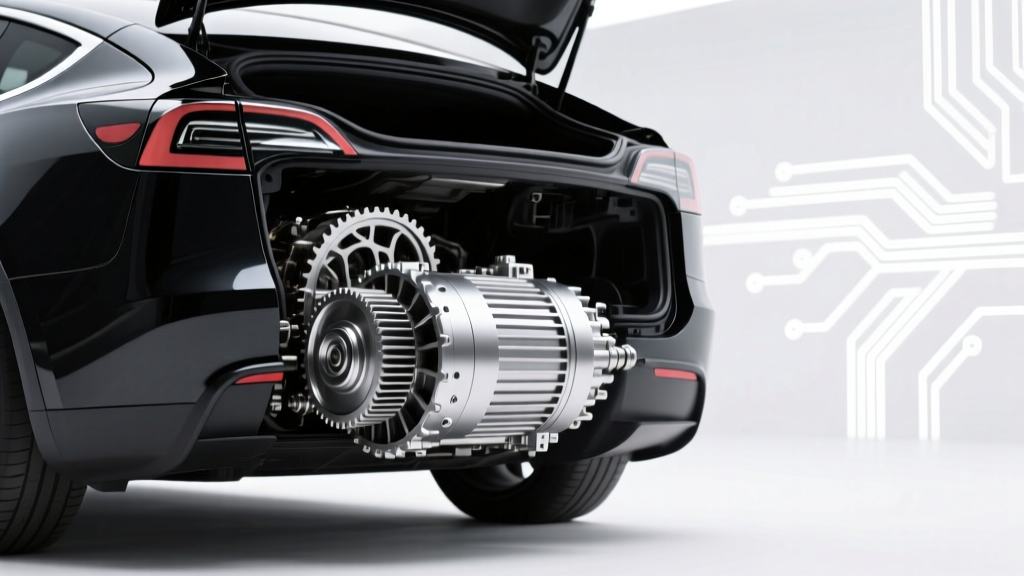
If you're shopping for an electric vehicle and find yourself asking, "does a Tesla have a transmission?" — the answer is technically yes, but it's nothing like the multi-gear automatic or manual transmission in a gas car. Every Tesla uses a single-speed reduction gearbox that transfers power from the electric motor(s) to the wheels. There are no gears to shift, no clutch, no torque converter, and no shift shock. The motor spins at up to 20,000 RPM and the gearbox reduces that to wheel speed.
This single-speed design is one of the defining differences between driving an EV and driving an internal-combustion vehicle. It's also why Teslas deliver instant, seamless torque from 0 mph all the way to top speed — and why they require almost zero drivetrain maintenance over their lifetime.
In this guide, we'll break down exactly how Tesla's drivetrain works, what it means for performance and efficiency, and how the full Tesla lineup stacks up in 2026 on range, charging, pricing, and real-world ownership.
How Tesla's Single-Speed Gearbox Works
In a conventional gas car, the engine produces usable power in a narrow RPM band (typically 1,500–5,000 RPM), so a multi-speed transmission — usually 6 to 10 gears — is required to keep the engine in that sweet spot as vehicle speed increases. An electric motor doesn't have this limitation. Tesla's permanent-magnet and induction motors produce maximum torque from 0 RPM and can spin efficiently up to roughly 20,000 RPM.
The single-speed reduction gearbox in a Tesla typically has a ratio around 9:1. That means for every nine revolutions of the motor, the axle turns once. This is enough to cover the full speed range from 0 mph to 155+ mph without shifting.
Why No Multi-Speed Transmission?
- Efficiency: Electric motors are ~90–95% efficient across a wide RPM range. Adding gears would introduce friction losses and mechanical complexity without meaningful efficiency gains.
- Reliability: Fewer moving parts means fewer failure points. Tesla's gearbox is essentially a sealed, lubricated unit that requires no fluid changes under normal ownership.
- Weight and packaging: A multi-speed gearbox would add weight and take up space better used for battery capacity.
- Performance: Instant torque from 0 RPM means there's no need to "rev into" a powerband. The car accelerates seamlessly without interruption.
The one notable exception in the EV world was the original 2008 Tesla Roadster, which initially shipped with a two-speed transmission. Tesla quickly abandoned the design due to durability issues and replaced it with a single-speed unit — a decision that cemented the single-speed approach across the entire lineup ever since.
Tesla's 2026 Motor and Drivetrain Configurations
Tesla offers several drivetrain configurations across its 2026 lineup. The motor setup directly affects performance, efficiency, and all-weather capability — and it's all managed through that same single-speed reduction gear.
| Configuration | Motor Type | Drivetrain | Models Available |
|---|---|---|---|
| Single Motor | Permanent-magnet rear motor | RWD | Model 3, Model Y |
| Dual Motor | Induction front + PM rear | AWD | Model 3, Model Y, Model S |
| Plaid (Tri-Motor) | Three carbon-sleeve PM motors | AWD | Model S, Model X |
| Cybertruck Dual/Tri | PM motors w/ steer-by-wire | AWD | Cybertruck |
In dual-motor and tri-motor setups, Tesla uses an induction motor on the front axle that can freewheel (disconnect) when not needed, reducing parasitic drag and boosting highway efficiency. The rear permanent-magnet motor handles primary propulsion. This is managed entirely by software — the driver never feels a transition.
2026 Tesla Lineup: Range, Battery, and Charging Specs
Here's how the current 2026 Tesla lineup stacks up on the metrics that matter most to buyers. All range figures are EPA estimates; real-world results follow below.
| Model | EPA Range | Battery (kWh usable) | Chemistry | Peak DC Charge | 10–80% Time | Level 2 Rate | 0–60 mph | HP |
|---|---|---|---|---|---|---|---|---|
| Model 3 RWD | 272 mi | ~60 kWh | LFP | 170 kW | ~25 min | 11.5 kW (~44 mi/hr) | 5.8s | 283 |
| Model 3 Long Range AWD | 363 mi | ~79 kWh | NMC | 250 kW | ~22 min | 11.5 kW (~44 mi/hr) | 4.2s | 366 |
| Model 3 Performance | 315 mi | ~79 kWh | NMC | 250 kW | ~22 min | 11.5 kW (~44 mi/hr) | 2.9s | 510 |
| Model Y Long Range AWD | 320 mi | ~79 kWh | NMC | 250 kW | ~22 min | 11.5 kW (~44 mi/hr) | 4.8s | 384 |
| Model S Long Range | 402 mi | ~100 kWh | NMC | 250 kW | ~27 min | 11.5 kW (~34 mi/hr) | 3.1s | 670 |
| Model X Long Range | 348 mi | ~100 kWh | NMC | 250 kW | ~28 min | 11.5 kW (~30 mi/hr) | 3.8s | 670 |
EPA range is measured under mixed city/highway conditions at moderate temperatures. In real-world use, expect the following adjustments:
- Highway driving (75+ mph): Subtract 10–15% from EPA. A Model 3 Long Range rated at 363 mi will deliver roughly 310–325 mi at sustained interstate speeds.
- Cold weather (below 32°F): Subtract 20–30% depending on severity and whether you precondition. LFP batteries (Model 3 RWD) are more sensitive to cold than NMC.
- City / stop-and-go: Often meets or exceeds EPA thanks to regenerative braking recapturing energy.
Source: fueleconomy.gov and owner-reported data.
LFP vs. NMC: What Tesla Buyers Need to Know
The Model 3 RWD uses a lithium iron phosphate (LFP) battery, while Long Range and Performance variants use nickel manganese cobalt (NMC). The trade-offs are significant:
- LFP advantages: Longer cycle life, less degradation over time, can be charged to 100% daily without harm, lower cost, no cobalt.
- LFP trade-offs: Lower energy density (shorter range for same weight), slower charging in cold weather, less accurate state-of-charge estimation at low percentages.
- NMC advantages: Higher energy density (more range), better cold-weather performance, faster DC charging.
- NMC trade-offs: Tesla recommends charging to 80% daily for longevity; 100% only for road trips.
Charging: Home and DC Fast Charging Explained
Tesla's single-speed drivetrain doesn't affect charging, but the battery chemistry and thermal management system do. Here's what charging looks like across different levels:
| Charging Level | Power (kW) | Miles Added per Hour | Use Case |
|---|---|---|---|
| Level 1 (120V standard outlet) | ~1.4 kW | ~3–5 mi/hr | Overnight trickle, emergencies |
| Level 2 (240V home Wall Connector) | 11.5 kW | 30–44 mi/hr | Daily home charging |
| DC Fast Charge (Supercharger V3/V4) | 170–250 kW peak | ~1,000 mi/hr (peak) | Road trips, rapid top-ups |
Understanding the Charge Curve
The peak DC charge rate (e.g., 250 kW) is only sustained at a low state of charge — typically between 5–25%. As the battery fills, the charge rate tapers to protect cell health. From 80–100%, charging slows dramatically. This is why Tesla and the industry quote 10–80% charge times rather than 0–100%.
Tesla's navigation system automatically preconditions the battery when you route to a Supercharger — warming or cooling the pack to the optimal temperature for maximum charge speed. Skipping preconditioning (e.g., driving to a charger without using navigation) can add 5–10 minutes to your charge session, especially in cold weather.
Pricing, Tax Credits, and Total Cost
Tesla's pricing has shifted frequently. Here are the 2026 MSRP figures and federal tax credit considerations for the core lineup:
| Model / Trim | Base MSRP | §30D Federal Credit | Effective Price | Credit Notes |
|---|---|---|---|---|
| Model 3 RWD | $38,990 | Up to $7,500 | ~$31,490 | Subject to battery sourcing, income caps |
| Model 3 Long Range AWD | $44,990 | Up to $7,500 | ~$37,490 | Subject to battery sourcing, income caps |
| Model Y Long Range AWD | $44,990 | Up to $7,500 | ~$37,490 | Subject to battery sourcing, income caps |
| Model S Long Range | $79,990 | $0 | $79,990 | Exceeds $55,000 sedan MSRP cap |
| Model X Long Range | $84,990 | Up to $7,500 | ~$77,490 | SUV cap is $80,000; subject to sourcing/income |
Federal Tax Credit Eligibility (IRS §30D)
The §30D credit is not automatic. Eligibility depends on several factors that change over time. As of 2026, the key requirements include:
- Income caps: Modified AGI must not exceed $150,000 (single), $225,000 (head of household), or $300,000 (joint filers).
- MSRP caps: Sedans (Model 3, Model S) must be under $55,000. SUVs, vans, and trucks (Model Y, Model X, Cybertruck) must be under $80,000.
- Battery sourcing: A percentage of critical minerals and battery components must be sourced from the US or FTA partners. These thresholds increase annually and can reduce the credit to $3,750 or $0 if not met.
- Point-of-sale transfer: You can transfer the credit to the dealer at purchase for an immediate price reduction, or claim it on your tax return.
Always verify current eligibility at irs.gov before purchasing, as sourcing rules tighten each year.
Interior, Cargo, Technology, and Driver Assistance
Tesla's interior philosophy is minimalist — some say too minimal. The 15.4-inch center touchscreen controls nearly everything, including climate, mirrors, and glovebox. There's no traditional instrument cluster; speed and navigation appear on the left edge of the main screen.
Passenger and Cargo Dimensions
| Model | Front Legroom | Rear Legroom | Cargo (rear seats up) | Cargo (seats folded) | Frunk |
|---|---|---|---|---|---|
| Model 3 | 42.7 in | 35.2 in | 23 cu ft | ~50 cu ft | ~3.1 cu ft |
| Model Y | 41.8 in | 39.0 in | 30 cu ft | ~72 cu ft | ~4.1 cu ft |
| Model S | 42.7 in | 35.4 in | 28 cu ft | ~65 cu ft | ~5.3 cu ft |
| Model X | 41.2 in | 38.4 in | ~37 cu ft | ~88 cu ft | ~6.5 cu ft |
Tech and Driver Assistance
Every Tesla includes Basic Autopilot, which provides adaptive cruise control and lane centering — a Level 2 SAE driver-assist system. The driver must keep hands on the wheel and eyes on the road at all times.
Full Self-Driving (Supervised) is an optional upgrade (~$8,000 or $99/month) that adds automatic lane changes, traffic light/stop sign recognition, and navigate-on-autopilot. Despite the name, FSD Supervised remains a Level 2 system — it does not make the car autonomous. Only Level 4 robotaxi services like Waymo operate without a driver.
Tesla's Autopilot and FSD (Supervised) are SAE Level 2 systems. The driver is fully responsible for monitoring the road and must be prepared to take over instantly. These are not self-driving systems.
Other notable tech includes over-the-air software updates that add features post-purchase, Sentry Mode (surveillance recording while parked), Dog Mode, and Tesla's native Supercharger navigation with real-time stall availability.
Warranty, Efficiency, and Ownership Costs
Warranty Coverage
- Basic Vehicle: 4 years / 50,000 miles
- Battery & Drive Unit (Model 3/Y RWD): 8 years / 100,000 miles (min 70% capacity retention)
- Battery & Drive Unit (Long Range / Performance / Model S/X): 8 years / 120,000 miles (min 70% capacity retention)
Tesla's warranty guarantees the battery will retain at least 70% of its original capacity during the warranty period. In practice, NMC Tesla batteries typically show 5–8% degradation in the first 50,000 miles before leveling off, based on fleet data. LFP batteries degrade even more slowly.
Efficiency
| Model | MPGe (combined) | kWh/100 mi |
|---|---|---|
| Model 3 RWD | 132 MPGe | 25 |
| Model 3 Long Range AWD | 131 MPGe | 26 |
| Model Y Long Range AWD | 122 MPGe | 28 |
| Model S Long Range | 120 MPGe | 28 |
Tesla remains one of the most efficient EV manufacturers, largely due to strong thermal management, low drag coefficients (Model 3: Cd 0.219), and the inherent efficiency of the single-speed drivetrain. Per fueleconomy.gov, the Model 3 RWD costs roughly $550/year to drive 15,000 miles at average US electricity rates — compared to $1,800+ for a comparable gas sedan.
Who Should Buy a Tesla — And Who Shouldn't
- You want access to the Supercharger network — still the most reliable, widespread DC fast-charging network in North America (now opening to other brands via NACS).
- You value over-the-air updates that genuinely add features over time.
- You want strong efficiency and proven battery longevity.
- You prefer a minimalist interior and touchscreen-centric controls.
- You need a strong public charging ecosystem for road trips.
- You want physical buttons, a traditional instrument cluster, or Apple CarPlay/Android Auto (Tesla does not support either).
- You want a more luxurious or traditionally finished interior at the Model 3/Y price point.
- You prefer dealer-based service and support rather than Tesla's mobile/service-center model.
- You want a heads-up display or more advanced driver-assist hardware (e.g., GM's Super Cruise on mapped highways).
- Best-in-class charging network (Supercharger)
- Industry-leading efficiency (kWh/100 mi)
- Instant, seamless torque from single-speed drivetrain — zero maintenance
- Over-the-air updates add real features
- Strong resale value and brand recognition
- Excellent real-world range on Long Range trims
- No Apple CarPlay / Android Auto
- Minimalist interior isn't for everyone; limited physical controls
- Panel gaps and build consistency still vary
- FSD (Supervised) costs $8,000 and remains Level 2
- LFP battery in RWD trims struggles with cold-weather charging
- Insurance costs can be higher than competitors
Frequently Asked Questions
Does a Tesla have a transmission?
Yes — every Tesla has a single-speed reduction gearbox. It functions like a transmission in that it transfers motor power to the wheels, but it has only one gear ratio (approximately 9:1). There are no gear shifts, no clutch, and no transmission fluid to change under normal use.
Do Teslas need transmission fluid changes?
Tesla's gearbox contains a small amount of lubricating oil, but it is sealed and generally not considered a service item under normal ownership. Unlike a gas car's automatic transmission fluid (which may need changing every 30,000–60,000 miles), Tesla's gearbox oil is designed to last the life of the vehicle.
Why don't Teslas need multiple gears?
Electric motors produce maximum torque from 0 RPM and operate efficiently up to ~20,000 RPM. A single gear ratio covers the entire speed range from 0–155+ mph. Adding gears would introduce weight, complexity, friction losses, and potential failure points without meaningful benefit.
How does the single-speed gearbox affect driving feel?
It creates the signature EV experience: smooth, uninterrupted acceleration with no shift shock or power interruption. You feel a continuous, linear pull from stoplight speed to highway speed. There's no hunting for gears on inclines and no downshift delay when you floor it.
Is the Model 3 RWD's LFP battery a problem?
Not for most buyers. LFP batteries last longer and can be charged to 100% daily without degradation concerns. The trade-offs are less range (272 vs. 363 mi EPA), slower cold-weather charging, and slightly less accurate state-of-charge readings. If you live in a cold climate or regularly road-trip, Long Range NMC is the better choice.
Does a Tesla qualify for the federal EV tax credit?
It depends on the model, your income, and current battery-sourcing rules. The Model 3 and Model Y have been eligible for up to $7,500 under §30D, but critical-mineral and battery-component sourcing requirements tighten annually. Model S exceeds the $55,000 sedan MSRP cap and does not qualify. Always check irs.gov for current eligibility before purchasing.
How long do Tesla batteries last?
Tesla's battery warranty guarantees at least 70% capacity retention over 8 years / 100,000–120,000 miles (depending on trim). Fleet data suggests most Tesla batteries retain 85–90% capacity at 100,000 miles. Full replacement, if needed outside warranty, costs approximately $12,000–$16,000 depending on the model.