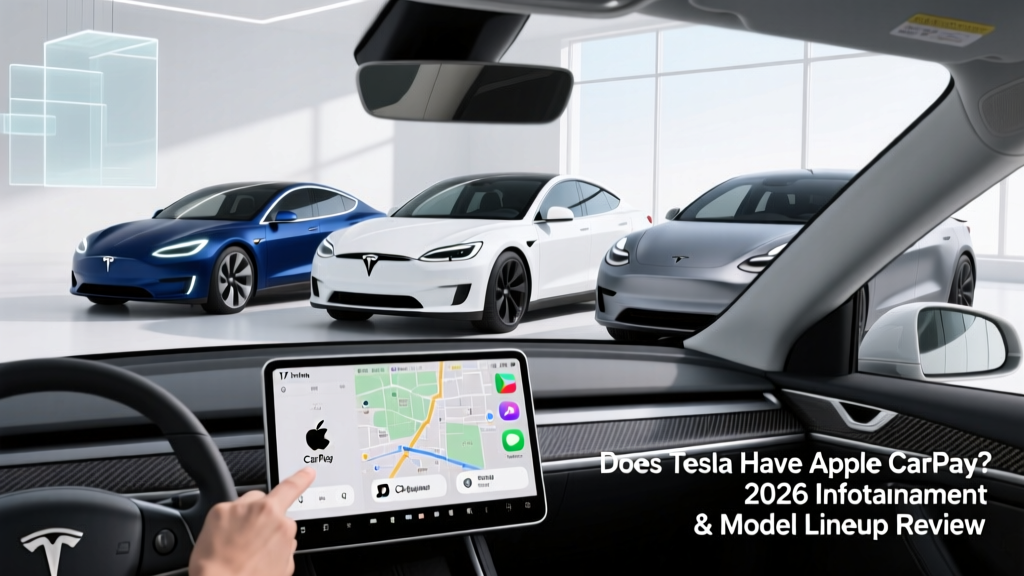
If you are shopping for a Tesla in 2026, one question almost certainly comes up: does Tesla have Apple CarPlay? The short answer is no. Tesla does not support Apple CarPlay or Android Auto in any model — not via wired USB, not via wireless connection, and not as an optional software package. Instead, Tesla uses a proprietary, vertically integrated infotainment system that handles navigation, media, vehicle controls, and over-the-air updates natively.
That answer is only the starting point. The real question for buyers is whether Tesla's native system is good enough to replace what CarPlay offers, and how the rest of the Tesla lineup stacks up on the metrics that actually matter: range, charging speed, price, and tax-credit eligibility. Below is a full 2026 breakdown of the Tesla ecosystem — the infotainment philosophy, the current vehicle lineup, and the ownership math you need before signing a purchase agreement.
Why Tesla Refuses Apple CarPlay (And What You Get Instead)
Tesla's reasoning is architectural. The company treats its 15.4-inch center touchscreen (15.0-inch in Model 3, 16.2-inch in Model S/X) not as a display accessory but as the primary vehicle interface. Climate controls, glovebox release, mirror adjustments, and drive-mode settings all route through the screen. Allowing Apple CarPlay to overlay a second operating system would, in Tesla's view, fragment that control layer and complicate over-the-air update pipelines.
What you get in its place:
- Native navigation with real-time Supercharger routing, preconditioning for fast charging, and traffic-aware ETA.
- Streaming apps — Spotify, Apple Music (via Bluetooth or native login), Tidal, TuneIn, YouTube, Netflix, and Disney+ (while parked).
- Phone integration via Bluetooth: calls, contacts, text-message display, and basic voice commands through the steering-wheel button.
- Tesla mobile app for remote climate, charging status, location, and phone-as-key functionality.
- Gaming and entertainment — a growing library of in-car games playable while parked, plus a theater mode.
- Display your iPhone's native Apple Maps interface on the car screen
- Integrate Siri for hands-free voice control of vehicle functions
- Show iMessage conversations in full (limited notification display only)
- Support third-party navigation apps like Waze or Google Maps on-screen
If you depend on Apple Maps for navigation or Siri for voice commands, you will be running those on your phone mounted on a separate holder — not on the Tesla display.
2026 Tesla Lineup: Range, Battery, and Efficiency at a Glance
Tesla's 2026 lineup includes the Model 3 sedan, Model Y crossover, Model S luxury sedan, and Model X luxury SUV. The Cybertruck rounds out the portfolio as a full-size electric pickup. Here is how they compare on the numbers that drive purchase decisions.
| Spec | Model 3 LR AWD | Model Y LR AWD | Model S LR | Model X LR | Cybertruck AWD |
|---|---|---|---|---|---|
| EPA Range | 341 mi | 320 mi | 402 mi | 335 mi | 340 mi |
| Battery (usable kWh) | ~79 kWh (NMC) | ~79 kWh (NMC) | ~95 kWh (NMC) | ~95 kWh (NMC) | ~123 kWh (NMC) |
| MPGe (combined) | 134 MPGe | 122 MPGe | 124 MPGe | 109 MPGe | 76 MPGe |
| kWh/100 mi | 25 kWh | 28 kWh | 28 kWh | 31 kWh | 47 kWh |
| 0–60 mph | 4.2 sec | 4.8 sec | 3.1 sec | 3.8 sec | 4.1 sec |
| Horsepower | 346 hp | 384 hp | 670 hp | 670 hp | 600 hp |
| Drivetrain | Dual-motor AWD | Dual-motor AWD | Dual-motor AWD | Dual-motor AWD | Dual-motor AWD |
| Cargo (cu ft) | 23 (trunk+frunk) | 76 (rear folded) | 28 (trunk+frunk) | 88 (rear folded) | 67 (bed+frunk) |
| Base MSRP | $47,740 | $49,630 | $79,990 | $84,990 | $79,990 |
EPA estimates assume a mix of city and highway driving at moderate temperatures. In sustained 75-mph highway driving, expect to lose roughly 10–15% from the EPA sticker — a Model 3 Long Range delivers approximately 290–305 miles on a full charge at interstate speeds. In cold weather (below 32°F), range drops 20–30% due to cabin heating demands and battery chemistry resistance, meaning that same Model 3 may deliver 240–270 miles in winter conditions. Tesla's heat pump (standard on all 2026 models) mitigates this compared to older resistance-heater EVs, but physics still applies.
Charging Speed: Supercharger Network and Home Level 2
Charging infrastructure is Tesla's strongest competitive moat. The Supercharger network exceeds 60,000 stalls globally, with V4 cabinets delivering up to 250 kW to compatible vehicles. Here is what that looks like in practice.
| Charging Level | Power | Model 3/Y | Model S/X | Cybertruck |
|---|---|---|---|---|
| Level 1 (120V household) | ~1.4 kW | ~3 mi/hr | ~3 mi/hr | ~2 mi/hr |
| Level 2 (240V home Wall Connector) | 11.5 kW | ~44 mi/hr | ~40 mi/hr | ~34 mi/hr |
| DC Fast (Supercharger V3/V4) | Up to 250 kW | 10–80% in ~25 min | 10–80% in ~30 min | 10–80% in ~35 min |
A note on charge-curve taper: Tesla vehicles, like all EVs, do not sustain peak charge rates across the entire session. A Model 3 Long Range may accept 250 kW at 10% state of charge but drops to roughly 150 kW by 50% and below 75 kW past 80%. This is why manufacturers quote 10–80% times rather than 0–100%. Charging past 80% at a DC fast charger is slow enough that you are better off moving on and topping up later unless you specifically need a full battery for the next leg.
For home charging, Tesla's Wall Connector costs $475 (hardware only). Installation by a licensed electrician typically runs $500–$2,000 depending on panel proximity, conduit length, and whether your electrical panel needs an upgrade from 100A to 200A service. The Wall Connector delivers up to 11.5 kW on a 60-amp circuit, adding roughly 44 miles of range per hour for a Model 3 — enough to fully replenish overnight for nearly any daily commute.
Pricing, Trims, and Federal Tax Credit Eligibility
Tesla's pricing has fluctuated frequently over the past few years. As of early 2026, here is the current lineup with federal tax credit context. The IRS §30D clean vehicle credit provides up to $7,500 for qualifying new EVs, but eligibility depends on three constraints that eliminate many Tesla configurations.
- MSRP cap: Sedans (Model 3, Model S) must be ≤$55,000. SUVs/pickups (Model Y, Model X, Cybertruck) must be ≤$80,000.
- Buyer income cap: Modified AGI ≤$150,000 (single), ≤$225,000 (head of household), ≤$300,000 (married filing jointly).
- Battery sourcing: Increasing percentages of critical minerals and battery components must be sourced from the U.S. or free-trade-agreement partners. Sourcing requirements tighten annually.
- Point-of-sale transfer: Eligible buyers can transfer the credit to the dealer at purchase, reducing the upfront price rather than waiting for a tax refund.
Always verify current eligibility on fueleconomy.gov before purchasing — battery-sourcing compliance can change with supply-chain adjustments.
| Model & Trim | Base MSRP | Est. After $7,500 Credit | Credit Eligible? |
|---|---|---|---|
| Model 3 RWD | $39,990 | ~$32,490 | Yes (if sourcing met) |
| Model 3 Long Range AWD | $47,740 | ~$40,240 | Yes (under $55K cap) |
| Model 3 Performance | $54,990 | ~$47,490 | Yes (under $55K cap) |
| Model Y Long Range AWD | $49,630 | ~$42,130 | Yes (SUV cap $80K) |
| Model Y Performance | $53,490 | ~$45,990 | Yes (SUV cap $80K) |
| Model S Long Range | $79,990 | $79,990 | No (exceeds $55K sedan cap) |
| Model X Long Range | $84,990 | $84,990 | No (exceeds $80K SUV cap) |
| Cybertruck AWD | $79,990 | ~$72,490 | Borderline (sourcing dependent) |
Tech, Driver Assistance, and What Tesla Does Best
Tesla's infotainment system — even without CarPlay — is one of the most capable in the EV market. The navigation system integrates Supercharger stops, preconditions the battery for optimal charge speed on arrival, and provides real-time stall availability. The media system supports native Spotify, Apple Music via Bluetooth, and video streaming while parked. Over-the-air updates regularly add features; Tesla has deployed UI overhauls, new games, and efficiency improvements without dealership visits.
On the driver-assistance side, every Tesla ships with Basic Autopilot (traffic-aware cruise control and lane-centering). This is an SAE Level 2 system — you must keep your hands on the wheel and eyes on the road at all times. The optional Full Self-Driving (Supervised) package ($8,000 one-time or $99/month) adds automatic lane changes, traffic-light and stop-sign recognition, and autosteer on city streets. Despite the name, FSD Supervised remains SAE Level 2: the driver is legally and practically responsible for all driving decisions. Only Level 4 systems like Waymo's driverless service operate without a human in the loop, and those are limited to geofenced urban areas.
Tesla Autopilot and FSD (Supervised) are SAE Level 2 driver-assistance systems. They assist with steering, acceleration, and braking under active driver supervision. They are not self-driving. You must remain alert, keep hands on the wheel, and be prepared to take over instantly.
Pros, Cons, and Who Should Buy a Tesla in 2026
- Supercharger network remains the most reliable and widespread DC fast-charging ecosystem in North America
- Class-leading efficiency — Model 3 achieves 134 MPGe combined, among the highest of any EV
- Over-the-air updates continuously improve the vehicle post-purchase
- Strong resale value relative to most EV competitors
- Minimal maintenance — no oil changes, fewer brake replacements due to regenerative braking
- Model 3 and Model Y qualify for the $7,500 federal tax credit (subject to sourcing and income rules)
- No Apple CarPlay or Android Auto — a dealbreaker for some buyers
- Touchscreen-dependent controls require menu-diving for basic adjustments (mirrors, vents, glovebox)
- Build quality inconsistency — panel gaps and paint defects still reported, though improving
- FSD (Supervised) costs $8,000 and remains Level 2 — not a hands-off autonomous system
- Model S and Model X exceed MSRP caps and do not qualify for the federal tax credit
- Service center wait times can be lengthy in smaller metro areas
Who a Tesla Suits Best
- Daily commuters who can install a Level 2 home charger and want minimal fuel and maintenance costs
- Road-trip drivers who value the Supercharger network for reliable long-distance travel
- Tech-forward buyers who prefer a single integrated system over phone-mirroring and appreciate OTA updates
- Families (Model Y, Model X) needing cargo space, good safety ratings, and low running costs
Who Should Look Elsewhere
- CarPlay loyalists who want Apple Maps, Siri, and their iPhone interface on the car screen — consider the Hyundai Ioniq 5, BMW i4, or Ford Mustang Mach-E
- Rural drivers far from Supercharger corridors — verify DC fast-charging availability in your area before committing
- Luxury sedan buyers wanting traditional build quality and dealership service — the BMW i5 or Mercedes EQE may be more satisfying despite higher pricing
Warranty Coverage and Long-Term Ownership
Tesla's warranty structure is straightforward but slightly below some competitors on bumper-to-bumper duration:
- Basic vehicle: 4 years / 50,000 miles
- Battery and drive unit (Model 3 RWD): 8 years / 100,000 miles
- Battery and drive unit (Model 3 LR, Model Y, Model S, Model X): 8 years / 120,000 miles
- Battery degradation threshold: Tesla warrants that the battery will retain at least 70% of its original capacity during the warranty period. If degradation exceeds 30%, Tesla will repair or replace the battery.
In practice, Tesla's NMC batteries degrade roughly 5–8% over the first 50,000 miles, then the curve flattens significantly. Data from high-mileage Tesla owners shows many batteries retaining 85–90% capacity at 100,000 miles. The NHTSA has awarded the Model 3 and Model Y five-star overall safety ratings, and the IIHS has named the Model 3 a Top Safety Pick+ in recent years.
Frequently Asked Questions
Does Tesla have Apple CarPlay in 2026?
No. Tesla does not offer Apple CarPlay or Android Auto in any 2026 model. The company uses its own proprietary infotainment system with native navigation, streaming apps, and phone integration via Bluetooth. If CarPlay is essential to your driving experience, you will need to use your phone on a separate mount.
What is the real-world range of the Tesla Model 3 Long Range?
The EPA rates the Model 3 Long Range AWD at 341 miles. In real-world highway driving at 75 mph, expect approximately 290–305 miles. In cold weather below freezing, range can drop to 240–270 miles depending on cabin-heating demands and driving style.
How fast does a Tesla charge at a Supercharger?
Model 3 and Model Y can accept up to 250 kW at V3/V4 Superchargers, charging from 10% to 80% in approximately 25 minutes. Model S and X take roughly 30 minutes, and the Cybertruck approximately 35 minutes. Charging slows significantly past 80% due to battery-protection protocols.
How much does a Tesla cost after the federal tax credit?
The Model 3 RWD starts at $39,990 and drops to approximately $32,490 after the $7,500 federal credit (if you meet income, sourcing, and point-of-sale transfer requirements). The Model Y Long Range starts at $49,630 and drops to roughly $42,130. The Model S and Model X do not qualify because they exceed the MSRP caps.
Is Tesla's FSD actually self-driving?
No. Tesla's Full Self-Driving (Supervised) is an SAE Level 2 driver-assistance system. Despite the name, you must keep your hands on the wheel, monitor the road, and be ready to take over at any moment. True self-driving (Level 4) is currently available only through limited robotaxi services like Waymo in select cities.
Does Tesla qualify for the federal EV tax credit?
It depends on the model and your situation. The Model 3 and Model Y generally qualify for up to $7,500 under IRS §30D, provided you meet income caps ($150K single / $300K joint), the vehicle's battery sourcing meets current-year requirements, and you use the point-of-sale transfer or claim the credit on your tax return. The Model S and Model X exceed MSRP caps and are ineligible. Always verify on fueleconomy.gov before purchasing.
Is a Tesla worth buying vs. competitors like the Hyundai Ioniq 5 or BMW i4?
If Supercharger access, integrated software, and efficiency are your top priorities, Tesla remains the benchmark. If you want Apple CarPlay, more traditional build quality, or a dealer-service experience, the Ioniq 5 (800V ultra-fast charging, CarPlay standard) or BMW i4 (premium interior, CarPlay, strong driving dynamics) are compelling alternatives. Cross-shop based on your specific needs rather than brand loyalty alone.