If you're coming from a gasoline vehicle, the idea that an electric car might not have a traditional multi-gear transmission can feel counterintuitive. After all, internal combustion engines need six, eight, or even ten gears to stay in their narrow power band. So does Tesla have a transmission? The short answer is yes — but it's a single-speed reduction gearbox, not the multi-gear unit you're used to. And that difference is one of the biggest reasons EVs feel so fundamentally different to drive.
In this deep-dive, we'll break down exactly how Tesla's drivetrain works, why a single-speed gearbox is the right engineering choice for most EVs, and what it means for real-world performance, efficiency, and ownership. We'll also pull together the key specs across Tesla's 2026 lineup so you can see how this drivetrain philosophy plays out in actual cars you can buy today.
How Tesla's Single-Speed Transmission Works
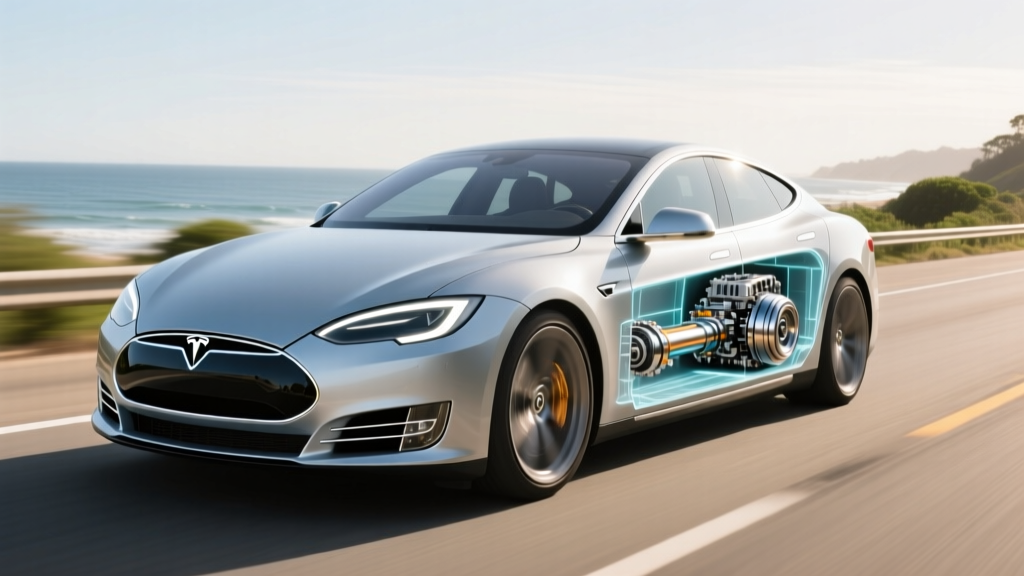
Every Tesla vehicle uses what engineers call a single-speed reduction gearbox. Unlike an internal combustion engine (ICE), which produces usable torque only within a narrow RPM range (typically 1,500–5,500 RPM), an electric motor delivers maximum torque from zero RPM and maintains a broad, flat power curve all the way to its redline — often 15,000–20,000 RPM or higher.
Because of this, there's no need to shift gears to keep the motor in a sweet spot. Tesla's reduction gearbox uses a fixed gear ratio — typically around 9:1 to 10:1 — to multiply the motor's torque and reduce its output speed to something appropriate for the wheels. Think of it as permanently locked in what would feel like a very low gear on a conventional car, except the electric motor's enormous RPM range means that "one gear" covers everything from a standstill to 155+ mph.
Why Tesla Doesn't Need Multiple Gears
There are three physics-driven reasons Tesla (and most EV makers) stick with a single-speed unit:
- Instant torque from zero RPM. Electric motors don't need to "spool up." You get full pulling force the instant you touch the pedal, which eliminates the need for a low first gear to get moving.
- Wide power band. A typical Tesla drive unit produces strong, consistent power from near-zero to 15,000+ RPM. A gas engine making peak power at 5,500 RPM and falling off sharply by 7,000 RPM needs multiple ratios to stay useful. An EV motor simply doesn't have that problem.
- Efficiency and simplicity. Every additional gear set adds weight, friction losses, complexity, and potential failure points. A single-speed gearbox is lighter, more efficient (fewer parasitic losses), and virtually maintenance-free — there's no transmission fluid to change on a schedule like you would with an automatic.
There are exceptions in the broader EV world. The original first-generation Tesla Roadster (2008) actually launched with a two-speed gearbox, but it proved unreliable and was quickly replaced with a single-speed unit. Porsche's Taycan uses a two-speed transmission on the rear axle to optimize both launch acceleration and high-speed efficiency — but this is an expensive, complex solution that most automakers, including Tesla, have determined isn't worth the trade-offs for mainstream vehicles.
What This Means for the Driving Experience
The single-speed design is directly responsible for the driving characteristics that EV owners love:
- Seamless acceleration. No shift pauses, no gear hunting on hills, no clunky downshifts. Power delivery is a smooth, uninterrupted curve.
- One-pedal driving feel. When you lift off the accelerator, regenerative braking kicks in through the same gearbox, slowing the car while feeding energy back into the battery.
- Silence. Without gear shifts, there are no clunks, whines, or rev-matching sounds. The reduction gear is nearly silent in operation.
- Instant passing power. Because there's no downshift delay, highway passing maneuvers are immediate. You don't wait for the transmission to kick down — the torque is already there.
The trade-off? At very high speeds (130+ mph), a single-speed gearbox means the motor is spinning near its upper limit, and efficiency drops off more than a multi-speed design would. For 99% of driving, this is irrelevant — but it's why a Porsche Taycan's two-speed rear axle gives it a slight high-speed efficiency edge on the Autobahn.
Tesla's 2026 Lineup: Drivetrain and Performance Specs
Here's how Tesla's single-speed philosophy translates across the current 2026 model lineup. Every vehicle below uses a fixed-ratio reduction gearbox — no exceptions.
| Model | Drivetrain | Horsepower | 0-60 mph | Top Speed | EPA Range |
|---|---|---|---|---|---|
| Model 3 RWD | Single-motor RWD | 271 hp | 5.8 sec | 125 mph | 363 mi |
| Model 3 Long Range AWD | Dual-motor AWD | 346 hp | 4.2 sec | 125 mph | 341 mi |
| Model Y Long Range AWD | Dual-motor AWD | 384 hp | 4.8 sec | 135 mph | 320 mi |
| Model S Long Range | Dual-motor AWD | 670 hp | 3.1 sec | 155 mph | 402 mi |
| Model X Long Range | Dual-motor AWD | 670 hp | 3.8 sec | 155 mph | 335 mi |
| Cybertruck AWD | Dual-motor AWD | 600 hp | 3.9 sec | 130 mph | 340 mi |
Source: Tesla official specifications and EPA Fuel Economy. Specs reflect 2026 model year where published.
Battery, Range, and Charging: What Powers the Single-Speed System
The single-speed gearbox doesn't operate in isolation — it's paired with Tesla's battery pack and power electronics to deliver the performance figures above. Here's what you need to know about the energy side of the equation.
Battery Chemistry and Capacity
Tesla uses two primary battery chemistries across its lineup:
- LFP (Lithium Iron Phosphate): Used in the Model 3 RWD and Model Y RWD. LFP cells are slightly heavier and less energy-dense than NMC, but they offer longer cycle life, better thermal stability, and can be charged to 100% daily without accelerated degradation. Tesla recommends periodic 100% charges for LFP packs to keep the BMS calibrated.
- NMC (Nickel Manganese Cobalt): Used in Long Range and Performance variants. NMC offers higher energy density (more range in the same physical space) but Tesla recommends daily charging to 80% to maximize long-term battery health, reserving 100% for road trips.
| Model / Trim | Usable Capacity | Chemistry | EPA Range | Efficiency |
|---|---|---|---|---|
| Model 3 RWD | ~57.5 kWh | LFP | 363 mi | 132 MPGe / 25 kWh/100mi |
| Model 3 Long Range AWD | ~75 kWh | NMC | 341 mi | 134 MPGe / 25 kWh/100mi |
| Model Y Long Range AWD | ~75 kWh | NMC | 320 mi | 122 MPGe / 28 kWh/100mi |
| Model S Long Range | ~95 kWh | NMC | 402 mi | 124 MPGe / 27 kWh/100mi |
| Cybertruck AWD | ~123 kWh | NMC (4680 cells) | 340 mi | ~70 MPGe / ~48 kWh/100mi |
- Highway driving at 75 mph: Subtract 10-15% from EPA. A Model 3 LR rated at 341 miles will deliver roughly 290-305 miles on a flat, temperate highway run.
- Cold weather (below 32°F): Subtract 20-30% depending on severity. Battery chemistry is less efficient in the cold, and cabin heating draws significant energy. A Model Y LR may deliver 225-260 miles in sub-freezing conditions.
- City / mixed driving in mild weather: You may actually exceed EPA estimates thanks to regenerative braking recapturing energy at low speeds.
Charging Speed: DC Fast and Home Level 2
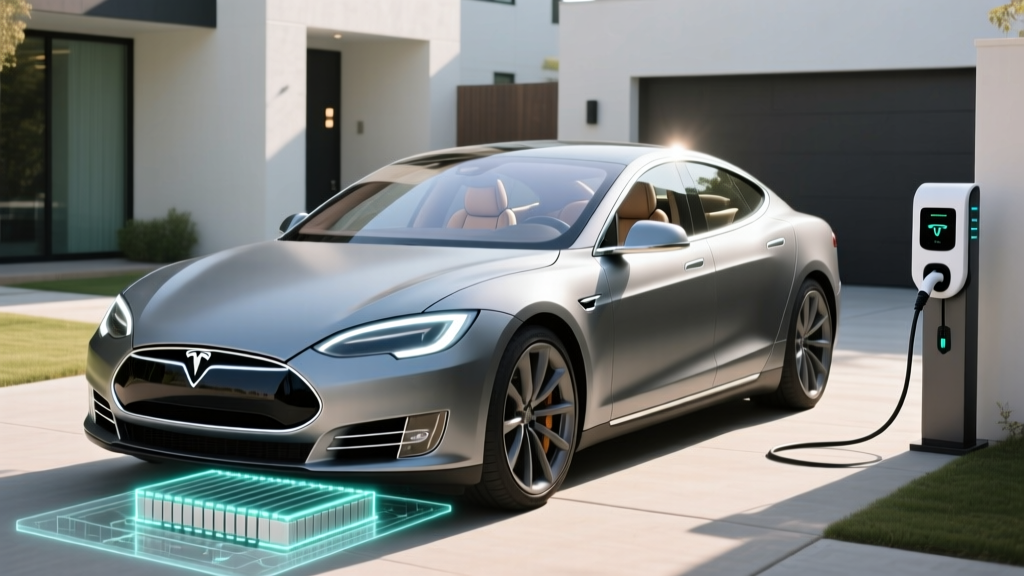
Tesla's single-speed drivetrain has no bearing on charging — that's entirely a function of the battery pack architecture and onboard charger. Here's what to expect:
| Model | Max DC Fast Charge | 10-80% DC Time | Level 2 Home Rate | Level 2 Miles/Hr |
|---|---|---|---|---|
| Model 3 (all trims) | 250 kW | ~25 min | 11.5 kW (48A) | ~44 mi/hr |
| Model Y (all trims) | 250 kW | ~27 min | 11.5 kW (48A) | ~40 mi/hr |
| Model S / X | 250 kW | ~30 min | 11.5 kW (48A) | ~34 mi/hr (S) / ~30 mi/hr (X) |
| Cybertruck | 250 kW (800V arch) | ~28 min | 11.5 kW (48A) | ~22 mi/hr |
Charging curve reality: Peak DC charge rates of 250 kW are sustained only at low state-of-charge (roughly 10-35%). Above 50% SoC, the rate tapers significantly — expect 80-120 kW. Above 80%, it drops further to protect the battery. This is why the 10-80% metric matters more than the peak kW number. Always precondition your battery (navigate to a Supercharger in the Tesla app or nav) before arriving to unlock the fastest charge curve.
Pricing, Tax Credits, and Ownership Costs
Tesla's pricing has shifted frequently in recent years. Here's where the 2026 lineup stands at base MSRP, before any incentives:
| Model / Trim | Base MSRP | Under §30D MSRP Cap? | Est. Credit (if eligible) |
|---|---|---|---|
| Model 3 RWD | ~$38,990 | Yes (sedan cap: $55,000) | Up to $7,500 |
| Model 3 Long Range AWD | ~$44,990 | Yes | Up to $7,500 |
| Model Y Long Range AWD | ~$44,990 | Yes (SUV/truck cap: $80,000) | Up to $7,500 |
| Model S Long Range | ~$74,990 | No (exceeds $55K sedan cap) | $0 |
| Model X Long Range | ~$79,990 | Yes (SUV cap: $80,000) | Up to $7,500 |
| Cybertruck AWD | ~$79,990 | Yes (truck cap: $80,000) | Up to $7,500 (sourcing-dependent) |
The up-to-$7,500 credit is not automatic. You must meet all of the following under current IRS rules:
- Buyer income caps: Modified AGI ≤ $150,000 (single) / $300,000 (joint) / $225,000 (head of household).
- MSRP caps: Sedans ≤ $55,000; SUVs, vans, and trucks ≤ $80,000.
- Battery sourcing requirements: The credit splits into two halves ($3,750 each) — one for critical-minerals sourcing and one for battery-component manufacturing. Sourcing rules tighten annually; check the latest IRS guidance or consult a tax professional for your specific purchase year.
- Point-of-sale transfer: As of 2024+, eligible buyers can transfer the credit to the dealer at purchase, reducing the purchase price upfront rather than waiting for a tax refund.
Warranty, Cargo Space, and Daily Practicality
The simplicity of Tesla's single-speed drivetrain extends to the warranty and ownership experience. With no multi-gear transmission to rebuild, no clutch packs to wear, and no transmission fluid to service, there are fewer mechanical failure points.
Warranty Coverage
- Basic Vehicle: 4 years / 50,000 miles (all models)
- Battery & Drive Unit: 8 years / 100,000 miles (Model 3/Y RWD); 8 years / 120,000 miles (Model 3/Y Long Range, Model S/X)
- Battery capacity retention threshold: Tesla warrants that the battery will retain at least 70% of its original capacity during the warranty period.
Cargo and Passenger Space
| Model | Cargo (rear seats up) | Cargo (rear seats folded) | Rear Legroom | Frunk |
|---|---|---|---|---|
| Model 3 | 23 cu ft | ~60 cu ft | 35.2 in | 3.1 cu ft |
| Model Y | 30 cu ft | ~72 cu ft | 41.6 in | 4.1 cu ft |
| Model S | 28 cu ft | ~80 cu ft | 35.4 in | ~3.0 cu ft |
| Model X | ~24 cu ft (5-seat) | ~92 cu ft | 38.4 in | ~3.0 cu ft |
Standout Tech Features
- Autopilot (standard): SAE Level 2 driver-assist with adaptive cruise, lane centering, and automatic emergency braking. The driver must remain engaged at all times.
- Full Self-Driving Supervised (optional, ~$8,000): Adds automatic lane changes, navigate-on-autopilot, traffic light/stop sign recognition, and parking assist. Still SAE Level 2 — not autonomous driving.
- 15.4" touchscreen (Model 3/Y) / 17" (Model S/X): All vehicle controls run through the central screen. No physical instrument cluster.
- Over-the-air updates: Tesla regularly pushes software updates that can add features, improve efficiency, or adjust driving dynamics — no dealer visit required.
- Sentry Mode & Dashcam: Built-in camera recording with USB storage, triggered by motion detection when parked.
Pros, Cons, and Who Should Buy a Tesla
✓ Pros
- Single-speed gearbox means zero shift lag, near-silent operation, and minimal drivetrain maintenance
- Class-leading Supercharger network access (17,000+ stalls in North America)
- Strong real-world efficiency — Tesla's powertrain and thermal management are among the best in the industry
- Over-the-air updates keep the car improving post-purchase
- LFP battery option on base trims allows daily 100% charging without degradation concerns
- Instant torque + no transmission = seamless, linear acceleration at any speed
✗ Cons
- Minimalist interior not for everyone — no physical buttons, stalks, or instrument cluster
- Repair costs out-of-warranty can be high; Tesla's service center network is still growing
- FSD Supervised is expensive and still requires full driver attention (Level 2, not autonomous)
- Panel gaps and build quality have improved but still draw criticism vs. legacy luxury brands
- Model S and X exceed the MSRP cap for the federal tax credit (sedan: $55K)
- Cybertruck's real-world range falls notably short of early projections due to weight and aerodynamics
Who This EV Suits Best
- Daily commuters: Model 3 RWD — lowest cost, LFP battery for worry-free daily charging, 363 mi EPA range is more than enough.
- Families needing space: Model Y Long Range — SUV cargo room, 320 mi range, optional third-row seat for small children.
- Road-trip enthusiasts: Model S Long Range — 402 mi EPA range, 250 kW Supercharging, Supercharger network makes long-haul driving straightforward.
- Truck buyers / towing: Cybertruck — 11,000-lb towing capacity, stainless-steel exoskeleton, but expect real-world range closer to 250-280 mi when towing.
Frequently Asked Questions
Does Tesla have a transmission?
Yes — every Tesla has a single-speed reduction gearbox. It uses a fixed gear ratio (approximately 9:1 to 10:1) to translate the electric motor's high-RPM output into wheel-appropriate torque and speed. There are no gear shifts. This is fundamentally different from the multi-speed automatic or manual transmissions in gas-powered cars.
Does Tesla have a clutch?
No. Since there's only one gear ratio and the electric motor can spin from zero RPM, there's no need for a clutch to engage or disengage the drivetrain. The motor simply starts and stops with the vehicle.
Do you ever need to change Tesla's gearbox fluid?
Tesla's reduction gearbox uses a small amount of lubricating fluid, but it's generally considered a sealed, lifetime unit. Unlike a conventional automatic transmission that requires fluid changes every 30,000-60,000 miles, Tesla's single-speed gearbox has no scheduled fluid service interval. If a drive unit is replaced under warranty, the new unit comes pre-filled.
Why did the original Tesla Roadster have a two-speed transmission?
The 2008 Roadster used a two-speed gearbox because its early-generation electric motor had a narrower power band and needed a low gear for strong acceleration and a high gear for top speed. Tesla quickly found the two-speed unit unreliable and switched to a single-speed design, which became the standard for all subsequent models as motor technology improved.
Does Tesla's single-speed gearbox limit top speed?
For practical purposes, no. Tesla models have top speeds ranging from 125 mph (Model 3 RWD) to 200 mph (Model S Plaid). The motor's ability to spin at 15,000-20,000+ RPM through the fixed reduction ratio provides more than enough top-end speed for any legal driving. The limitation is electronic, not mechanical.
Is Tesla's drivetrain more reliable than a gas car's transmission?
Fewer moving parts generally means fewer failure points. A single-speed reduction gearbox has no clutch packs, torque converters, solenoids, or bands to wear out. While Tesla vehicles have had their share of build-quality issues (panel gaps, suspension components), the drive unit and gearbox have proven to be among the most reliable components in the vehicle. Most drive units last well beyond 150,000 miles without issue.
For the latest EPA range figures and efficiency ratings, always check fueleconomy.gov. For current federal tax credit rules, refer to the IRS Clean Vehicle Credits page.