If you've been searching for a three-row electric SUV from Tesla, the answer to "does Tesla have a 7-seater?" is yes — but with major caveats. As of 2026, Tesla offers two vehicles with optional or standard third-row seating: the Model Y (with an optional third-row package) and the Model X (available in 6- or 7-seat configurations). However, these two vehicles serve vastly different buyers, with dramatically different range, pricing, and practicality profiles.
Below, we profile both Tesla 7-seater options with exact EPA data, real-world range expectations, charging speeds, and current federal tax credit eligibility so you can decide which — if either — fits your family.
2026 Tesla Model Y: The Affordable 7-Seater (With Trade-Offs)
The refreshed Model Y (sometimes referred to as the "Juniper" update) continues to offer an optional third-row seat on the Long Range AWD trim. This $2,000 add-on transforms the Model Y from a 5-seat crossover into a compact 7-seater. But before you check that box, you need to understand what you're getting — and what you're giving up.
| Spec | Value |
|---|---|
| EPA Range | 311 miles (5-seat); ~295 miles (7-seat) |
| Battery Capacity | ~75 kWh usable (NMC chemistry) |
| Drivetrain | Dual-Motor AWD |
| Horsepower | ~384 hp |
| 0–60 mph | 4.8 seconds |
| Max DC Fast Charge | 250 kW (peak) |
| 10–80% DC Charge Time | ~27 minutes |
| Level 2 Home Charging | 11.5 kW (~44 miles/hr) |
| EPA Efficiency | 122 MPGe combined / 28 kWh/100mi |
| Cargo (behind 3rd row) | ~12 cu ft |
| Cargo (3rd row folded) | ~34 cu ft |
| Cargo (all rows folded) | ~72 cu ft |
| 3rd-Row Legroom | ~26.5 inches |
| Base MSRP (Long Range AWD) | $49,990 |
| 7-Seat Add-On | +$2,000 |
| Battery/Drive Unit Warranty | 8 years / 120,000 miles |
Third-Row Practicality: Kids Only
The Model Y's third row is best described as occasional-use seating for children or very short trips. With 26.5 inches of legroom, adults will find it cramped beyond 15–20 minutes. Cargo space behind the third row shrinks to roughly 12 cubic feet — enough for a couple of backpacks or a single small stroller, but not a full grocery run with all seven seats occupied.
If your use case involves regularly transporting more than five people, the Model Y's third row is a compromise. If it's an occasional need — carpool duty once a week, visiting grandparents — it's a reasonable trade-off for the price.
2026 Tesla Model X: The True 7-Seater EV
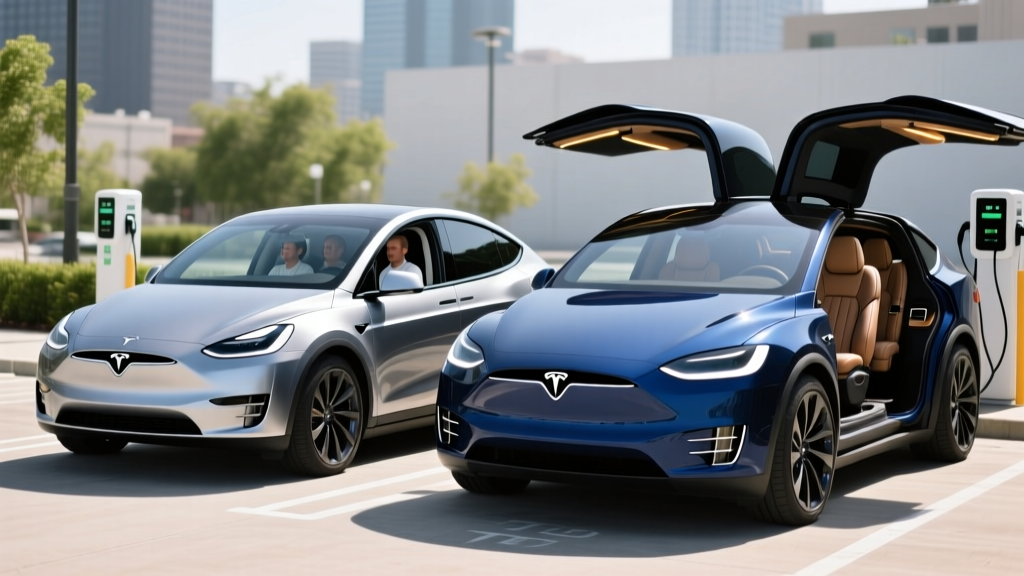
The Model X remains Tesla's flagship SUV and the only Tesla designed from the ground up to accommodate seven adults (though comfort in the third row still has limits). Available in a 7-seat configuration (2+3+2 layout) or a 6-seat layout with second-row captain's chairs, the Model X delivers meaningfully more space, power, and range — at a premium that puts it in a different market segment entirely.
| Spec | Value |
|---|---|
| EPA Range | 335 miles |
| Battery Capacity | ~100 kWh usable (NMC chemistry) |
| Drivetrain | Dual-Motor AWD |
| Horsepower | ~670 hp |
| 0–60 mph | 3.8 seconds |
| Max DC Fast Charge | 250 kW (peak) |
| 10–80% DC Charge Time | ~32 minutes |
| Level 2 Home Charging | 11.5 kW (~34 miles/hr) |
| EPA Efficiency | 109 MPGe combined / 31 kWh/100mi |
| Cargo (behind 3rd row) | ~22 cu ft |
| Cargo (3rd row folded) | ~57 cu ft |
| Cargo (all rows folded) | ~88 cu ft |
| 3rd-Row Legroom | ~32.7 inches |
| Base MSRP (Long Range) | $79,990 |
| Battery/Drive Unit Warranty | 8 years / 150,000 miles |
Third-Row Comfort: Adults Welcome (Mostly)
With 32.7 inches of third-row legroom, the Model X can accommodate adults on longer drives — though it's still tighter than a minivan's third row. The 22 cubic feet of cargo space behind the third row is a significant step up from the Model Y, fitting a full set of carry-on luggage or a week's groceries for a family of seven.
Charging Speed Comparison: Model Y vs. Model X
Charging speed is where many buyers get tripped up. Both vehicles peak at 250 kW on a V3 Tesla Supercharger, but peak rate is not sustained rate. The charge curve tapers significantly above 80% State of Charge (SoC) — this is why we report 10–80% times rather than 0–100%.
| Charging Level | Model Y LR AWD | Model X LR |
|---|---|---|
| Level 1 (120V / 12A) | ~3–4 mi/hr | ~3 mi/hr |
| Level 2 (240V / 48A) | 11.5 kW (~44 mi/hr) | 11.5 kW (~34 mi/hr) |
| DC Fast Charge (peak) | 250 kW | 250 kW |
| DC 10–80% Time | ~27 minutes | ~32 minutes |
| DC 10–50% Time | ~14 minutes | ~17 minutes |
| Connector | NACS (native) | NACS (native) |
Both vehicles use the NACS (North American Charging Standard) connector natively, giving access to the full Tesla Supercharger network — currently the most reliable DC fast-charging network in the US. This is a meaningful ownership advantage over CCS-equipped competitors still reliant on third-party networks with variable uptime.
For home charging, a Level 2 wall connector on a 60-amp circuit delivers 11.5 kW to both vehicles. The Model Y adds range faster per kW because it's lighter and more efficient (44 miles/hr vs. 34 miles/hr). A full overnight charge easily replenishes either vehicle for daily driving.
Federal Tax Credit Eligibility (§30D)
Federal EV tax credit rules under IRS §30D have specific requirements that affect both Tesla 7-seaters differently in 2026.
| Factor | Model Y LR AWD (7-seat) | Model X LR (7-seat) |
|---|---|---|
| Base MSRP | $51,990 (incl. 7-seat) | $79,990 |
| SUV MSRP Cap (§30D) | $80,000 ✓ | $80,000 ✓ |
| Income Cap (Modified AGI) | $150K single / $300K joint | $150K single / $300K joint |
| Battery Sourcing Compliance | Partial — verify at purchase | Partial — verify at purchase |
| Maximum Potential Credit | Up to $7,500 | Up to $7,500 |
| Point-of-Sale Transfer | Yes (dealer-registered) | Yes (dealer-registered) |
| Effective Price (max credit) | ~$44,490 | ~$72,490 |
Critical caveat: The full $7,500 credit has two components — $3,750 for critical minerals sourcing and $3,750 for battery component sourcing. Tesla's battery supply chain has shifted over recent years, and eligibility for each half can change. Always verify current sourcing compliance on the IRS website or with your tax professional before assuming the full credit. Additionally, buyer income caps apply: modified AGI must not exceed $150,000 (single), $225,000 (head of household), or $300,000 (joint filing).
Both vehicles qualify as SUVs under the §30D MSRP cap of $80,000, keeping them eligible — unlike sedans, which face a $55,000 cap.
Driver Assistance & Technology
Both the Model Y and Model X come equipped with Tesla's Basic Autopilot standard, which includes adaptive cruise control and lane centering. Tesla's Full Self-Driving (Supervised) remains an $8,000 option or $99/month subscription.
Neither Autopilot nor FSD (Supervised) is "self-driving." Both are SAE Level 2 driver-assistance systems requiring the driver to remain fully attentive, hands on or near the wheel, and ready to take over at any moment. True driverless operation (Level 4) is currently only available via commercial robotaxi services like Waymo in select cities.
Both vehicles feature Tesla's 15.4-inch center touchscreen, over-the-air software updates, a front trunk (frunk), and access to the Supercharger network. The Model X adds falcon-wing rear doors (power-operated, with ultrasonic obstacle detection), a 17-inch center display, a rear-seat entertainment screen, and standard air suspension for adjustable ride height.
Pros and Cons
Model Y 7-Seat — Pros
- Most affordable 7-seat EV on the market
- Supercharger network access (NACS native)
- Strong efficiency: 122 MPGe combined
- Eligible for up to $7,500 federal credit
- Quick DC charging: ~27 min 10–80%
Model Y 7-Seat — Cons
- Third row fits only small children
- Just 12 cu ft cargo behind 3rd row
- Range drops to ~295 mi with 7-seat option
- Real-world highway range ~255–270 mi
- No air suspension; firmer ride
Model X 7-Seat — Pros
- Third row fits adults on longer trips
- 22 cu ft cargo behind 3rd row
- 335 mi EPA range; 670 hp dual-motor AWD
- Falcon-wing doors ease 3rd-row access
- Standard air suspension; premium interior
Model X 7-Seat — Cons
- $80K MSRP — luxury-SUV pricing
- Lower efficiency: 109 MPGe combined
- Falcon-wing doors can malfunction (known issue)
- Heavier; longer 10–80% charge time (~32 min)
- Large footprint; tight in urban garages
Competitor Comparison: Rivian R1S and Kia EV9
The Tesla 7-seaters don't exist in a vacuum. Two key competitors deserve consideration:
- Rivian R1S (Dual-Motor, ~$75,900): A true body-on-frame 3-row SUV with up to ~340 miles of range (Max Pack), genuine off-road capability, and a more spacious third row than the Model Y. However, it lacks Supercharger network access (though Rivian now has adapter-based access) and has longer charge times.
- Kia EV9 (Land AWD, ~$59,900): A newer entrant offering a roomy third row, 800V architecture for fast DC charging (up to 236 kW, 10–80% in ~20 min), and a more traditional SUV layout. NACS adapter required for Supercharger access. EPA range is approximately 280 miles for the AWD variant.
For buyers prioritizing value and Supercharger convenience, the Model Y wins. For those needing genuine adult-sized third-row seating without the Model X price tag, the EV9 is the strongest alternative. For off-road capability and adventure use, the R1S stands alone.
Who Should Buy a Tesla 7-Seater?
Choose the Model Y 7-seat if: You need a third row only occasionally (carpool, short trips with kids), prioritize efficiency and low cost per mile, want Supercharger network convenience, and have a budget around $45K–$55K after incentives.
Choose the Model X 7-seat if: You regularly transport 6–7 people including adults, need meaningful cargo space with all seats up, want flagship performance and air suspension, and have a budget above $72K after incentives.
Look elsewhere if: You need minivan-level third-row comfort and cargo volume (consider the Chrysler Pacifica Hybrid PHEV), require serious off-road capability (Rivian R1S), or want the fastest-charging 3-row EV at a mid-range price (Kia EV9).
Frequently Asked Questions
Does Tesla have a 7-seater?
Yes. The Model Y offers an optional third row (7 seats total) on the Long Range AWD trim for an additional $2,000. The Model X comes standard with a 7-seat configuration (or an optional 6-seat layout with captain's chairs). The Model Y's third row is suitable only for children; the Model X can accommodate adults in its third row.
What is the real-world range of the 7-seat Tesla Model Y?
The EPA rates the 7-seat Model Y Long Range AWD at approximately 295 miles. In real-world highway driving at 70–75 mph, expect 255–270 miles. In cold weather below 30°F, range can drop to 220–240 miles. Plan charging stops accordingly, especially on road trips.
How fast does the Tesla Model X charge at home and on DC fast chargers?
On a Level 2 home charger (240V, 48A), the Model X charges at 11.5 kW, adding roughly 34 miles of range per hour — enough for a full overnight charge. On a V3 Supercharger (250 kW peak), the Model X charges from 10–80% in approximately 32 minutes, though the charge curve tapers significantly above 80% SoC.
Does the Tesla Model Y or Model X qualify for the federal EV tax credit?
Both vehicles may qualify for up to $7,500 under IRS §30D, provided the buyer meets income requirements ($150K single / $300K joint) and the vehicle meets battery sourcing requirements. Both fall under the $80,000 SUV MSRP cap. However, the exact credit amount depends on current battery component and critical mineral sourcing rules, which can change. Verify on irs.gov or with a tax professional before purchasing.
Is the Tesla Model X worth it over the Model Y for families?
If you regularly need seating for 6–7 adults or older children and require substantial cargo space with all seats in use, the Model X is the clear choice — it offers 32.7 inches of third-row legroom vs. the Model Y's 26.5 inches, plus nearly double the behind-third-row cargo volume. However, the Model X costs roughly $28,000 more than a 7-seat Model Y. If the third row is for young children on occasional trips, the Model Y delivers far better value and efficiency.
What is the battery warranty on Tesla's 7-seaters?
The Model Y Long Range carries an 8-year/120,000-mile battery and drive unit warranty. The Model X Long Range extends that to 8 years/150,000 miles. Both warranties guarantee a minimum 70% battery capacity retention over the warranty period, per Tesla's official warranty documentation.