The Short Answer: Which Teslas Offer Third-Row Seating?
If you've been searching whether Tesla makes a three-row electric SUV, the answer is yes — but with major caveats that affect real-world usability. As of the 2026 model year, Tesla offers third-row seating in exactly two vehicles: the Model Y (optional 7-seat configuration) and the Model X (available in 6-seat or 7-seat layouts). Neither is a traditional full-size three-row SUV, and the third-row experience differs dramatically between them.
The Model Y's third row is a compact, occasional-use bench best suited for small children. The Model X delivers a genuinely usable third row with adult-capable headroom and legroom, but at more than double the price. Below, we break down both vehicles with exact specs, real-world range data, charging performance, and total ownership costs so you can decide which — if either — fits your family.
2026 Tesla Model Y 7-Seat: Specs, Range, and Third-Row Reality
The refreshed Model Y (internally called the "Juniper" update that launched in early 2025) carries into 2026 with a slightly restyled interior, improved suspension tuning, and the continued availability of a 7-seat option on the Long Range AWD trim. This is Tesla's most affordable path to three rows, but buyers need clear expectations about what that third row actually delivers.
| Spec | Value |
|---|---|
| EPA Range | 320 miles (7-seat); 337 miles (5-seat) |
| Battery (usable) | ~78 kWh, NMC (nickel manganese cobalt) |
| Drivetrain | Dual-motor AWD |
| Horsepower | 384 hp combined |
| 0–60 mph | 4.8 seconds |
| MPGe (combined) | 122 MPGe (28 kWh/100 mi) |
| Max DC Fast Charge | 250 kW peak (V3 Supercharger) |
| 10–80% DC Charge Time | ~25 minutes |
| Level 2 Home Charging | 11.5 kW (~44 mi/hr on 48A circuit) |
| Cargo (behind 3rd row) | 12.8 cu ft |
| Cargo (3rd row folded) | 30.2 cu ft |
| Cargo (all rows folded) | 72.1 cu ft |
| 3rd-Row Legroom | 26.5 inches |
| Battery Warranty | 8 years / 120,000 miles |
| Base MSRP (7-seat) | $50,490 (includes $2,000 7-seat option) |
Third-Row Usability: Kids Only
At 26.5 inches of legroom, the Model Y's third row is strictly for children or very short trips. Adults will find their knees pressed into the second-row seatbacks, and the sloping roofline limits headroom significantly. Access requires folding and sliding the second-row bench, which is manageable but not effortless. If your use case involves regularly carrying more than five people, the Model Y's third row will feel like a compromise.
With the third row upright, cargo space shrinks to 12.8 cubic feet — enough for a couple of grocery bags or a stroller, but not both simultaneously. Fold the third row flat and you recover 30.2 cubic feet, which handles most family gear runs comfortably.
2026 Tesla Model X: The Genuine Three-Row EV
The Model X remains Tesla's only vehicle with a genuinely adult-capable third row. For 2026, it continues on the same platform introduced with the Plaid refresh, with minor software and efficiency updates. Buyers choose between a 6-seat layout (two captain's chairs in the second row) or a 7-seat layout (second-row bench). The 6-seat configuration is more popular and offers easier third-row access via the walk-through gap between captain's chairs.
| Spec | Value |
|---|---|
| EPA Range | 335 miles (35" wheels); 311 miles (22" wheels) |
| Battery (usable) | ~95 kWh, NMC |
| Drivetrain | Dual-motor AWD |
| Horsepower | 670 hp combined |
| 0–60 mph | 3.8 seconds |
| MPGe (combined) | 102 MPGe (33 kWh/100 mi) |
| Max DC Fast Charge | 250 kW peak |
| 10–80% DC Charge Time | ~30 minutes |
| Level 2 Home Charging | 11.5 kW (~34 mi/hr) |
| Cargo (behind 3rd row) | 15.0 cu ft (plus front trunk) |
| Cargo (3rd row folded) | 43.0 cu ft |
| Cargo (all rows folded) | 81.5 cu ft |
| 3rd-Row Legroom | 32.7 inches |
| Battery Warranty | 8 years / 150,000 miles |
| Base MSRP (7-seat) | $81,630 |
Falcon Wing Doors and Third-Row Access
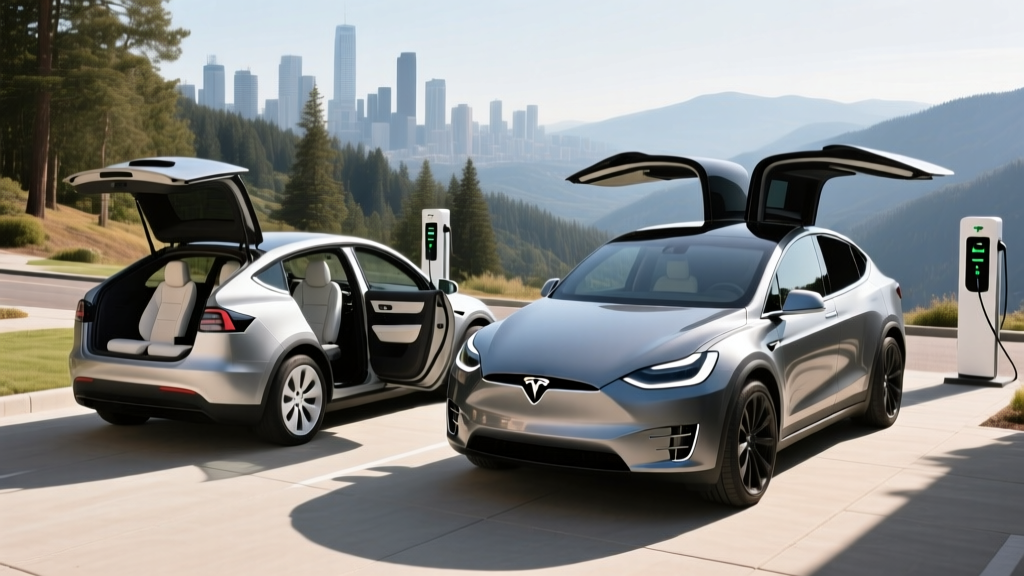
The Model X's signature Falcon Wing rear doors open upward, creating a wide aperture that makes loading children into car seats and accessing the third row significantly easier than in a conventional SUV. The doors use ultrasonic sensors to avoid obstacles in tight parking spaces, though they operate more slowly than standard doors and can be a liability in heavy rain (water drips from the hinge seams onto the interior). In our experience, the novelty wears off but the utility persists for families with young children.
Charging Speed and Infrastructure: What Owners Actually Experience
Both the Model Y and Model X peak at 250 kW on Tesla's V3 Superchargers, but sustained charge rates tell the real story. Neither vehicle sustains 250 kW for long — the charge curve tapers aggressively above 50% state of charge (SoC).
| Metric | Model Y LR AWD (7-Seat) | Model X LR (7-Seat) |
|---|---|---|
| Peak DC Rate | 250 kW | 250 kW |
| Sustained Avg (10–80%) | ~140 kW | ~120 kW |
| 10–80% Time | ~25 min | ~30 min |
| Miles Added in 15 min | ~180 mi | ~160 mi |
| Level 2 (240V/48A) | 11.5 kW / ~44 mi/hr | 11.5 kW / ~34 mi/hr |
| Level 1 (120V/12A) | ~1.4 kW / ~5 mi/hr | ~1.4 kW / ~4 mi/hr |
For home charging, both vehicles accept up to 11.5 kW on a 240-volt, 60-amp circuit (48 amps continuous). A full overnight charge from 20% to 80% takes roughly 4–5 hours for the Model Y and 5–6 hours for the Model X. We strongly recommend installing a Tesla Wall Connector or a high-quality universal Level 2 unit on a dedicated 60-amp breaker. Budget $800–$2,500 for professional installation depending on your panel's proximity to the garage and whether a panel upgrade is needed. Consult a licensed electrician for your specific situation.
Preconditioning matters: navigate to a Supercharger using the car's built-in navigation, and the battery will warm to optimal temperature before arrival, improving charge speed by 15–30% in cold weather. Without preconditioning, a cold battery may initially accept only 50–80 kW.
Pricing, Trims, and Federal Tax Credit Eligibility
Pricing is where these two vehicles diverge sharply. The Model Y with the 7-seat option starts under $51,000, while the Model X clears $80,000 before options. Federal tax credit eligibility under IRS §30D adds complexity.
| Vehicle | Base MSRP | Federal Credit Potential | Effective Price (if eligible) |
|---|---|---|---|
| Model Y LR AWD (7-seat) | $50,490 | Up to $7,500 | ~$42,990 |
| Model X LR (7-seat) | $81,630 | $0 (exceeds MSRP cap) | $81,630 |
Tax Credit Rules That Matter
The Model Y Long Range AWD may qualify for up to $7,500 under §30D, provided all conditions are met. As of 2026, those conditions include:
- MSRP cap: SUVs must not exceed $80,000 (Model Y qualifies)
- Buyer income cap: Modified AGI ≤ $300,000 (joint), $225,000 (head of household), $150,000 (single)
- Battery sourcing: Critical minerals and battery components must meet escalating domestic-content thresholds that tighten annually
- Point-of-sale transfer: Eligible buyers can apply the credit as a down-payment reduction at purchase rather than waiting for tax filing
- Final assembly: Must occur in North America (Tesla's Fremont and Austin plants qualify)
The Model X exceeds the $80,000 SUV MSRP cap at $81,630 base, making it ineligible for the federal §30D credit regardless of buyer income. Some state-level incentives may still apply — check your local DMV or energy office for current programs.
Tax credit rules change frequently and depend on battery-sourcing supply chains that shift throughout the year. Always verify current eligibility at fueleconomy.gov and consult a tax professional before making a purchase decision based on credit assumptions.
Driving, Tech, and Daily Ownership
Both vehicles share Tesla's minimalist interior architecture centered on a 15.4-inch touchscreen (Model Y) or 17-inch touchscreen (Model X). The Model X adds a secondary 8-inch rear passenger display and a yoke-style steering wheel option, though a conventional round wheel remains available.
Autopilot and FSD (Supervised)
Every Tesla ships with basic Autopilot (traffic-aware cruise control and lane centering). Full Self-Driving (Supervised) is a $8,000 option or $99/month subscription that adds automatic lane changes, traffic light/stop sign recognition, and Navigate on Autopilot. Critical clarification: FSD is an SAE Level 2 driver-assistance system. It requires continuous driver supervision, hands on or near the wheel, and does not make the vehicle autonomous. Tesla's naming convention is widely considered misleading by safety advocates and regulators.
Notable Drawbacks
The Model Y's ride quality improved with the Juniper refresh but remains firmer than competitors like the Hyundai Ioniq 5 or Kia EV9. Road noise is noticeable at highway speeds. The all-glass roof provides excellent light but contributes to cabin heat gain in summer — the included tint helps, but many owners add aftermarket ceramic film. The Model X, despite its premium price, shows interior material quality that lags behind legacy luxury brands; panel gaps remain a common owner complaint.
Model Y 7-Seat vs. Model X: Head-to-Head
| Attribute | Model Y LR AWD 7-Seat | Model X LR 7-Seat |
|---|---|---|
| 3rd-Row Legroom | 26.5" (children only) | 32.7" (adults possible) |
| Cargo Behind 3rd Row | 12.8 cu ft | 15.0 cu ft |
| EPA Range | 320 mi | 335 mi |
| 0–60 mph | 4.8 sec | 3.8 sec |
| 10–80% Charge | ~25 min | ~30 min |
| Base Price | $50,490 | $81,630 |
| Tax Credit Eligible | Potentially up to $7,500 | No (MSRP cap) |
| Towing Capacity | 3,500 lbs | 5,000 lbs |
Model Y 7-Seat Pros
- Most affordable 3-row EV on the market
- Access to Tesla Supercharger network (17,000+ stalls in North America)
- Strong efficiency at 122 MPGe combined
- OTA software updates continuously add features
- Potential $7,500 federal tax credit reduces effective price
Model Y 7-Seat Cons
- Third row is unusable for adults
- Minimal cargo space with all rows upright
- Firm ride and noticeable road noise
- No physical instrument cluster or stalks (turn signals on steering wheel)
- FSD subscription model adds long-term cost
Model X Pros
- Genuinely usable third row for adults on short trips
- Falcon Wing doors ease car-seat loading
- 5,000-lb towing capacity
- Standard adaptive air suspension
- Supercharger network access
Model X Cons
- $81,630 starting price — no federal tax credit
- Lower efficiency (102 MPGe) means higher charging costs
- Falcon Wing doors are slow and can leak in heavy rain
- Interior quality doesn't match the luxury price point
- Larger size makes city parking challenging
Key Competitors: Should You Look Beyond Tesla?
The three-row EV market has expanded significantly. Before committing, cross-shop these alternatives:
- Kia EV9 (2026): Starts at ~$56,000, EPA range up to 304 miles, genuine adult-capable third row with 32.0 inches of legroom, CCS charging (NACS adapter available), eligible for $7,500 credit. Better third row than Model Y, lower price than Model X.
- Hyundai Ioniq 9 (2026): Newly introduced, 3-row SUV on the E-GMP platform, targeting 335+ miles EPA, 800V architecture for ultra-fast charging (~18 min 10–80% at 350 kW). Strong Model X competitor at a lower price.
- Rivian R1S (Dual-Motor): Starts at ~$76,000, EPA range up to 352 miles (Max Pack), genuine three rows, excellent off-road capability. No federal credit due to price, but a compelling adventure-family vehicle.
- Volkswagen ID. Buzz (2026): 3-row electric minivan, ~$60,000 starting, EPA range ~231 miles. Lower range but unbeatable passenger and cargo versatility for families who prioritize space over distance.
Choose the Model Y 7-Seat If:
- You need occasional third-row seating for children only
- Budget is a primary concern and you want the cheapest 3-row EV
- You value Supercharger network access for road trips
- You qualify for the §30D tax credit
Choose the Model X If:
- You regularly carry six or seven people, including adults in the third row
- You need 5,000-lb towing capability
- Budget is flexible above $80,000
- You want air suspension and a premium (if imperfect) experience
Look at the Kia EV9 or Ioniq 9 If:
- You need a real adult-capable third row at a sub-$65,000 price
- You want faster 800V DC charging capability
- You prefer physical controls and a more traditional interior layout
Frequently Asked Questions
Does Tesla have 3 rows in any current model?
Yes. The 2026 Model Y offers an optional 7-seat configuration (third row for children only), and the 2026 Model X comes standard with a choice of 6-seat or 7-seat layouts with an adult-capable third row. No other Tesla model — including the Model 3, Model S, or Cybertruck — offers three rows.
What is the real-world range of the 7-seat Model Y?
The EPA rates it at 320 miles. Real-world highway driving at 70–75 mph typically yields 270–290 miles. In freezing temperatures, expect 220–250 miles. The 7-seat option reduces range by approximately 10–17 miles compared to the 5-seat configuration due to added weight.
How fast does the Model X charge at home and on the road?
At home on a 240V/48A Level 2 charger, the Model X charges at 11.5 kW, adding roughly 34 miles per hour — a full overnight session replenishes most daily driving. On a V3 Supercharger (250 kW DC), a 10–80% charge takes approximately 30 minutes, with the average sustained rate around 120 kW due to charge-curve tapering above 50% SoC.
Does the Model Y 7-seat qualify for the $7,500 federal EV tax credit?
It may, but eligibility depends on multiple factors. The Model Y's MSRP is under the $80,000 SUV cap, and final assembly occurs in the US. However, the buyer must meet income thresholds (≤$300,000 joint AGI), and the battery must meet critical-mineral and component sourcing requirements that change throughout the year. Verify current eligibility at fueleconomy.gov before purchasing and consider consulting a tax professional.
Is the Model X worth $81,000 vs. the Kia EV9 or Rivian R1S?
It depends on priorities. The Model X offers Supercharger network access, strong acceleration, and Falcon Wing door utility for families with young children. However, the Kia EV9 delivers a comparable or better third row at $25,000 less (with tax credit), and the Rivian R1S offers superior off-road capability and build quality at a similar price. The Model X's weakest argument in 2026 is interior quality relative to its premium price tag.
Can I tow with a 3-row Tesla?
Yes. The Model Y tows up to 3,500 pounds (suitable for a small utility trailer or a pair of jet skis). The Model X tows up to 5,000 pounds (capable of pulling a mid-size camper trailer). Note that towing reduces range by 30–50% depending on trailer weight and aerodynamics. Plan charging stops accordingly.
What is the battery warranty on these vehicles?
The Model Y Long Range battery and drive unit are warrantied for 8 years or 120,000 miles, whichever comes first, with a minimum 70% capacity retention threshold. The Model X covers 8 years or 150,000 miles with the same 70% retention floor. In practice, NMC batteries in Teslas typically retain 85–90% capacity at 100,000 miles based on fleet data, though individual results vary with charging habits and climate.