Quick Answer: Does Subaru Have an EV?
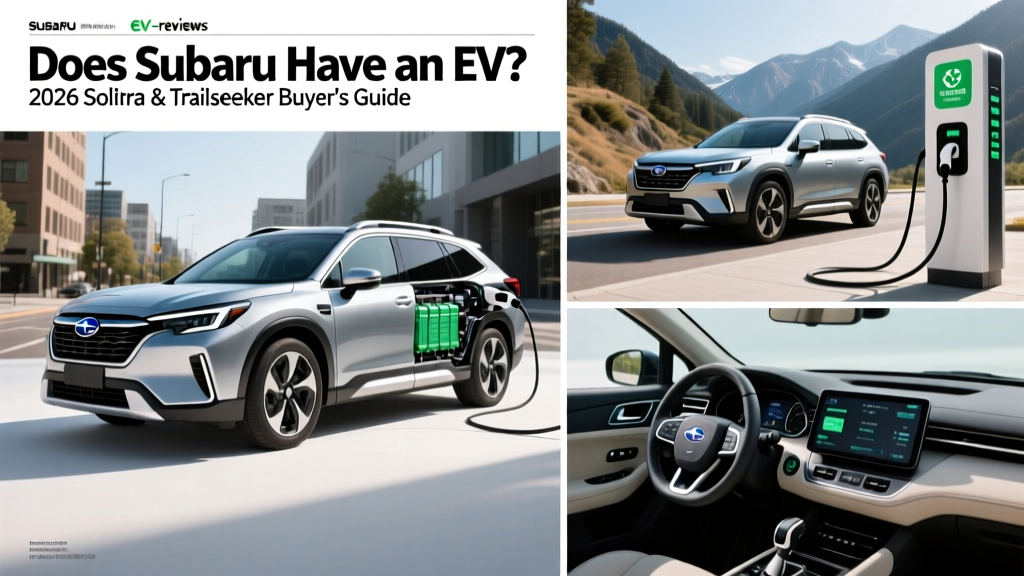
Yes. Subaru currently sells one all-electric vehicle in the U.S.: the Subaru Solterra, a compact electric SUV co-developed with Toyota (which sells the near-identical bZ4X). For the 2026 model year, the Solterra offers up to 227 miles of EPA-estimated range, standard all-wheel drive, and starts at approximately $44,995 MSRP. Subaru has also announced a second EV, the Trailseeker (a larger, three-row electric SUV based on the Uncharted concept), expected to arrive for the 2027 model year. Beyond these, Subaru offers several plug-in hybrid (PHEV) options, notably the Crosstrek Hybrid.
The 2026 Subaru Solterra: Full EV Specs at a Glance
The Solterra is Subaru's first and currently only battery-electric vehicle. Built on the e-Subaru Global Platform (shared with the Toyota bZ4X and Lexus RZ), it targets the compact electric SUV segment occupied by the Hyundai Ioniq 5, Ford Mustang Mach-E, and Volkswagen ID.4. Here's exactly what you're getting for 2026:
| Specification | 2026 Subaru Solterra (AWD) |
|---|---|
| EPA Range | 227 mi (Limited/Touring trims with 20" wheels); up to 227 mi (Premium with 18" wheels) |
| Battery Capacity | 72.8 kWh usable (NMC lithium-ion) |
| Powertrain | Dual-motor AWD, 215 hp, 249 lb-ft torque |
| 0–60 mph | ~6.5 seconds |
| DC Fast Charge (Peak) | ~150 kW (10–80% in ~35 minutes) |
| Level 2 Charge Rate | 7.2 kW onboard charger (~9.5 hours 0–100%) |
| Efficiency | 104 MPGe combined (2.9 kWh/mi) |
| Cargo Volume | 23.8 cu ft (rear seats up); 63.5 cu ft (folded) |
| Ground Clearance | 8.3 inches |
| Towing Capacity | Not rated for towing |
| Base MSRP | ~$44,995 (Premium); ~$48,995 (Limited); ~$52,995 (Touring) |
| Battery Warranty | 8 years / 100,000 miles (70% capacity retention) |
| ADAS | Subaru EyeSight (SAE Level 2 driver-assist) |
Sources: EPA Fueleconomy.gov, Subaru.com
Real-World Range: What 227 EPA Miles Actually Means
The EPA sticker is a starting point, not a guarantee. Subaru's 227-mile rating assumes a mix of city and highway driving at moderate temperatures. In practice, several factors compress that number:
Real-World Range Expectations
- Mild weather, mixed driving: 210–225 miles achievable
- Sustained highway (75+ mph): Expect ~180–195 miles — EVs lose efficiency at high speed because there's no multi-gear transmission to keep the motor in its sweet spot
- Cold weather (below 30°F): 155–180 miles — battery chemistry slows, and cabin heating draws significant energy. The Solterra uses a heat pump (standard on Touring, optional on lower trims), which helps but doesn't eliminate the loss
- Mountain driving / heavy cargo: Subtract 10–15% for sustained climbs
For most daily commutes under 40 miles round-trip, the Solterra's range is more than sufficient — you'd charge every 4–5 days at home. But if your routine includes regular 200-mile highway trips or you live in a cold northern climate, the margin gets thin. That's where understanding the charging picture becomes critical.
Charging the Solterra: Home and on the Road
The Solterra's charging performance is one area where honest assessment matters. At a peak of ~150 kW on DC fast charging, it trails competitors like the Hyundai Ioniq 5 (which peaks at ~240 kW on its 800V architecture). Here's what charging actually looks like:
| Charging Level | Power (kW) | Miles Added per Hour | Typical Use Case |
|---|---|---|---|
| Level 1 (120V household outlet) | ~1.4 kW | ~4–5 mi/hr | Emergency / overnight top-up |
| Level 2 (240V home charger) | 7.2 kW | ~25 mi/hr | Daily home charging (full charge in ~9.5 hrs) |
| DC Fast Charging | Peak ~150 kW | ~150 mi in 30 min (10–80%) | Road trips — expect tapering above 80% |
Charging curve reality: The Solterra's ~150 kW peak is not sustained. Like all EVs, charge speed tapers as the battery fills. You'll see the highest rates between 10–50% State of Charge (SoC), then a significant slowdown past 80%. Plan road-trip stops around 10–80% charges rather than topping to 100% at a fast charger — the last 20% can take as long as the first 70%.
Home charging access is essential. If you can install a Level 2 home charger (a 240V outlet or hardwired unit), the Solterra is a practical daily driver. A typical home Level 2 installation runs $500–$2,000 depending on your electrical panel's capacity and the distance from panel to garage. If your home has a 200-amp panel with spare capacity, you're likely on the lower end. Older homes with 100-amp service may need a panel upgrade ($1,500–$3,000+). Always get a quote from a licensed electrician before committing.
Solterra vs. Gas and Hybrid: Cost of Ownership Breakdown
Is the Solterra cheaper to own than a comparable gas Subaru, like the Outback or Forester? The answer depends on your mileage, electricity rates, and how long you keep the vehicle. Here's a 5-year comparison assuming 15,000 miles/year, $0.14/kWh average electricity, and $3.50/gallon gas:
| Cost Category | 2026 Solterra (EV) | 2026 Subaru Outback (Gas, 29 MPG combined) |
|---|---|---|
| Base MSRP | ~$44,995 | ~$32,695 |
| Estimated Federal Tax Credit (§30D) | Up to $7,500 (subject to income, MSRP, and sourcing rules — see IRS.gov) | $0 |
| Effective Purchase Price | ~$37,495 (if full credit applies) | $32,695 |
| 5-Year Fuel/Energy Cost (75,000 mi) | ~$3,019 (at $0.14/kWh, 2.9 kWh/mi) | ~$9,052 (at $3.50/gal, 29 MPG) |
| 5-Year Maintenance Estimate | ~$1,200 (no oil changes, fewer moving parts; cabin filter, brake fluid, tire rotation) | ~$3,200 (oil changes, filters, spark plugs, transmission fluid) |
| 5-Year Insurance Estimate | ~$9,500 (EV premiums run 10–20% higher on average) | ~$7,800 |
| 5-Year Total Cost of Ownership | ~$51,214 | ~$52,747 |
Insurance estimates based on national averages from III.org. Tax credit eligibility varies — consult a tax professional and review current rules at IRS.gov.
The Solterra narrows the gap significantly when the full §30D credit applies, primarily through fuel savings (~$6,000 over 5 years) and lower maintenance. However, insurance is measurably higher, and the credit is not guaranteed for every buyer. Key §30D eligibility factors include:
- Income caps: Modified AGI ≤ $150,000 (single) / $300,000 (joint)
- MSRP cap: SUVs/vans/pickups ≤ $80,000; sedans ≤ $55,000 (Solterra qualifies as an SUV)
- Battery sourcing: Critical minerals and battery components must meet phased-in domestic/free-trade sourcing thresholds that tighten each year
- Point-of-sale transfer: As of 2024+, you can transfer the credit to the dealer at purchase for an immediate price reduction, rather than waiting to claim it on your tax return
Common Subaru EV Misconceptions, Corrected
| Myth | Fact |
|---|---|
| "Subaru doesn't make an EV yet" | The Solterra has been on sale since the 2023 model year and is in its 2026 iteration with incremental range and tech updates. |
| "The Solterra can't handle snow and trails like a real Subaru" | The Solterra has standard dual-motor AWD, 8.3 inches of ground clearance, and Subaru's X-Mode traction system. It's not a lifted off-roader, but it handles snow and light trails competently — comparable to a base Outback. |
| "EV batteries need replacing every few years" | Modern NMC batteries degrade gradually. Subaru warrants the Solterra's battery for 8 years/100,000 miles at 70% capacity retention. Real-world data from similar platforms shows ~10–15% degradation at 100,000 miles. Full battery replacement (rarely needed) runs $12,000–$18,000 out of warranty. |
| "I can charge from any outlet and be fine" | Level 1 (120V) adds only ~4–5 miles per hour. For a 72.8 kWh battery, a full charge would take over 50 hours. Level 2 (240V) home charging is practically mandatory for daily use. |
| "The Solterra qualifies for the full $7,500 tax credit for everyone" | Credit eligibility depends on your income, the vehicle's battery sourcing compliance for the current year, and MSRP caps. Some buyers may qualify for $3,750 (partial) or $0. Always verify against current IRS guidance before purchasing. |
What About the Subaru Trailseeker and Future EVs?
Subaru has announced plans to expand its EV lineup. The Trailseeker — previewed by the Uncharted concept — is expected to be a three-row electric SUV targeting the 2027 model year. Subaru has stated a goal of selling only electrified vehicles (EVs and hybrids) by the early 2030s, but specific models, battery specs, and pricing for the Trailseeker and beyond remain preliminary and unconfirmed as of this writing. We'll update this guide with verified specifications when Subaru releases them.
Should You Buy the Solterra? A Decision Framework
Choose the Subaru Solterra if:
- You have reliable home charging access (garage, driveway, or dedicated parking with a 240V outlet)
- Your daily driving is under 80 miles round-trip, with occasional longer trips under 180 miles
- You value standard AWD and Subaru's EyeSight safety suite as non-negotiable features
- You qualify for the §30D federal tax credit, bringing the effective price closer to a gas Outback
- You prefer the Subaru brand ecosystem, dealer network, and resale reputation
Look elsewhere if:
- You regularly drive 200+ miles between charging opportunities — consider the Hyundai Ioniq 5 (305 mi EPA) or Tesla Model Y (320 mi EPA) for more range
- You need fast DC charging for frequent road trips — the Solterra's ~150 kW peak and 35-minute 10–80% time lags behind the Ioniq 5's ~18-minute 10–80% at 240 kW
- You need a third row or towing — wait for the Trailseeker or consider the Kia EV9 (300 mi, 5,000 lb towing)
- You cannot install home charging and your area lacks reliable public Level 2 infrastructure — a PHEV like the Subaru Crosstrek Hybrid (17 mi electric-only, then gas) may be a better bridge
- You live in an extreme cold climate and need maximum winter range — the Solterra's 227 mi baseline drops to ~155–180 mi in deep cold; vehicles with larger batteries (100+ kWh) handle cold better
First-Time EV Buyer Essentials: What to Know Before You Commit
If the Solterra is your first EV, these practical considerations go beyond the spec sheet:
1. Home charging is the foundation. Over 80% of EV charging happens at home. Before purchasing, get an electrician's assessment of your panel capacity and the cost to run a 240V/50-amp circuit to your parking spot. Budget $500–$2,000 for installation on top of $300–$700 for a quality Level 2 charger (e.g., ChargePoint Home Flex, Emporia Vue, or Tesla Universal Wall Connector).
2. Learn the connector landscape. The 2026 Solterra uses the CCS1 connector for DC fast charging and J1772 for Level 2. The industry is shifting to NACS (Tesla's connector, now adopted by Ford, GM, Rivian, and others). Subaru has not yet announced a NACS transition timeline for the Solterra. CCS1 chargers remain widely available on Electrify America, EVgo, and ChargePoint networks, but NACS access (including Tesla Superchargers) may require an adapter — confirm compatibility with Subaru before relying on it.
3. Plan for cold weather. If you live where winters dip below freezing, preconditioning is essential. The Solterra allows you to warm the battery and cabin while plugged in, which preserves range and improves charge speed. Use the Subaru app to schedule preconditioning before your morning commute.
4. Budget for higher insurance. EV insurance premiums average 10–20% higher than equivalent gas vehicles due to higher repair costs and battery replacement expenses. Get quotes from your insurer before finalizing the purchase.
5. Understand the warranty. Subaru covers the Solterra's battery for 8 years/100,000 miles against degradation below 70% capacity. The basic vehicle warranty is 3 years/36,000 miles, and the powertrain warranty is 5 years/60,000 miles. These are industry-standard but not class-leading — Hyundai/Kia offers 10-year/100,000-mile battery coverage.
Frequently Asked Questions
Does Subaru have a fully electric car available now?
Yes. The Subaru Solterra is a fully electric compact SUV currently on sale in the U.S. for the 2026 model year, with 227 miles of EPA-estimated range, standard AWD, and pricing starting around $44,995.
Is the Subaru Solterra the same as the Toyota bZ4X?
They share the same e-Subaru Global Platform, battery, and powertrain, but differ in tuning, styling, and standard equipment. The Solterra comes standard with AWD (the bZ4X offers FWD on its base trim) and Subaru's X-Mode off-road software. Range and charging specs are very similar but not identical due to wheel/tire and weight differences.
Does the Solterra qualify for the $7,500 federal EV tax credit?
It may, but eligibility is not universal. Under current IRS §30D rules, you must meet income caps ($150K single / $300K joint MAGI), the vehicle must meet battery-sourcing requirements that change annually, and the MSRP must be under $80,000 for SUVs (the Solterra qualifies). Some buyers may receive the full $7,500, a partial $3,750, or nothing. Check IRS.gov and consult a tax professional before relying on the credit.
Can the Subaru Solterra tow?
No. As of the 2026 model year, the Solterra is not rated for towing. If towing is a priority, consider the Ford Mustang Mach-E (up to 1,500 lbs with the GT) or the Hyundai Ioniq 5 (up to 2,300 lbs with the long-range AWD).
How long does the Solterra battery last?
Based on data from similar NMC battery platforms, expect approximately 10–15% capacity loss over 100,000 miles. Subaru warrants the battery to retain at least 70% capacity for 8 years/100,000 miles. Out-of-warranty replacement, if ever needed, is estimated at $12,000–$18,000 including labor.
Is Subaru making more EVs?
Yes. Subaru has announced the Trailseeker, a larger three-row electric SUV expected for the 2027 model year. The company has also committed to offering electrified powertrains across its lineup by the early 2030s. Final specifications, pricing, and availability have not been confirmed.