Does My Tesla Have Grok? Here's What You Need to Know in 2026
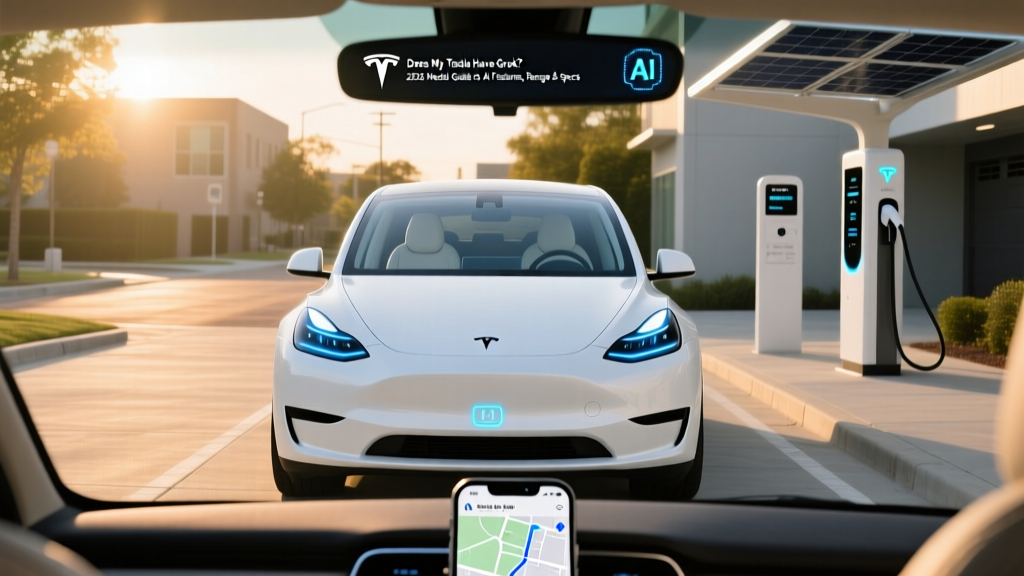
If you've heard Tesla integrating xAI's Grok AI assistant into its vehicles and wondered, "does my Tesla have Grok?" — the answer depends on your model year, trim, and software version. As of early 2026, Tesla has rolled out Grok integration to select vehicles running the latest software builds, but it's not universal across the fleet. This guide breaks down exactly which Teslas support Grok, how it works, and pairs that with the hard numbers every buyer needs: real-world range, charging speeds, pricing, and federal tax credit eligibility.
2026 Tesla Lineup: Specs, Range, and Grok Compatibility at a Glance
| Spec | Model 3 Long Range | Model Y Long Range | Model S | Model X |
|---|---|---|---|---|
| EPA Range | 363 mi | 320 mi | 402 mi | 335 mi |
| Battery (usable) | ~75 kWh, NMC | ~75 kWh, NMC | ~95 kWh, NMC | ~95 kWh, NMC |
| Max DC Charge | 250 kW | 250 kW | 250 kW | 250 kW |
| 10-80% DC Time | ~25 min | ~27 min | ~30 min | ~31 min |
| Level 2 (mi/hr) | ~44 mi/hr (11.5 kW) | ~44 mi/hr (11.5 kW) | ~34 mi/hr (11.5 kW) | ~34 mi/hr (11.5 kW) |
| 0-60 mph | 4.2 sec | 4.8 sec | 3.1 sec | 3.8 sec |
| Horsepower | ~346 hp | ~384 hp | ~670 hp | ~670 hp |
| Drivetrain | Dual Motor AWD | Dual Motor AWD | Dual Motor AWD | Dual Motor AWD |
| MPGe (combined) | 132 MPGe | 117 MPGe | 120 MPGe | 109 MPGe |
| Base MSRP | $47,740 | $48,990 | $79,990 | $84,990 |
| Grok Support | Yes (Highland+) | Yes (Juniper+) | Yes (2024+) | Yes (2024+) |
Sources: EPA / fueleconomy.gov, Tesla.com. Pricing reflects MSRP before destination fees and before any tax credits.
Real-World Range: What the EPA Sticker Doesn't Tell You
- Model 3 LR (EPA 363 mi): Expect ~290-320 mi on highway trips at 70-75 mph; ~240-270 mi in freezing weather with cabin heat.
- Model Y LR (EPA 320 mi): Expect ~255-285 mi highway; ~215-245 mi in cold conditions.
- Model S (EPA 402 mi): Expect ~330-360 mi highway; ~275-310 mi in cold weather.
- Model X (EPA 335 mi): Expect ~270-295 mi highway; ~225-260 mi in cold conditions.
Tesla's EPA range figures are among the most accurate in the industry thanks to the brand's heat pump efficiency and strong thermal management. However, EPA testing includes a mix of city and highway driving with moderate temperatures. In real-world highway use — where aerodynamic drag dominates at speeds above 65 mph — every Tesla loses roughly 10-15% versus the sticker. Cold weather compounds this: battery internal resistance increases and cabin heating draws energy, pushing losses to 25-35% in sub-freezing conditions. Tesla's heat pump (standard on all current models) mitigates some of this compared to resistive heaters, but physics is physics.
For road-trip planning, Tesla's built-in navigation with Supercharger routing accounts for these variables using real-time data, which is a genuine advantage over third-party route planners. The car will tell you exactly how much charge you'll arrive with, and it's typically accurate within 2-3%.
Charging Speed: DC Fast Charging and Home Level 2
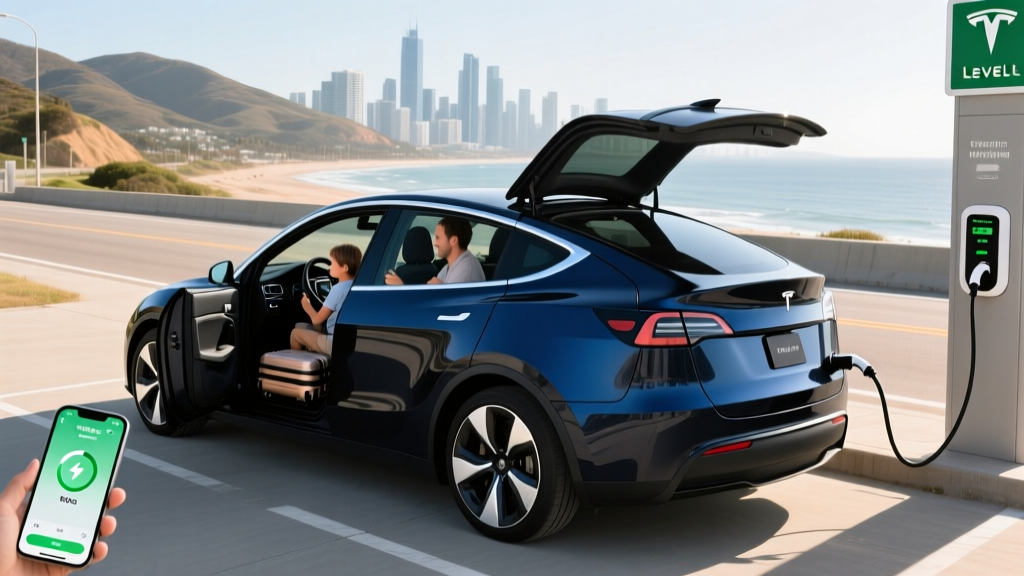
All 2026 Teslas use the NACS (North American Charging Standard) connector natively — the port Tesla designed and which has now been adopted industry-wide. This means access to the entire Supercharger network (20,000+ stalls in North America) without adapters, plus growing access to other networks that have added NACS cables.
| Charging Level | Power | Speed (approx.) | Use Case |
|---|---|---|---|
| Level 1 (120V outlet) | ~1.4 kW | 3-5 mi/hr | Overnight trickle; emergency top-ups |
| Level 2 (240V, 48A) | 11.5 kW | 34-44 mi/hr | Daily home charging; full charge in 7-9 hours |
| DC Fast (V3 Supercharger) | Peak 250 kW | 10-80% in ~25-31 min | Road trips; rapid top-ups |
| DC Fast (V4 Supercharger) | Peak 350+ kW* | Future hardware; limited rollout | Next-gen stalls in deployment |
*V4 Supercharger stalls with higher kW output are being deployed, but current Tesla vehicles are limited by their onboard charge architecture to ~250 kW peak. kW is power (charge speed); kWh is energy (battery capacity) — these are not interchangeable.
Charging curve reality: Tesla's 250 kW peak is only sustained at low states of charge (roughly 5-25% SoC). The rate tapers progressively: expect ~180 kW around 40% SoC, ~100 kW at 60%, and ~50 kW or less above 80%. This is why the 10-80% time is the meaningful metric — charging the final 20% can take as long as the first 70%. Always precondition your battery (the car does this automatically when you navigate to a Supercharger) to hit peak charge rates, especially in cold weather.
For home charging, Tesla's Wall Connector ($420) or any J1772/NACS Level 2 station delivering 48 amps on a 60-amp circuit will add roughly 34-44 miles of range per hour depending on the model. Most owners charge overnight and wake up to a full battery every morning — making public charging relevant mainly for road trips.
What Grok Actually Does in Your Tesla
Grok is xAI's large language model, and Tesla has integrated it as a conversational voice assistant accessible through the touchscreen and voice commands. Here's what it can and cannot do:
What Grok handles:
- Natural-language destination input ("take me to the best sushi place within 10 minutes that has charging nearby")
- Real-time questions about vehicle features, settings, and troubleshooting
- General knowledge queries, news summaries, and conversational interaction while parked
- Points-of-interest recommendations with contextual awareness of your location and charge state
What Grok does NOT do:
- Control driving functions (steering, braking, acceleration)
- Replace or modify Autopilot/FSD (Supervised) — those remain separate SAE Level 2 driver-assistance systems
- Access private vehicle data beyond what you explicitly query
- Function identically across all Tesla models — capabilities vary by MCU hardware generation
Pricing, Tax Credits, and Total Cost
| Model / Trim | Base MSRP | §30D Credit Eligible? | Effective Price (if eligible) |
|---|---|---|---|
| Model 3 RWD | $38,990 | Yes — up to $7,500 | ~$31,490 |
| Model 3 Long Range AWD | $47,740 | Yes — up to $7,500 | ~$40,240 |
| Model Y Long Range | $48,990 | Yes — up to $7,500 | ~$41,490 |
| Model Y Performance | $52,490 | Yes — up to $7,500 | ~$44,990 |
| Model S | $79,990 | No (over MSRP cap) | $79,990 |
| Model X | $84,990 | No (over MSRP cap) | $84,990 |
Federal §30D tax credit rules (2026): Under IRS clean vehicle credit rules, the credit is up to $7,500 and can now be transferred to the dealer at point of sale as an instant rebate. However, eligibility depends on several conditions:
- MSRP cap: Sedans (Model 3) must be under $55,000; SUVs/trucks (Model Y) must be under $80,000. Model S and Model X exceed these caps.
- Buyer income cap: Modified AGI must not exceed $150,000 (single), $225,000 (head of household), or $300,000 (joint filing).
- Battery sourcing: Critical minerals and battery components must meet phased-in domestic/free-trade-agreement sourcing percentages that tighten annually. Tesla's US-built vehicles with LFP batteries (some Model 3 RWD) have faced partial credit reductions in past years due to mineral sourcing — always verify the current status on the IRS eligible vehicles list before purchasing.
- Point-of-sale transfer: You can apply the credit as an immediate price reduction at the dealership, reducing your out-of-pocket cost without waiting to file taxes.
Tax credit eligibility rules change and vary by buyer. Consult a tax professional and verify on irs.gov before purchasing.
Cargo, Passenger Space, and Practicality
Interior dimensions matter for daily usability. Here's how the lineup compares:
- Model 3: 23 cu ft trunk + frunk; 42.3" front legroom, 35.2" rear. Tight rear middle seat. Frunk adds useful grocery/gym-bag space.
- Model Y: 30 cu ft behind rear seats (76 cu ft with seats folded) + frunk; 41.8" front, 39.2" rear. Genuinely spacious for a compact SUV crossover — the best-selling vehicle in the world for a reason.
- Model S: 28 cu ft trunk + frunk; 42.4" front, 35.4" rear. Premium sedan comfort but rear space is modest for the price point.
- Model X: Up to 88 cu ft with seats folded + frunk; available in 5, 6, or 7-seat configs. Falcon-wing doors are dramatic but add weight and complexity.
For families, the Model Y is the clear practicality winner. For solo commuters prioritizing efficiency and range, the Model 3 Long Range offers the best mi-per-dollar ratio. Model S/X serve buyers who want flagship performance and prestige, though they compete with luxury EVs from BMW (i7), Mercedes (EQS), and Lucid (Air) that offer comparable or superior rear-seat luxury.
Warranty, Reliability, and Ownership Costs
Tesla's warranty structure is straightforward:
- Basic vehicle: 4 years / 50,000 miles
- Battery & drive unit (Model 3/Y): 8 years / 120,000 miles (Long Range/AWD); 8 years / 100,000 miles (RWD)
- Battery & drive unit (Model S/X): 8 years / 150,000 miles
- Capacity retention guarantee: Tesla warrants that the battery will retain at least 70% of original capacity during the warranty period. In practice, Tesla batteries have shown strong longevity — data aggregated by Tesla's fleet indicates average degradation of ~12-15% over 200,000 miles for NMC packs.
Insurance costs remain a notable ownership factor. Teslas tend to carry higher premiums than comparable ICE vehicles — 15-30% above average for Model 3/Y, and significantly more for Model S/X Performance trims. Get quotes before committing. Tesla's own insurance product (available in most states) uses real-time driving data and can be competitive for safe drivers.
Pros, Cons, and the Competition
Pros
- Best-in-class Supercharger network (20,000+ stalls, high uptime)
- Industry-leading energy efficiency (MPGe) across the lineup
- Over-the-air updates continuously add features
- Strong resale value relative to most EV competitors
- Grok AI integration adds genuine convenience for navigation and queries
- Heat pump standard — excellent cold-weather efficiency
Cons
- Model S/X are expensive and no longer class-leading in luxury
- No Apple CarPlay or Android Auto — Tesla's ecosystem is closed
- FSD (Supervised) costs $8,000 extra or $99/mo and remains Level 2
- Insurance premiums above segment average
- Model 3 rear seat is tight for adults on long trips
- Panel gaps and build consistency improved but still trail legacy luxury OEMs
Key competitors to cross-shop:
- Hyundai Ioniq 5 N / Ioniq 6: 800V architecture enables 10-80% in ~18 min; NACS adapter included; strong value.
- BMW i4 / iX: Superior interior materials and ride refinement; competitive range; pricier.
- Ford Mustang Mach-E: Strong driving dynamics; NACS adapter for Supercharger access; more traditional dealership experience.
- Lucid Air: Crushes Model S on range (up to 516 mi EPA) and rear-seat space; limited service network.
Who Should Buy a Tesla in 2026?
Choose a Tesla if: You want the most reliable public charging network in North America, value OTA software updates, want Grok AI for voice-based convenience, and prioritize energy efficiency. The Model 3 and Model Y remain the default recommendations for first-time EV buyers who can charge at home.
Look elsewhere if: You need Apple CarPlay, want a traditional dealership service experience, are buying a luxury sedan above $75K (consider Lucid, BMW i7, or Mercedes EQS), or need the fastest possible DC charging (Hyundai/Kia's 800V platform charges faster).
Frequently Asked Questions
Does every 2026 Tesla come with Grok?
No. Grok requires the latest MCU hardware and software version 2025.44 or later. Model 3 Highland (2024+), Model Y Juniper (2025+), and refreshed Model S/X (2024+) support it. Older Model 3/Y vehicles with previous-generation hardware do not receive Grok even with software updates.
Is Grok a subscription feature?
As of early 2026, basic Grok voice-assistant functionality is included with the vehicle. Tesla has not announced a separate Grok subscription tier, though premium features could be gated behind Tesla's existing Premium Connectivity subscription ($9.99/mo) in the future.
Can Grok control my Tesla's driving?
No. Grok is an infotainment and information AI. It does not interface with steering, braking, or throttle systems. Tesla's Autopilot and FSD (Supervised) remain separate SAE Level 2 driver-assistance features that require active driver supervision at all times.
What's the real-world range of the Model 3 Long Range?
The EPA rates it at 363 miles. On highway road trips at 70-75 mph, expect 290-320 miles. In freezing temperatures with cabin heating, expect 240-270 miles. Tesla's trip planner with Supercharger routing is highly accurate for real-world trip planning.
Do Model 3 and Model Y still qualify for the $7,500 federal tax credit?
Yes, as of 2026, both Model 3 and Model Y are eligible for up to $7,500 under IRS §30D, provided you meet income caps ($150K single / $300K joint) and the specific vehicle's battery sourcing meets current-year critical mineral and component requirements. The credit can be transferred to the dealer as a point-of-sale rebate. Model S and Model X do not qualify due to MSRP caps ($55K sedan / $80K SUV). Always verify on irs.gov before purchase.
How does Tesla's charging network compare to competitors?
Tesla's Supercharger network has the highest stall count, best uptime (~97%+), and most seamless plug-and-charge experience in North America. With the NACS standard now adopted by Ford, GM, Rivian, Hyundai, and others, the network is opening up — but Tesla owners still get priority access and native integration. Non-Tesla EVs using the network via NACS adapter may face slower peak speeds depending on their vehicle's charge architecture.
Should I buy a Tesla or a competitor in 2026?
For most buyers who can charge at home and want hassle-free road-trip charging, the Model 3 or Model Y remains the strongest all-around choice. If you prioritize interior luxury (BMW iX), ultra-fast DC charging (Hyundai Ioniq 5), or maximum range in a sedan (Lucid Air), competitors have legitimate advantages. Test-drive at least two alternatives before committing.