Quick Answer: Does Mazda Make an EV?
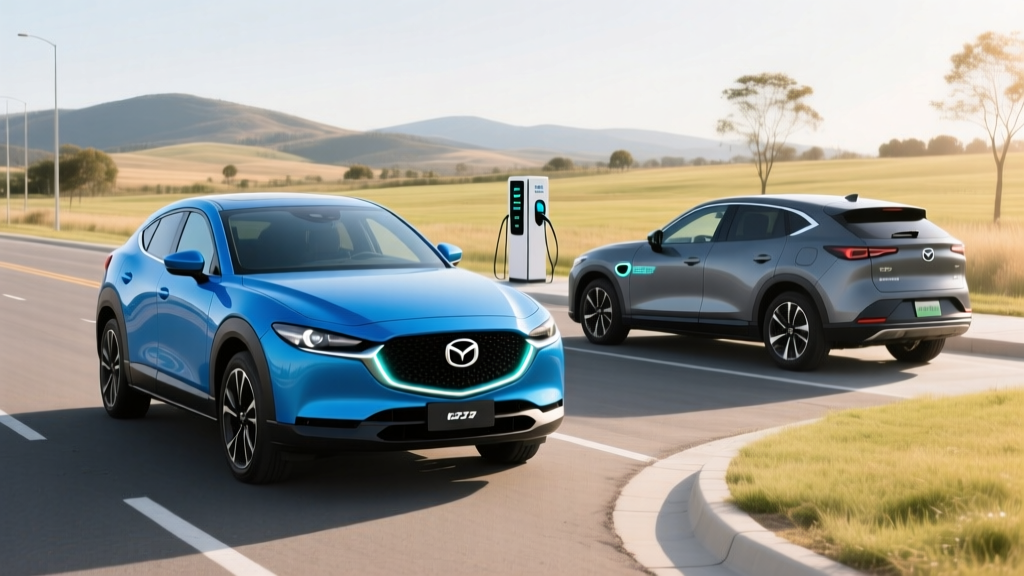
Yes. As of the 2026 model year, Mazda offers one fully electric vehicle — the Mazda MX-30 EV — alongside two plug-in hybrids: the CX-70 PHEV and CX-90 PHEV. The MX-30 carries an EPA-estimated 100 miles of range from its 35.5 kWh battery, starting near $34,000. The CX-70 PHEV delivers 26 miles of electric-only driving before the gas engine kicks in. However, the MX-30 is only sold in California and a handful of ZEV-mandate states, which limits availability for most US buyers.
The 2026 Mazda MX-30 EV: Specs, Range, and Pricing
The MX-30 remains Mazda's sole battery-electric offering and occupies a niche position in the EV market. It was designed as a short-range urban commuter rather than a long-haul road-tripper. Here's what the numbers look like:
| Specification | 2026 Mazda MX-30 EV |
|---|---|
| EPA Range | 100 miles |
| Battery (usable) | 35.5 kWh (NMC lithium-ion) |
| Motor Output | 143 hp / 200 lb-ft torque |
| 0-60 mph | ~8.7 seconds |
| DC Fast Charge (peak) | 50 kW (CCS) |
| 10-80% DC Charge | ~36 minutes |
| Level 2 Charge Rate | 6.6 kW (~7 hours, 0-100%) |
| EPA Efficiency | 92 MPGe combined |
| Base MSRP | $34,110 (Select) |
| Battery Warranty | 8 years / 100,000 miles |
Real-World Range vs. EPA Sticker
The EPA rates the MX-30 at 100 miles, but expect 75-85 miles on the highway at sustained 70+ mph speeds and 65-75 miles in freezing temperatures with cabin heat running. This is a strict city-and-suburb vehicle. If your daily round-trip commute exceeds 60 miles, you'll be living on the edge of its comfort zone — especially once you factor in a 20% battery buffer to avoid deep-discharge stress on the NMC pack.
Mazda's Plug-In Hybrids: CX-70 PHEV and CX-90 PHEV
For most US buyers asking "does Mazda make an EV," the more practical answer is Mazda's plug-in hybrid lineup. Both the CX-70 PHEV (two-row midsize SUV) and CX-90 PHEV (three-row) share the same electrified powertrain and offer a bridge between gas and full-electric ownership.
| Spec | CX-70 PHEV | CX-90 PHEV |
|---|---|---|
| Electric-Only Range | 26 miles (EPA) | 26 miles (EPA) |
| Battery | 17.8 kWh (NMC) | 17.8 kWh (NMC) |
| Combined System HP | 323 hp | 323 hp |
| MPG (gas-only, combined) | 25 MPG | 25 MPG |
| MPGe (electric + gas) | 56 MPGe | 56 MPGe |
| Level 2 Charge Time | ~2.5 hours (0-100%) | ~2.5 hours (0-100%) |
| Base MSRP | $55,385 | $50,595 |
| §30D Tax Credit Eligibility | Up to $3,750* | Up to $3,750* |
*PHEV tax credit under IRS §30D is subject to MSRP caps ($80,000 for SUVs), buyer income limits ($300K joint / $150K single), and battery-component/critical-mineral sourcing requirements. Eligibility changes frequently — verify on the IRS clean vehicle credit list before purchasing. Consult a tax professional for your specific situation.
Cost Breakdown: MX-30 EV vs. Mazda3 Gas vs. CX-70 PHEV
Understanding the real cost of ownership requires looking beyond MSRP. Here's a 5-year total cost of ownership (TCO) comparison assuming 12,000 miles/year, $3.50/gallon regular unleaded, and $0.14/kWh residential electricity:
| Cost Factor (5-Year) | MX-30 EV | Mazda3 2.5S (Gas) | CX-70 PHEV |
|---|---|---|---|
| Purchase Price (base MSRP) | $34,110 | $25,590 | $55,385 |
| Est. Tax Credit | $0** | $0 | Up to $3,750 |
| Fuel / Electricity (5 yrs) | $2,520 | $7,560 | $4,400 (mixed) |
| Maintenance (5 yrs) | $1,200 | $3,800 | $2,800 |
| Insurance (est. avg) | $8,500 | $6,800 | $9,200 |
| Est. 5-Year TCO | $46,330 | $43,750 | $68,035 |
**MX-30 tax credit status: The MX-30's battery sourcing has not consistently met the critical-mineral and battery-component requirements under §30D. Check the fueleconomy.gov credit listing for current eligibility before purchase. The credit can be transferred to the dealer as a point-of-sale discount if eligible.
The MX-30's fuel savings are real — roughly $1,000/year less than the Mazda3 — but the insurance premium gap and lack of federal credit narrow the advantage. The CX-70 PHEV costs significantly more upfront but eliminates range anxiety entirely and offers a 323-hp inline-six that outperforms both alternatives.
Charging the MX-30: What Owners Actually Experience
The MX-30's 50 kW peak DC fast-charging rate is its most significant limitation in 2026. For context, competitors like the Hyundai Kona Electric and Chevrolet Equinox EV accept 100+ kW, cutting charge stops to under 20 minutes. The MX-30's 36-minute 10-80% session means road trips require patience — though with only 100 miles of range, long road trips aren't this car's purpose.
At home on a Level 2 charger (240V, 32A), the MX-30's small 35.5 kWh battery fills in about 5-7 hours, which is perfectly adequate for overnight replenishment. A basic Level 2 home installation typically runs $500-$2,000 depending on your panel capacity and the distance from your electrical panel to the charging location. If your home has a 200-amp panel with spare capacity, expect the lower end. A panel upgrade to 200A can add $1,500-$3,000.
For apartment dwellers or those without dedicated parking, the MX-30's short range becomes a genuine liability. Public Level 2 chargers (typically 6-19 kW) will take 2-5 hours for a full charge, and relying on 50 kW DC fast chargers for daily top-ups is both time-consuming and potentially harmful to long-term NMC battery health if done exclusively.
Common Misconceptions About Mazda's EVs
| Myth | Fact |
|---|---|
| "Mazda doesn't make any electric cars." | The MX-30 EV has been in production since 2022 and continues for 2026. The CX-70 and CX-90 PHEVs also offer meaningful electric-only driving. |
| "The MX-30 qualifies for the full $7,500 tax credit." | As of 2026, the MX-30 has not consistently met §30D battery-sourcing requirements. Always verify on irs.gov before purchase. |
| "100 miles of range is useless." | The average US commute is under 40 miles round-trip per FHWA data. For single-car households or second-car urban use, 100 miles covers most daily needs — if you can charge at home. |
| "Mazda PHEVs don't need to be plugged in." | They operate as conventional hybrids when the battery depletes, but you lose the 26 miles of zero-emission driving and the 56 MPGe rating. Unplugged, expect ~25 MPG combined — similar to a standard gas SUV. |
| "The MX-30 is available nationwide." | Mazda limits MX-30 sales to California and ZEV-mandate states (Oregon, Washington, and a few others). It is not available in most of the US. |
Decision Framework: Should You Buy a Mazda Electrified Vehicle?
Choose the MX-30 EV if:
- You live in California or a ZEV-mandate state where it's sold
- Your daily driving is under 60 miles round-trip
- You have reliable home Level 2 charging access
- You want a distinctive, premium-feeling subcompact EV under $35K
- This is a second vehicle in a multi-car household
Choose the CX-70 or CX-90 PHEV if:
- You need an SUV with cargo space and towing capability (3,500 lbs)
- Your commute is under 26 miles and you can charge at home nightly
- You take regular road trips where EV charging infrastructure is sparse
- You want to reduce fuel consumption without range anxiety
- You need three rows (CX-90) or want a sportier two-row (CX-70)
Look at other brands if:
- You need 250+ miles of EPA range for highway commuting (consider Hyundai Ioniq 5, Tesla Model Y, or Chevrolet Equinox EV)
- You want DC fast charging above 150 kW for road trips
- You live outside Mazda's MX-30 sales territory and want a full EV
- Federal tax credit eligibility is a deal-breaker (the MX-30 may not qualify)
What First-Time Mazda EV Buyers Should Know
If you're considering the MX-30 or a Mazda PHEV as your first electrified vehicle, three practical realities matter more than spec-sheet numbers:
1. Your electrical panel determines home charging feasibility. Before committing, have a licensed electrician assess whether your panel can support a 240V/40A circuit for Level 2 charging. The MX-30's small battery charges quickly on Level 2, but you still need the infrastructure. Budget $500-$2,000 for installation — more if a panel upgrade is required.
2. Cold weather cuts range 20-35%. The MX-30's 100-mile EPA rating can drop to 65-80 miles in sustained sub-freezing temperatures because the vehicle uses resistive heating (no heat pump). If you live in the upper Midwest or Northeast, this is a significant factor. The PHEVs sidestep this issue since the gas engine provides heat without draining the battery.
3. Insurance costs are typically 15-25% higher for EVs. Insurers price EVs higher due to battery replacement costs and specialized repair requirements. Get a quote before signing a purchase agreement — the MX-30's $34K price may carry an $8,500+ annual premium in some states, which eats into fuel savings.
Frequently Asked Questions
Does Mazda make a fully electric SUV?
Not yet. The MX-30 is a subcompact crossover, not a full SUV. Mazda has announced plans for additional EVs built on a dedicated platform, but as of 2026, no electric CX-5 or CX-50 exists. The CX-70 PHEV and CX-90 PHEV are the closest electrified SUV options in Mazda's current lineup.
Is the Mazda MX-30 worth buying in 2026?
It depends entirely on your use case. At $34,110 with 100 miles of range and 50 kW DC charging, the MX-30 is outclassed on paper by the Hyundai Kona Electric (261 miles, $33K) and Chevrolet Equinox EV (315 miles, ~$33K). Its value proposition rests on Mazda's interior quality, driving dynamics, and the cork-trimmed cabin aesthetic. If range and charging speed are priorities, look elsewhere. If you want a stylish, well-built urban commuter and can charge at home, it's a reasonable niche pick.
Will Mazda release a longer-range EV?
Mazda has confirmed a dedicated EV platform in development, with larger battery options expected to deliver 250+ miles of range. However, no specific model has been announced for US sale as of early 2026. These upcoming vehicles are preliminary and specs are not finalized.
Can I charge a Mazda PHEV at a public EV charger?
Yes, but only at Level 2 (J1772 connector) chargers. The CX-70 PHEV and CX-90 PHEV do not support DC fast charging. Expect about 2.5 hours for a full charge at a public Level 2 station — fine for destination charging (shopping, work) but impractical for quick top-ups.
What's the warranty on Mazda's EV battery?
The MX-30's high-voltage battery is covered for 8 years or 100,000 miles against defects and excessive capacity loss (typically below 70% state of health). The CX-70 and CX-90 PHEV batteries carry the same 8-year/100,000-mile warranty. Replacement costs for the MX-30's 35.5 kWh pack are estimated at $6,000-$9,000 out of warranty — less than larger packs due to the smaller capacity.