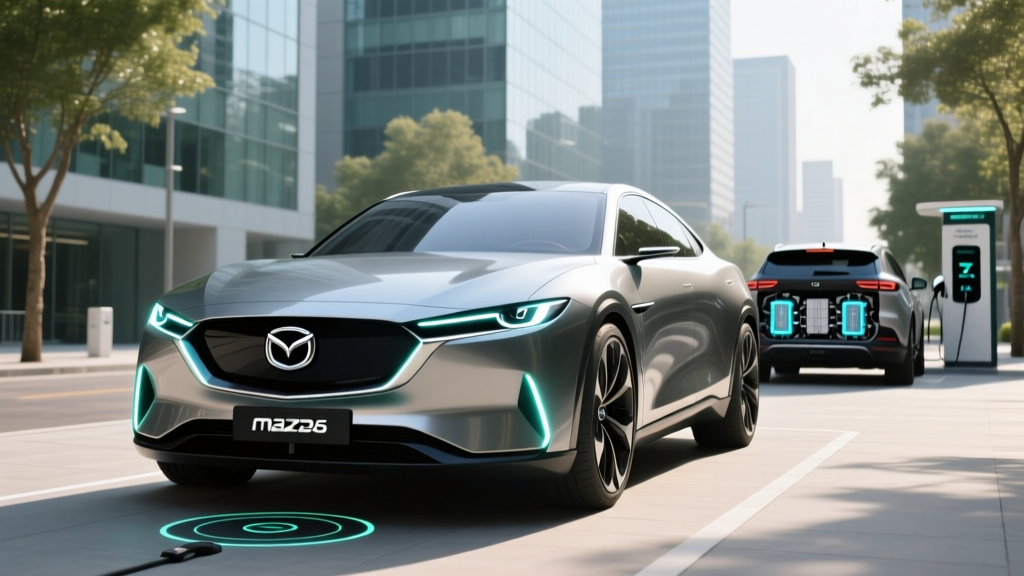
Quick Answer: Does Mazda Have an Electric Car?
Yes. Mazda sells the MX-30 EV, a fully electric compact crossover with an EPA-estimated 100 miles of range and a starting MSRP around $34,110. However, it is currently limited to California-dealership sales and carries significant range limitations compared to rivals. Mazda also offers two plug-in hybrids — the CX-70 PHEV (26 miles electric-only) and CX-90 PHEV (26 miles electric-only) — that deliver partial electric driving without range anxiety.
If you've been searching whether Mazda has joined the electric vehicle market, the answer is more nuanced than a simple yes or no. Mazda's electrification strategy in 2026 spans a limited-availability battery-electric vehicle (BEV), two plug-in hybrids (PHEVs), and mild-hybrid powertrains across the rest of the lineup. For buyers attracted to Mazda's premium interiors, driving dynamics, and reliability reputation, understanding exactly what's available — and where the real value sits — matters more than the headline.
This guide breaks down every electrified Mazda you can buy today with exact EPA range figures, battery specs, charging speeds, pricing, and federal tax credit eligibility. We'll also put the MX-30 head-to-head against competing EVs so you can decide if Mazda's electric offering fits your driving life — or if a PHEV makes more sense.
The Mazda MX-30 EV: Specs, Range, and Real-World Reality
The Mazda MX-30 is the brand's first and only fully electric vehicle available in the U.S. market. It's a compact crossover with Mazda's signature design language, a minimalist interior featuring sustainable materials like cork trim, and the brand's trademark attention to ride quality. But its headline spec — 100 miles of EPA-estimated range — demands honest discussion.
| Spec | Value |
|---|---|
| EPA Range | 100 miles |
| Real-World Range (highway/cold) | ~70–85 miles |
| Battery Capacity | 35.5 kWh (usable) |
| Battery Chemistry | NMC (nickel-manganese-cobalt) |
| Motor Output | 143 hp / 200 lb-ft torque |
| 0–60 mph | ~9.0 seconds |
| Max DC Fast Charge | 50 kW (CCS1) |
| 10–80% DC Charge Time | ~36 minutes |
| Level 2 AC Charge Rate | 6.6 kW (~7.5 hrs 0–100%) |
| MPGe (combined) | 92 MPGe |
| Base MSRP | $34,110 |
| Battery Warranty | 8 years / 100,000 miles |
| Federal Tax Credit (§30D) | Not eligible (Japan-assembled) |
Real-World Range Reality: The MX-30's 100-mile EPA estimate assumes moderate city driving in temperate conditions. Expect 70–85 miles during sustained highway driving at 70+ mph, and potentially as low as 60–70 miles in sub-freezing winter temperatures. The 35.5 kWh battery is roughly half the capacity of competitors like the Chevrolet Bolt EUV or Hyundai Kona Electric. Mazda deliberately chose a smaller battery to reduce weight and manufacturing emissions, but the tradeoff is clear at the pump — or rather, the charger.
Charging the MX-30: What to Expect
The MX-30 uses a CCS1 connector for DC fast charging and a standard J1772 inlet for Level 1 and Level 2 AC charging. Its peak DC charge rate of 50 kW is modest by 2026 standards — most competitors accept 150 kW or more. That means even at a fast charger, you're looking at over 35 minutes to go from 10% to 80%. For context, a Hyundai Ioniq 5 at a 350 kW station does the same in roughly 18 minutes.
Level 2 home charging at 6.6 kW will replenish the MX-30's small battery overnight in about 5–6 hours from a near-empty state, which is manageable for daily commuters who can charge at home every night. However, the MX-30 is not a road-trip vehicle. Its combination of short range and slow fast-charging makes intercity travel impractical for most drivers.
Mazda's Plug-In Hybrids: CX-70 PHEV and CX-90 PHEV
For many Mazda shoppers, the brand's PHEV models offer a more practical path to electrification. Both the CX-70 PHEV (two-row midsize SUV) and CX-90 PHEV (three-row) share the same plug-in hybrid powertrain: a 2.5-liter four-cylinder engine paired with an electric motor and a 17.8 kWh battery pack.
| Spec | CX-70 PHEV | CX-90 PHEV |
|---|---|---|
| Electric-Only Range | 26 miles (EPA) | 26 miles (EPA) |
| Battery Capacity | 17.8 kWh | 17.8 kWh |
| Combined System HP | 323 hp | 323 hp |
| 0–60 mph | ~6.0 sec | ~6.3 sec |
| MPG (hybrid mode) | 25 mpg combined | 25 mpg combined |
| MPGe (electric mode) | 56 MPGe | 56 MPGe |
| Level 2 Charge Time (0–100%) | ~3 hours (6.6 kW) | ~3 hours (6.6 kW) |
| Base MSRP | ~$40,445 | ~$50,970 |
| Max DC Fast Charge | None (AC only) | None (AC only) |
| Federal Tax Credit (§30D) | Not eligible | Not eligible |
| Battery Warranty | 8 years / 100,000 miles | 8 years / 100,000 miles |
The 26-mile electric-only range is enough to cover most daily commutes and school runs without using a drop of gasoline. When the battery depletes, the vehicles operate as conventional hybrids — no range anxiety, no need to find a charger on long trips. Level 2 home charging refills the battery in about 3 hours, so overnight charging easily restores full electric range each morning.
The catch: neither PHEV qualifies for the federal §30D clean vehicle tax credit because both are assembled in Japan, and the credit requires final assembly in North America. You can verify assembly location for any vehicle using the VIN decoder at fueleconomy.gov.
MX-30 EV vs. the Competition: Range, Price, and Value
To understand where the MX-30 sits in the EV market, here's how it compares to other affordable electric crossovers available in 2026:
| Model | EPA Range | Battery (kWh) | Max DC Charge | 10–80% Time | Base MSRP | Tax Credit |
|---|---|---|---|---|---|---|
| Mazda MX-30 | 100 mi | 35.5 | 50 kW | ~36 min | $34,110 | No |
| Hyundai Kona Electric | 261 mi | 64.8 | 100 kW | ~43 min | $32,975 | No |
| Chevrolet Bolt EUV | 247 mi | 65.0 | 55 kW | ~45 min | $29,800 | Yes (§30D) |
| Nissan LEAF S | 212 mi | 60.0 | 50 kW | ~60 min | $29,230 | No |
| Tesla Model 3 RWD | 272 mi | 60.0 | 170 kW | ~25 min | $38,990 | Yes (§30D) |
The numbers paint a clear picture: the MX-30 offers less than half the range of most competitors while charging slower than nearly all of them. It also fails to qualify for the federal tax credit, making it more expensive out-of-pocket than the Bolt EUV or Model 3, both of which can receive up to $7,500 at point of sale under current IRS §30D rules — subject to income caps, MSRP limits, and battery sourcing requirements.
Where the MX-30 wins is interior quality, driving refinement, and Mazda's design ethos. If you prioritize cabin materials and a quiet, composed ride over range and charging speed, it's a defensible — if niche — choice.
Real Costs of Owning a Mazda MX-30 EV
Let's break down the five-year ownership economics of the MX-30 compared to a similarly priced gas-powered Mazda CX-30, assuming 12,000 miles driven per year.
| Category | MX-30 EV | CX-30 (2.5L AWD) |
|---|---|---|
| Purchase Price (base MSRP) | $34,110 | $26,500 |
| Federal Tax Credit | $0 | $0 |
| Fuel/Energy (5 yrs, 60k mi) | ~$2,700 (home L2) | ~$7,800 (gas @ $3.50/gal, 28 mpg) |
| Maintenance (5 yrs) | ~$1,500 | ~$3,200 |
| Insurance (5 yrs est.) | ~$8,400 | ~$7,200 |
| Estimated Depreciation | ~$17,000 | ~$12,000 |
| Total 5-Year Cost | ~$63,710 | ~$56,700 |
The MX-30 saves roughly $5,100 in fuel and $1,700 in maintenance over five years — about $6,800 total. But those savings don't overcome the $7,610 higher purchase price, higher insurance premiums typical of EVs, and steeper depreciation driven by range limitations. The math only improves if you qualify for state-level EV rebates (California's CVRP, for example, has offered up to $7,000 for income-eligible buyers — check your state energy office for current programs).
What About the PHEVs?
The CX-90 PHEV's economics shift if most of your driving falls within the 26-mile electric-only window. A driver with a 20-mile round-trip commute who charges nightly could use gasoline only on weekends and longer trips, achieving real-world efficiency far above the 25 mpg hybrid-mode rating. But without the federal tax credit, the $50,970 starting price requires a long payback period versus the gas CX-90.
Common Misconceptions About Mazda EVs
| Myth | Fact |
|---|---|
| "Mazda doesn't make electric cars." | The MX-30 EV is a fully electric BEV, and the CX-70/CX-90 PHEVs offer 26 miles of electric-only driving. |
| "The MX-30 qualifies for the $7,500 tax credit." | It does not. The MX-30 is assembled in Japan, and §30D requires North American final assembly. |
| "100 miles of range is enough for everyone." | Only if your daily driving is under 60–70 miles round-trip, you charge at home nightly, and you rarely drive in extreme cold or on highways. For most U.S. drivers, 100 miles is limiting. |
| "Mazda PHEVs can fast-charge." | Neither the CX-70 PHEV nor CX-90 PHEV supports DC fast charging. They are limited to Level 2 AC charging at 6.6 kW. |
| "The MX-30 uses a NACS/Tesla connector." | The MX-30 uses CCS1 for DC charging and J1772 for AC. Mazda has not announced a NACS transition for this model. |
Decision Framework: Should You Buy a Mazda EV or PHEV?
Choose the Mazda MX-30 EV if:
- Your daily driving is consistently under 60 miles round-trip
- You have reliable home Level 2 charging (garage or driveway with a 240V outlet)
- You live in California (the only state where it's sold through dealerships)
- You value Mazda's interior design and driving feel over range and charging speed
- You have a second gas or hybrid vehicle for longer trips
Choose the CX-70 PHEV or CX-90 PHEV if:
- Your commute is under 26 miles and you can charge at home nightly
- You want electric daily driving but need gas-engine flexibility for road trips
- You need more cargo space and passenger capacity than the MX-30 offers
- You live outside California and need a Mazda dealership nearby
- You want Mazda's inline-six driving dynamics with partial electrification
Look at competing EVs (Bolt EUV, Model 3, Ioniq 5) if:
- You need 200+ miles of range for highway commuting or road trips
- You want to qualify for the federal §30D tax credit (up to $7,500)
- You rely on public DC fast charging and need 150+ kW charge speeds
- You live in a region with extreme cold that further reduces range
- You want access to the Tesla Supercharger network (NACS) or robust CCS infrastructure
What First-Time Mazda EV Buyers Should Know
If you're considering the MX-30 as your first electric vehicle, here are the practical realities that don't appear in brochures:
Home charging is nearly mandatory. With only 100 miles of range, relying on public charging is impractical and expensive. Budget $500–$2,000 for a Level 2 home charger installation (equipment + licensed electrician + permit), depending on whether your electrical panel needs an upgrade. A 240V/30A circuit is sufficient for the MX-30's 6.6 kW onboard charger.
Cold weather will shrink your range. The MX-30's small battery has less buffer against temperature-related losses. In sustained sub-30°F conditions, expect real-world range to drop to 60–75 miles. If you live in a cold climate, this vehicle may not serve as your primary car.
Charging speed matters more than you think. The 50 kW DC fast-charge ceiling means highway rest stops won't be quick. Plan any trip over 70 miles carefully around charger availability, and understand that the MX-30's charge curve stays relatively flat — there's no dramatic peak-and-taper like larger batteries, but there's also no speed advantage.
The battery warranty is solid. Mazda covers the MX-30's traction battery for 8 years or 100,000 miles against defects and excessive degradation (typically defined as falling below 70% capacity). This is industry-standard and provides reasonable peace of mind for a small battery that cycles more frequently.
Frequently Asked Questions
Does Mazda have a fully electric car in 2026?
Yes. The Mazda MX-30 EV is a fully electric compact crossover with 100 miles of EPA-estimated range, a 35.5 kWh battery, and a starting price of $34,110. It is currently sold only through California dealerships.
Why is the MX-30's range so low compared to other EVs?
Mazda intentionally chose a smaller 35.5 kWh battery to keep the vehicle lightweight and reduce manufacturing emissions. The tradeoff is 100 miles of range versus 200–300+ miles from competitors with larger 60–80 kWh battery packs.
Does the Mazda MX-30 qualify for the federal EV tax credit?
No. Under current IRS §30D rules, the vehicle must undergo final assembly in North America to qualify. The MX-30 is assembled in Japan, making it ineligible regardless of buyer income or MSRP. Always verify eligibility at irs.gov before purchasing.
Can I buy the MX-30 outside of California?
As of 2026, Mazda limits MX-30 sales to California dealerships. There has been no official announcement of a broader U.S. rollout. If you live outside California, the CX-70 PHEV and CX-90 PHEV are available nationwide.
How long does it take to charge the MX-30 at home?
On a Level 2 (240V) home charger at 6.6 kW, the MX-30 charges from empty to full in approximately 5–6 hours. On a standard 120V Level 1 outlet, expect 15+ hours — impractical for daily use given the vehicle's limited range.
Are the CX-70 PHEV and CX-90 PHEV better choices than the MX-30?
For most buyers, yes. The PHEVs offer 26 miles of electric-only driving for daily commutes, plus a gas engine for road trips — eliminating range anxiety. They're also available nationwide. The tradeoff is higher starting prices ($40,445 and $50,970 respectively) and no DC fast-charging capability.
What's Mazda's EV roadmap beyond the MX-30?
Mazda has announced plans for additional battery-electric models, including a next-generation EV built on a dedicated platform, expected later this decade. However, no specific model names, specs, or U.S. launch dates have been confirmed. Treat any range or pricing claims for unreleased models as preliminary.