Quick Answer: Does Mazda Have an EV?
Yes. As of 2026, Mazda sells one fully electric vehicle in the U.S. — the Mazda MX-30 EV (a subcompact crossover with ~100 miles of EPA range) — plus two plug-in hybrids: the CX-70 PHEV and CX-90 PHEV, each offering around 26 miles of electric-only driving. Mazda has also announced plans for additional dedicated EVs by the late 2020s, but the MX-30 and its PHEV siblings are what you can actually buy today.
If you've been browsing Mazda's showroom and wondering whether the brand has caught up to the EV wave, the answer is nuanced. Mazda's electrification strategy has been cautious, prioritizing plug-in hybrids for its larger SUVs while limiting its pure battery-electric offering to a single, range-limited model. For some buyers, that's perfectly fine. For others, it's a dealbreaker. This guide breaks down exactly what Mazda offers, what each model costs to buy and run, and how to decide whether a Mazda electrified vehicle fits your driving life.
Mazda's Full Electrified Lineup for 2026
Mazda's U.S. electrified lineup currently consists of three models. Here's how they stack up on the numbers that matter most:
| Spec | MX-30 EV (2025/2026) | CX-70 PHEV | CX-90 PHEV |
|---|---|---|---|
| Powertrain | Battery Electric (BEV) | Plug-in Hybrid (PHEV) | Plug-in Hybrid (PHEV) |
| Battery (usable) | ~35.5 kWh (NMC) | ~17.8 kWh (lithium-ion) | ~17.8 kWh (lithium-ion) |
| EPA Electric Range | 100 mi | 26 mi (EV only) | 26 mi (EV only) |
| Combined MPGe (EV mode) | 92 MPGe | 56 MPGe (EV+gas combined) | 56 MPGe (EV+gas combined) |
| Gas MPG (PHEV, charge-depleted) | N/A | ~25 MPG combined | ~25 MPG combined |
| Horsepower | 145 hp | 323 hp (combined system) | 323 hp (combined system) |
| 0–60 mph | ~9.1 sec | ~6.3 sec | ~6.3 sec |
| Max DC Fast Charge | 50 kW (CCS) | N/A (AC charging only) | N/A (AC charging only) |
| 10–80% DC Charge | ~36 min | N/A | N/A |
| Level 2 (AC) Charge Time | ~5 hrs (6.6 kW) | ~3 hrs (7.2 kW onboard) | ~3 hrs (7.2 kW onboard) |
| Starting MSRP | ~$34,000 | ~$54,000 | ~$56,000 |
| Federal Tax Credit (§30D) | Up to $7,500 (eligibility varies) | Up to $7,500 (eligibility varies) | Up to $7,500 (eligibility varies) |
| Battery Warranty | 8 yr / 100,000 mi | 8 yr / 100,000 mi | 8 yr / 100,000 mi |
The MX-30 EV: Mazda's Only Pure Electric Car
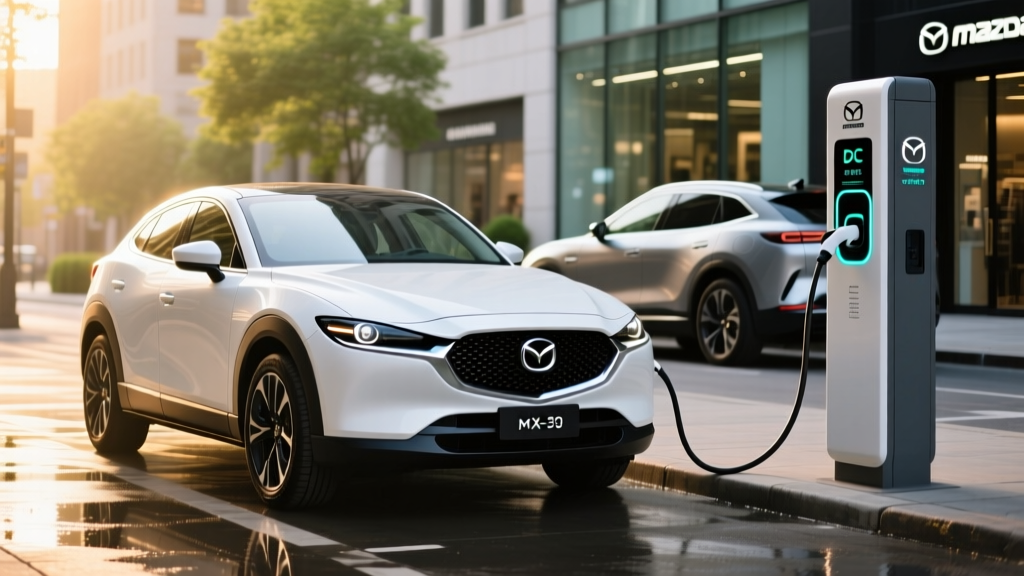
The MX-30 is the vehicle people usually mean when they ask "does Mazda have an EV?" It's a stylish subcompact crossover with Mazda's signature interior quality, but its 100-mile EPA range makes it one of the shortest-range new EVs on the market. For context, the Hyundai Kona Electric delivers 261 miles and the Chevrolet Equinox EV offers over 300 miles on a single charge.
Real-World Range Reality: MX-30 EV
EPA Sticker: 100 miles
Expect in real-world driving: 80–90 miles on the highway; as low as 65–75 miles in freezing temperatures with cabin heat. The MX-30's small 35.5 kWh battery leaves little buffer for range loss from cold, speed, or elevation.
Charging Speed: The 50 kW Limitation
The MX-30's DC fast charging tops out at 50 kW via CCS. That's notably slow by 2026 standards — most competitors peak between 150–350 kW. A 10–80% charge takes roughly 36 minutes. On a Level 2 home charger at 6.6 kW, a full charge takes about 5 hours, which is fine for overnight replenishment. The practical implication: the MX-30 is best suited as a commuter car that charges at home, not a road-trip vehicle.
Who the MX-30 Works For
If your daily commute is under 40 miles round-trip, you have reliable home charging, and you rarely drive more than 80 miles in a single day, the MX-30's range won't be an issue. You'll also appreciate the quiet, torque-rich electric drivetrain and Mazda's premium interior materials — cork-trimmed console, recycled upholstery, and a well-tuned chassis. But if you need flexibility for weekend trips, live in a cold climate, or lack home charging, the MX-30's limitations become serious quickly.
CX-70 and CX-90 PHEV: Mazda's Plug-in Hybrid SUVs
For buyers who need SUV space and longer-range capability, Mazda's answer is plug-in hybrid technology. The CX-70 (two-row) and CX-90 (three-row) share the same PHEV powertrain: a 2.5-liter four-cylinder engine paired with an electric motor and a ~17.8 kWh battery. Both deliver 26 miles of electric-only range — enough to cover many daily commutes without burning gas.
Once the battery is depleted, these SUVs operate as conventional hybrids, returning roughly 25 MPG combined. That's a meaningful improvement over their non-PHEV siblings, which average around 20–23 MPG. Over a year of 15,000 miles, the fuel savings can be substantial if you charge regularly.
The PHEVs charge exclusively via AC — there is no DC fast-charging capability. On a Level 2 charger at 7.2 kW, replenishing the battery takes about 3 hours. On a standard 120V household outlet (Level 1), expect roughly 10–12 hours. This means the PHEV strategy only pays off if you can charge at home or at work.
EV vs. Gas vs. PHEV: What It Actually Costs
Numbers drive EV purchase decisions. Here's a five-year cost comparison between the MX-30 EV, the CX-90 PHEV, and the gas-only CX-90, assuming 15,000 miles per year, home charging at $0.14/kWh, and gas at $3.50/gallon:
| Cost Category (5 Years) | MX-30 EV | CX-90 PHEV | CX-90 Gas (Turbo) |
|---|---|---|---|
| Base MSRP | $34,000 | $56,000 | $44,000 |
| Est. Federal Tax Credit (§30D) | Up to -$7,500* | Up to -$7,500* | $0 |
| Effective Purchase Price | ~$26,500 | ~$48,500 | $44,000 |
| Fuel / Electricity (5 yr) | ~$3,200 | ~$5,800 | ~$12,500 |
| Maintenance (5 yr) | ~$1,800 | ~$3,200 | ~$3,500 |
| Est. Insurance (5 yr) | ~$8,500 | ~$9,200 | ~$8,000 |
| Total 5-Year Cost | ~$40,000 | ~$66,700 | ~$68,000 |
*§30D tax credit eligibility depends on MSRP caps, buyer income limits, battery sourcing requirements, and point-of-sale transfer rules. Verify current-year rules at IRS.gov or consult a tax professional. Credit amounts shown are maximum potential; your actual credit may be lower or zero.
The MX-30 EV's low effective price after the tax credit makes it one of the cheapest ways to drive a new premium-branded EV in 2026. The CX-90 PHEV saves roughly $1,300 over the gas CX-90 across five years — but only if you charge regularly. Drive a PHEV without charging and you'll actually spend more on fuel than the gas version due to the extra weight of the battery system.
Federal Tax Credit: What Mazda Buyers Need to Know
§30D Clean Vehicle Credit Checklist
- MSRP Caps: SUVs (CX-70 PHEV, CX-90 PHEV) must be under $80,000 MSRP. The MX-30, classified as a car, must be under $55,000. All current Mazda electrified models qualify on price.
- Income Limits: Modified AGI must not exceed $300,000 (married filing jointly), $225,000 (head of household), or $150,000 (single).
- Battery Sourcing: The credit is split into two halves — $3,750 for critical minerals and $3,750 for battery components. Sourcing requirements tighten annually. Check the latest fueleconomy.gov listings for current eligibility by model and trim.
- Point-of-Sale Transfer: As of 2024, buyers can transfer the credit to the dealer for an upfront price reduction — you don't have to wait until tax filing. This is available for qualifying Mazda models.
- One-Time Use: The §30D credit is available once per VIN. You cannot claim it again if you've already used your annual credit limit.
Real-World Ownership: Home Charging, Climate, and Daily Life
Buying a Mazda EV or PHEV isn't just about the sticker price — it's about whether your daily life supports electrified driving. Here are the practical factors that determine satisfaction:
Home Charging Access
The MX-30 and both PHEVs are designed around home charging. The MX-30's 100-mile range means you'll want a Level 2 (240V) home charger to replenish fully overnight. A typical Level 2 installation costs $500–$2,000 for the charger unit plus $800–$3,000 for electrician labor and permits, depending on your panel capacity and wiring distance. If your home has a 200-amp panel with spare capacity, expect the lower end. Older homes with 100-amp service may need a panel upgrade ($1,500–$4,000).
For the CX-70 and CX-90 PHEVs, even a standard 120V outlet can replenish the 26-mile battery overnight, though Level 2 cuts the time to ~3 hours.
Cold-Weather Range Loss
EV batteries lose efficiency in cold temperatures. For the MX-30, expect 20–35% range reduction in sustained freezing weather — dropping its real-world range to roughly 65–75 miles. The MX-30 does not come standard with a heat pump (which would reduce this loss), so cabin heating draws directly from the traction battery. PHEV owners face less anxiety because the gas engine provides heat and range once the battery is depleted.
Public Charging and Road Trips
The MX-30's 50 kW DC fast-charging rate and CCS connector mean road trips require careful planning. A 200-mile trip requires at least one 30–40 minute charging stop, and you'll need to rely on CCS-compatible networks like Electrify America or EVgo. Tesla Superchargers are increasingly opening to non-Tesla vehicles via NACS adapters, but CCS-to-NACS adapters add cost and complexity. For the PHEVs, road trips are a non-issue — the gas engine takes over seamlessly.
Common Misconceptions About Mazda's EVs
| Myth | Fact |
|---|---|
| "Mazda doesn't make any electric cars." | The MX-30 EV is a fully battery-electric vehicle available in the U.S., and Mazda offers two PHEVs (CX-70, CX-90). |
| "The MX-30 can't handle real driving." | With 100 miles of range, it covers the average American commute (~37 miles round-trip per FHWA data) with room to spare — but it's not suited for long road trips without planning. |
| "PHEVs are just complicated gas cars." | A PHEV driven and charged daily can operate as an EV for most commutes while eliminating range anxiety. The CX-90 PHEV's 26-mile EV range covers many daily drives entirely on electricity. |
| "EV batteries need replacing every few years." | Mazda warranties its EV and PHEV batteries for 8 years / 100,000 miles. Modern lithium-ion packs are designed to retain 70–80%+ capacity well beyond 150,000 miles with proper charging habits. |
| "The tax credit means it's automatically $7,500 off." | Credit amount depends on battery sourcing, your income, and MSRP caps. Some trims may qualify for $3,750, the full $7,500, or nothing at all. Always verify on fueleconomy.gov. |
Decision Framework: Which Mazda Electrified Vehicle Fits You?
Choose the MX-30 EV if:
- Your daily driving is under 70 miles round-trip
- You have reliable home charging (garage or driveway with 240V access)
- You live in a mild climate or accept reduced winter range
- You want the lowest purchase price and fuel cost after the tax credit
- You rarely take road trips over 100 miles
Choose the CX-70 or CX-90 PHEV if:
- You need a midsize or three-row SUV for family or cargo
- You want EV-like commuting (26 miles electric) with gas-engine flexibility for longer drives
- You can charge at home or at work daily
- You live in a cold climate where pure EV range loss is a concern
- You're not ready to commit to a full BEV but want to reduce fuel consumption
Wait or look at another brand if:
- You need 250+ miles of EV range — look at the Hyundai Ioniq 5, Tesla Model Y, or Ford Mustang Mach-E
- You need fast DC charging for frequent road trips — the MX-30's 50 kW cap is limiting
- You lack any home or workplace charging — a conventional hybrid (like the Toyota RAV4 Hybrid) will serve you better
- You want a Mazda EV with longer range — Mazda has announced future dedicated EV platforms for the late 2020s, but nothing is on sale yet
What's Next for Mazda's EV Plans?
Mazda has outlined a multi-phase electrification roadmap. The company plans to introduce dedicated EV platforms later in the decade, with models expected to offer significantly more range than the MX-30. Mazda is also collaborating with Toyota on battery and platform technology. However, as of 2026, these future models remain announced — not available for purchase. If you need a Mazda electrified vehicle now, the MX-30, CX-70 PHEV, and CX-90 PHEV are your options.
Frequently Asked Questions
Does Mazda have a fully electric SUV?
The MX-30 EV is classified as a subcompact crossover, which functions like a small SUV. Mazda does not currently offer a midsize or full-size fully electric SUV. For larger electrified SUVs, the CX-70 PHEV and CX-90 PHEV are plug-in hybrids, not pure EVs.
How much does it cost to charge the MX-30 at home?
At the U.S. average electricity rate of ~$0.16/kWh, fully charging the MX-30's 35.5 kWh battery costs about $5.68. That provides roughly 100 miles of range — about 5.7 cents per mile. Compare that to a gas CX-90 at roughly 14–16 cents per mile at $3.50/gallon.
Can I take the MX-30 on a road trip?
It's possible but requires planning. With 100 miles of range and a 50 kW peak charge rate, you'll stop every 70–80 miles for roughly 35–40 minutes at a DC fast charger. Most EV owners who road-trip frequently choose vehicles with 250+ miles of range and 150+ kW charging.
Do the CX-70 and CX-90 PHEVs qualify for the $7,500 tax credit?
They may qualify for up to $7,500 under §30D, but the actual amount depends on battery sourcing requirements (critical minerals and components), your income, and current-year IRS rules. The point-of-sale transfer option lets you apply the credit as a dealer discount at purchase. Always check IRS.gov and fueleconomy.gov for the latest eligibility.
Is Mazda's EV battery reliable long-term?
Mazda warranties its high-voltage batteries for 8 years or 100,000 miles (whichever comes first) against capacity loss below a specified threshold. Industry data from sources like NHTSA and third-party fleet studies show modern lithium-ion packs typically retain 85–90% capacity at 100,000 miles with normal use. Avoid frequent DC fast charging to 100% and prolonged storage at very low or very high states of charge to maximize longevity.
Should I buy a Mazda EV or a Tesla?
If you prioritize range, fast charging, and access to the Supercharger network, Tesla's Model Y (320+ miles, 250 kW peak charging) is the stronger EV. If you value Mazda's interior quality, driving dynamics, and a lower entry price after incentives — and your driving is mostly local — the MX-30 can be a satisfying commuter EV. For SUV buyers who aren't ready for full EV, Mazda's PHEVs offer a practical middle ground that Tesla doesn't provide.