Quick Answer: Does Lexus Have an Electric Car?
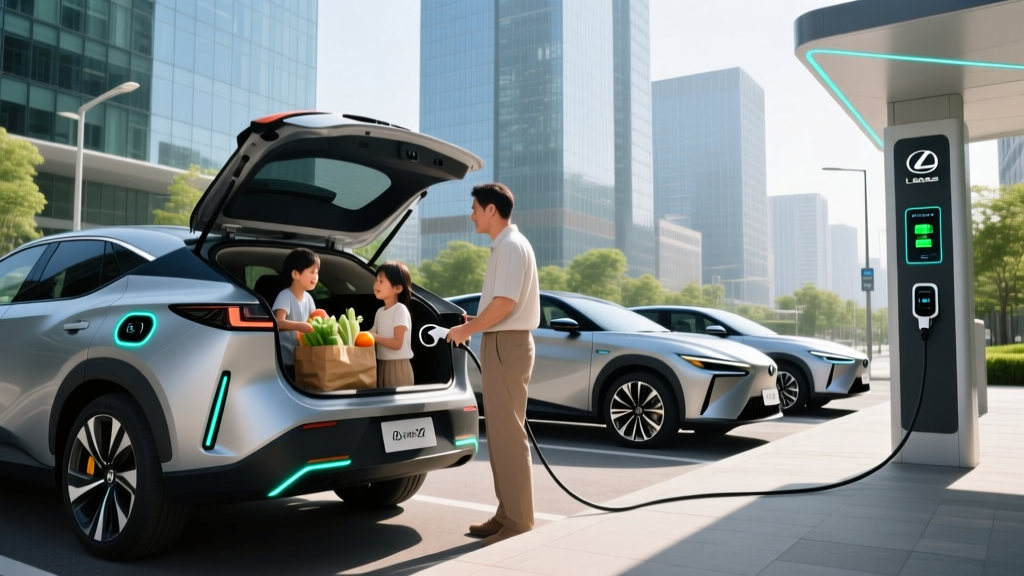
Yes. As of the 2026 model year, Lexus sells two fully electric vehicles in the United States: the Lexus RZ 450e (dual-motor AWD) and the Lexus RZ 300e (single-motor FWD). Both are compact luxury crossover SUVs built on Toyota's dedicated e-TNGA EV platform. The RZ 450e delivers an EPA-estimated 220 miles of range with its 71.4 kWh battery, while the RZ 300e extends that to an EPA-estimated 266 miles. Pricing starts around $44,900 for the RZ 300e and $52,900 for the RZ 450e before incentives. Lexus does not currently offer an electric sedan or larger SUV, and the brand's extensive hybrid lineup remains separate from its EV offerings.
The 2026 Lexus RZ Lineup: Specs at a Glance
Lexus has kept the RZ lineup focused and relatively simple compared to competitors with sprawling trim ladders. Here are the core specifications you need to evaluate whether either model fits your driving needs.
| Specification | RZ 300e (FWD) | RZ 450e (AWD) |
|---|---|---|
| Base MSRP (2026) | $44,900 | $52,900 |
| Drivetrain | Single-motor FWD | Dual-motor AWD (DIRECT4) |
| Horsepower | 201 hp | 308 hp |
| 0–60 mph | ~7.4 sec | ~5.0 sec |
| Battery (usable) | 71.4 kWh (Lithium-ion) | 71.4 kWh (Lithium-ion) |
| EPA Range | 266 mi | 220 mi (18" wheels) / 196 mi (20" wheels) |
| Efficiency | 118 MPGe combined | 102 MPGe combined |
| Max DC Fast Charge | ~150 kW (peak) | ~150 kW (peak) |
| 10–80% DC Charge | ~30 min | ~30 min |
| Level 2 (240V) Rate | ~7.7 kW | ~7.7 kW |
| Level 2 Full Charge | ~9.5 hours | ~9.5 hours |
| Charging Port | CCS1 (J1772 AC) | CCS1 (J1772 AC) |
| Cargo Volume | 34.9 cu ft (rear up) | 34.9 cu ft (rear up) |
| Battery Warranty | 8 yr / 100,000 mi | 8 yr / 100,000 mi |
| Federal Tax Credit (§30D) | Up to $7,500 (eligibility varies) | Up to $7,500 (eligibility varies) |
Real-World Range vs. EPA Sticker
The EPA numbers tell only part of the story. In mixed highway driving at 70–75 mph, expect the RZ 450e to deliver roughly 185–200 miles and the RZ 300e to deliver around 230–245 miles before needing a charge. In cold weather (below 32°F), lithium-ion batteries lose efficiency and cabin heating draws significant power — plan for a 15–25% range reduction in winter conditions. The RZ lacks a heat pump in some trims, which exacerbates cold-weather losses compared to rivals like the Hyundai Ioniq 5 or BMW iX that include one standard.
How Does a Lexus EV Compare to a Lexus Hybrid?
Lexus built its reputation on hybrids, and models like the NX 350h and RX 500h are among the most refined in the luxury segment. If you're cross-shopping within the brand, here's how the RZ stacks up against a similarly sized Lexus hybrid.
| Factor | Lexus RZ 450e (EV) | Lexus NX 350h (Hybrid) |
|---|---|---|
| Base MSRP | $52,900 | $43,965 |
| Powertrain | Dual-motor EV, 308 hp | 2.5L 4-cyl hybrid, 244 hp |
| EPA Fuel Economy | 102 MPGe | 39 MPG combined |
| Range / Tank | 220 mi (EPA) | ~528 mi (13.2-gal tank) |
| Fuel/Energy Cost (est.) | ~$0.04–0.12/mi (home vs. public) | ~$0.10–0.14/mi (gas at $3.50/gal) |
| Annual Fuel/Energy (12k mi) | $480–$1,440 | $1,200–$1,680 |
| Maintenance (annual est.) | ~$200–$400 | ~$500–$800 |
| Federal Tax Credit | Up to $7,500 (see eligibility) | None (HEV) |
| Refueling Time | 30 min (10–80% DC) or 9.5 hr (L2) | ~5 min at a gas station |
The hybrid wins on upfront price and total range without any charging logistics. The EV wins on per-mile energy cost (especially with home charging), lower maintenance, and potential tax incentives. The gap narrows considerably if you rely solely on public DC fast charging, where electricity costs can approach or exceed gasoline on a per-mile basis.
Real Costs of Owning a Lexus RZ: Purchase Through Year Five
Sticker price is just the entry point. Here's a realistic five-year cost breakdown for the RZ 450e Premium, assuming 12,000 miles per year, home Level 2 charging at the national average of $0.16/kWh, and a mix of 85% home / 15% public DC charging.
| Cost Category | RZ 450e (EV) | NX 350h (Hybrid) |
|---|---|---|
| Purchase Price (base) | $52,900 | $43,965 |
| Federal Tax Credit (§30D) | –$3,750 to –$7,500* | $0 |
| Home Charger Install (L2) | $800–$2,000 | $0 |
| Energy/Fuel (5 years) | $3,200–$5,400 | $6,000–$8,400 |
| Maintenance (5 years) | $1,000–$2,000 | $2,500–$4,000 |
| Insurance (5-year est.) | $9,000–$12,000 | $7,500–$10,000 |
| Estimated Depreciation (5 yr) | $22,000–$28,000 | $18,000–$22,000 |
| Approx. 5-Year Total | $64,000–$78,000 | $59,000–$70,000 |
*Federal §30D tax credit eligibility depends on your modified adjusted gross income, the vehicle's MSRP (must be ≤$80,000 for SUVs), battery critical-mineral sourcing, and final assembly requirements. The RZ is assembled in Japan, which affects critical-mineral and assembly provisions under current IRS rules. Credit amounts have been reduced for some trims and model years — always verify current eligibility on IRS.gov or with a tax professional. Point-of-sale transfer is available if eligible.
The RZ's higher purchase price and steeper depreciation (common for luxury EVs) mean it doesn't automatically beat the NX 350h on total cost of ownership. The breakeven point depends heavily on your charging setup, local electricity rates, and whether you qualify for the full tax credit. Buyers with home solar or low utility rates see the strongest EV economics.
Charging the Lexus RZ: What You Actually Need to Know
The RZ uses a CCS1 connector for DC fast charging and a J1772 connector for Level 1 and Level 2 AC charging. Unlike Tesla's NACS or vehicles with built-in NACS ports, the RZ requires a CCS-to-NACS adapter (sold separately by Tesla or third parties) to access Tesla Superchargers. The broader Electrify America, EVgo, and ChargePoint networks all support CCS natively.
| Charging Level | Power | Speed (miles/hour added) | Use Case |
|---|---|---|---|
| Level 1 (120V outlet) | ~1.2 kW | ~4–5 mi/hr | Emergency / overnight trickle |
| Level 2 (240V, 32A) | ~7.7 kW | ~25–28 mi/hr | Home daily charging (recommended) |
| DC Fast Charge | Up to ~150 kW peak | ~180+ mi/hr at peak | Road trips; 10–80% in ~30 min |
A critical ownership consideration: the RZ's peak DC charge rate of ~150 kW is modest by 2026 standards. Competitors like the Hyundai Ioniq 5 (up to 240 kW on 800V architecture) or the Porsche Macan Electric (up to 270 kW) charge significantly faster. The RZ's charge curve also tapers noticeably above 60% state of charge, meaning the 60–80% portion takes disproportionately longer than the 10–40% portion. On road trips, plan stops around the 10–70% window for the best time efficiency.
Home charging installation for a Level 2 setup typically costs between $800 and $2,000 if your electrical panel has capacity for a new 240V/40A circuit. If your home needs a panel upgrade (common in older homes with 100A service), add $1,500–$3,000. Always get a quote from a licensed electrician before purchasing the vehicle — this is a cost that surprises many first-time EV buyers.
Common Misconceptions About Lexus EVs
Several myths persist in buyer forums and comment sections. Here's what the data actually shows.
| Myth | Fact |
|---|---|
| "Lexus doesn't make electric cars." | Lexus has sold the RZ 450e since the 2023 model year and added the RZ 300e for 2025. Both are available new in 2026. |
| "The RZ gets the same range as a Tesla Model Y." | The Model Y Long Range AWD achieves an EPA 310+ miles. The RZ 450e achieves 220 miles — a ~90-mile gap. The RZ 300e at 266 miles is closer but still trails. |
| "EVs need no maintenance." | EVs eliminate oil changes, spark plugs, and transmission fluid, but still require tire rotations (EVs wear tires faster due to weight and instant torque), cabin air filters, brake fluid checks, and wiper/washer service. Budget $200–$400/year. |
| "The battery will need replacing in 5 years." | Lexus warranties the RZ battery for 8 years/100,000 miles against defects and excessive capacity loss (below 70% retention). Industry data from fueleconomy.gov and long-term fleet studies show modern lithium-ion EV batteries typically retain 85–92% capacity at 100,000 miles. |
| "I can charge at any Tesla Supercharger." | Only with a CCS-to-NACS adapter, and not all Supercharger stalls have been opened to non-Tesla vehicles. Check the Tesla app for compatible locations before relying on this. |
| "The federal tax credit is a guaranteed $7,500." | The §30D credit is subject to income caps ($150K single / $300K joint), MSRP caps ($80K for SUVs), critical-mineral sourcing requirements, and final-assembly rules. The RZ's Japan assembly and battery sourcing have affected partial or full credit availability in recent years. Verify on IRS.gov. |
Who Should Buy a Lexus RZ — and Who Shouldn't
The RZ occupies a specific niche: luxury-brand loyalists who want a quiet, well-built EV crossover without the tech-forward (and sometimes polarizing) approach of Tesla or the sporty ambition of Porsche. It's not the range leader, not the fastest charger, and not the best value in the segment. But it delivers Lexus's hallmark refinement, strong build quality, and a dealership experience many luxury buyers prefer.
Decision Framework: Is the Lexus RZ Right for You?
Choose the RZ 300e if:
- You prioritize range over acceleration (266 mi EPA is the best in the RZ lineup)
- Your daily commute is under 80 miles round-trip with home charging available
- You live in a mild climate where cold-weather range loss is minimal
- You want a luxury EV under $50,000 before incentives
Choose the RZ 450e if:
- You need AWD for snow, rain, or mountain driving
- You value the 5.0-second 0–60 time and DIRECT4 torque-vectoring
- Your typical trips stay under 180 miles (accounting for real-world highway range)
- You're upgrading from a Lexus RX or NX and want to stay in the brand
Look elsewhere if:
- You regularly drive 300+ miles between charges — consider the Tesla Model Y, Hyundai Ioniq 5, or Rivian R2
- Fast road-trip charging is a priority — the RZ's ~150 kW peak rate and 30-minute 10–80% time trails 800V rivals
- You need three rows of seating — the RZ is a compact two-row crossover
- You lack home or workplace charging access — public-only charging erodes cost savings and adds time
- Maximizing federal tax credit is essential — verify RZ eligibility against current IRS §30D requirements before committing
What First-Time EV Buyers Should Know Before Choosing Lexus
If the RZ is your first EV, a few ownership realities are worth internalizing before signing a purchase agreement:
- Home charging is the foundation. Over 80% of EV charging happens at home. Without a Level 2 setup, you'll rely on slower Level 1 (adding ~20 miles overnight) or frequent public charging trips. Confirm your home's electrical capacity before buying.
- Plan road trips around chargers, not gas stations. Use apps like PlugShare or A Better Routeplanner to map DC fast-charger locations along your common routes. The CCS network is expanding but still has gaps in rural areas.
- Tires wear faster on EVs. The RZ weighs approximately 4,600 lbs, and instant electric torque accelerates tread wear. Budget for tire replacement every 25,000–35,000 miles rather than the 50,000+ miles typical on lighter gas vehicles.
- Insurance premiums are typically 15–25% higher for EVs compared to equivalent gas vehicles, driven by higher repair costs and battery replacement risk. Get quotes before purchase.
- Depreciation on luxury EVs has been steeper than on Lexus hybrids or gas models. If you plan to sell or trade in within three years, factor this into your total cost calculation.
Frequently Asked Questions
Does Lexus have a fully electric car in 2026?
Yes. Lexus sells the RZ 300e (FWD, 266 mi EPA range) and the RZ 450e (AWD, 220 mi EPA range) as 2026 models. Both are compact luxury crossover SUVs. Lexus does not currently offer an electric sedan, truck, or three-row SUV.
Is the Lexus RZ a hybrid or a full EV?
The RZ is a battery-electric vehicle (BEV) — it has no gasoline engine and must be plugged in to recharge. Lexus continues to sell hybrid (HEV) and plug-in hybrid (PHEV) versions of the NX, RX, and other models, but those are separate vehicles from the RZ.
How long does it take to charge the Lexus RZ at home?
On a Level 2 home charger (240V, ~7.7 kW), a full charge from empty takes approximately 9.5 hours. Most owners plug in nightly and wake up to a full battery. On a standard 120V outlet (Level 1), expect roughly 4–5 miles of range added per hour — adequate only for very low-mileage drivers or as a backup.
Does the Lexus RZ qualify for the $7,500 federal tax credit?
Eligibility varies. The §30D credit depends on your income (capped at $150K single / $300K joint), the vehicle's MSRP (must be ≤$80K for SUVs), battery critical-mineral sourcing, and final assembly location. The RZ is assembled in Japan, which has affected eligibility under recent IRS rules. Always check the latest guidance on IRS.gov or consult a tax professional before relying on the credit.
What is the real-world range of the Lexus RZ 450e?
The EPA rates the RZ 450e at 220 miles (18-inch wheels) or 196 miles (20-inch wheels). In real-world highway driving at 70–75 mph, expect roughly 185–200 miles. In cold weather below freezing, plan for 150–175 miles. These figures assume no preconditioning; using the RZ's battery preconditioning feature before fast charging or departure can recover some efficiency.
How does the Lexus RZ compare to the Tesla Model Y?
The Model Y Long Range AWD offers significantly more EPA range (~310+ miles), faster DC charging (up to 250 kW on V3 Superchargers), access to the Tesla Supercharger network, and a lower starting price. The RZ counters with traditional luxury build quality, a quieter cabin, physical controls, Lexus dealership service, and a less tech-centric interior. If range and charging speed are priorities, the Model Y leads. If brand loyalty and refinement matter more, the RZ has merit.
Will Lexus release more electric cars?
Toyota (Lexus's parent company) has announced plans for a broader EV lineup, including a next-generation platform with improved range and charging. However, as of 2026, no additional Lexus EV models beyond the RZ 300e and RZ 450e are confirmed for the U.S. market. Any future models should be treated as announced/preliminary until official specifications and pricing are released.